
CBD and Driving: Can You Drive After Taking Oil
CBD is not prohibited while driving, but THC is. What are the consequences under Article 87 of the Code of Offenses and Article 178a of the Penal Code, how does testing work during a check, and what does the label not say.
You use CBD and wonder if you can get behind the wheel. The legal answer is short: cannabidiol itself is not a controlled substance in Poland, and no regulation prohibits driving after taking it. The problem lies elsewhere. A significant portion of products sold as CBD oil also contains THC, and tetrahydrocannabinols are listed in the official register of substances that act similarly to alcohol. Detection of THC in a driver triggers liability, and this occurs in two very different variants: once as an offense, and once as a crime. Below you will find both variants with legal bases, the course of testing during a roadside check, and what the label of the oil containing THC does not say. You will also see what was actually measured in studies on driving under the influence of cannabis, as results are often summarized online in a way that contradicts their actual findings.
KEY INFORMATION
• CBD is not a controlled substance in Poland, THC is.
• Driving under the influence of THC is an offense under Article 87 § 1 of the Code of Offenses, with a fine starting from 2500 PLN and a driving ban.
• Driving while impaired by THC is a crime under Article 178a § 1 of the Penal Code, with a penalty of up to 3 years imprisonment.
• Of 25 CBD products tested in the USA, three exceeded the local limit of 0.3% THC (Gurley et al., 2020).
What does Polish law say about CBD while driving?
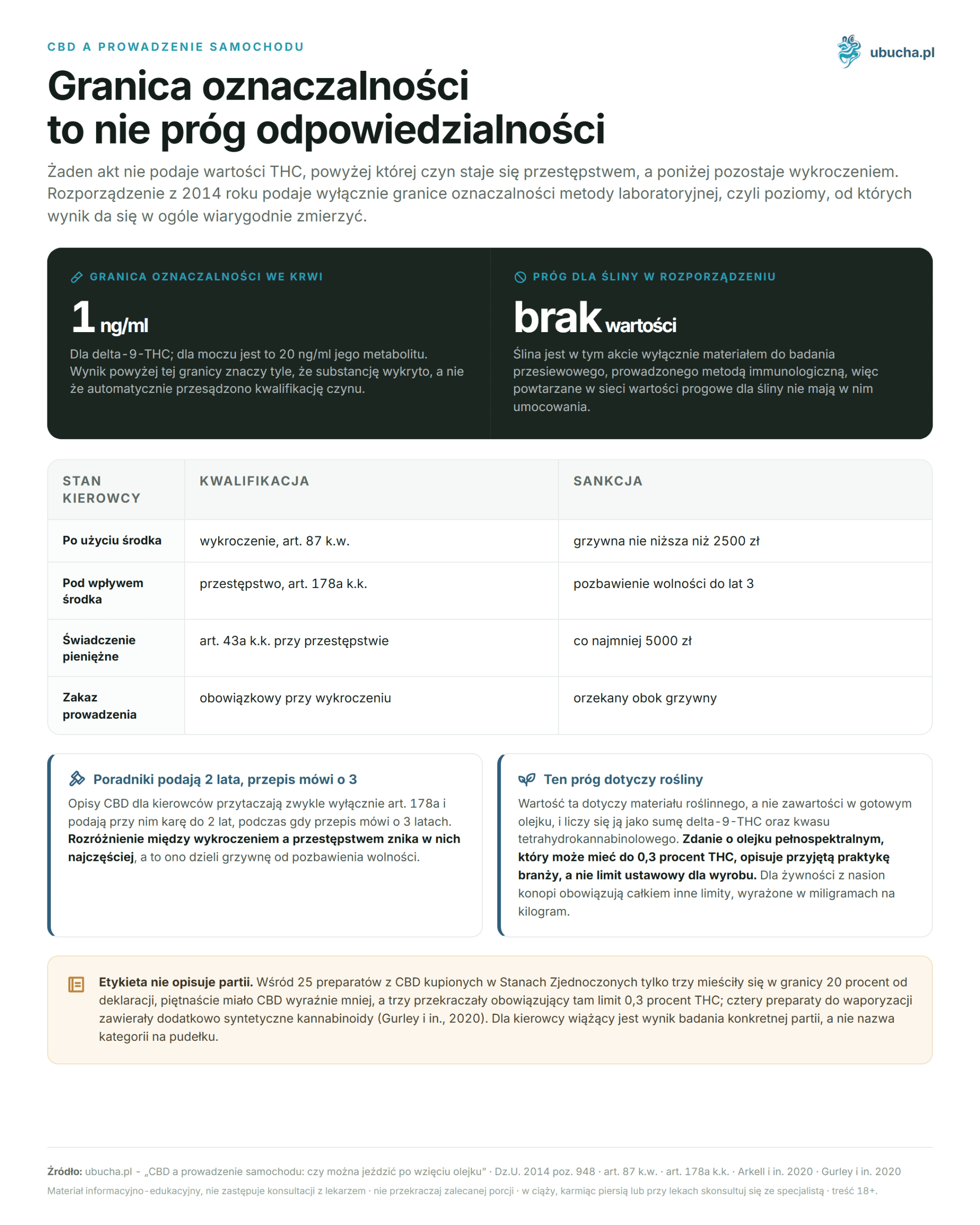
Cannabidiol is not a controlled substance and does not appear on any list concerning drivers. The ban applies to THC. The Minister of Health’s regulation from July 16, 2014, explicitly lists tetrahydrocannabinols among substances that act similarly to alcohol (Journal of Laws 2014 item 948, § 1 point 4). If a test shows THC, the law recognizes two separate levels of liability.
| Driver’s Condition | Legal Basis | Qualification | Sanction |
|---|---|---|---|
| Under the influence of a substance acting similarly to alcohol | Article 87 § 1 and § 3 of the Code of Offenses | offense | arrest or a fine of no less than 2500 PLN, mandatory driving ban |
| Under the influence of a narcotic substance | Article 178a § 1 of the Penal Code, Article 43a § 2 of the Penal Code | crime | imprisonment for up to 3 years and a monetary penalty of at least 5000 PLN |
You can check the wording of both regulations in the consolidated texts: Code of Offenses, Journal of Laws 2025 item 734 and Penal Code, Journal of Laws 2025 item 383. The distinction between them is not a formality, as it divides an offense from a crime, and in guides about CBD, it often disappears: they describe only Article 178a and state a penalty of up to 2 years, while the regulation mentions 3 years.
What is not present in Polish law, but what readers usually look for first: the concentration threshold. No act specifies the THC value above which the act becomes a crime and below which it remains an offense. The 2014 regulation only provides the detection limits of the laboratory method, which are the levels at which a result can be reliably measured. This is not the same as the threshold of liability and these numbers should not be interpreted that way.
Separately, it is worth organizing the value that appears most frequently in texts about CBD. The 0.3% THC threshold applies to the plant, not the content in the finished oil, and it is calculated as the sum of delta-9-THC and THCA. The statement “full spectrum oil can contain up to 0.3% THC” describes the accepted industry practice, not a statutory limit for the product. For food from hemp seeds, completely different limits apply, expressed in milligrams per kilogram.
Does CBD impair driving?
In a study involving real driving on public roads, cannabis with a CBD dominance did not worsen driving compared to placebo, while variants containing THC did worsen it in the first hour. However, the results pertain to vaporization of the flower, not sublingual oil, and the authors themselves caution that the confidence interval for the CBD variant does not exclude clinically significant impairment.
This refers to a trial published in the journal JAMA (Arkell et al., 2020). It involved 26 healthy individuals who occasionally used cannabis, and 22 of them completed a full set of eight drives. Each participant went through four vaporization variants of 13.75 mg of THC or CBD, and the standard deviation of lane position was measured over a hundred-kilometer route. In the window from 40 to 100 minutes after vaporization, the deviation increased by 2.33 cm (95% CI 0.80 to 3.86) after THC-dominant flower and by 2.83 cm (95% CI 1.28 to 4.39) after the variant with equal amounts of THC and CBD, while the variant with CBD dominance did not differ from placebo. In the window from 240 to 300 minutes, none of these differences were statistically significant. Sixteen out of 188 drives were interrupted for safety reasons.
The second conclusion from the same research group is more important for drivers than the first: CBD does not protect against the effects of THC. In a simulator trial, cannabis containing equal amounts of THC and CBD was not less impairing than cannabis with only THC, and in some cognitive tasks, it performed worse; the THC concentration in plasma was higher after it (Arkell et al., 2019, 14 participants). The belief that the addition of CBD “balances” THC has no support in this data.
Caution in the other direction is also warranted. Both studies measured inhalation of flower, not oral intake of oil, so directly transferring conclusions would be an overreach. Regarding CBD, the European Food Safety Authority stated in 2026 that there is still insufficient data on neurological and psychiatric safety to assess it (EFSA, 2026). If you feel drowsy after your dose, do not drive, regardless of what the measurement showed in a laboratory with twenty-six volunteers.
What type of extract should you choose if you drive?
From the perspective of testing for THC, the concentration of CBD on the label is not as important as the type of extract and the actual THC content confirmed by laboratory testing of the batch. A 10% isolate oil and a 10% full spectrum oil have the same number on the package but completely different consequences for the driver.
| Type of Extract | What the Manufacturer Declares | What It Means for Driving |
|---|---|---|
| Isolate | only CBD, usually with a purity of 99% or higher | THC is not in the declared composition, so the risk is the lowest |
| Broad spectrum | other cannabinoids and terpenes, THC described as undetectable | undetectable means below the detection limit of the method, not zero |
| Full spectrum | full plant profile including THC | THC is present by design, and its amount depends on the batch |
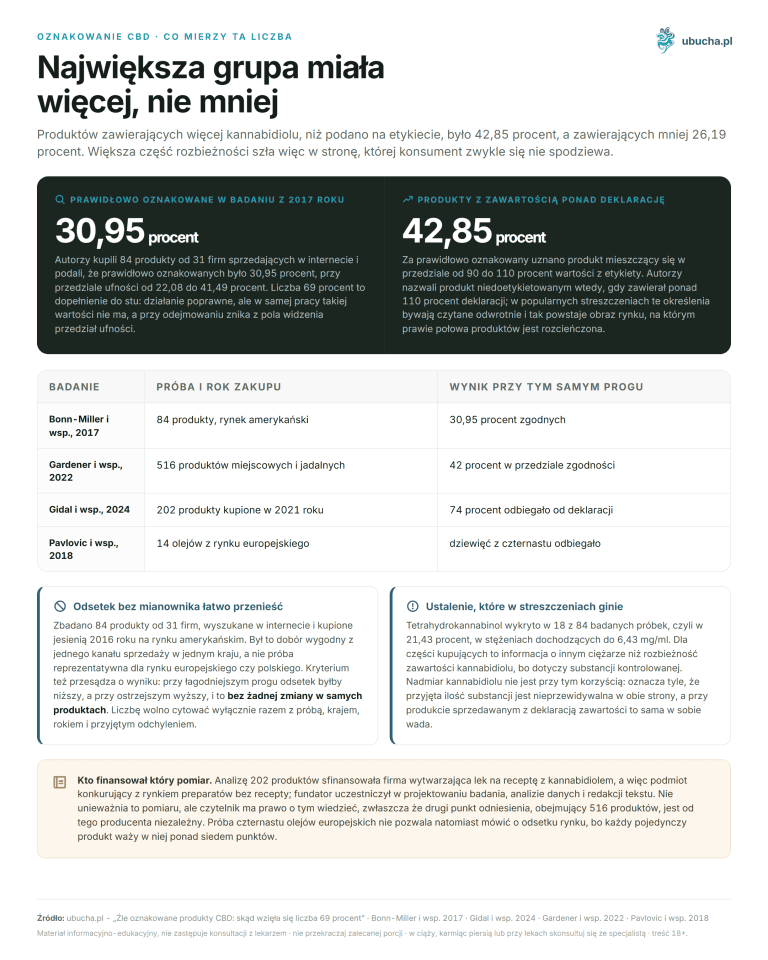
This is where the real problem begins, as the manufacturer’s declaration may not match the content. In an American study of 25 CBD products purchased at regular retail outlets, only three fell within a 20% margin of the declaration, fifteen had significantly less CBD, two had more than half more, and three exceeded the local limit of 0.3% THC; four vaporization products additionally contained synthetic cannabinoids (Gurley et al., 2020). The authors state outright that products exceeding the THC limit can cost consumers their jobs after a failed test.
The European market appears similar. An analysis of fourteen CBD oils available in EU countries found that nine had CBD content significantly deviating from the declared amount (Pavlovic et al., 2018). Both trials are small and date back a few years, so they do not describe the entire current market. However, they are sufficient to justify one practical rule: for drivers, the result of testing a specific batch is binding, not the category name on the box.
What does a THC test look like during a roadside check?
The basis is Article 129j of the Road Traffic Law. The test is first conducted using a non-laboratory method, namely a screening test, and blood or urine is taken when the subject refuses, when their condition prevents the screening test, or as a consequence of such a test. The regulation also allows for testing a driver without their consent, after informing them of this.
The screening test involves non-invasive collection of a saliva sample and placing it in a device operating by immunological method. Laboratory analysis looks different: blood and urine are tested using gas or liquid chromatography coupled with mass spectrometry, and the regulation provides detection limits for them. For blood, it is 1 ng/ml delta-9-THC, for urine 20 ng/ml of its metabolite, namely 11-nor-9-carboxy-delta-9-THC.
Two things are worth noting from this. First, the regulation does not provide any concentration threshold for saliva; saliva is only a material for screening tests, so repeated threshold values for saliva circulating online have no basis in this act. Second, the detection limit is a parameter of the measurement method. A result above it means that the substance was detected, not that the qualification of the act is automatically determined.
If you use a CBD product, keep the laboratory test result of your batch along with the packaging. It is not a document that exempts you and does not replace a blood test, but it describes what you are actually taking and can be useful in proceedings. We have gathered more about the tests themselves and detection times in an article on CBD and drug tests, and what documents a patient treated with cannabis should carry is described in a separate text about police control and medical marijuana.
What to do before getting behind the wheel after CBD?
The rules boil down to four decisions, none of which concern the number of milligrams. All relate to what you take and what you know about it.
- Check the type of extract, not just the CBD concentration on the label, and ask the seller for the batch test result if it is not provided.
- If you are subject to routine testing at work or drive professionally, choose products without THC in the composition and avoid full-spectrum variants.
- Do not assume that the legality of the product means no risk behind the wheel; the law reacts to the presence of THC in the body, not to the status of the store where you bought the oil.
- If you feel drowsy or slowed down after your dose, postpone driving, as you are responsible for the consequences regardless of the test result.
Finally, a number that organizes the scale of the entire discussion. The European Food Safety Authority established in 2026 a temporary safe dose of CBD at 0.0275 mg per kilogram of body weight per day, which is about 2 mg per day for a person weighing 70 kg, and noted that this applies only to supplements with a purity of CBD of at least 98% and without nanoparticles. The same document states that the safety of CBD cannot be established in individuals under 25 years of age, in pregnant and breastfeeding women, and in individuals taking medications. We explain how cannabidiol differs from intoxicating substances in the text about whether CBD is non-psychoactive.
Frequently Asked Questions
Is CBD legal for drivers in Poland?
Yes. Cannabidiol is not a controlled substance and no regulation prohibits driving after taking it. The restriction concerns THC, which the Minister of Health’s regulation from 2014 lists among substances that act similarly to alcohol. The legal risk arises from the THC content in the product, not from CBD itself.
Does CBD oil impair driving?
This is unknown for oil, as studies on driving involved vaporization. In a road trial published in JAMA, CBD-dominant cannabis did not worsen driving compared to placebo, but the authors noted that the confidence interval does not exclude clinically significant impairment (Arkell et al., 2020).
Does CBD protect against the effects of THC while driving?
No. In a simulator study, cannabis with equal amounts of THC and CBD was not less impairing than cannabis with only THC, and in some cognitive tasks, it performed worse; the THC concentration in plasma was higher after it (Arkell et al., 2019). The addition of CBD does not balance THC.
What does a roadside test detect?
First, a screening test from saliva, using an immunological method. Blood and urine are tested in the laboratory when the driver refuses the screening test or as a consequence of it. The detection limits are 1 ng/ml delta-9-THC in blood and 20 ng/ml of its metabolite in urine. The regulation does not provide a threshold for saliva.
What are the consequences of driving after THC detection?
It depends on the qualification of the act. Being under the influence is an offense under Article 87 § 1 of the Code of Offenses: arrest or a fine of no less than 2500 PLN and a mandatory driving ban. Being under the influence is a crime under Article 178a § 1 of the Penal Code: imprisonment for up to 3 years and a monetary penalty of at least 5000 PLN.
This article is for informational and educational purposes and does not constitute legal advice. The legal status described in the article is valid as of the publication date, and regulations regarding cannabis may change. Consult a lawyer or current legal acts before making decisions.
Author: Michał Waluk · Published: 2026-06-02 · Updated: 2026-08-15