
CBD for Concentration and Productivity: Does Cannabidiol Help with Mental Work
Does CBD improve concentration? In trials involving healthy adults, cognitive tests did not budge. We check what was actually studied and what it means.
Type “CBD for concentration” into a search engine, and you will find hundreds of promises of calm focus and a productive day. The problem is that there is almost no research behind these promises. We searched European PMC for clinical trials measuring the impact of cannabidiol on attention, working memory, or mental work efficiency in healthy adults. We found three types of studies: anxiety research, sleep studies, and safety studies, where cognitive tests were used to check if CBD was causing any harm. None showed an improvement in focus. Below, we show exactly what was studied, where the data ends, and why the argument “less anxiety means better work” is an assumption, not a measured result.
KEY INFORMATION
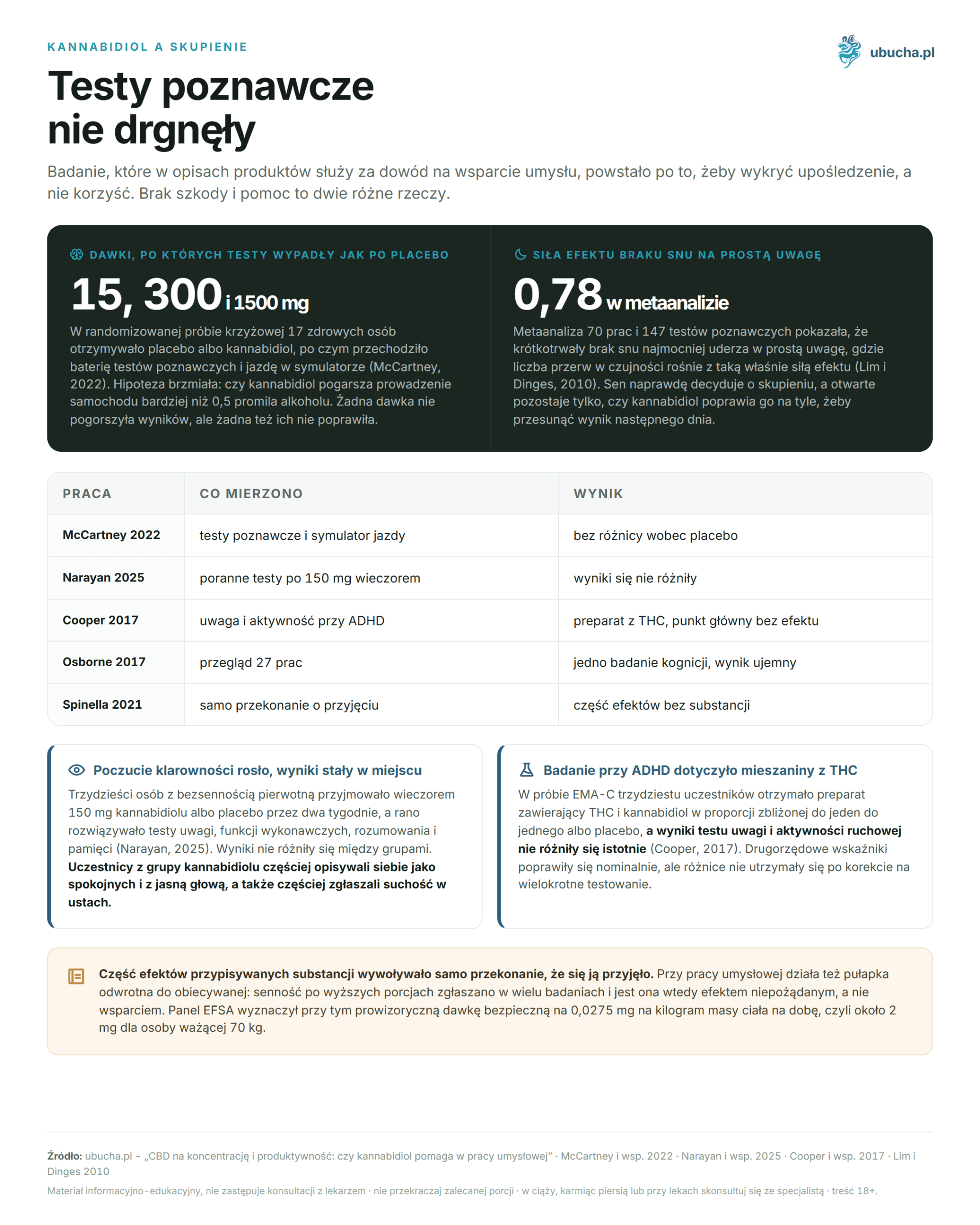
• No clinical trial has shown that CBD improves cognitive functions in healthy adults: doses of 15, 300, and 1500 mg yielded test results similar to placebo (McCartney et al., J Psychopharmacol, 2022).
• The existing data pertains to anxiety, sleep, and safety. No one has measured productivity.
• 150 mg of CBD in the evening for two weeks in individuals with insomnia did not change morning attention and memory test results (Narayan et al., Psychopharmacology, 2025).
• In an anxiety test in healthy men, only 300 mg worked, while 150 mg and 600 mg performed like placebo (Linares et al., 2019).
• The mere belief that cannabidiol was taken produced some of the effects attributed to the substance (Spinella et al., 2021).
Does CBD improve concentration in healthy adults?
There is no study that has shown this. In a randomized crossover trial, 17 healthy individuals received either placebo or 15, 300, and 1500 mg of cannabidiol, after which they underwent a battery of cognitive tests and driving in a simulator. No dose worsened the results, but none improved them either (McCartney et al., Journal of Psychopharmacology, 2022).
This work was designed to detect impairment, not benefit. Its hypothesis was: does CBD impair driving more than 0.5 blood alcohol content. The answer was reassuring. Attention, working memory, and reaction time tests performed after cannabidiol were the same as after placebo, and participants did not report feelings of intoxication. Marketing turned this result into “CBD supports cognitive functions,” which is a misrepresentation: lack of harm and help are two different things.
The same applies to the entire literature. A systematic review encompassing 27 studies, including 18 preclinical and 9 clinical, found only one clinical study measuring cognition, which yielded a negative result for the Stroop test (Osborne, Solowij, and Weston-Green, Neuroscience and Biobehavioral Reviews, 2017). The authors emphasize something that gets lost in abstracts: cannabidiol improved cognition in damage models, meaning in animals with induced deficits, and alleviated THC-induced disorders. This is evidence of restoring damaged function, not enhancing healthy function.
If not productivity, what was actually studied?
Three areas: anxiety, sleep, and safety. In none of these was the endpoint focus at work, the number of tasks completed, or the duration of attention on a project. Anxiety scales, cortisol levels, fMRI signals, sleep quality, and neuropsychological test results used to detect harm were measured.
| Area | Example Study | What was measured | Mental Work? |
|---|---|---|---|
| Situational Anxiety | Linares et al., 2019, 57 healthy men | Mood scale, blood pressure, heart rate | no |
| Social Phobia | Bergamaschi et al., 2011, 24 patients | Severity of speech anxiety | no |
| Brain Response to Fear | Fusar-Poli et al., 2009, 15 healthy men | fMRI signal, skin response | no |
| Sleep | Narayan et al., 2025, 30 individuals with insomnia | Attention and memory tests the next day | yes, no effect |
| Safety | McCartney et al., 2022, 17 healthy individuals | Driving in a simulator, cognitive tests | yes, no effect |
Note the last column. The two studies that measured cognitive performance did so to rule out harm, and both came out neutral. The others studied emotions, not work. There is no conspiracy or oversight: no one simply funded a trial where healthy people would solve tasks on time after CBD.
Does less anxiety mean better mental work?
This is an assumption, not a measured result. In studies where anxiety actually decreased, no one checked either work efficiency or attention span. Transferring conclusions from one to the other requires two logical leaps, both of which are uncertain.
The first leap goes from population to population. Bergamaschi et al. (Neuropsychopharmacology, 2011) administered 600 mg of cannabidiol to patients with untreated social phobia before a simulated speech and noted a significant decrease in anxiety. These are diagnosed patients, not individuals who simply find it hard to sit down to a report. In 57 healthy men subjected to the same test, the dose-response curve turned out to be bell-shaped: only 300 mg reduced anxiety, while 150 mg and 600 mg did not differ from placebo (Linares et al., Brazilian Journal of Psychiatry, 2019).
The second leap goes from anxiety scale to work outcome. Brain imaging shows the mechanism but not the professional effect: 600 mg of CBD weakened the amygdala and cingulate cortex response to images of frightened faces in 15 healthy men (Fusar-Poli et al., Archives of General Psychiatry, 2009). BOLD signal is not the number of pages written. It is also worth remembering that stress indeed damages the prefrontal cortex, as described in Arnsten’s review in Nature Reviews Neuroscience (2009), but this truth speaks to stress, not to cannabidiol.
The sharpest version of the problem was shown in a study of expectations. Forty-three healthy adults were given hemp seed oil without CBD, and in one session, they were told they were receiving cannabidiol. This belief alone increased drowsiness and changed heart rate variability, and those who believed in the anxiolytic effect of CBD reported less anxiety (Spinella et al., Psychopharmacology, 2021).
How does CBD differ from caffeine, L-theanine, and nootropics?
In mechanism and state of evidence. Caffeine blocks adenosine receptors and increases alertness, which has been confirmed in hundreds of trials involving humans. Cannabidiol does not have such a dossier, and it should not be attributed effects of others just because it ended up on the same store shelf.
The connection of CBD with adenosine is repeated online so often that it sounds like a clinical fact. It comes from a laboratory work where cannabidiol inhibited the ENT1 nucleoside transporter in cells and in mice (Carrier, Auchampach, and Hillard, PNAS, 2006). From inhibiting a transporter in a dish to increasing alertness in humans with a dropper dose is a very long way, and no one has yet traveled it.
The situation with L-theanine is similar. The combination of cannabidiol with this amino acid has only been tested in a mouse model of caffeine-induced sleep disorders (Kim et al., Biomolecules and Therapeutics, 2026). There is no human trial, so the promise of “calm focus” from such a combination is a sales hypothesis.
Nootropics are a separate category with their own, uneven evidence base. Bacopa monnieri or lion’s mane have been studied for memory in humans, which does not mean they work strongly, but it means someone has measured it at all. Cannabidiol has not competed in this arena. A comparison of substances marketed for focus can be found in the post about natural nootropics.
How much CBD should I take if I still want to try?
There is no “focus” dose because there are no studies from which it could be derived. The only reference point is anxiety trials, and these yield an uncomfortable result for stores: in healthy men, 300 mg worked, while 150 mg and 600 mg performed like placebo (Linares et al., 2019).
Portions found in hemp oils and guides usually fall within the range of 10-25 mg per day, which is ten times below the dose that did anything in that experiment. This does not mean that a smaller portion is useless. It means that no one has checked it for attention, so any “it will work before the meeting” is a conclusion from nothing.
It is also worth looking at pharmacokinetics soberly. A review of data in humans reports a half-life of 1.4 to 10.9 hours after sublingual aerosol and 2 to 5 days with chronic oral administration, with maximum concentration reached within the first 4 hours and higher after a fatty meal (Millar et al., Frontiers in Pharmacology, 2018). The range is enormous because the data comes from different forms of the preparation.
If you want to conduct your own test, do it on a regular workday, not before an important presentation, and record one specific indicator, such as the number of interrupted work blocks. Without recording, you will assess the effect by memory, which is susceptible to the expectations described by Spinella. Practical portion breakdown can be found in the text about CBD dosing.
Does better sleep after CBD translate to the next day?
In the only trial that measured this, no. Thirty individuals with primary insomnia took 150 mg of cannabidiol or placebo in the evening for two weeks, and in the morning, they solved attention, executive function, reasoning, and memory tests. Results did not differ between groups (Narayan et al., Psychopharmacology, 2025).
Interestingly, what did change. Participants in the CBD group more often described themselves as calm and “clear-headed,” and also reported dry mouth more frequently. The subjective sense of clarity increased, while test results remained unchanged. This is exactly the discrepancy that feeds opinions online: people feel a difference that measurement tools do not see.
The basis of the entire reasoning is solid. A meta-analysis of 70 studies and 147 cognitive tests showed that short-term sleep deprivation hits simple attention the hardest, where the number of lapses in alertness increases with an effect size of 0.78 (Lim and Dinges, Psychological Bulletin, 2010). Sleep really determines focus. The only question that remains is whether cannabidiol improves it enough to shift the next day’s result, and the answer so far is: this has not been demonstrated. More about the data on sleep is discussed in the text does CBD help with sleep.
Does CBD help with ADHD and attention deficits?
The only randomized trial in adults with ADHD did not show an effect on the primary endpoint. In the EMA-C study, thirty participants received Sativex or placebo, and attention and motor activity test results did not differ significantly between groups (Cooper et al., European Neuropsychopharmacology, 2017).
Two caveats are more important than the result itself. First, Sativex contains THC and cannabidiol in a roughly one-to-one ratio, so this was not a CBD study, but a mixture. Second, secondary measures, such as hyperactivity and inhibition measures, nominally improved, but the differences did not hold after correction for multiple testing. A serious adverse event in the form of muscle spasms was also reported in the active group.
The authors called this preliminary support for the theory of self-medication, not evidence of efficacy. The distance between such a conclusion and the slogan “CBD for ADHD” is enormous. If you suspect you have an attention disorder, a psychiatric diagnosis is the first step, and no supplement can replace it. We discuss this topic more broadly in the post about CBD and ADHD.
When is CBD not the answer to focus problems?
When the problem has a medical name or a simple behavioral cause. Distraction can be a symptom of sleep debt, hypothyroidism, anemia, depression, or undiagnosed ADHD, and in these situations, selecting the concentration of oil is a waste of time that can easily be mistaken for action.
The assessment of the safety of cannabidiol has tightened. EFSA in its 2026 opinion set a provisional safe dose at 0.0275 mg/kg body weight per day, which is about 2 mg for a person weighing 70 kg, and stated that safety cannot be established in individuals under 25 years of age, in pregnant and breastfeeding women, and in those taking medications. Adverse effects can be mild: drowsiness, dry mouth, and less frequently gastrointestinal discomfort. However, it is important to remember the inhibition of CYP450 enzymes, through which cannabidiol can change the concentration of other medications. In the case of ongoing pharmacotherapy, a conversation with a doctor or pharmacist is mandatory.
There is also a trap opposite to the promised one. Drowsiness after higher doses has been reported in many studies, and in mental work, this is an undesirable effect, not support. Methods for improving focus with the best documentation have nothing to do with supplements: sufficient sleep, physical activity, and reducing digital distractions. Cannabidiol may be an addition for someone who is coping with tension, but it is not a tool for boosting the brain.
Frequently Asked Questions
Does CBD improve concentration?
There is no study that has shown this. In a randomized trial involving 17 healthy individuals, doses of 15, 300, and 1500 mg of cannabidiol did not change cognitive test results compared to placebo (McCartney et al., Journal of Psychopharmacology, 2022). Lack of deterioration is not the same as improvement.
Does CBD impair thinking ability and reaction time?
In previous trials, no. The same study by McCartney from 2022 examined driving in a simulator and a battery of cognitive tests after doses up to 1500 mg and found no impairment or feeling of intoxication. The concern about brain fog relates to THC, not cannabidiol.
How much CBD should I take for focus?
It is not possible to provide such a dose, as there are no studies from which it could be derived. The closest reference point is anxiety trials, where only 300 mg worked in healthy men, while 150 mg and 600 mg performed like placebo (Linares et al., 2019).
Can CBD be combined with coffee?
There is no published trial involving humans that has tested this combination for alertness. Do not add oil to hot beverages, as high temperatures degrade cannabidiol. The effects of such a combination have not been studied, so observe your own reaction instead of relying on an added effect.
Does CBD help with ADHD?
The only randomized trial in adults with ADHD involved a preparation with THC and cannabidiol, not just CBD, and did not show an effect on the primary endpoint, which was attention and activity test results (Cooper et al., European Neuropsychopharmacology, 2017).
How long does CBD stay in the body?
A review of pharmacokinetic data in humans reports a half-life of 1.4 to 10.9 hours after sublingual aerosol and 2 to 5 days with chronic oral administration (Millar et al., Frontiers in Pharmacology, 2018). Maximum concentration occurs within the first 4 hours.
Is CBD addictive?
The WHO report from 2018 states that cannabidiol does not exhibit addictive potential and has a good safety profile. EFSA in its 2026 opinion set a provisional safe dose at 0.0275 mg/kg body weight per day, which is about 2 mg for a person weighing 70 kg. However, this does not mean that the substance works for concentration.
If despite the lack of evidence for pro-cognitive effects you want to try cannabidiol for yourself, you can find the assortment in the hemp oils section.
This article is for informational and educational purposes and does not constitute medical advice. Before starting to use cannabis or CBD for therapeutic purposes, consult a doctor, especially if you are taking other medications, are pregnant, or breastfeeding.
Author: Michał Waluk · Published: 2026-06-22 · Updated: 2026-08-08