
Supplements for Vegetarians and Vegans: What is Missing in a Plant-Based Diet and How to Supplement
A plant-based diet requires B12, DHA from algae, and vitamin D. What do scientific reviews say about deficiencies, upper limits, and annual monitoring?
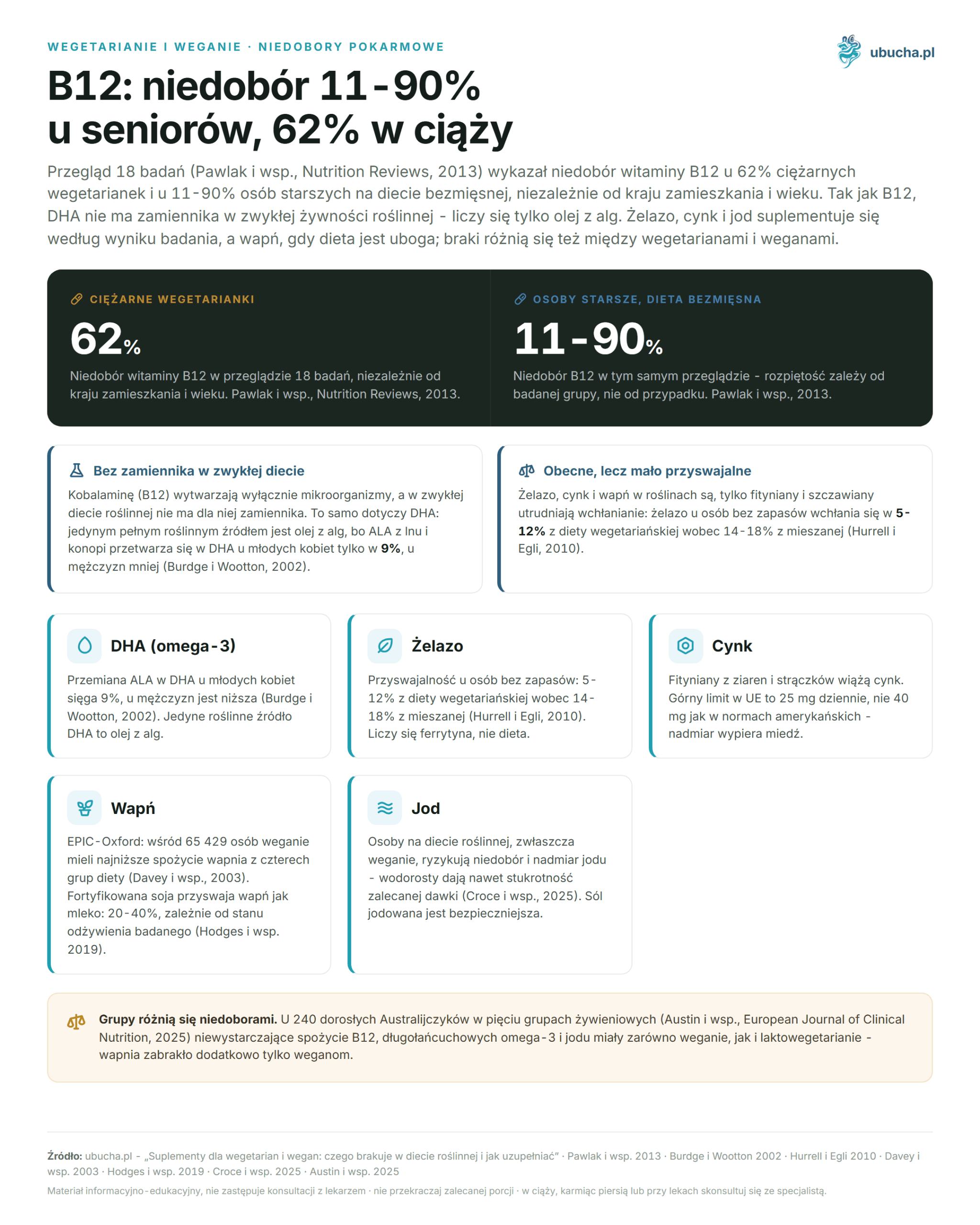
A plant-based diet can be complete, but it does not become complete by itself. A review of 18 studies published in Nutrition Reviews found a deficiency of vitamin B12 in 62% of pregnant vegetarians and in 11-90% of older adults on a meatless diet, regardless of country of residence and age. This is not an exotic exception, but a predictable consequence of a diet in which several nutrients are absent or present in poorly absorbable forms. The good news is that the list of deficiencies is short and well described. Below you will find each of them separately: what scientific reviews say about it, where the upper limit of safety lies, and how to recognize that a supplement is unnecessary.
KEY INFORMATION
• B12 is the only absolutely mandatory supplement on a vegan diet, with deficiencies found in 21-41% of teenagers (Pawlak et al., Nutrition Reviews, 2013).
• The conversion of ALA from flax and hemp to DHA reaches 9% in young women, lower in men (Burdge and Wootton, 2002).
• The bioavailability of iron from a vegetarian diet is estimated at 5-12% compared to 14-18% from a mixed diet (Hurrell and Egli, 2010).
• The upper tolerated level of zinc intake in the European Union is 25 mg per day, not 40 mg as in American standards.
• Seaweeds can provide even a hundred times the recommended iodine intake (Croce et al., 2025).
Does a vegan have to supplement vitamin B12?
Yes, without exception. No plant product provides bioavailable B12 in an amount that covers the daily requirement, which for an adult is 2.4 µg. A review of 18 studies (Pawlak et al., Nutrition Reviews, 2013) found a deficiency in 62% of pregnant vegetarians, in 25-86% of children, and in 21-41% of teenagers, more often in vegans than in vegetarians. The authors emphasize that the deficiency occurs regardless of age, place of residence, and type of meatless diet, and conclude with a recommendation for regular intake of a B12 supplement.
Cobalamin is produced exclusively by microorganisms. Animal products contain it because animals consume bacteria from feed or receive supplements in farming. Seaweeds, unfortified nutritional yeast, and tempeh do not solve this issue. The deficiency acts insidiously: the body uses the liver’s reserves for a long time, and symptoms develop slowly, so before the level drops to a critical value, some damage to the nervous system may already be irreversible.
This is confirmed by the latest cross-sectional measurement of intake. Austin et al. (European Journal of Clinical Nutrition, 2025) compared 240 adult Australians in five dietary groups. Vegans and lacto-vegetarians had insufficient intake of B12, long-chain omega-3 fatty acids, and iodine, while vegans additionally lacked calcium. They consumed more iron than meat-eaters, which we will discuss shortly.
We have noticed that the most common mistake is not refusing supplementation but relying on fortified foods. The amounts of B12 in plant-based drinks and cereals can be small and variable between batches, and covering 2.4 µg daily from such foods alone requires precision that no one can maintain for a year. Establish a supplementation schedule with your doctor or follow the instructions of a specific product, as it depends on its form and potency.
Where to get DHA on a plant-based diet without fish?
From algal oil. Fish obtain DHA from algae and plankton, so algal oil leads to the same source via a shorter route. The body can convert alpha-linolenic acid from flax and hemp into DHA, but it does so poorly: in young women, the conversion reached 9%, lower in men.
A review by Burdge and Calder (Reproduction Nutrition Development, 2005) summarized this unequivocally. Increasing ALA intake raises the proportion of EPA in plasma lipids, red blood cells, and breast milk, while DHA does not increase, and with high ALA intake, it can even decrease. In an isotopic study, Burdge and Wootton (British Journal of Nutrition, 2002) administered 700 mg of carbon-labeled ALA to young women and tracked it in plasma for 21 days. 9% of the administered dose was converted to DHA, 21% to EPA, and about 22% was burned as carbon dioxide within the first day. Flax alone is not enough.
Practically, it looks simple. Choose algal oil from the Schizochytrium or Nannochloropsis genus, take the capsule with a meal containing fat, and keep the package in the fridge after opening, as omega-3 fatty acids oxidize quickly. How much to take should be determined with your doctor: the requirement during pregnancy and breastfeeding is higher. Algal oil also has an advantage over fish oil that is rarely mentioned: it does not carry the risk of mercury or dioxins from wild catch.
How much iron does a vegetarian need and when to supplement it?
More than a meat-eater, but supplementation is needed less often than one might think. The problem is not the amount on the plate, but the bioavailability. Hurrell and Egli (American Journal of Clinical Nutrition, 2010) compiled isotopic data and estimated the bioavailability of iron at 14-18% from a mixed diet compared to 5-12% from a vegetarian diet in individuals without reserves of this element. These values were used to base reference intake standards, hence the multiplier of 1.8, which American standards use to raise the requirements for vegetarians.
However, the number in the diet does not determine anything, as seen from Austin’s measurement: more iron on the plate did not translate into better status. Hurrell and Egli also note that the status of the subject’s reserves influences absorption more strongly than the composition of the diet.
Therefore, check ferritin, not just morphology. A value below 30 µg/l indicates depleted reserves, even before anemia appears. At 30-70 µg/l, usually, the diet alone is sufficient, provided you eat legumes and tofu together with a source of vitamin C. Hunt (American Journal of Clinical Nutrition, 2003) states directly that vegetarians have lower iron reserves and that premenopausal women struggle to achieve the recommended intake from food alone, but the benefits of routine supplementation for everyone have not been demonstrated. In developed countries, no health damage has been shown from lower iron absorption on a varied meatless diet.
The form of the supplement matters mainly for the stomach: malate, fumarate, and amino acid chelate are usually better tolerated than the cheaper sulfate. Keep it away from coffee and calcium, as this interval costs nothing, but do not give up whole grains in an attempt to avoid phytates. Hurrell and Egli caution that the impact of individual components was measured in single-meal studies, and in a varied diet, it turned out to be significantly more modest. The supplementation schedule is also not obvious, which we discuss in the text Iron every other day instead of daily.
What vitamin D to choose on a plant-based diet?
From October to March, skin synthesis in Poland practically ceases, so this topic concerns everyone, not just vegans. The upper limit was set by the EFSA opinion from 2012, establishing the tolerated upper intake level for adults at 100 µg, or 4000 IU per day. This is a ceiling, not a recommendation: the dose is adjusted to the test result, not the season.
Vegans have an additional problem with the form. Regular D3 comes from sheep lanolin and is suitable for vegetarians but not for vegans. The alternative is D3 from lichens, biochemically identical and fully plant-based. Ergocalciferol, or D2, is also plant-based, but raises the level of the active form in the blood less effectively.
It is worth knowing who will actually benefit from supplementation. A meta-analysis of individual data from 25 studies (Martineau et al., BMJ, 2017) included 11,321 participants and showed protection against respiratory infections at an odds ratio of 0.88 with a confidence interval from 0.81 to 0.96. However, the effect was very unevenly distributed. Only daily and weekly doses provided protection (0.81; 0.72-0.91), while bolus doses did not work at all (0.97; 0.86-1.10). Within the group taking daily or weekly doses, individuals with a baseline level of 25(OH)D below 25 nmol/l had an odds ratio of 0.30 (0.17-0.53), while those above this value had only 0.75 (0.60-0.95). Thus, the supplement corrects a deficiency but does not boost immunity in someone who does not have a deficiency. You can read more about seasonal immune support in the post Supplements for Autumn and Immunity.
Does a plant-based diet provide enough calcium?
It depends on the selection of plants, not just the elimination of dairy. In the EPIC-Oxford cohort, which included 65,429 people, vegans had the lowest intake of calcium, vitamin B12, vitamin D, and zinc among the four dietary groups compared (Davey et al., Public Health Nutrition, 2003).
The problem lies in bioavailability and is less well studied than popular percentage tables suggest. Oxalates and phytates present in plants bind calcium and reduce its absorption, and a review by Hodges et al. (Nutrients, 2019) points out an exception: soy is rich in both compounds, yet it releases calcium well. Studies with a double isotopic marker have shown that the bioavailability of calcium from fortified soy milk matches that of cow’s milk and is 20-40% depending on the nutritional status of the subject.
For other plant-based drinks, the same review states something worth knowing before purchasing: apart from soy, there is no data on the bioavailability of calcium from any of them. Identical content on the label does not guarantee identical nutritional value, as the form of the salt used for fortification and the way it is distributed in the product determine it.
The conclusion aligns with what Weaver et al. (American Journal of Clinical Nutrition, 1999) wrote a quarter of a century earlier: some plants provide absorbable calcium, but the amount of vegetables needed to meet the requirement makes a purely plant-based diet impractical without fortified foods or supplements. If you drink fortified soy milk daily and eat tofu set with calcium salts, you are probably on the safe side.
What should you know about zinc on a plant-based diet?
That a plant-based diet usually provides a lot of it, but poorly absorbable. Phytic acid from whole grains and legumes binds this element in the intestine. Hunt (American Journal of Clinical Nutrition, 2003) summarizes that the absorption of iron and zinc is lower on a meatless diet, but available assessment methods do not yet allow us to determine whether this translates into a real deficiency. This is a rare case where the honest answer is “we don’t know”.
Before reaching for a capsule, improve your cooking. Soaking legumes, sprouting seeds, and fermentation reduce phytate content, so sourdough bread, tempeh, and tofu release zinc better than raw grains. Good sources also include hulled hemp seeds, which according to the USDA FoodData Central database contain 9.9 mg of zinc per 100 g. You can find them in the hemp food section.
If you supplement, the upper limit is crucial, as there is often a discrepancy between standards. American standards set the tolerated upper intake level at 40 mg per day, while in the European Union, the value is lower, 25 mg. A product chosen according to American standards may therefore exceed the EU limit, even though everything looks correct on the label. Above this limit, zinc, with prolonged use, displaces copper and leads to its deficiency, including anemia and neurological symptoms. Keep it away from iron, as both compete for the same transporters. We have detailed the specifics in the text Zinc for Immunity and Acne.
Where to get iodine if you don’t eat fish or dairy?
Safest from iodized salt, and with low intake, from a potassium iodide supplement. Fish, seafood, and dairy are excluded on a vegan diet, and land plants contain as much iodine as was in the soil, which in Poland is usually little. The recommended intake for adults is 150 µg per day, and the tolerated upper level is 1000 µg, with EFSA proposing a stricter limit of 600 µg.
Seaweeds seem like an obvious solution and that is why they can be dangerous. A review by Croce et al. (Frontiers in Endocrinology, 2025) shows that people on plant-based diets, especially vegan ones, risk both iodine deficiency and excess. The iodine content in nori or kelp varies drastically between species and batches, and the authors state that seaweeds can provide even a hundred times the recommended daily intake. The American Thyroid Association advises against iodine supplements and kelp exceeding 500 µg of iodine daily, for both adults and children, including during pregnancy and breastfeeding.
Supplements are not safer than the seaweeds themselves. Croce et al. cite an analysis of American multivitamin supplements, where the content measured in the laboratory significantly differed from the label declaration, and excess iodine most often came from added kelp. The word “natural” on the package is not information about the dose.
A simple rule suffices. Iodized table salt used daily covers most of the requirement, and those who use little salt should reach for a supplement with iodide or potassium iodate. Leave seaweeds as a flavoring additive, not as a source of iodine. During pregnancy, dosing is determined by a doctor: the requirement increases, and the margin between too little and too much is narrow, and women of childbearing age and children are indicated by the authors of the review as most at risk of thyroid effects.
How to arrange a minimal set and how to monitor yourself?
A healthy adult vegan needs three supplements permanently: vitamin B12, DHA from algae, and vitamin D from October to March. The rest is chosen based on results, not just in case. This set precisely closes the gaps identified in Austin’s study and in the EPIC-Oxford cohort.
Supplement iron, zinc, and iodine selectively. Once a year, perform a complete blood count with a smear, ferritin, serum B12, 25(OH)D, and TSH, and if something deviates from the norm, repeat the measurement after 3-4 months of taking the supplement and check if the dose is effective. For B12, it is worth asking for methylmalonic acid along with the vitamin itself, as serum B12 levels can appear normal while metabolism is already impaired.
With vitamin D, remember to interpret the result, as laboratories can be more lenient than guidelines. The Polish consensus involving eight scientific societies (Płudowski et al., Nutrients, 2023) confirmed three ranges of 25(OH)D levels: deficiency below 20 ng/ml, suboptimal state between 20 and 30 ng/ml, and optimal concentration from 30 to 50 ng/ml. A result of 22 ng/ml is therefore not a reason to close the topic, but to discuss the dose.
Most deficiencies can be corrected within a few months, and a well-planned plant-based diet is safe long-term. Safe does not mean maintenance-free. How supplementation priorities change at different life stages is described in the post Supplements for Women Over 40.
Frequently Asked Questions
Does a vegan have to supplement vitamin B12?
Yes, without exception. No plant product provides bioavailable B12 in the necessary amount, and the daily requirement for an adult is 2.4 µg. Pawlak et al. (Nutrition Reviews, 2013) found a deficiency in 62% of pregnant vegetarians and in 21-41% of teenagers, regardless of age and place of residence.
Where to get DHA on a plant-based diet without fish?
From algal oil, as algae are the primary source of DHA in the food chain. In an isotopic study, young women converted 9% of the provided alpha-linolenic acid into DHA, and about 22% burned within a day (Burdge and Wootton, 2002). In men, the conversion is lower, so flax alone is not enough.
Does every vegetarian have to supplement iron?
No. The bioavailability of iron from a vegetarian diet is estimated at 5-12% compared to 14-18% from a mixed diet, hence the higher intake standards. However, supplementation depends on the ferritin level, not just the diet: below 30 µg/l it makes sense, and the benefits of routine iron supplementation for all vegetarians have not been demonstrated.
What level of vitamin D is considered optimal in Poland?
From 30 to 50 ng/ml. Below 20 ng/ml is a deficiency, and the range of 20-30 ng/ml is considered suboptimal (Płudowski et al., Nutrients, 2023). The tolerated upper intake level for adults is 4000 IU per day according to the EFSA opinion from 2012.
What is the upper limit of safe zinc intake?
In the European Union, it is 25 mg per day, not 40 mg as in American standards. A product chosen according to American standards may therefore exceed the EU limit. Above this limit, long-term use leads to copper deficiency, including anemia and neurological symptoms.
Are seaweeds a good source of iodine?
No, because the dose is unpredictable. Iodine content varies between species and batches, and seaweeds can provide even a hundred times the recommended intake (Croce et al., 2025). Iodized salt or a potassium iodide supplement is more reliable.
Do hemp seeds help on a plant-based diet?
They help, although they cannot replace a supplement. One hundred grams of hulled hemp seeds contain 31.6 g of protein, 9.9 mg of zinc, and 7.95 mg of iron (USDA FoodData Central, item 170148). A review from Frontiers in Nutrition (2025) praises their fatty acid profile but notes that clinical evidence is still lacking, and ALA from hemp will not cover the need for DHA.
Supporting products for a plant-based diet can be found in the supplements section of the Bucha store.
This article is for informational and educational purposes and does not constitute medical advice. Before starting supplementation, consult your doctor, especially if you are taking medications regularly, are pregnant or breastfeeding, or have a chronic illness.
Author: Michał Waluk · Published: 2026-06-22 · Updated: 2026-08-15