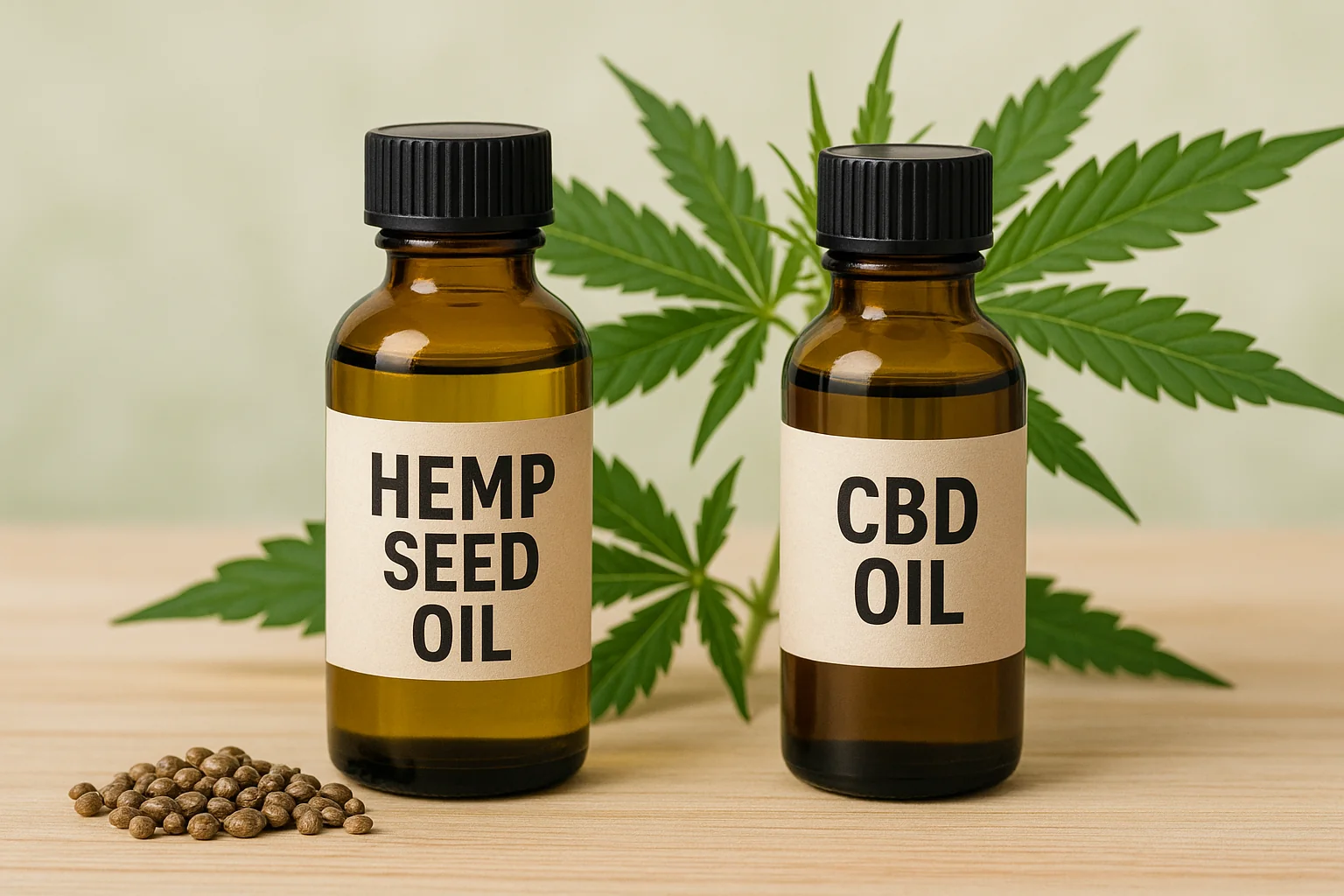

Hemp Oil vs CBD Oil: What Are the Differences and What to Choose
Hemp seed oil does not contain cannabinoids, CBD oil is made from flowers. Check what the differences are, how to read labels, and which to choose for your goal.
This is one of the most common purchasing mistakes in the cannabis category: a customer looks for CBD oil, puts hemp seed oil in the cart, and wonders why they feel no effect. The label itself does not always help. In an analysis of 84 CBD products purchased online from 31 companies, only less than 31 percent had cannabidiol content consistent with the label (Bonn-Miller et al., 2017). The mistake is easier because both products come from the same plant, both have a cannabis leaf on the packaging, and both are sometimes described with the word “cannabis.” They differ in raw material, composition, price per milliliter, and application. This article explains these differences specifically: where each product comes from, what it contains, what it is used for, and how to distinguish one from the other before you pay.
KEY INFORMATION
• Hemp seed oil does not contain cannabinoids, as it is made from seeds, not flowers or leaves.
• The omega-6 to omega-3 ratio in hemp seeds ranges from 2:1 to 3:1 (Rodriguez-Leyva and Pierce, 2010).
• CBD oil is an extract from flowers and leaves; cannabidiol does not show addictive potential in humans (WHO, 2018).
• Only 31 percent of tested CBD oils had content consistent with the label (Bonn-Miller et al., 2017).
• These are complementary products, not competitive: one is food, the other is a supplement.
Where does hemp seed oil come from, and where does CBD oil come from?
From the same plant, but from two different parts, and that explains everything else. Hemp seed oil is mechanically pressed from Cannabis sativa L. seeds, which do not naturally contain cannabinoids. CBD oil is made from an extract of flowers and leaves, which are the parts where the plant produces cannabidiol.
cannabinoids are produced in resin glands called trichomes, present on flowers and leaves. Seeds do not have them, so seed oil is a food product with a fatty profile, not a cannabinoid preparation. Hemp seeds, on the other hand, are a rich source of omega-3 and omega-6 fatty acids, beneficial for the cardiovascular system (Rodriguez-Leyva and Pierce, 2010).
The difference in raw material directly translates to cost. Pressing seeds is a simple mechanical process. Extraction from flowers, usually conducted with carbon dioxide or ethanol, requires precise equipment, temperature and pressure control, and then standardization and laboratory testing. Additionally, the raw material: both parts of the plant may be sourced from strains grown for completely different yields, one for seeds, the other for cannabidiol content in flowers.
What exactly are the differences between the two products?
The differences are most quickly seen when compared side by side. The table below compares features that have practical significance when purchasing. No column is better than the other, as these are two products that meet different needs.
Pay special attention to three rows. The raw material determines everything else, as cannabinoids cannot be obtained from seeds by any pressing method. The volume of the packaging is the quickest visual signal: a quarter-liter bottle is almost always culinary oil, while a 10 ml dropper bottle is a cannabinoid preparation. The place of sale also says something, though least reliably, as both products today end up in the same online stores and stand next to each other on the same list of results.
| Feature | Hemp Seed Oil | CBD Oil |
|---|---|---|
| Raw Material | Seeds | Flowers and Leaves |
| Main Ingredient | Omega-3, Omega-6, Omega-9 Fatty Acids | Cannabidiol (CBD) |
| Cannabinoids | None | CBD, in some products also other phyto-substances |
| Color and Taste | Greenish-yellow, nutty | Dark, herbal |
| Application | Cold Kitchen, Cosmetics | Dietary Supplement |
| Volume of Packaging | Usually 250-500 ml | Usually 10-30 ml |
| Where to Buy | Grocery Store, Health Food | Pharmacy, Cannabis Store, Online |
What is hemp seed oil used for?
Primarily for cold consumption. The ratio of linoleic acid to alpha-linolenic acid, that is, omega-6 to omega-3, ranges in hemp seeds from 2:1 to 3:1, and such a proportion is described by the authors of the review as beneficial for a healthy diet (Rodriguez-Leyva and Pierce, 2010).
In the kitchen, hemp oil works well as an addition to salads, smoothies, or bread. It is not suitable for frying, as it has a low smoke point and oxidizes at high temperatures. Its distinct, nutty flavor pairs well with stronger ingredients. If you are looking for specific applications, we have gathered them in a post about hulled hemp seeds in the kitchen, and separately described how to make homemade hemp milk.
The second application is cosmetics. Hemp seed oil is sometimes an ingredient in creams and balms, where fatty acids support the skin’s hydrolipid barrier. Manufacturers list it in the ingredient list as \”Cannabis sativa seed oil\” and this is where the misunderstanding begins: the presence of this name in a cream does not mean that the product contains cannabidiol. It means exactly that pressed seed oil was used in it.
What is CBD oil and how does it work?
It is an extract from the flowers and leaves of cannabis, with cannabidiol as its main active ingredient. The WHO report from 2018 states directly that in humans, CBD does not show effects indicating potential for abuse or addiction and that it is usually well tolerated and has a good safety profile (WHO Expert Committee on Drug Dependence, 2018).
The same report adds a caveat that is rarely remembered: reported adverse effects may result from interactions between cannabidiol and medications already taken by the patient. This is not a theoretical note, but a reason why people on regular pharmacotherapy should discuss supplementation with their doctor.
Cannabidiol interacts with the endocannabinoid system, a network of receptors and neurotransmitters present throughout the body, which co-regulates sleep, mood, and stress response. Oils differ in their spectrum: full-spectrum contains the full profile of phyto-substances from the plant, broad-spectrum removes THC while retaining the rest, and isolate is pure cannabidiol. Ethan Russo described a phenomenon called the entourage effect, in which phyto-substances from cannabis work together and mutually modify their properties (Russo, Frontiers in Plant Science, 2018).
We have noticed that customers often ask why CBD oil does not work immediately. The answer partly lies in pharmacokinetics: the maximum concentration of cannabidiol in the blood occurs within zero to four hours after administration, and via the oral route later than via inhalation (Millar et al., 2018).
How to read labels to avoid confusing products?
Look for the name of the raw material and the declaration of content in milligrams, as these determine the product. Labels of cannabis products can be misleading, and regulations do not prohibit placing graphics of a cannabis leaf or the word “cannabis” on a product that does not contain a gram of cannabidiol.
| Label Signal | What It Means |
|---|---|
| “Cannabis sativa seed oil”, “hemp seed oil” | Food oil without cannabidiol |
| “cannabidiol”, “CBD extract”, “hemp extract” | Product containing cannabidiol |
| Declaration in milligrams, e.g., 500 mg CBD | The most reliable signal of CBD oil |
| No number in mg | Almost certainly culinary oil |
However, the declaration is just the beginning, as it can be unreliable. In a study of 84 oils, capsules, and CBD liquids purchased online from 31 companies, compliance with the label was found in less than 31 percent of cases: nearly 43 percent of products contained more cannabidiol than declared, and about 26 percent less (Bonn-Miller et al., 2017). In 21 percent of samples, THC was detected. The authors note that low content may undermine any clinical response.
Therefore, the second signal to look for is a Certificate of Analysis (CoA) issued by an independent laboratory, with a cannabinoid profile and tests for heavy metals and pesticide residues. Such a document is not issued for hemp seed oil, as there is no cannabinoid whose content needs to be verified. We have gathered a practical checklist of things to check in a post about how to choose CBD oil.
Can both products be used simultaneously?
Yes, and this combination has pharmacological justification. Cannabidiol is a lipophilic substance, so it absorbs better in the presence of fat. In a study where eight adults with drug-resistant epilepsy took the same dose of CBD once on an empty stomach and once after a fatty meal, the area under the concentration curve was on average four times higher after the meal, and the maximum concentration was fourteen times higher (Birnbaum et al., 2019).
In practice, it looks simple: a tablespoon of hemp seed oil in a salad or smoothie in the morning, and CBD oil taken sublingually with the same meal. The oil provides fatty acids, and the presence of fat improves the absorption of cannabidiol. A review of pharmacokinetic studies confirms this direction: the maximum concentration of CBD increases after a meal and in fatty preparations (Millar et al., 2018).
One caveat remains important. If you are taking medications metabolized in the liver by CYP450 enzymes, cannabidiol may change the rate of their metabolism, which the WHO report also points out. Hemp seed oil does not affect this pathway, as it does not contain cannabinoids. In the case of regular pharmacotherapy, discussing the inclusion of CBD oil with a doctor is simply sensible.
Which product to choose for your goal?
The decision is based on the goal, not the price or appearance of the packaging. Choose hemp seed oil if you are looking for a plant source of omega fatty acids, want to diversify your diet with culinary oil, or need an ingredient for homemade cosmetics. It is a food product with real nutritional value, without any cannabinoid effects.
Choose CBD oil if you are looking for a supplement that interacts with the endocannabinoid system, care about supporting sleep quality or reducing tension, or want to consciously supplement your daily routine with cannabis phyto-substances. Look for a product with a CoA certificate and clearly stated cannabidiol content in milligrams.
The price difference between the two arises from the process, not from the margin. Culinary oil is sold in bottles measured in hundreds of milliliters and costs a fraction of what CBD oil costs per milliliter. For a rough estimate: in the category of oils in the store at Bucha, the prices of 10 ml packages range from 65 to 190 PLN, as of August 10, 2026. CBD oil priced like culinary oil should raise suspicions about the actual content of cannabidiol.
We have noticed that a significant portion of customers do not need to choose at all. Hemp seed oil in the diet and CBD oil as a supplement are two non-overlapping products. The oil will not enhance the action of the oil beyond the described fat effect, but it provides independent benefits from omega fatty acids.
Frequently Asked Questions
Does hemp seed oil contain CBD?
No. It is made from seeds, which do not naturally contain cannabinoids, as these are produced in the flowers and leaves. Hemp seed oil is a food product rich in omega-3 and omega-6 fatty acids, without cannabinoid effects (Rodriguez-Leyva and Pierce, 2010).
How can I tell on the label which product it is?
The name “Cannabis sativa seed oil” or “hemp seed oil” indicates oil without cannabidiol. The term “cannabidiol”, “CBD extract” or “hemp extract” indicates a product with CBD. A declaration of content in milligrams, for example, 500 mg CBD, always indicates an oil, not a culinary oil.
Can the declaration on the packaging be trusted?
Not unconditionally. In an analysis of 84 CBD products purchased online, compliance with the label was found in less than 31 percent of cases, and THC was detected in 21 percent of samples (Bonn-Miller et al., 2017). Therefore, it is worth looking for products with a Certificate of Analysis (CoA) from an independent laboratory.
Which oil should I use for cooking?
Only hemp seed oil and only cold, as it has a low smoke point. CBD oil should not be heated or used for frying or baking. It is intended for sublingual use or as a dietary supplement.
Is it worth taking CBD oil with a meal?
Yes, because fat increases absorption. After a fatty meal, the area under the curve of cannabidiol concentration was on average four times higher than on an empty stomach, and the maximum concentration was fourteen times higher (Birnbaum et al., 2019). A similar direction is confirmed by a review of pharmacokinetic studies in humans.
Can CBD oil interact with medications?
Yes. The WHO report from 2018 indicates that reported adverse effects of cannabidiol may result from interactions with medications already taken by the patient. This applies to drugs metabolized by CYP450 enzymes. Hemp seed oil does not affect this pathway.
The current selection can be found in the oils category. Stock levels and prices change regularly.
This article is for informational and educational purposes. It contains internal links to product categories available in the store at Bucha. Prices and specifications may change: check the current data on the product page before purchasing.
Author: Michał Waluk · Published: 2026-08-09 · Updated: 2026-08-10