
Is CBD Safe? Facts and Myths About Using CBD
Is CBD safe? We check WHO data, the frequency of side effects, drug interactions, and the quality of products on the market without marketing simplifications.
Cannabidiol has a reputation as a mild and safe substance, and this opinion is largely justified. The problem is that consumer texts usually end with this one sentence, while the most interesting aspects begin thereafter. The World Health Organization did indeed assess pure cannabidiol positively, but at the same time, a pharmacological review showed that adverse effects occurred in nearly half of the people using CBD, and a quality study of products sold online revealed that most of them had labels inconsistent with their content. Safety here is not just an answer to one question, but to three separate ones: about the potential for addiction, about side effects, and about interactions with medications. Below, we compare one with the other: what has been confirmed, how often problems arise, and where data still ends.
KEY INFORMATION
• The World Health Organization Expert Committee assessed pure cannabidiol in 2018 as a well-tolerated substance, with no potential for abuse and no psychoactive properties (WHO ECDD, 2018).
• Adverse effects occurred in nearly half of the people using CBD and were dose-dependent (Brown and Winterstein, 2019).
• The most commonly reported symptoms are fatigue, diarrhea, and changes in appetite and body weight (Iffland and Grotenhermen, 2017).
• CBD inhibits CYP3A4 and CYP2C19 enzymes and P-glycoprotein, so the potential for interactions with commonly used medications is high (Brown and Winterstein, 2019).
• Of the 84 products purchased online, only 30.95% had content consistent with the label, and THC was detected in 21.43% (Bonn-Miller et al., 2017).
• The U.S. Food and Drug Administration advises against using CBD during pregnancy and while breastfeeding.
Is CBD safe according to the World Health Organization?
Yes, with reservations regarding the scope of this assessment. The World Health Organization Expert Committee on Drug Dependence published a critical review of cannabidiol in 2018, in which it recognized it as a well-tolerated substance, devoid of psychoactive properties and not exhibiting abuse or dependence potential. Based on this, the committee recommended that products considered to be pure cannabidiol not be included in international drug control.
This was an assessment with real regulatory consequences, and it largely shaped the current legal status of CBD in Europe. However, it is worth noting the phrasing that usually gets lost in quotes: the review concerned products considered to be pure cannabidiol. It was not an assessment of any oil available in retail.
It is important to understand what such a document is in the procedure. A critical review is a formal stage preceding a decision to include a substance in international drug control, so its subject remains the molecule itself and data about its action, not the market of products containing it. The committee assesses whether the substance needs to be listed in the convention, and that question is narrower than the consumer’s question about the safety of a specific product.
This difference is not a formality. The safety assessment of a molecule and the safety assessment of a product are two separate matters, and the divergence between them is well documented in this industry. Pure cannabidiol may have an excellent profile, while a specific shelf oil may contain a different dose than declared on the label or a contaminant of tetrahydrocannabinol.
Another thing worth remembering is the scope of the very concept of safety. The lack of addiction potential does not mean the absence of side effects or the absence of interactions with medications. These are three independent questions, and the answers to them differ from one another, as discussed in the following sections.
How often does CBD cause side effects?
More often than the reputation of this substance suggests. The review by Brown and Winterstein, published in 2019, analyzed data from medicinal product characteristics containing cannabidiol and showed that side effects occurred in nearly half of the people using CBD. Their frequency showed a general dose dependence: the higher the dose, the greater the likelihood of a problem.
The authors listed the most common as elevated liver enzyme activity, drug-induced sedation, sleep disturbances, infections, and anemia. Some of these symptoms surprise readers accustomed to describing CBD as a sleeping aid: cannabidiol is often marketed as a help for falling asleep, while clinical data show sleep disturbances appear among the side effects. The presence of infections and anemia on this list can also be surprising, but it reminds us where the data come from: from patients treated for severe diseases, taking other medications concurrently.
A slightly different set is indicated by the review by Iffland and Grotenhermen from 2017, which included clinical data and animal studies. The most commonly reported symptoms there were fatigue, diarrhea, and changes in appetite and body weight. The authors also noted that compared to medications used for the same indications, cannabidiol performs favorably in terms of side effects.
Both assessments can be reconciled, and it is worth doing so directly, as it is easy to draw a misleading conclusion from each one separately. The data mostly come from studies on drug-resistant epilepsy, where the doses used are many times higher than typical consumer supplementation. Cannabidiol is simultaneously better tolerated than the medications it was compared to, and it is not a neutral substance. Both of these things are true at the same time.
Does CBD intoxicate like THC?
No. Cannabidiol does not produce the euphoria or perceptual disturbances typical of tetrahydrocannabinol, as confirmed by both the World Health Organization assessment and the review of clinical data. The expert committee stated directly that it lacks psychoactive properties in the sense that they are discussed in relation to THC.
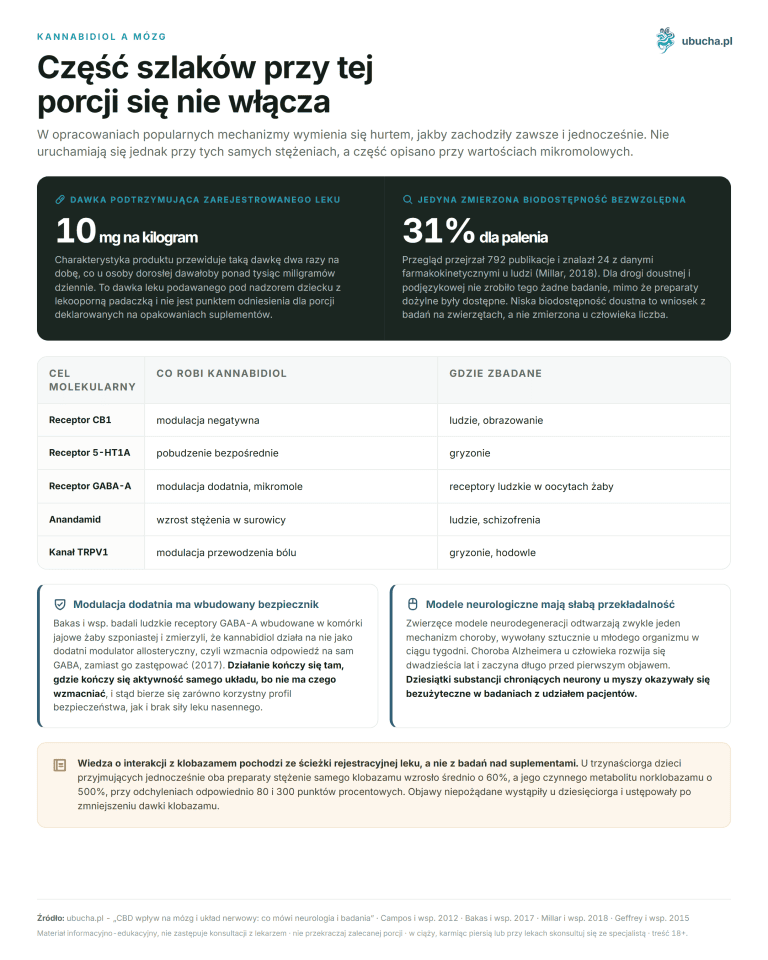
The basis is molecular. Tetrahydrocannabinol directly stimulates the CB1 receptor, primarily concentrated in the central nervous system, and this stimulation is responsible for the characteristic intoxication. Cannabidiol does not act on this receptor in that way. Its influence on the body occurs through different pathways, including serotonin and vanilloid receptors, which gives a completely different picture of action.
It is precisely this lack of direct stimulation of the CB1 receptor that has become the basis for the recommendation that pure cannabidiol not be included in drug control. The dispersed mechanism also explains why the effects attributed to CBD can be subtle and difficult to measure: the substance does not hit one switch but modulates several systems at once, and the strength of this modulation depends on the dose and the individual.
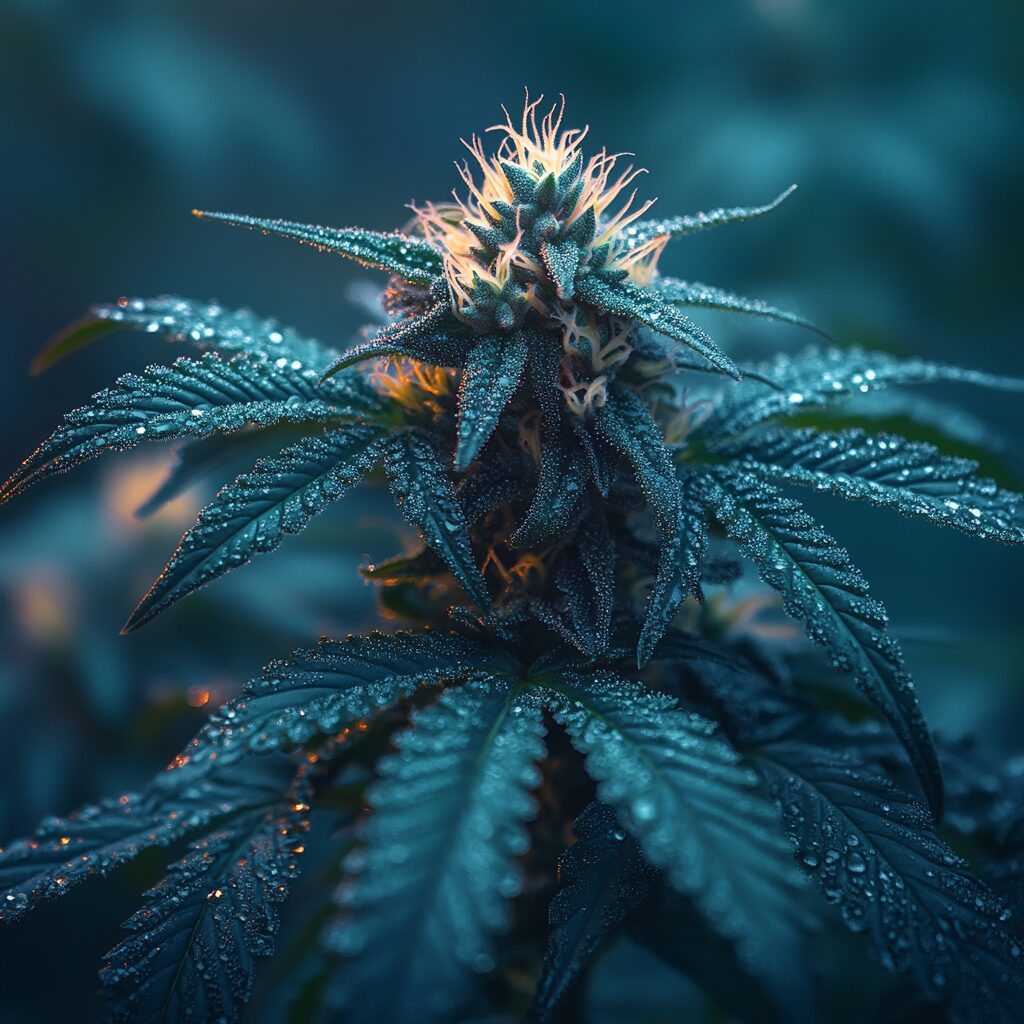
So where does the confusion come from? From the origin of both substances. Cannabidiol and tetrahydrocannabinol come from the same plant, and hemp flower looks and smells similar to material with a high THC content. The sensory similarity is complete, even though the pharmacological difference is fundamental.
It is worth distinguishing two things that are often mixed up at this point. The absence of intoxication does not mean the absence of influence on the central nervous system. Drug-induced sedation and drowsiness are documented side effects of cannabidiol, so stating that CBD does nothing to well-being is as inaccurate as claiming it causes intoxication.
What drug interactions does CBD cause?
This is the most serious practical risk associated with cannabidiol and simultaneously the most often overlooked in consumer content. Cannabidiol affects enzymes involved in drug metabolism, primarily CYP3A4 and CYP2C19, as well as P-glycoprotein, responsible for removing substances from cells. The authors of the 2019 review assessed the potential for interactions with commonly used medications as high.
The mechanism is predictable. If cannabidiol slows the breakdown of another drug, the concentration of that drug in the blood increases, and the patient at an unchanged dose may experience overdose symptoms. The phenomenon also works the other way: CBD is described both as a substance that affects other drugs and as one that is affected by other drugs.
| Drug Group | What is the risk? |
|---|---|
| Anticoagulants | Increased concentration may enhance anticoagulant effects and increase the risk of bleeding |
| Antiepileptics | Documented interaction with clobazam, usually requiring a dose reduction |
| Immunosuppressants | Narrow therapeutic window, so even a moderate increase in concentration can be significant |
| Statins | Metabolized by CYP3A4, and higher concentrations increase the risk of muscle damage |
| Some antidepressants | CYP2C19 pathway is involved in their metabolism, which alters the concentrations obtained |
A simple guideline can be helpful for initially assessing risk. If a drug’s leaflet warns against drinking it with grapefruit juice, the product is likely metabolized by CYP3A4, the same pathway affected by cannabidiol. This does not replace consultation but allows for quickly identifying medications that require special attention in the home medicine cabinet.
The authors’ recommendations are cautious and boil down to three possibilities: reducing the dose of the drug metabolized by these pathways, monitoring for side effects, or considering alternative therapy. None of these decisions should be made independently. If you are taking medications regularly, a conversation with a doctor or pharmacist should precede the first dose of cannabidiol, not occur after problems arise.
Do CBD products match what is on the label?
Usually not. The most frequently cited study on this issue was published in 2017: Bonn-Miller’s team purchased 84 cannabidiol products from 31 companies online and tested their actual composition. Compliance with the label declaration was found in 30.95% of cases, or 26 products out of 84.
The remaining products were distributed in a way that is worth stating precisely, as it is often cited in reverse. 42.85% of products had an understated declaration, meaning the actual content was higher than stated. 26.19% had an overstated declaration, meaning the content was lower than promised. In other words, the most common mistake was not deceiving the customer about the quantity but providing a value lower than the actual one.
This finding has an underrated practical consequence, stemming directly from the previous section. Since the adverse effects of cannabidiol depend on the dose, a product containing more than declared on the label exposes the user to symptoms that they will not connect with the dose they are taking, as they calculate it according to the packaging. An understated declaration can thus be a health problem, even if the customer does not feel deceived.
Another finding was the presence of tetrahydrocannabinol. It was detected in 18 out of 84 samples, or 21.43%, at concentrations reaching 6.43 mg per milliliter. For most people, this has no practical significance, but for pregnant women, individuals undergoing drug testing, and patients reacting to small doses of THC, this is a real risk.
The conclusion is simple and independent of the brand: the actual composition is indicated by the certificate of analysis of a specific batch, not the label on the packaging. If you want to understand why hemp products are sold in different legal categories and what this changes for quality requirements, we have described it in the text about the difference between a dietary supplement and a drug.
Is CBD safe during pregnancy and breastfeeding?
It is not recommended, and this is one of the few areas where agency positions are unequivocal. The U.S. Food and Drug Administration strongly advises against using cannabidiol, tetrahydrocannabinol, and hemp products in any form during pregnancy and while breastfeeding.
The reason is not proven harm but rather a lack of data allowing for a safety determination, combined with warning signals from animal studies. Research involving pregnant women is not conducted for ethical reasons, so the knowledge gap is permanent and will not close in the foreseeable future. Cannabidiol is also a highly lipophilic substance, making its transfer into milk likely, although the scale of this phenomenon in humans has not been well described.
Additionally, there is an argument that stems directly from the previous section. Since one in five tested products contained undeclared tetrahydrocannabinol, even assuming that pure cannabidiol would prove to be neutral, the buyer has no certainty about what they are actually taking. In pregnancy, this uncertainty weighs significantly more than in any other situation.
The practical recommendation is cautious and sounds the same in regulatory agency materials: during pregnancy and lactation, it is better to refrain from cannabidiol, and if you were using it before learning about your pregnancy, inform your attending physician instead of seeking answers online. We discuss this topic more broadly in a separate article about CBD during pregnancy and breastfeeding.
What did the CBD registration study in children show?
It showed both efficacy and the price paid for it. The study by Devinsky et al. published in 2017 included 120 children and young adults with Dravet syndrome, a severe form of drug-resistant epilepsy. Participants received cannabidiol at a dose of 20 mg per kilogram of body weight per day or placebo, in both cases as an adjunct to standard treatment. The study had a double-blind design with a placebo group, and it was funded by the manufacturer of the product, which was noted in the publication.
The result on the efficacy side was clear. The median number of seizures per month decreased from 12.4 to 5.9 in the group receiving cannabidiol, while in the placebo group it changed from 14.9 to 14.1. A reduction in seizure frequency of at least half was achieved by 43% of participants compared to 27% on placebo. Complete cessation of seizures occurred in 5% of the treated group and in no one in the placebo group. The adjusted difference between groups in the change in seizure frequency was 22.8 percentage points in favor of cannabidiol.
Equally important is the second part of the result, which almost always appears in texts about the safety of CBD. Adverse effects occurred more frequently in the group receiving cannabidiol than in the placebo group, among which diarrhea, vomiting, fatigue, fever, drowsiness, and abnormal liver test results were listed. More participants receiving CBD also withdrew from the study than those receiving placebo.
The conclusion for the reader looking for a supplement is different than what the mere existence of a registered drug suggests. Registration proves that in a strictly defined indication, the benefit outweighs the risk under the supervision of a neurologist. It does not prove that cannabidiol is neutral, and the doses used in this study were many times higher than typical supplementation.
How to dose CBD to minimize risk?
The rule is to start with a small dose and gradually increase it. This arises not from clinical guidelines for healthy adults, as there are none, but from two observations contained in the data described above: the frequency of side effects increases with the dose, and the response to cannabidiol is highly individual.
In practice, this means starting with several milligrams per day and increasing the dose every few days, observing your own reaction. This method is called titration and is used whenever the same dose produces very different effects in different people. Two individuals of similar body weight may require distinctly different portions.
When converting drops to milligrams, a simple calculation helps. A 10 ml bottle of oil with a concentration of 5% contains 500 mg of cannabidiol, at 10% it is 1000 mg, and at 15% it is 1500 mg. Knowing the number of drops obtained from the packaging, one can calculate the content of a single drop, although manufacturers provide this value differently, and it is worth checking it on the label of the specific product.
The route of administration also matters, as the same number of milligrams produces different effects. Oil taken sublingually is absorbed faster, while capsules and edibles go through liver metabolism before entering circulation, causing the effect to appear later but last longer. When comparing your own reactions, it is worth comparing the same form of the preparation.
Two situations require deviating from this rule in favor of a conversation with a doctor. The first is regular medication use, especially those with a narrow therapeutic window. The second is doses significantly higher than consumer doses, where the risk of interactions is no longer theoretical. We have gathered practical aspects of choosing the preparation itself in the guide to CBD oils.
Is CBD safe for dogs and cats?
The data is early, and the most frequently cited study concerns dogs with degenerative joint disease. The team by Gamble et al. conducted a pharmacokinetic analysis and a controlled study with a crossover design in which dogs received oil with cannabidiol at a dose of 2 mg per kilogram of body weight every twelve hours for four weeks.
On the efficacy side, the result was positive. Pain assessment and activity conducted by owners and independent veterinary assessment showed significant reduction in pain complaints and increased activity during the period of cannabidiol administration. The half-life was 4.2 hours at both tested doses.
However, what the blood biochemistry showed is significant. Owners did not report adverse effects, but laboratory tests revealed a significant increase in alkaline phosphatase activity during cannabidiol administration. This is a liver signal that cannot be noticed without a blood test, and the main reason why using CBD in an animal should be done under veterinary supervision, not based on an internet table. In practice, this means a control blood test before starting administration and after a few weeks, not just observing the animal’s behavior.
Separate caution is required for cats, whose metabolism of plant substances differs from that of dogs, as well as the composition of the preparation itself. Products intended for humans may be sweetened with xylitol, which is toxic to dogs. Dosing based on body weight is detailed in the text about CBD oil for dogs and cats.
What do we still not know about the safety of CBD?
The most honest list of gaps was compiled by the authors of the 2017 safety review themselves, and it is worth quoting because it never appears in marketing materials. In the conclusions, they stated directly that some important toxicological parameters remain unstudied, and as an example, they pointed to the potential impact of cannabidiol on hormonal regulation.
The second gap they indicated concerns the scale and duration of studies. There is a lack of trials with a larger number of participants and those in which cannabidiol was administered chronically over a long period. Most available data comes from studies on epilepsy and psychotic disorders, thus from patients, not from healthy individuals using low doses for years.
The third area is the action of cannabidiol on liver enzymes and drug transporters. The authors noted that it requires further research, among other things, to determine when the effect of such an interaction is unfavorable and when it is used intentionally, as in reducing the dose of clobazam in epilepsy. It is also worth noting that most clinical data concern pharmaceutical-grade purified cannabidiol, not full-spectrum products sold to consumers, which additionally contain other cannabinoids and terpenes.
What does this mean for someone who simply wants to know if they can take the oil? That the available data well describe short-term use in adults without chronic diseases and poorly describe everything outside of that. The absence of warning signals in an area that no one has studied is not evidence of safety, and this distinction often disappears in texts about cannabidiol.
What regulations govern CBD in Poland?
Pure cannabidiol does not appear in any lists of controlled substances, so it is not prohibited in Poland. However, the plant material from which it is derived is regulated, and this is where the boundary of product legality lies.
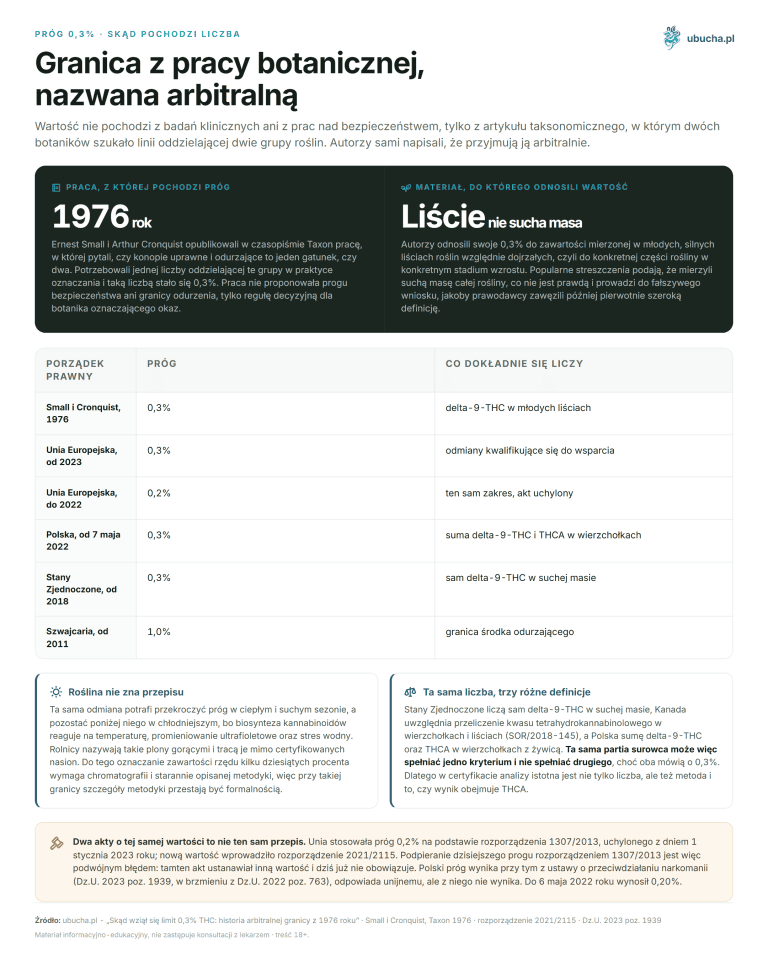
Hemp is a plant in which the total content of delta-9-THC and tetrahydrocannabinolic acid, or THCA, in flowering or fruiting tops does not exceed 0.3% when calculated on a dry weight basis, with the sum rounded to one decimal place. The basis is Article 4 point 5 of the Act of July 29, 2005 on Counteracting Drug Addiction (t.j. Dz.U. 2023 poz. 1939), as amended by the Act of March 24, 2022 (Dz.U. 2022 poz. 763), effective from May 7, 2022. Previously, the threshold was 0.20%.
Two details are often misrepresented even in industry texts. The threshold concerns the sum of delta-9-THC and THCA, not just delta-9-THC itself, which changes the result of laboratory testing, as a significant portion of the cannabinoid in the plant material exists in its acidic form. The national threshold corresponds to the EU threshold of the same value, but it does not imply: these are two separate regulations.
Separately, food from hemp seeds is regulated, where limits are expressed in milligrams per kilogram, not percentages: 3.0 mg/kg for seeds and processed products and 7.5 mg/kg for hemp seed oil. In food trade, cannabidiol also remains subject to the EU novel food procedure, which has not yet been completed, which is why many products are sold as cosmetics or extracts rather than as dietary supplements.
It is also worth noting the status of HHC, or hexahydrocannabinol, which is sometimes marketed as a legal substitute for tetrahydrocannabinol. HHC is a controlled substance in Poland, and its trade and possession outside the provisions of the Act on Counteracting Drug Addiction remain prohibited, regardless of the form of the product and regardless of how the seller describes it.
Frequently Asked Questions
Can you overdose on CBD?
There have been no reported deaths caused solely by cannabidiol, and the World Health Organization has assessed it as a well-tolerated substance. However, at high doses, adverse effects increase: drowsiness, diarrhea, and elevated liver enzymes. The risk depends on the dose, so increasing it is not without consequences.
How often does CBD cause side effects?
In a review of data from medicinal product characteristics, side effects occurred in nearly half of the people using cannabidiol and were dose-dependent. The most common included elevated aminotransferases, drug-induced sedation, and sleep disturbances. The data mainly come from therapeutic doses, significantly higher than consumer doses.
Will CBD show up on a drug test?
Pure cannabidiol should not yield a positive result, as tests detect THC metabolites. The risk arises from product contamination: in a study of 84 products purchased online, tetrahydrocannabinol was detected in 21.43% of samples. For mandatory tests, a certified batch isolate is safer.
Can CBD be combined with medications?
Not without consultation. Cannabidiol affects the CYP3A4 and CYP2C19 enzymes and P-glycoprotein, and the potential for interactions with commonly used medications is assessed as high. Special caution is required for anticoagulants, antiepileptics, and immunosuppressants with a narrow therapeutic window.
Is CBD addictive?
No. The World Health Organization Expert Committee stated in 2018 that pure cannabidiol does not exhibit abuse potential or dependence and recommended that it not be included in international drug control. No physiological withdrawal symptoms have been reported after discontinuation.
Can I drive after taking CBD?
Cannabidiol itself does not impair driving ability comparably to alcohol or THC, but drug-induced sedation and drowsiness are documented side effects. Additionally, a full-spectrum product may contain trace amounts of THC. It is better to test a new dose on a day without driving.
Is CBD safe for older adults?
It requires greater caution, mainly due to polypharmacy. The more medications metabolized by CYP3A4 and CYP2C19 that are taken, the greater the likelihood of significant interaction. For older adults, it is sensible to start with lower doses and agree on use with the attending physician.
How long can CBD be safely used?
It is unknown. The authors of the safety review indicated the lack of studies with a long duration of chronic administration as a significant gap. With prolonged use of higher doses, periodic monitoring of liver enzymes is reasonable, especially since elevated aminotransferases are among the more common side effects.
If you are looking for a product with an available certificate of analysis, you can find a review of available items in the oils section.
This article is for informational and educational purposes and does not constitute medical advice. Before starting to use cannabis or CBD for therapeutic purposes, consult a doctor, especially if you are taking other medications, are pregnant, or breastfeeding.
Author: Michał Waluk · Published: 2026-05-06 · Updated: 2026-08-10