
Psychedelic Therapy 2026: MDMA, Psilocybin, Phase III Trials, FDA and Status in Poland
MDMA in PTSD and psilocybin in treatment-resistant depression: what phase III studies showed, why FDA refused registration, and legal status in Poland.
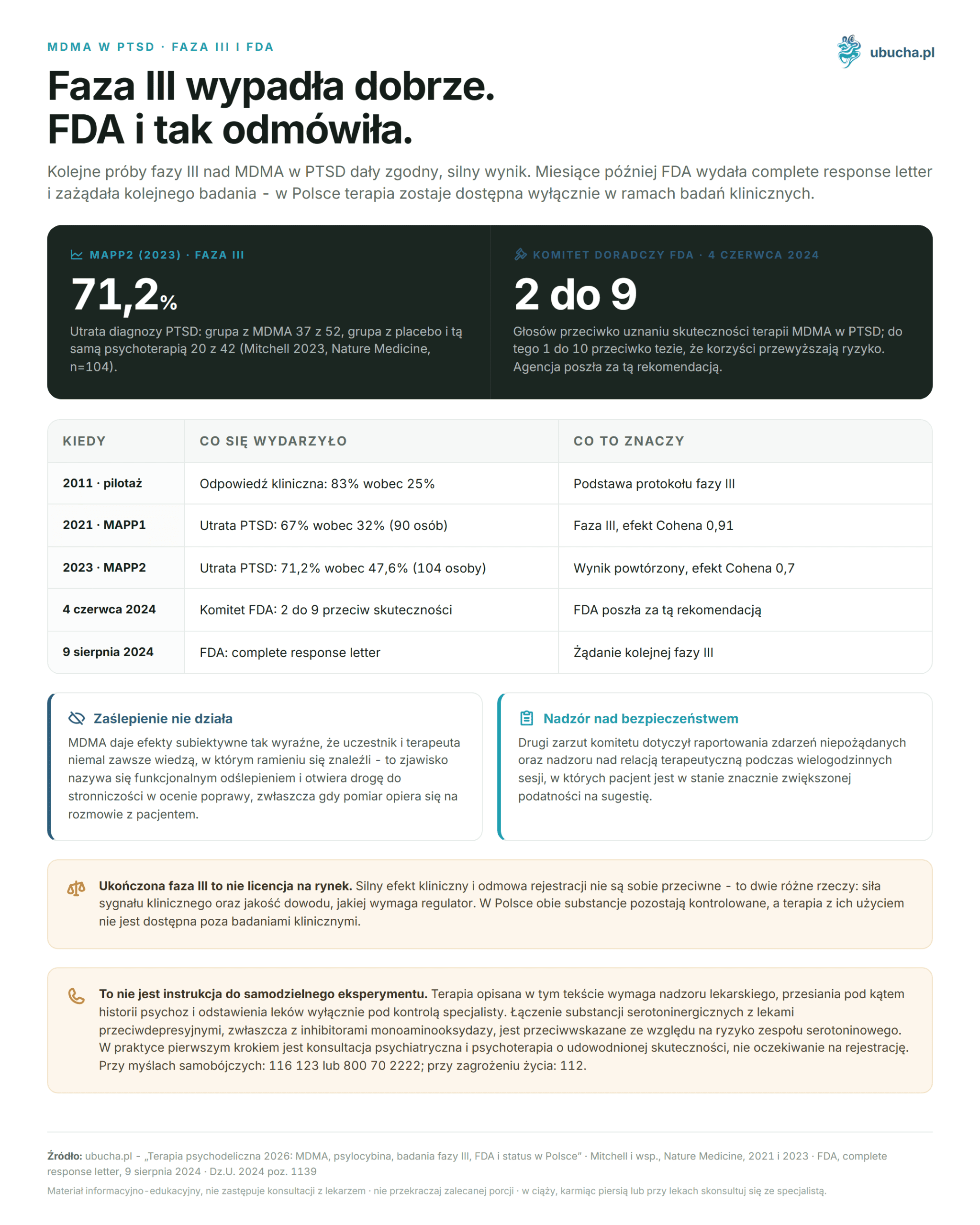
Psychedelic-assisted therapy has progressed over two decades from a taboo topic to a subject of registration studies. In the second phase III trial on MDMA in post-traumatic stress disorder, 71.2% of participants no longer met PTSD diagnostic criteria, compared to 47.6% in the psychotherapy-only group (Mitchell 2023, Nature Medicine). Several months later, the US regulatory agency refused to approve this therapy and demanded another study. These two sentences are not contradictory but describe two different things: the strength of the clinical signal and the quality of evidence required by the regulator. This text consistently separates them. You will find results of published phase II and III trials on MDMA and psilocybin, data on adverse effects directly from these publications, a description of the clinical protocol, reasons for registration refusal, and the legal status of both substances in Poland as of August 2026. You will not find a single milligram number here, as the text concerns treatment of mental disorders and decisions are made with a doctor.
KEY INFORMATION
• In the MAPP2 study, 71.2% of participants in the MDMA group lost the PTSD diagnosis versus 47.6% in the control group (Mitchell 2023, Nature Medicine, n=104).
• The US FDA refused MDMA registration in August 2024 and demanded another phase III study.
• Australia since July 1, 2023, allows prescribing MDMA in PTSD and psilocybin in treatment-resistant depression by psychiatrists with separate authorization.
• In Poland, MDMA and psilocybin remain controlled substances, and therapy using them is not available outside clinical trials.
• A review in the American Journal of Psychiatry concludes that the evidence base is insufficient for routine use of any psychedelic (Reiff 2020).
What is psychedelic-assisted therapy?
It is a clinical protocol where administration of the psychoactive substance is only one element, not the entire treatment. Preparatory and integration meetings with therapists surround the dose session, which itself lasts several hours under constant supervision. Without this framework, it is not therapy but just substance administration.
The scale of evidence is summarized by a review by Reiff et al. published in the American Journal of Psychiatry (American Journal of Psychiatry, 2020). The authors searched PubMed and PsycINFO for 2007-2019, reviewed 1603 records, filtered down to 161 papers, and finally identified 14 well-designed clinical trials on LSD, MDMA, psilocybin, and ayahuasca.
The conclusion of this review is often omitted in popular texts but is the most honest statement in the entire field. Randomized trials support the efficacy of MDMA in PTSD and psilocybin in depression and anxiety associated with cancer, but the collected evidence base is insufficient for registration of any psychedelic for routine psychiatric use. Evidence for LSD and ayahuasca is called preliminary.
It is worth immediately separating two things often conflated in public debate. The first is a scientific question: does the substance help in a specific diagnosis compared to a fair control group. The second is a regulatory question: are the collected data consistent and safe enough for the regulatory agency to approve the drug for market release. The answer to the first question is cautiously positive today. The answer to the second, in August 2024, was negative.
While writing this text, we noticed that most materials in the Polish internet cite only efficacy percentages and omit how many hours of therapist contact accompanied each dose. This is not a technical detail. In MAPS studies, one substance session was accompanied by a dozen or so sessions without it.
Where did psychedelic psychiatry come from?
From a chemical lab and by chance. Albert Hofmann synthesized LSD at Sandoz in the late 1930s and discovered its effects in 1943. Fifteen years later, the same team isolated psilocybin and psilocin from Psilocybe mushrooms. Sandoz distributed both substances to research centers under trade names for years.
The first wave of research ended for political, not scientific reasons. The Harvard Psilocybin Project led by Timothy Leary and Richard Alpert in 1960-1962 was methodologically weak, and its authors increasingly linked research with public promotion of the substances. Both lost their positions in 1963. The US Controlled Substances Act of 1970 and the UN Convention on Psychotropic Substances of 1971 closed the topic for a generation.
The silence was broken by a study by Roland Griffiths and team at Johns Hopkins, published in Psychopharmacology (Psychopharmacology, 2006). Thirty volunteers with no prior hallucinogen experience received psilocybin and methylphenidate as a comparator in a double-blind, crossover design. Sessions lasted eight hours individually in conditions described as comfortable and supportive.
The result was twofold. Psilocybin caused acute perceptual changes and mood instability, including anxiety, while increasing measures of mystical experience. After two months, participants rated the experience as personally and spiritually significant, confirmed independently by observers from their environment. This last point is the strongest in the work: the assessment did not come solely from the person who knew what they took.
| Date | Event |
|---|---|
| 1943 | Hofmann describes LSD effects at Sandoz lab |
| 1958 | Isolation of psilocybin and psilocin from Psilocybe mushrooms |
| 1960-1962 | Harvard Psilocybin Project ends with departure of both researchers |
| 1970-1971 | Controlled Substances Act and UN convention close research |
| 2006 | Griffiths et al. publish work opening the renaissance |
How do psychedelics change brain function?
On two levels that must be separated: structural and network. Structural level concerns connections between neurons; network level concerns how large brain areas cooperate at rest. Recent studies have addressed both, but in different models and with varying strength of conclusions.
The structural level is best described by Shao et al. in Neuron (Neuron, 2021). The team imaged chronically, using two-photon microscopy, dendritic spines of layer V pyramidal neurons in the medial frontal cortex of mice. A single psilocybin dose caused about a 10% increase in spine size and density, driven by accelerated formation rate. The change appeared within a day and persisted a month later. Authors also noted alleviation of stress-related behavioral deficit and increased excitatory transmission.
This is an animal study. Direct extrapolation to human depression is an overreach, though it regularly appears in press materials.
The network level is described by Carhart-Harris et al. in Scientific Reports (Scientific Reports, 2017). Nineteen patients with treatment-resistant depression underwent fMRI before and after psilocybin treatment; quality data were obtained from sixteen. Post-treatment, cerebral blood flow decreased in the temporal cortex, including the amygdala, correlating with symptom reduction.
Here is a detail that refutes the most repeated internet claim. After treatment, functional connectivity within the default mode network did not decrease but increased. The popular statement about psilocybin permanently loosening this network describes the acute effect during substance action, not the post-therapy state. Authors call this pattern a reset and clearly distinguish it from previously observed acute effects. Clinical response criteria at five weeks were met by 47% of subjects.
What did the first MDMA study in PTSD show?
That the signal exists and can be measured without harm to participants. The first completed clinical trial on MDMA as a psychotherapy adjunct was published by Mithoefer et al. in the Journal of Psychopharmacology (Journal of Psychopharmacology, 2011). Before MDMA criminalization in 1985, only case reports existed.
Twenty people with chronic PTSD resistant to psychotherapy and pharmacotherapy were enrolled. Twelve were randomized to active substance arm, eight to placebo. Each underwent two eight-hour experimental psychotherapy sessions; both groups received the same preparatory and control meetings without substance.
The primary measure was the CAPS scale, performed before treatment, four days after each session, and two months after the second session. Score reduction was significantly greater in the MDMA group at all three time points. Clinical response was achieved by 10 of 12 in the active group (83%) versus 2 of 8 in placebo (25%).
Safety data are equally important. No serious adverse events related to the substance, no adverse neurocognitive effects, nor clinically significant blood pressure increases were noted. With twenty people, this is not population safety proof but a premise to design a larger study.
This work built the methodological foundation on which MAPS based the phase III protocol: fixed number of substance sessions, multiple psychotherapy sessions without it, assessment by independent blinded diagnosticians. We separately describe how these protocols looked in veteran populations.
What results did the first phase III trial yield?
The largest published in PTSD so far, with a rare effect size in psychiatry. The MAPP1 study, published by Mitchell et al. in Nature Medicine (Nature Medicine, 2021), included 90 people with severe PTSD, including patients with comorbidities explicitly listed: dissociation, depression, history of alcohol and other substance use disorders, and childhood trauma.
Baseline CAPS-5 scores averaged 44.0 in the MDMA arm and 44.2 in placebo. Mean diagnosis duration was 14.8 years and 13.2 years respectively. This population had not responded to prior treatment for over a decade, not recent trauma cases.
After randomization, participants underwent manualized psychotherapy with MDMA or placebo, both arms supplemented with three preparatory and nine integration sessions. Mean CAPS-5 change in completers was -24.4 points in MDMA group versus -13.9 in placebo, with Cohen’s d effect size 0.91. Functional improvement measured by Sheehan scale also improved.
The most cited number comes from the detailed part: 28 of 42 (67%) in MDMA group lost PTSD diagnosis versus 12 of 37 (32%) in placebo. Full remission was achieved by 14 of 42 (33%) versus 2 of 37 (5%).
| Outcome after treatment | MDMA group | Placebo with psychotherapy |
|---|---|---|
| CAPS-5 score change | minus 24.4 pts | minus 13.9 pts |
| Loss of PTSD diagnosis | 28 of 42 (67%) | 12 of 37 (32%) |
| Full remission | 14 of 42 (33%) | 2 of 37 (5%) |
| Cohen’s effect size | 0.91 | - |
Did the second phase III trial confirm this result?
Yes, with a weaker effect size and a more diverse population. The MAPP2 study, published by Mitchell et al. in Nature Medicine (Nature Medicine, 2023), was a confirmatory trial: same protocol, different group, assessment by blinded independent diagnosticians.
104 people were randomized: 53 to MDMA arm and 51 to placebo with identical psychotherapy. Severe PTSD was present in 76 of 104 (73.1%), moderate in 28 (26.9%). Authors emphasize ethnic diversity: 28 of 104 identified as Latino, 35 of 104 as non-white. This addresses criticism that earlier trials were demographically narrow.
Mean CAPS-5 change was -23.7 points in MDMA group versus -14.8 in control, with Cohen’s d 0.7. Functional improvement by Sheehan scale was 3.3 points versus 2.1.
PTSD diagnosis was lost by 37 of 52 (71.2%) in MDMA group versus 20 of 42 (47.6%) in control. Remission criteria were met by 24 of 52 (46.2%) versus 9 of 42 (21.4%).
Two points are more important than the percentage. First: effect size dropped from 0.91 to 0.7 moving from severe to mixed sample, a normal clinical signal behavior supporting its reality. Second: the control group receiving psychotherapy also improved strongly. Nearly half lost diagnosis. The difference is significant but not a difference between treatment and nothing.
Why does the control group improve in these studies?
Because they receive full psychotherapy, not nothing. This is the most often overlooked element in the psychedelic discussion and the one that most changes result interpretation. In both phase III MDMA trials, the control arm underwent the same protocol as the active arm, with the same hours of contact with two therapists. The only difference was whether the active substance was administered during sessions.
The effect is visible in numbers. In MAPP1, CAPS-5 dropped by 13.9 points in control, and 32% lost PTSD diagnosis. In MAPP2, the drop was 14.8 points, and 47.6% lost diagnosis. Almost half of people with severe or moderate PTSD, ill for over a decade, lost criteria after manualized psychotherapy alone.
The conclusion is uncomfortable for both sides. Psychedelic therapy supporters lose the argument that these are patients without alternatives. Skeptics lose the argument that the entire effect is placebo, as the difference between arms was statistically significant and replicated in an independent confirmatory trial.
A similar pattern is seen with psilocybin. In direct comparison with escitalopram, QIDS-SR-16 score dropped by 6.0 points in the drug arm, and the 2.0-point difference favoring psilocybin was not statistically significant. In the Compass study, the control arm receiving a microdose plus full psychological support improved MADRS by 5.4 points.
How to read Cohen’s effect size here? A value of 0.7 means the average improvement in the active group exceeds the control group’s average by seven-tenths of a standard deviation. In psychiatry, this is high, though comparing it with other studies only makes sense if the same scale was used. It does not mean 70% of patients will benefit. Effect size describes a shift in the entire distribution, not the percentage helped.
What about safety in MDMA studies?
Adverse events are common, mostly mild and predictable by type, but the suicide risk profile requires separate description. In MAPP2, the most frequent events in the MDMA group were muscle tension in 31 of 53 and nausea in 24 of 53 (Nature Medicine, 2023).
| Adverse event | MDMA group (n=53) |
|---|---|
| Muscle tension | 31 people (58.5%) |
| Nausea | 24 people (45.3%) |
| Decreased appetite | 19 people (35.8%) |
| Excessive sweating | 18 people (34.0%) |
| Feeling hot | 14 people (26.4%) |
| Feeling cold | 11 people (20.8%) |
Serious adverse events occurred in seven people overall: five in the MDMA group and two in control. There were no deaths or serious adverse events as defined by regulations.
Suicidal ideation data must be read separately, as the internet corpus repeats a number not in the paper. Over 80%, exactly 87 of 104, had lifetime suicidal thoughts. During the last preparatory session, suicidal thoughts were reported by 13 of 53 (24.5%) in MDMA group and 12 of 51 (23.5%) in control. Three people in the entire study (two MDMA, one control) had active suicidal thoughts with some intent. No suicidal behaviors were observed, and no serious events of this category were reported.
Interpreting these numbers requires caution both ways. They are high because the severe PTSD population is high risk regardless of treatment, and the difference between arms is small. At the same time, they show why the regulatory agency wanted a stricter reporting system before allowing such therapy outside clinical trials.
Why did the FDA refuse MDMA registration in 2024?
Because it considered that with such pronounced subjective effects, efficacy cannot be proven in a standard blinded trial design, and the safety reporting system was insufficient. The US agency issued a complete response letter to Lykos Therapeutics, MAPS’ operational arm, on August 9, 2024, demanding another phase III study.
The decision was preceded by a psychopharmacology advisory committee meeting on June 4, 2024. The committee voted 2 to 9 against recognizing MDMA therapy efficacy in PTSD and 1 to 10 against the benefit-risk balance under the proposed risk minimization program. The agency followed this recommendation.
The first objection concerned blinding. MDMA produces such clear subjective effects that participants almost always know their arm, and the therapist knows it with them. This phenomenon is called functional unblinding and opens the way to bias in improvement reporting, especially when measurement relies on patient interview.
The second objection concerned adverse event reporting and supervision of the therapeutic relationship during long sessions where the patient is highly suggestible. The third concerned how well results from a selected group translate to routine psychiatric practice.
This problem has no simple solution and is more interesting than the verdict itself. If the substance reveals itself to the participant in the first hour, no placebo will be truly blind, and criteria developed for antidepressants no longer fit. Whether a separate regulatory framework is needed for therapy with a psychotherapeutic component remains open. The same methodological dispute recurs in psilocybin registration programs.
What do psilocybin studies in treatment-resistant depression show?
A moderately strong effect after a single dose, which weakens over several weeks. The largest published study is a phase II trial by Compass Pathways, described by Goodwin et al. in the New England Journal of Medicine (New England Journal of Medicine, 2022). It involved 233 adults with treatment-resistant depression.
Participants were randomized to three arms differing only by the size of a single synthetic psilocybin dose; the smallest served as an active control. All received psychological support. The endpoint was change in MADRS score from baseline to week three.
Baseline MADRS was 32 or 33 points in each group. After three weeks, it dropped by 12.0 points in the highest dose arm, 7.9 in the medium dose, and 5.4 in control. The difference between highest dose and control was 6.6 points and statistically significant. The difference between medium dose and control was 2.5 points and not significant.
Authors also noted two points often lost in press summaries. Response and remission rates at three weeks supported the main result, but maintenance of response at twelve weeks did not. Adverse events occurred in 179 of 233 (77%), and suicidal thoughts, behaviors, or self-harm were noted in all dose arms, including control.
The authors’ cautious conclusion: the study showed superiority of the highest dose over control in the three-week window, with significant adverse events, and questions of efficacy and safety require larger, longer trials comparing psilocybin with existing treatments.
Does psilocybin outperform escitalopram?
In direct comparison, it did not win the primary endpoint, though it did in most secondary measures. The direct comparison was conducted by Carhart-Harris et al. at Imperial College London, published in the New England Journal of Medicine (New England Journal of Medicine, 2021). This work is often mistakenly attributed to Nature Medicine in Polish internet.
Fifty-nine patients with long-term moderate to severe depression were enrolled. Thirty were randomized to psilocybin arm, twenty-nine to escitalopram. The design was double-blind and double-dummy: the psilocybin group received daily oral placebo, and the escitalopram group received two sessions with microdose psilocybin. All had psychological support; the study lasted six weeks.
QIDS-SR-16 scores dropped by 8.0 points in psilocybin group and 6.0 in escitalopram. The 2.0-point difference was not statistically significant. Clinical response was 70% vs. 48%, remission 57% vs. 28%. Adverse event rates were similar.
Authors note a caveat: other endpoints favored psilocybin but were not corrected for multiple comparisons, so these advantages lack confirmatory power. A six-week trial on a selected group of 59 does not resolve superiority over standard treatment.
Remember this: two sessions performed no worse than six weeks of daily medication. This result justifies further research, not clinical practice change.
How long does psilocybin’s effect last?
In two independent Johns Hopkins observations, most responders maintained improvement for a year. The baseline study was published by Davis et al. in JAMA Psychiatry (JAMA Psychiatry, 2021). It included 27 adults diagnosed with depression, not taking antidepressants and without history of psychosis, serious suicide attempt, or psychiatric hospitalization.
Participants were randomized to immediate or delayed treatment by eight weeks, creating a waiting list control. Each had two psilocybin sessions within about eleven hours of supportive psychotherapy. Intervention and assessments at weeks one and four were completed by 24 of 27 (89%).
Baseline GRID-HAMD was 22.8 points. In immediate group, it dropped to 8.0 at week one and 8.5 at week four; in delayed group, 23.8 and 23.5 respectively. Clinical response (50% score reduction) was achieved by 17 of 24 (71%) at both time points. Remission was 14 (58%) at week one and 13 (54%) at week four.
Continuation was described by Gukasyan et al. in Journal of Psychopharmacology (Journal of Psychopharmacology, 2022). All 24 attended a twelve-month visit. Clinical response was maintained by 75%, remission by 58%, with effect sizes from 2.0 to 2.6 at follow-ups. No serious psilocybin-related adverse events were reported, and no participant reported use outside the study.
Does psilocybin help anxiety in oncology patients?
This is the best documented area outside depression and PTSD, with follow-up of several years. Griffiths et al. described a study of 51 patients with life-threatening diagnosis and depression or anxiety symptoms (Journal of Psychopharmacology, 2016). The design was randomized, double-blind, crossover, comparing very low dose placebo and high dose five weeks apart.
The high dose produced large reductions in clinician-rated and self-rated depression and anxiety, increased quality of life, meaning, optimism, and reduced fear of death. After six months, about 80% still showed clinically significant symptom reduction. Over 80% reported moderate or greater improvement in well-being and life satisfaction, confirmed by observers.
Simultaneously, Ross et al. conducted a study at NYU with 29 patients with cancer-related anxiety and depression, also crossover with niacin as comparator (Journal of Psychopharmacology, 2016). Psilocybin produced immediate and sustained improvement in anxiety and depression, and reduced demoralization and hopelessness.
The most interesting is long-term observation. Agin-Liebes et al. contacted NYU study participants still alive and assessed 15 people at 3.2 and 4.5 years post-psilocybin (Journal of Psychopharmacology, 2020). At the second time point, 60-80% met criteria for clinically significant anti-anxiety or antidepressant response, and 71-100% attributed positive life changes to the experience.
Authors note a limitation: the crossover design means all eventually received psilocybin, limiting efficacy conclusions. Fifteen people is a small group. Qualification for such studies is based on strict exclusion criteria described separately.
What is known about psilocybin in alcohol dependence?
One randomized study with clear results and long follow-up. Bogenschutz et al. published a double-blind trial where participants with alcohol dependence underwent twelve weeks of manualized psychotherapy, receiving psilocybin or active placebo diphenhydramine at weeks four and eight (JAMA Psychiatry, 2022).
Ninety-five people aged 25-65 with alcohol dependence and at least four heavy drinking days in the prior month were enrolled. Randomization assigned 49 to psilocybin and 46 to diphenhydramine. Primary analysis included 93 who took at least one dose. Psychotherapy included motivational and cognitive-behavioral approaches.
The endpoint was percent heavy drinking days over 32 weeks from first dose, measured retrospectively. It was 9.7% in psilocybin group and 23.6% in placebo, a 13.9 percentage point difference, statistically significant. Average daily alcohol consumption was also lower. No serious adverse events were reported in the psilocybin group.
Authors cautiously conclude the result justifies further research on psilocybin as part of alcohol dependence treatment, not implementation. Recruitment lasted six years (2014-2020) at two academic centers; people with serious mental disorders or other substance dependencies were excluded. This is again a selected population, not the typical addiction clinic patient mix.
How large is the psychedelic effect in meta-analyses?
Large, with few studies and high methodological diversity, which meta-analyses cite as main limitation. Leger and Unterwald searched MEDLINE and Web of Science, collecting 1591 records, of which nine clinical trials met inclusion criteria (Journal of Psychopharmacology, 2022).
The pooled analysis showed large and significant effect sizes: 1.26 for anxiety and 1.38 for depression. Effects persisted in early (up to one week) and later measurements. No significant differences were found between psilocybin, ayahuasca, and LSD studies, but a significant difference favored multiple-dose studies over single-dose ones. No serious adverse events were reported in included studies.
However, this result must be read alongside the study’s purpose. It was not to announce efficacy but to check how methodological differences affect results in a young field. Authors call the marked heterogeneity of study designs a major problem, a statement as important as the numbers.
Nine studies are too few to claim established knowledge. By comparison, reviews of classic antidepressants rely on much larger data. Large effect sizes with few studies usually diminish as more, less invested teams join. This is the natural history of most promising psychiatric signals, with no reason to assume otherwise here.
How is the therapeutic session protocol structured?
Around three phases: preparation, dosing session, and integration. Their arrangement is not esoteric but a set of safeguards developed and described in literature. The most cited document is the safety guidelines by Johnson, Richards, and Griffiths published in Journal of Psychopharmacology (Journal of Psychopharmacology, 2008).
Authors note classical hallucinogens are relatively physiologically safe and not considered addictive but carry specific psychological risks. The most probable is overwhelming distress during substance action, potentially leading to dangerous behaviors like leaving the session site. Less often, prolonged substance-triggered psychoses occur.
| Safeguard | Purpose |
|---|---|
| Exclusion of persons with personal or family history of psychotic disorders | Reduces risk of prolonged psychosis |
| Building trust before session | Decreases likelihood of distress and session escape |
| Careful participant preparation | Provides interpretive framework for difficult moments |
| Physically safe session environment | Limits risk of injury and dangerous behaviors |
| Presence of at least two monitors | Ensures support and mutual oversight throughout session |
| Post-session contact | Allows detection of rare persistent perceptual disturbances |
Most is known about the integration phase from qualitative studies. Watts et al. conducted semi-structured interviews with twenty patients treated with psilocybin for treatment-resistant depression six months post-sessions (Journal of Humanistic Psychology, 2017). Participants described two change mechanisms: moving from disconnection to connection and from emotional avoidance to acceptance. Previous pharmacological treatment and brief therapies were described as reinforcing disconnection and avoidance.
This work does not measure relapse or compare therapy with and without integration, though it is sometimes cited as such. It says something else and stronger: patients can name what they believe made the treatment work, and their description does not align with pharmacological language.
What risks does psychedelic therapy carry?
The greatest is an overwhelming experience during substance action. Beyond that, prolonged psychoses in predisposed individuals and interactions with serotonergic drugs matter. The scale of the first risk outside clinical settings is shown by a survey by Carbonaro et al. in Journal of Psychopharmacology (Journal of Psychopharmacology, 2016).
The study included 1993 people who completed an online survey about their hardest psychological experience after consuming psilocybin mushrooms. All respondents described their worst experience by design, so percentages relate to this category, not all experiences.
Thirty-nine percent rated the experience as one of the five hardest in their life. Eleven percent exposed themselves or others to physical injury risk. Probability increased with estimated dose size, length and difficulty of the experience, and lack of physical comfort and social support. Aggressive or violent behavior was reported by 2.6%, and medical help by 2.7%. Among those whose experience was over a year ago, 7.6% later sought treatment for persistent psychological symptoms. Three cases involved onset of persistent psychotic symptoms, and three others a suicide attempt. Despite difficulties, 84% said the experience helped them.
Authors conclude: the frequency of risky behaviors and persistent distress is extremely low when psilocybin is administered in laboratory studies to screened, prepared, and supported individuals. The difference between these two worlds is the entire content of the protocol described in the previous section.
Drug interactions are a separate area. Combining serotonergic substances with antidepressants, especially monoamine oxidase inhibitors, is contraindicated due to serotonin syndrome risk, and psychiatric medications are discontinued before studies only under physician supervision. In the MAPP1 protocol, psychiatric medication washout preceded randomization.
Where is psychedelic therapy legal today?
In one country nationwide and several US states via local programs. Australia was first to move psilocybin and MDMA from the prohibited substances list to controlled medicines, effective July 1, 2023 (Therapeutic Goods Administration, 2023).
The change is narrower than headlines suggest. It concerns only two indications: MDMA in PTSD and psilocybin in treatment-resistant depression. Only psychiatrists with prior approval from a bioethics committee registered with the national research council and authorization from the agency under a separate program may prescribe. In all other uses, both substances remain prohibited, effectively limiting them to clinical trials.
In the US, no psychedelic is registered as a drug. Oregon passed Measure 109 in November 2020, creating a state psilocybin service program launched in 2023. Colorado passed Proposition 122 in November 2022, building its own broader program. Both operate at state level and do not change federal status.
In the EU, the European Medicines Agency has not registered any classic psychedelic. Research programs run in several countries, but outside them both substances remain controlled. For a Polish patient, this means the only legal way to access such therapy is participation in a registered clinical trial, not commercial therapeutic stays abroad.
We noticed that Polish-language descriptions of the Australian program regularly omit the double approval required from the physician. Without it, the picture is false: it is not a prescription issued in a clinic but a path closer to a clinical trial than ordinary treatment.
What is the legal status of MDMA and psilocybin in Poland?
Both substances are controlled in Poland, and therapy using them is not available outside scientific research. Lists of narcotics and psychotropic substances are not in the act itself but in the Minister of Health’s regulation of August 17, 2018, on the list of psychotropic substances, narcotics, and new psychoactive substances, whose consolidated text was published as Dz.U. 2024 poz. 1139.
Criminal liability is regulated by the Act of July 29, 2005, on counteracting drug addiction, consolidated as Dz.U. 2023 poz. 1939. Many online materials still cite the original 2005 publication, which is outdated.
Possession contrary to the act is a crime under Article 62. The basic type under paragraph 1 is punishable by up to 3 years imprisonment. The qualified type under paragraph 2, concerning a significant amount, is punishable by 1 to 10 years; the lower limit is as important as the upper, as it excludes imprisonment. Cultivation of psilocybin-containing mushrooms is covered by Article 63.
No registered MDMA- or psilocybin-assisted therapy program exists in Poland. Conducting a clinical trial with a controlled substance requires institutional approvals and permits under controlled substances and clinical trial regulations, not just the center’s decision.
A statement that must be said plainly here: the research results described are not instructions. Substances were administered in hospital conditions, after screening for heart disease and psychosis history, after supervised medication washout, with two people present for several hours, and with prepared crisis procedures. Outside such a setting, none of these numbers apply.
What legal mental health support is available in Poland?
A full set of proven effective treatments, access to which can be difficult but which exist and are reimbursed. First-line in PTSD and depression remains evidence-based psychotherapy, provided in mental health clinics under public payer contracts and privately. PTSD treatment uses trauma-focused cognitive-behavioral therapy and eye movement desensitization therapy.
The second layer is pharmacotherapy. Serotonin and serotonin-norepinephrine reuptake inhibitors are first-line treatments in depression and PTSD, with safety profiles known from decades of observation. Esketamine nasal spray is available in the EU for treatment-resistant depression, administered only in medical facilities under supervision after application.
The third layer is non-pharmacological: regular physical activity, sleep hygiene, alcohol reduction, social support. This sounds banal but is the part of treatment controlled by the patient and requires no waiting. We separately describe ketamine and esketamine treatment in resistant depression.
The fourth layer, least documented, is supplementation supporting sleep and subthreshold tension. The largest case series on cannabidiol is by Shannon et al. in Permanente Journal, including 72 adult psychiatric outpatients who added cannabidiol to existing treatment (Permanente Journal, 2019). Anxiety scores dropped in the first month in 57 of 72 (79.2%) and remained lower; sleep scores improved in 48 (66.7%) but fluctuated over time.
This is a retrospective documentation analysis, not a controlled study, and the authors conclude controlled trials are needed. Cannabidiol is not a treatment for depression, PTSD, or anxiety disorders and does not replace psychotherapy or medications. If you take psychiatric drugs, decide on any supplementation with your doctor due to real interaction risks.
Summary: what is known today about psychedelic therapy
It is known that a clinical signal exists and was replicated in an independent confirmatory trial. Two phase III MDMA trials in PTSD yielded consistent results with effect sizes 0.91 and 0.7. Psilocybin studies in treatment-resistant depression replicate between centers, and Johns Hopkins observation shows 75% response maintenance after a year.
It is also known where the signal is weak. Trials are small, populations selected, and blinding practically fails. The psychotherapy-only control group improves so much in PTSD that in MAPP2 nearly half lost diagnosis. In Compass, response maintenance at twelve weeks did not confirm the three-week result, and adverse events occurred in over three-quarters. The American Journal of Psychiatry review after 2007-2019 literature deemed the evidence base insufficient for routine use.
It is known that the protocol is not an addition to the substance but its condition. The 2008 safety guidelines list psychosis screening, trust building, preparation, safe environment, two monitors, and post-session contact. A survey among mushroom users outside clinics shows what happens without these safeguards.
Finally, it is known that in Poland none of this is legally available today outside clinical trials, and both substances remain controlled. For a person struggling with PTSD, depression, or anxiety now, the practical conclusion is simple: the first step is psychiatric consultation and evidence-based psychotherapy, not waiting for registration, which is years away.
Frequently Asked Questions
Are MDMA and psilocybin legal in Poland?
No. Both substances are listed in the register maintained by the regulation of the Minister of Health, whose consolidated text was published as Dz.U. 2024 poz. 1139. Possession contrary to the provisions of the Act on Counteracting Drug Addiction is a crime under Article 62: the basic type is punishable by up to 3 years imprisonment, and the type concerning a significant amount by 1 to 10 years imprisonment.
What did the phase III studies on MDMA in PTSD show?
In the MAPP1 study, the CAPS-5 score dropped by 24.4 points in the MDMA group versus 13.9 points in the placebo with psychotherapy group, with an effect size of 0.91. In the MAPP2 study, the decrease was 23.7 versus 14.8 points, and 71.2% of participants in the MDMA group lost the PTSD diagnosis compared to 47.6% in the control group.
Why did the FDA not register MDMA therapy?
The agency issued a complete response letter on August 9, 2024, and requested another phase III study. Earlier, the advisory committee voted 2 to 9 against recognizing efficacy and 1 to 10 against the benefit-risk balance. The main concerns were functional unblinding of trials and the adverse event reporting system.
How strong is the effect of psilocybin in treatment-resistant depression?
In the Compass study involving 233 people, the MADRS score dropped by 12.0 points after three weeks in the highest dose arm versus 5.4 points in the control arm. Maintenance of response after twelve weeks did not confirm the primary result, and adverse events occurred in 77% of participants.
Does the effect of psilocybin last for a year?
In the Johns Hopkins observation, all 24 people who completed treatment attended a visit after twelve months. Clinical response was maintained by 75% of participants, and remission by 58%. This is a small group without parallel control after the phase with a waiting list, so the result describes durability, not efficacy.
What risks does a psychedelic session carry?
The most common is an overwhelming experience during the substance’s effect. In a survey among 1993 people using mushrooms outside a clinical setting, 39% rated their hardest experience as one of the five hardest in life, and 11% exposed themselves or others to physical injury. Separate risks include psychoses in predisposed individuals and drug interactions.
Where is psychedelic therapy legally permitted?
In Australia since July 1, 2023, exclusively for MDMA in PTSD and psilocybin in treatment-resistant depression, and only for psychiatrists with agency authorization and bioethics committee approval. In other uses, both substances remain in the prohibited list. Oregon and Colorado run state programs that do not change federal status.
Can cannabidiol replace psychiatric treatment?
No. The largest case series includes 72 psychiatric outpatients who added cannabidiol to their existing treatment; anxiety scores dropped in the first month in 79.2% of them. This is a retrospective analysis, not a controlled study, and the authors themselves indicate the need for controlled trials.
This article is informational and educational. It describes clinical trials where substances are administered under physician supervision after participant qualification; self-use does not replicate these conditions. These substances are controlled in Poland under the Act on Counteracting Drug Addiction. If you have suicidal thoughts, call the free, 24/7 numbers 116 123 or 800 70 2222. In life-threatening situations: 112.
Author: Michał Waluk · Published: 2026-05-06 · Updated: 2026-08-10