
How to Alleviate Anxiety and Restlessness After Smoking Marijuana?
Acute anxiety after THC subsides on its own within a few hours. Check what really helps, why CBD is not an immediate remedy, and when to call 112.
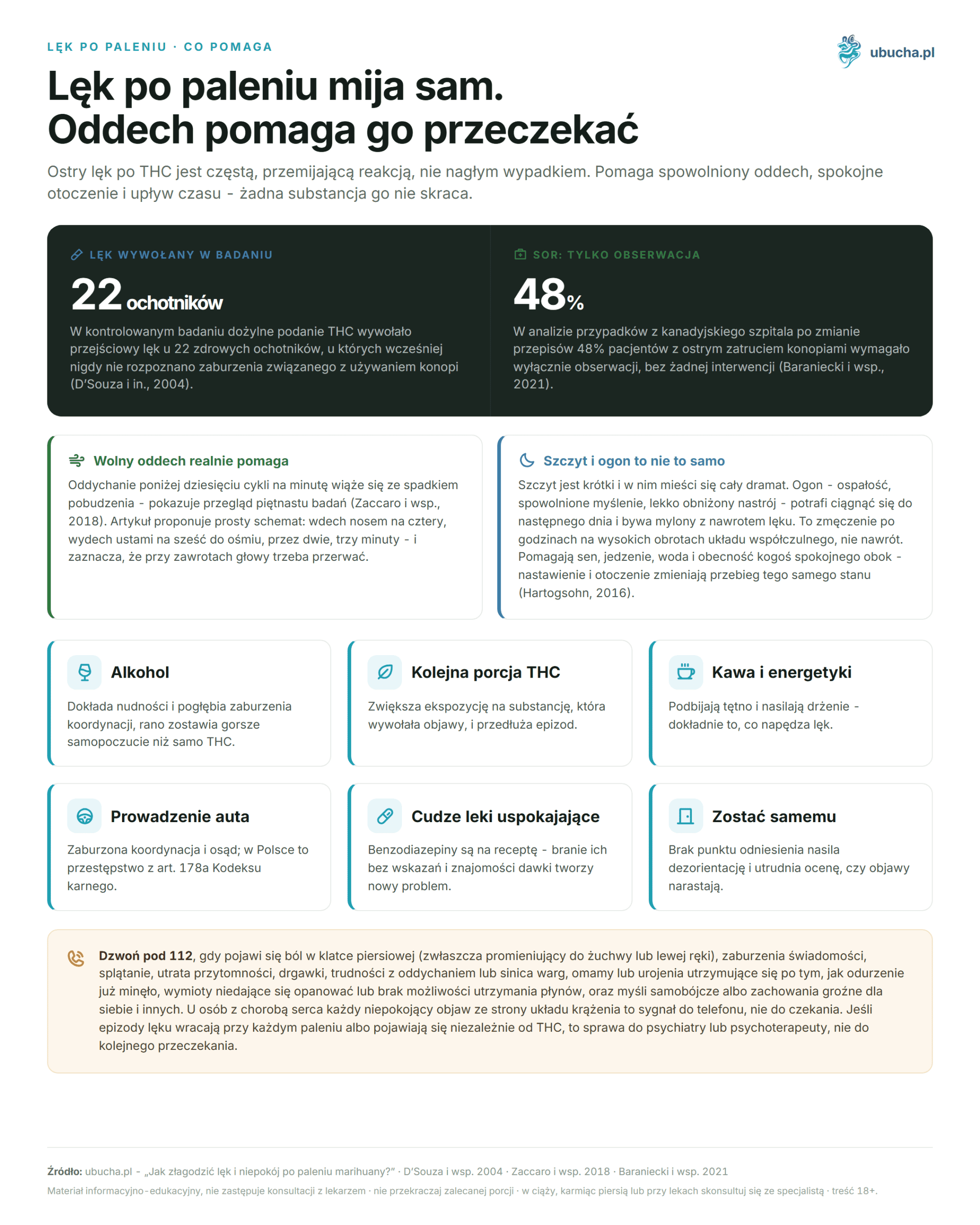
In a controlled study involving 22 healthy volunteers, intravenous THC at doses of 2.5 and 5 mg induced transient anxiety, perceptual disturbances, and symptoms resembling psychosis. These were individuals who had previously used cannabis but had never been diagnosed with a substance use disorder (D’Souza et al., 2004). So if anxiety hits you after smoking, nothing unusual has happened. This text does not explain receptor mechanisms. It shows what to do in the first minutes, what to avoid, which symptoms indicate the need for help, and which popular advice, including CBD, lacks research support. We start with the question that often comes to mind in such moments: how long will it last.
KEY INFORMATION
• Acute anxiety after THC subsides on its own, with the peak effect after inhalation occurring 30-45 minutes after the first puff (Huestis, 2007).
• Time, a quiet environment, water, and the presence of another person help.
• CBD from a bottle is not an immediate remedy: in studies, it was administered before the stressor, never during the attack.
• Chest pain, altered consciousness, uncontrollable vomiting: call 112.
How long does anxiety last after smoking marijuana and does it go away on its own?
Acute anxiety after THC subsides spontaneously. After inhalation, THC concentration in plasma peaks around 9 minutes, and the peak of subjective effects occurs 30-45 minutes after the first puff (Huestis, 2007). After that, the body does its job, and you don’t have to do anything but wait it out.
After consuming a THC product, the picture looks different. Absorption is slower, the concentration in plasma peaks only after 4-6 hours, and the return to baseline is significantly delayed compared to smoking. This is why episodes after eating last longer and often end with a visit to the emergency room: a person does not feel the effect after half an hour, adds a dose, and after two hours gets everything at once.
The practical value of these numbers is that they provide a reference point. When you sit with your heart pounding like a hammer and the certainty that this will never end, the belief in infinity is a symptom of panic, not a description of reality. In D’Souza’s study, symptoms after THC administration were explicitly described as transient, even though they encompassed a wide range: from altered perception, through anxiety, to short-term memory disturbances and increased cortisol levels.
It is worth separating two things: the peak and the tail. The peak is short, and all the drama is contained within it. The tail, which includes drowsiness, slowed thinking, and slightly lowered mood, can drag on until the next day and is often mistaken for a recurrence of anxiety. This is not a recurrence, just fatigue after several hours at high sympathetic nervous system activity. Sleep, food, and water handle the situation better than anything else.
If you want to see the full timeline of THC effects, we described it separately in the post how long the effects of smoking marijuana last. Here, one thing is enough: the clock works in your favor, and there is no way to speed it up with any home tricks.
What to do in the first minutes of acute anxiety after THC?
Sit down, slow your breath, and cut off stimuli. Slow breathing below ten cycles per minute increases heart rate variability and is associated with decreased arousal and improved well-being in healthy individuals, as summarized in a review of fifteen studies (Zaccaro et al., 2018). None of this removes THC from the blood. However, it calms the panic response that overlays the intoxication and accounts for most of the suffering.
The simplest scheme: inhale through your nose counting to four, exhale through your mouth counting to six or eight. A longer exhale than inhale is the whole secret. Do this for two or three minutes, calmly, without forcing. If you feel dizzy, stop and breathe normally. Hyperventilation, or rapid deep breathing, will do exactly the opposite: tingling fingers and dizziness can easily be mistaken for worsening condition.
Position yourself semi-reclined with your back supported, not flat. Sudden standing is out of the question, as THC lowers blood pressure and you may faint. The rest is about reducing stimuli:
- dimming the lights and silencing your phone, notifications heighten alertness
- turning off music with a strong rhythm, leaving silence or something calm
- removing excess clothing, opening a window for a few minutes
- not engaging in social media or content that excites you
- naming out loud five things you see, four you hear, three you touch
The last point is simply redirecting attention from catastrophic scenarios to what is in the room. It does not work like a drug. However, it provides an activity for a minute and interrupts the recurrence of the same thought, which is a lot during panic.
One thing that is easy to forget in such moments: you do not have to fix anything. The reflex says to do something, check your pulse, Google symptoms, call someone to ask if this is normal. Each of these actions feeds alertness, and alertness feeds anxiety. Put your phone out of reach. If you need to count something, count your breaths.
Why does a calm environment and the presence of another person help the most?
Because the experience after a psychoactive substance is shaped not only by pharmacology. Mindset and context, described in literature as set and setting, can change the course of the same pharmacological action, as detailed in a paper published in the Journal of Psychopharmacology (Hartogsohn, 2016). The same dose in a safe room and in a crowd at a concert gives two different evenings.
The presence of another person does not have a randomized study on anxiety after THC behind it, and it is fair to say that directly. However, it has simple logic: someone sitting next to you and being calm relieves you of the need to assess whether you are dying. That assessment is the most burdensome in such a state.
Practically, it looks like this. A familiar place instead of a foreign one. One person instead of a crowd. Short sentences instead of a life conversation, as an overloaded mind cannot keep up with complex syntax, and that in itself can be a source of disorientation. A repeated sentence every few minutes like: you are at home, this is THC action, it will pass.
The place also matters because it removes decisions from you. At home, you do not have to figure out how to get back, where the bathroom is, or what to say to strangers. Each such decision is a burden, and in a state of cognitive overload, even a trivial matter can grow to the size of an unsolvable problem. Familiar four walls solve this for free.
The environment also works the other way around, and this is often underestimated. A mirror, bright light, a TV with fast editing, conversations among several people at once. Each of these stimuli requires processing, and processing is sluggish in this state. The less happening around, the less material the mind receives to build disturbing interpretations.
How to help someone having an anxiety attack after marijuana?
Stay, speak calmly, and do nothing abruptly. Your task is to be a stable point of reference, not a medical rescuer. A person in acute anxiety after THC does not need a diagnosis or a lecture on receptors. They need someone who looks calm and repeats the same short sentence.
Start by naming the situation. Say where you are, what happened, and that the symptoms will pass in a few hours. Repeat this every few minutes, as short-term memory works poorly at that time, and information from two minutes ago may have already faded. Do not raise your voice and do not show impatience, even if you hear the same question for the tenth time.
What to avoid in the role of a companion? Do not convince them that the anxiety is unfounded, as for the other person it is entirely real at that moment, and such a conversation ends with a feeling of loneliness. Do not drive anyone away for a change of scenery. Do not encourage alcohol or another dose. Do not leave them alone in the bathroom if nausea has occurred.
While doing this, observe things that can be observed without medical knowledge: whether they are breathing freely, whether they respond to questions, whether they are maintaining fluids, whether they complain of chest pain. If any of these points starts to fail, call 112 instead of waiting for it to pass. A list of symptoms that necessitate a call is found later in the text.
Finally, a thing that is useful the next day. When it is all over, do not hold anyone accountable for what they said during the episode. People in acute anxiety say things they later regret, and shame is one of the reasons why next time they do not call anyone. A short sentence like: it’s good you said that, takes care of the matter.
Does CBD interrupt acute anxiety after THC?
There is no evidence for this, and the widespread advice diverges from what has actually been studied. The studies in which CBD reduced anxiety administered it orally before the stressor, in doses measured in hundreds of milligrams. In a systematic review of 87 studies, CBD did not affect anxiety in 70.3% of observations, and the authors were unable to formulate dosage recommendations (Kwee et al., 2022).
The dose-dependence is not straightforward. Both studies that examined it directly describe it as an inverted U: an intermediate dose worked, while lower and higher did not.
| Study | Participants and doses administered | Timing of administration | Outcome |
|---|---|---|---|
| Linares et al., 2019 | 57 healthy men; 150, 300, or 600 mg orally, plus a placebo group | before a simulated public speaking event | anxiety weaker only in the 300 mg group |
| Zuardi et al., 2017 | 60 healthy individuals; 100, 300, or 900 mg orally, plus clonazepam 1 mg and placebo | before a public speaking event | anxiety weaker at 300 mg only in the post-speech phase; clonazepam also worked during it and calmed more strongly |
| Englund et al., 2013 | 22 individuals on 600 mg orally versus 26 on placebo | 210 minutes before intravenous THC at a dose of 1.5 mg | less paranoia and less severe psychotic symptoms, but the PANSS result was not statistically significant |
| Bhattacharyya et al., 2010 | 6 volunteers in part with intravenous administration | oral CBD before intravenous THC | prevention of psychotic symptoms in a very small sample |
It is worth seeing how much this is in drops. A 10 ml bottle of 5% oil contains about 500 mg of phytochemicals, so the middle dose from Linares’s study is more than half of such a bottle consumed at once. A few drops under the tongue in the middle of a panic attack correspond to none of these studies either in quantity or timing: everywhere CBD was introduced into the body before the stressor.
The conclusion is simple: if you happen to have oil and want to use it, do not count on anything interrupting. Time and a calm environment do more here than anything from the shelf. The topic of CBD itself in anxiety disorders is discussed more broadly in the post CBD and THC in the treatment of anxiety disorders.
Where is today’s safety ceiling for CBD?
Significantly lower than the doses suggested in anxiety studies. The EFSA panel on nutrition and new foods established a provisional safe dose in 2026 at 0.0275 mg per kilogram of body weight per day, or about 2 mg daily for a person weighing 70 kg (EFSA, 2026). This value was derived using the benchmark dose method with an uncertainty factor of 400.
This is not a recommendation, but a limit that should not be exceeded, and it is subject to several conditions. It applies only to supplements with a purity of cannabidiol of at least 98%, without nanoparticles and with a safe production process. It does not apply to other forms.
However, the most important sentence of this position reads differently: the safety of CBD cannot be established in individuals under 25 years of age, in pregnant and breastfeeding women, and in individuals taking medications simultaneously. The panel lists the reasons for its caution. In animal studies, liver toxicity was repeatedly observed, in humans, hepatotoxic potential was described, especially with the simultaneous use of other medications, and long-term neurodevelopmental effects were noted after prenatal exposure. No one has yet studied immunotoxicity.
For a reader who is currently experiencing an acute reaction after THC, there is one practical conclusion. You are exactly the person EFSA mentions when they say there is no data: you have a psychoactive substance in your body, and possibly also medications. This is not the moment for an experiment with another preparation.
Do home remedies, from black pepper to warm infusions, actually work?
Not in a pharmacological sense. Beta-caryophyllene, a component of black pepper oil, does indeed bind to the CB2 receptor and acts as its agonist (Gertsch et al., 2008). However, no one has checked whether chewing peppercorns shortens anxiety after THC. The distance from the receptor in a test tube to relief in a room is long.
The same goes for terpenes from lavender or citrus peels. The hypothesis of their interaction with cannabinoids, known as the entourage effect, has been described as a research proposal requiring verification, not an established fact (Russo, 2011). The author concludes this work with a proposal for methods that could investigate such synergy in the future, and this best illustrates the stage of knowledge on this topic.
What really helps is banal and therefore easy to overlook. THC causes dry mouth, and dehydration plus sudden standing leads to dizziness and palpitations, which are sensations that panic immediately interprets as evidence of danger. A glass of water sipped slowly interrupts this feedback loop. Something light to eat works similarly, especially if it has been half a day since the last meal.
A warm infusion of mint or lemon balm has the status of a ritual rather than a drug. Holding a cup in your hands, warmth, and the necessity of slow sipping organize the next ten minutes by themselves. Similarly, a lukewarm, not hot shower. Let’s call things by their names: these are ways to wait it out, not medical interventions.
You will not find a table of supplement doses here, although similar guides regularly include one. Magnesium, L-theanine, or standardized extracts of lavender are studied in anxiety disorders, but not in acute reactions after THC, and taking anything in the middle of a panic attack adds just one variable to a situation that is already hard to navigate. Save experiments for a calmer day and preferably discuss them with a pharmacist.
The question remains, why do anything at all since nothing shortens the action of THC. The practical answer is: the ritual occupies hands and attention. A person who brews tea and drinks it in small sips stops scanning their body for evidence of disaster during that time. This is a real benefit, just of a different kind than pharmacological action.
What not to do when anxiety hits you after marijuana?
Most mistakes made in such moments boil down to attempts to speed up something that cannot be sped up. No home substance removes THC from the body faster, and some of them add symptoms that panic interprets as worsening. The table below collects these situations together.
| What to avoid | Why |
|---|---|
| Alcohol | Adds nausea and worsens coordination disorders, and in the morning leaves worse well-being than THC itself |
| Another dose of THC | Increases exposure to the substance that caused the symptoms and prolongs the episode |
| Coffee and energy drinks | Increase heart rate and intensify tremors, which are exactly the sensations that drive anxiety |
| Driving a vehicle | Motor coordination disorders and altered judgment are among the acute effects of cannabis (Volkow et al., 2014), and driving under the influence of a narcotic is a crime in Poland under Article 178a § 1 of the Penal Code |
| Other people’s sedatives | Benzodiazepines are prescription medications, and taking them without indications and without knowing the dose creates a new problem |
| Being alone in a foreign place | Lack of a reference point increases disorientation and makes it difficult to assess whether symptoms are worsening |
A separate note about alcohol, as it is the most common association. Mixing both substances is not a neutral experiment, and the mechanisms of this interaction are described in the text about mixing alcohol and marijuana. In acute anxiety, there is one more thing: vomiting in a state of confusion is a real risk of choking.
To the list, add two more things that seem innocent. A hot bath with dizziness and low blood pressure increases the chance of fainting in the tub, so if you do, take a lukewarm shower and preferably with someone in the apartment. The second point is going out alone to the street for fresh air. An open window provides the same air without street movement, strangers, and the risk of losing orientation two blocks from home.
There is also a purely cognitive error that prolongs every such episode: checking symptoms in a search engine. The results suggest the worst scenarios, panic interprets them as confirmation, heart rate rises, and the cycle closes. If you really need a medical assessment, call 112 or the night medical assistance instead of reading forums.
When does anxiety after marijuana require calling an ambulance?
Call 112 if you experience chest pain, altered consciousness, seizures, difficulty breathing, or psychotic symptoms persisting after intoxication has subsided. A separate situation is uncontrollable vomiting. These are moments when you do not diagnose yourself and do not wait for it to pass.
- chest pain, especially radiating to the jaw or left arm
- altered consciousness, confusion, loss of consciousness, seizures
- difficulty breathing, cyanosis of the lips
- hallucinations or delusions persisting after intoxication has already subsided
- uncontrollable vomiting, inability to maintain fluids
- suicidal thoughts or behaviors dangerous to oneself and others
- in individuals with heart disease, any alarming symptom from the circulatory system
Persistent vomiting after cannabis is called cannabinoid hyperemesis syndrome. In a systematic review, cyclic nausea and vomiting occurred in 100% of described individuals, with at least weekly cannabis use in 97.4%, compulsive hot baths providing relief in 92.3%, and symptoms subsiding after cessation in 96.8% of patients (Sorensen et al., 2017). Dehydration with such vomiting can be serious and requires hospital treatment.
It is also worth noting the psychotic symptoms. As long as intoxication lasts, perceptual distortions and suspicion fit within the picture of acute THC action. A warning signal is a situation where delusions or hallucinations continue even after the rest of the effects have subsided, or when a person stops recognizing their surroundings and loved ones. This requires psychiatric evaluation, not another hour in a dark room.
Fear of legal consequences cannot be a reason not to call. Medical personnel are bound by medical confidentiality, and tell the rescuers directly what and when was consumed, as this determines the course of action. It is also worth knowing what such a visit usually looks like: in a case analysis from a Canadian hospital after the change in regulations, 48% of patients with acute cannabis intoxication required only observation, without any intervention (Baraniecki et al., 2021).
Is there an antidote that reverses the effects of THC?
There is no antidote available in pharmacies or ambulances. A systematic review of pharmacological interventions for acute cannabis intoxication described the available data as sparse, and the two indicated as best documented, propranolol and rimonabant, come from research conditions and do not constitute emergency practice (Crippa et al., 2012).
In hospital practice, symptomatic treatment is used. In the previously cited analysis from Canada, the percentage of patients who were given a benzodiazepine increased from 24% to 51% after the change in regulations, while the number of laboratory and imaging tests decreased. These are prescription medications, administered under supervision, not something taken on your own from a friend.
We noticed while organizing this text how easily such a topic becomes cluttered with other numbers. Each reference in the current version underwent separate verification in Europe PMC: the title of the work, the first author’s name, the year, and the values given in the abstract. Where numbers were not in the abstract, we reached for the full text, and when it was not there either, the entire sentence disappeared along with the citation.
Similarly, various home antidotes circulating on the internet should be treated: sour drinks, activated charcoal, cold showers, intense exercise. None of them have documented effects on the course of an acute reaction, and some even harm, as physical exertion during tachycardia is the last thing someone convinced they are having a heart attack needs.
The practical conclusion is uncomfortable but honest. There is nothing that shortens the action of THC. However, there are many things that help survive those few hours as calmly as possible, and all have been described above. The rest is marketing. It is worth knowing this before someone sells you a rescue in a bottle at a price that suggests effectiveness.
How to reduce the risk of anxiety with the next contact with THC?
Start by acknowledging that the material available today is not like what it was years ago. An analysis of 38,681 samples seized in the United States showed an increase in THC content from about 4% in 1995 to about 12% in 2014, alongside a decrease in CBD content and a change in the ratio of both substances from fourteenfold to about eightyfold (ElSohly et al., 2016).
The same team in a newer study covering the years 2013-2022 found that in most tested samples, THC content exceeds 10%, regardless of the region of origin (ElSohly et al., 2024). A person returning to smoking after years of abstinence is therefore getting something completely different than they remember, and the belief that they know how much they can handle is one of the most common causes of acute reactions.
The second factor is context. Since mindset and environment change the course of the experience (Hartogsohn, 2016), a bad day, lack of sleep, or unfamiliar company are real risk factors, not excuses. If after the last time it ended with a panic attack, the probability of a repeat is high, and that is a signal for a conversation with a doctor, not for looking for a better breathing technique.
It is also worth knowing the long-term perspective. A review in the New England Journal of Medicine states that addiction develops in about 9% of people who have tried cannabis, in about one in six people starting in their teenage years, and in 25-50% of daily users (Volkow et al., 2014). We described how a break looks and what happens after cessation in the post about withdrawal syndrome after cannabis.
You will not find recommended milligrams in this text, as such advice cannot be given honestly. Material purchased outside of pharmacy circulation has not been tested for active substance content, so any number would be guesswork. Moreover, in Poland, we are talking about an illegal substance, and the only legal variant is a pharmacy product, where the dosage is determined by the prescribing doctor based on the prescription.
Where to seek help in Poland after acute anxiety from THC?
In a life-threatening situation, call 112, 24/7. For psychological support or a conversation about substance use, free national helplines operate, and mental health clinics funded by the NFZ accept adults without a referral.
| Number | Who answers | Availability |
|---|---|---|
| 112 | Emergency number, life and health threat | 24/7 |
| 800 70 2222 | Support Center for adults in psychological crisis, ITAKA Foundation | free, 24/7 |
| 116 123 | National Telephone Counseling for Individuals Experiencing Emotional Crisis | 24/7 |
| 116 111 | Helpline for children and youth, Foundation We Give Children Strength | daily, 24/7 |
| 800 199 990 | National Addiction Helpline, KCPU | daily 16:00-21:00 |
It is worth knowing the legal status so that fear of it does not block decisions. According to the Act on Counteracting Drug Addiction (consolidated text Journal of Laws 2023 item 1939), possession of THC-containing cannabis is punishable under Article 62, while Article 62a provides for the discontinuation of proceedings for a small amount for personal use. Industrial hemp remains legal, but the threshold concerns the plant, not the product, and counts as the sum of delta-9-THC and tetrahydrocannabinolic acid, which does not exceed 0.3% when calculated on a dry mass and is rounded to one decimal place. The basis is Article 4 point 5 of this act as amended by the act of March 24, 2022 (Journal of Laws 2022 item 763), effective from May 7, 2022. Medical marijuana is available only from a pharmacy, on a prescription Rpw.
Calling an ambulance due to an acute reaction to a substance is not a report to the police. The rescuer needs information on what was consumed to know what to look for and what not to do. If anxiety episodes return with every contact with THC or occur independently of it, make an appointment with a psychiatrist or psychotherapist. This is not a matter to wait out.
To see a psychiatrist under the NFZ, an adult can make an appointment without a referral; just go to a mental health clinic. Psychotherapy usually requires a referral from a doctor, but the initial consultation can be scheduled immediately. If the queues in your area are long, the support lines from the table above are free and anonymous, and a conversation with a consultant can be the first step in determining what you are actually looking for.
Frequently Asked Questions
How long does anxiety last after smoking marijuana?
After inhalation, THC concentration in plasma peaks around 9 minutes, and the peak of subjective effects occurs 30-45 minutes after the first puff (Huestis, 2007). Symptoms diminish over the next hours. After consuming a THC product, the concentration peaks only 4-6 hours after ingestion, so the episode lasts longer.
Does CBD interrupt an anxiety attack after THC?
There is no evidence for this. In studies where CBD reduced anxiety, it was administered orally before the stressor, not during the attack, and only part of the group benefited. In a review of 87 studies, CBD did not affect anxiety in 70.3% of observations (Kwee et al., 2022). A dose from a bottle of oil corresponds to nothing that has been studied.
Will alcohol or coffee help sober up after THC?
No. Caffeine increases heart rate and intensifies tremors, which are exactly the sensations that drive panic. Alcohol adds nausea and worsens coordination disorders. None of these substances speeds up the elimination of THC from the body. Only water, a calm environment, and time remain.
When to call 112 after marijuana?
Call 112 if you experience chest pain, altered consciousness, seizures, difficulty breathing, uncontrollable vomiting, or psychotic symptoms persisting after intoxication. Medical personnel are bound by medical confidentiality, so tell them directly what was consumed.
Will adding THC help calm down?
No. Another dose increases exposure to the substance that caused the symptoms and prolongs the episode. In a controlled study involving 22 healthy individuals, intravenous THC increased anxiety and altered perception (D’Souza et al., 2004). The only thing that shortens this state is the passage of time.
What are persistent vomiting after cannabis?
This is a possible presentation of cannabinoid hyperemesis syndrome. In a systematic review, cyclic nausea and vomiting occurred in 100% of described individuals, with at least weekly cannabis use in 97.4%, and symptoms subsided after cessation in 96.8% (Sorensen et al., 2017). Uncontrollable vomiting requires contact with a doctor.
Can I drive after the anxiety subsides?
Do not get behind the wheel the same day. A review in the New England Journal of Medicine lists motor coordination disorders and altered judgment among the acute effects of cannabis (Volkow et al., 2014). In Poland, driving under the influence of a narcotic is a crime under Article 178a § 1 of the Penal Code.
When the worst is over and you are looking for something warm for the evening, in the category teas and infusions you will find blends with mint and lemon balm. Treat them as part of calming the evening, not as a remedy for anxiety.
This article is for informational and educational purposes and does not constitute medical advice. Before starting to use cannabis or CBD for therapeutic purposes, consult a doctor, especially if you are taking other medications, are pregnant, or breastfeeding.
Author: Michał Waluk · Published: 2026-05-11 · Updated: 2026-08-11