
Which Supplements Are Really Not Worth the Money: Ranking by Evidence Strength
Detox, green coffee, CLA, echinacea, glucosamine, and multivitamins under scrutiny. We check in original studies which supplements are really not worth the money.
75 percent of Poles buy dietary supplements, and the average consumer spends over 200 PLN per year on them (Rynek Zdrowia, 2025). Forecasts predict exceeding 10 billion PLN by 2028. The supplement manufacturer does not have to prove that the product works. A notification submitted to the Chief Sanitary Inspector is sufficient. This compilation is not a list of bad companies or a call to stop taking everything. It is a review of substances where the gap between the marketing budget and the evidence base is the largest. We checked each item in original publications, not in manufacturers’ summaries. You will learn where evidence is simply lacking, where it is weak, and where large studies directly showed a lack of effect.
KEY INFORMATION
• 75 percent of Poles buy supplements, over 200 PLN per year per person (Rynek Zdrowia, 2025).
• The manufacturer demonstrates safety, not efficacy: a notification to the GIS is sufficient (NIK, 2017).
• The compilation is based on Cochrane reviews, large randomized studies, and the USPSTF position.
• Lack of evidence of effectiveness and evidence of lack of effect are two different things, separated here for each item.
How do we assess the strength of evidence in this compilation?
The position on the list is determined by the highest available level of evidence for a specific indication. A meta-analysis of randomized studies weighs the most, a single randomized study less, observational data even less, and results from test tubes or rodents alone are not sufficient. The second question is: who funded the study.
| Criterion | Weight | What we check |
|---|---|---|
| Quality of the highest available evidence | 40% | Meta-analysis of randomized studies is higher than a single RCT, observational data lower, in vitro studies the lowest |
| Size of clinical effect | 30% | Whether the difference from placebo is meaningful for the patient, not just for the statistical test |
| Consistency of results between studies | 20% | Whether independent research teams replicated the same result |
| Independence of funding | 10% | Whether the study was funded by the manufacturer or a public institution |
One distinction runs throughout the text. Lack of evidence of effectiveness means that no one has properly checked, not that it was checked and came out zero. Evidence of lack of effect is the opposite situation: a large, well-designed study compared the preparation with placebo and found no difference. The first situation may change after further studies. The second changes rarely.
Which supplements have the weakest evidence?
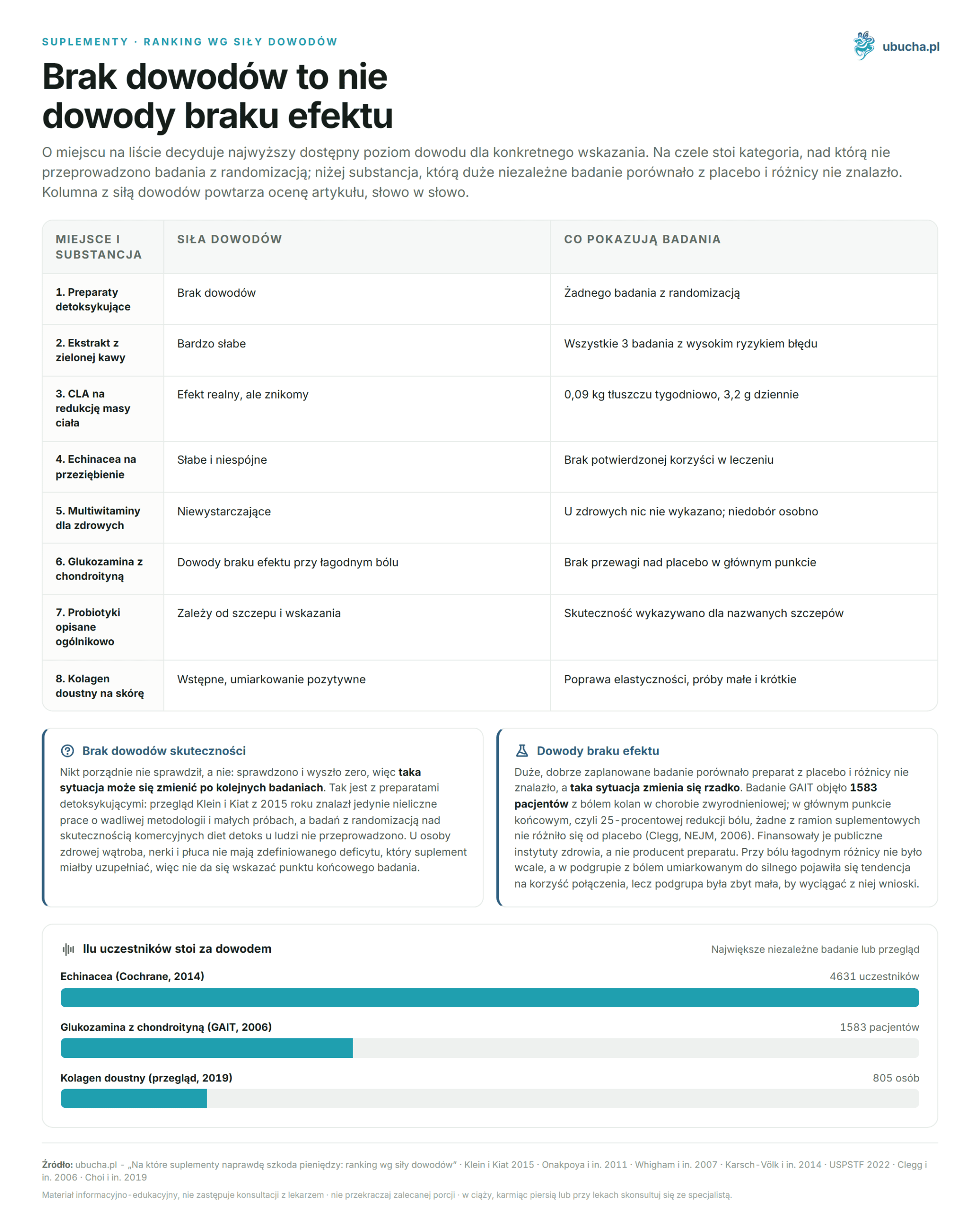
The weakest base is the entire category of detoxifying preparations, as there is not a single randomized study behind it. Closely following are two weight loss preparations: green coffee extract and CLA. The middle of the list is occupied by popular substances, but inconsistently studied, from echinacea to probiotics described in general terms.
| Place | Substance | Marketing promise | What studies show | Strength of evidence |
|---|---|---|---|---|
| 1 | Detoxifying preparations | Remove toxins, cleanse the liver | No randomized study has been conducted on commercial detox programs (Klein and Kiat, 2015) | Lack of evidence |
| 2 | Green coffee extract | Accelerates fat burning | Meta-analysis included 3 studies, all with high risk of error; one was later retracted (Onakpoya et al., 2011) | Very weak |
| 3 | CLA for weight loss | Burns fat, protects muscles | Meta-analysis: 0.09 kg of body fat per week at a dose of 3.2 g per day (Whigham et al., 2007) | Real effect, but negligible |
| 4 | Echinacea for colds | Shortens colds and prevents them | Cochrane, 24 studies, 4631 participants: no confirmed benefit in treatment (Karsch-Völk et al., 2014) | Weak and inconsistent |
| 5 | Multivitamins for healthy adults | Protect against heart disease and cancer | USPSTF 2022: insufficient evidence; beta-carotene and vitamin E advised against for this indication | Insufficient |
| 6 | Glucosamine with chondroitin | Rebuilds cartilage, alleviates knee pain | Study on 1583 patients: no advantage over placebo in the main endpoint (Clegg et al., 2006) | Evidence of lack of effect for mild pain |
| 7 | Probiotics without strain indication | Strengthen immunity, regulate flora | Effectiveness was demonstrated for named strains with named indications, not for products described in general terms | Depends on strain and indication |
| 8 | Oral collagen for skin | Smooths wrinkles in a few weeks | 11 studies, 805 people: improved skin elasticity, but trials were small and short (Choi et al., 2019) | Preliminary, moderately positive |
The last item is a borderline case and is intentionally at the end. Collagen made the list not because studies showed a lack of effect, but because the evidence base is much more modest than the shelf price and the way these preparations are advertised suggest. This is a difference worth remembering before reading the next sections.
Why is detox a marketing concept, not a physiological one?
Because there is not a single randomized study of a commercial detox program in the clinical literature. The review by Klein and Kiat in 2015 found only a few studies with flawed methodology and small samples, and the authors stated directly that no randomized studies on the effectiveness of commercial detox diets in humans have been conducted (Klein and Kiat, Journal of Human Nutrition and Dietetics, 2015).
Physiology explains why there is nothing to measure in such studies. The liver processes xenobiotics continuously through phase I and II metabolic reactions. The kidneys filter blood and remove metabolic waste products. The lungs excrete carbon dioxide. In a healthy person, these organs do not have a defined deficit that a supplement would need to fill, so it is impossible to identify an endpoint for the study. The manufacturer does not declare how much the concentration of something will drop, as no such quantity is provided.
We noticed that the word detox functions in two completely different worlds, and that is the source of all misunderstanding. In clinical medicine, detoxification means treating poisoning with a specific substance, conducted in a hospital, often using an antidote, with measurable blood concentration. In supplement marketing, detox is a metaphor for cleansing without a defined mechanism and without an endpoint. Two different concepts sound the same, and one borrows credibility from the other.
What do studies really show about oral collagen?
A systematic review from 2019 included 11 randomized studies and 805 participants. The authors considered the results to be preliminarily promising: collagen peptides improved skin elasticity and hydration, with no reported adverse effects (Choi et al., Journal of Drugs in Dermatology, 2019). The caveat concerns the scale, not the direction of the effect.
This is well illustrated by a study cited in the review. Proksch and colleagues administered 2.5 g or 5 g of collagen hydrolysate daily for 8 weeks to 69 women aged 35-55. Skin elasticity improved significantly in both groups compared to placebo, while hydration and transepidermal water loss did not reach significance (Proksch et al., Skin Pharmacology and Physiology, 2014). This is a well-conducted study, but very small and very short for the promise of reversing the skin aging process.
We noticed that questions about collagen most often come from people expecting visible change within a month. The honest answer is yes: with such a horizon, you will likely be disappointed, as the studies cited above lasted 8 weeks and measured elasticity with equipment, not appearance in the mirror. If you treat supplementation as part of a longer plan, alongside sun protection, the data looks more reasonable. However, the price of a serving can often be many times higher than the cost of a good UV filter.
Why did glucosamine with chondroitin not perform better than placebo?
The GAIT study included 1583 patients with knee pain due to osteoarthritis and compared five arms: glucosamine, chondroitin sulfate, both substances together, celecoxib, and placebo. In the main endpoint, which was a 25% reduction in pain, none of the supplement arms differed from placebo (Clegg et al., NEJM, 2006).
The weight of this result comes from the design of the study. It was funded by public health institutes, not the manufacturer of the preparation, the sample was large, and the blinding was complete. In the subgroup of patients with moderate to severe pain, there was a trend in favor of the combination of both substances, but the subgroup was too small to draw conclusions. With mild pain, there was no difference at all. This is a rare situation where we talk about evidence of lack of effect, not lack of evidence.
Do multivitamins for healthy adults make sense?
The US Preventive Services Task Force concluded in 2022 that the evidence for multivitamins in the prevention of cardiovascular disease and cancer is insufficient, assigning them a grade of I. The same document advises against beta-carotene and vitamin E for the same indication, with a grade of D, meaning a recommendation against use (USPSTF, JAMA, 2022).
These two assessments mean different things, and confusing them is a common mistake. Insufficient evidence is information about the state of knowledge, not about harm: at typical doses, multivitamins remain safe, just not shown to provide any benefit to a healthy person on a varied diet. A grade of D for beta-carotene is stronger because it is based on studies where the risk in the supplemented group was found to be higher. A completely separate issue is targeted supplementation: confirmed laboratory deficiency of a specific vitamin or limited absorption in older adults. There we are no longer talking about prevention in a healthy population, but about supplementing a measured deficiency, and that is a different question and different evidence. The practical conclusion is simple: before you buy a multivitamin, check your blood count and vitamin D levels, as the test result will tell you more than the declaration on the package.
What do reviews say about echinacea and green coffee extract?
A Cochrane review from 2014 included 24 studies with double-blind trials and 4631 participants. None of the 12 preventive comparisons showed a statistically significant difference in the number of people who had at least one cold, and among the seven therapeutic studies, one showed a reduction in symptoms (Karsch-Völk et al., Cochrane Database of Systematic Reviews, 2014). The authors did not rule out a weak benefit from some preparations, but did not confirm benefits in treatment. A separate problem is the lack of standardization: preparations differ in plant species, the part used, and form, so the results of one study do not automatically transfer to a product from the shelf.
Green coffee extract has an even narrower basis. A meta-analysis from 2011 gathered three studies and calculated an average weight difference of 2.47 kg in favor of the extract, while all three were rated as having a high risk of error, and the authors’ conclusion was: rigorous studies are needed (Onakpoya et al., Gastroenterology Research and Practice, 2011). One of these studies, a notorious crossover experiment from 2012, was later retracted from the literature.
We noticed a recurring pattern that connects most items on this list. A small study with a positive result makes its way into the media as a breakthrough, manufacturers cite it for years, and subsequent, better-designed studies either do not confirm the effect or scale it down significantly. Corrections never reach as far as the initial publication. Therefore, when checking substances, it makes more sense to look at a systematic review than at a single study that happened to come out favorably.
How to buy supplements to avoid wasting money?
Start with the indication, not the product name. A product described as strengthening or cleansing has no indication, so it cannot be checked for effectiveness. Then check if the effect was demonstrated in humans, in what sample size, and who funded the study. Studies funded by the manufacturer more often end with a favorable result for the sponsor (Lexchin et al., BMJ, 2003).
It is also worth knowing what the label cannot promise. Regulation 1924/2006 allows only health claims that have been previously approved and entered into the EU register (EUR-Lex, regulation 1924/2006). The rest of the message, i.e., the trade name, graphics, and description on the store page, is subject to looser rules. Additionally, there is control of the market entry itself: the Supreme Audit Office found that in about half of the 6,000 notifications from 2014-2016, the verification process was not even started (NIK, 2017).
This text does not avoid the assortment of our own store. Collagen, glucosamine with chondroitin, probiotics, and preparations with detox in the name are sold by us and still stand on the above list, because the position is determined by the strength of evidence, not the contents of the warehouse. We believe that the reader has the right to know where the evidence is strong and where it is lacking, even if it concerns the shelf from which we sell.
Frequently Asked Questions
How to check if a supplement has scientific evidence?
Start with PubMed and Cochrane Library databases. Look for meta-analyses and systematic reviews for a specific substance and specific indication, not for a general term like immune enhancement. Check if the effect was demonstrated in humans in a randomized and blinded study, in what sample size, and who funded it.
Are natural supplements always safe?
No. Natural origin says nothing about safety. St. John’s Wort weakens the effect of many medications, including cyclosporine, contraceptive pills, and some drugs used in HIV infection (NCCIH, NIH). A supplement marketed in Poland must meet food law requirements, not pharmaceutical ones.
Which supplements have the strongest evidence?
The best results are for preparations with a narrow, measurable indication: vitamin D with confirmed laboratory deficiency, omega-3 fatty acids with elevated triglycerides, creatine for muscle strength, melatonin for circadian rhythm disorders. The common feature is one specific endpoint that can be measured, not general enhancement of the body.
Does oral collagen actually work?
A review of 11 randomized studies involving 805 people found the results to be preliminarily promising: collagen peptides improved skin elasticity and hydration, with no reported adverse effects (Choi et al., 2019). The caveat concerns the scale, as the trials were small, short, and conducted at various doses.
Is it worth taking supplements preventively?
It depends on the substance and what is to be prevented. The USPSTF concluded in 2022 that the evidence for multivitamins in the prevention of heart disease and cancer is insufficient, and advised against beta-carotene and vitamin E for this indication (USPSTF, 2022). Supplementation with confirmed deficiency is a completely different situation.
Why are supplements without evidence legal?
Because they are subject to food law, not pharmaceutical law. The manufacturer reports the product to the Chief Sanitary Inspector and demonstrates safety, not efficacy. The Supreme Audit Office found that in about half of the 6,000 notifications from 2014-2016, verification was not even started (NIK, 2017). Only health claims on the label require approval.
Does echinacea have confirmed effects?
A Cochrane review from 2014 included 24 studies with double-blind trials and 4631 participants. None of the 12 preventive comparisons showed a statistically significant difference in the number of people with at least one cold, and among the seven therapeutic studies, one showed an effect (Karsch-Völk et al., 2014).
If you want to compare compositions and indications on your own, browse the supplements category in the Bucha store, where vitamins and herbal preparations are also available, and check for each of them whether a measurable effect can be indicated as stated on the label.
This article is for informational and educational purposes and does not replace consultation with a doctor. If you are pregnant, breastfeeding, taking medications, or have chronic conditions, consult the use of supplements or herbs with a specialist.
Author: Michał Waluk · Published: 2026-07-31 · Updated: 2026-08-08