
Cocoa with Adaptogens: What Daily Drinking of Functional Cocoa Provides
Functional cocoa with reishi, ashwagandha, maca, and chaga. What clinical studies have shown, how such a drink tastes, and how to make it at home without guessing.
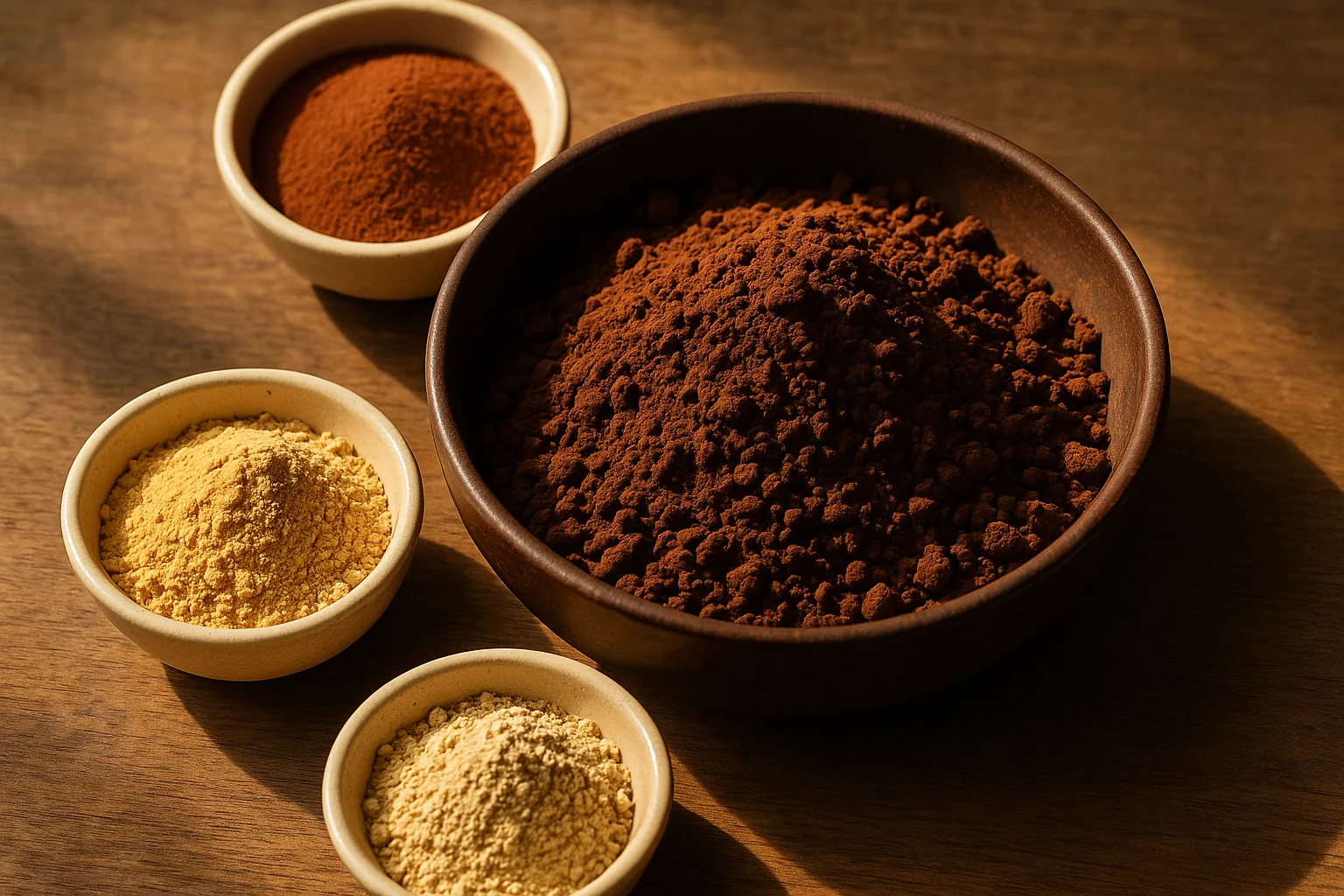
Functional cocoa is regular cocoa powder enriched with adaptogens or powdered mushrooms: reishi, ashwagandha, maca, or chaga. It works through cocoa flavanols, which dilate blood vessels, and through theobromine, which is milder than caffeine, and today only the first of these ingredients has a measurable health effect: a slight decrease in blood pressure. The idea is as old as the ritual drinks of the Mayans, but the promises on the labels are new and usually go further than the research. This text separates one from the other. We checked what has really been measured in the studies that such products refer to: how many people participated in the studies, how long they lasted, and what the outcomes were. You will also find a description of the taste of each of the four additions, a recipe for a homemade version of the drink, and a list of situations in which such a cup makes sense, as well as those in which it does not.
KEY INFORMATION
• Cocoa flavanols lower systolic blood pressure by an average of 1.76 mmHg, according to a review of 35 trials with 1804 participants (Ried et al., Cochrane, 2017).
• Ashwagandha lowered cortisol by 27.9% compared to 7.9% on placebo in 64 individuals under chronic stress (Chandrasekhar et al., 2012).
• Theobromine has a half-life of 7.2 hours compared to 4.1 hours for caffeine (Lelo et al., British Journal of Clinical Pharmacology, 1986).
• Reishi at a dose of 1.5 g daily for 4 weeks did not affect coagulation in healthy volunteers (Kwok et al., 2005).
What is functional cocoa and how does it differ from regular cocoa?
Functional cocoa is natural cocoa powder without sugar, enriched with an adaptogen or mushroom extract. The difference from instant cocoa is primarily in the ingredients: in the instant version, sugar is often the first ingredient, while cocoa appears in fourth or fifth place on the list.
The second difference concerns the raw material itself. Raw cocoa, dried at low temperatures, retains more flavanols than cocoa powder processed by the Dutch method, as alkalization reduces their content. This ingredient is responsible for most of the cardiovascular effects described below, so a label stating “alkalized cocoa” says something significant about the product.
The third difference is commercial and the hardest to verify in the store. Manufacturers rarely state how much extract is in a serving and from which part of the mushroom it was obtained. Extracts from the fruiting body and powder from the mycelium substrate are two different raw materials with different polysaccharide content, and both may be named the same on the packaging. If the manufacturer does not provide either the amount of extract or its origin, you have no way to relate the product to any study. We break down the comparison of cocoa and coffee with mushroom additions in a separate post about whether functional mushrooms in cocoa and coffee really work.
How does functional cocoa work and what does it help with?
Through three different ingredients, of which only one has strong data in humans. Cocoa flavanols stimulate the production of nitric oxide and dilate blood vessels, theobromine stimulates less than caffeine but stays in the body longer, and the adaptogen or mushroom extract brings mechanisms measured in trials where it was administered separately, outside of cocoa.
| Ingredient | How it works | What data exists in humans |
|---|---|---|
| Cocoa flavanols | stimulate the production of nitric oxide, which dilates blood vessels | blood pressure: 35 trials and 1804 participants (Ried 2017) |
| Theobromine | methylxanthine with a half-life of 7.2 hours | metabolism itself, measured in six men (Lelo 1986) |
| Adaptogen or mushroom extract | depending on the raw material: cortisol, NK cells, reported desire | trials with capsules or extracts, never with cocoa |
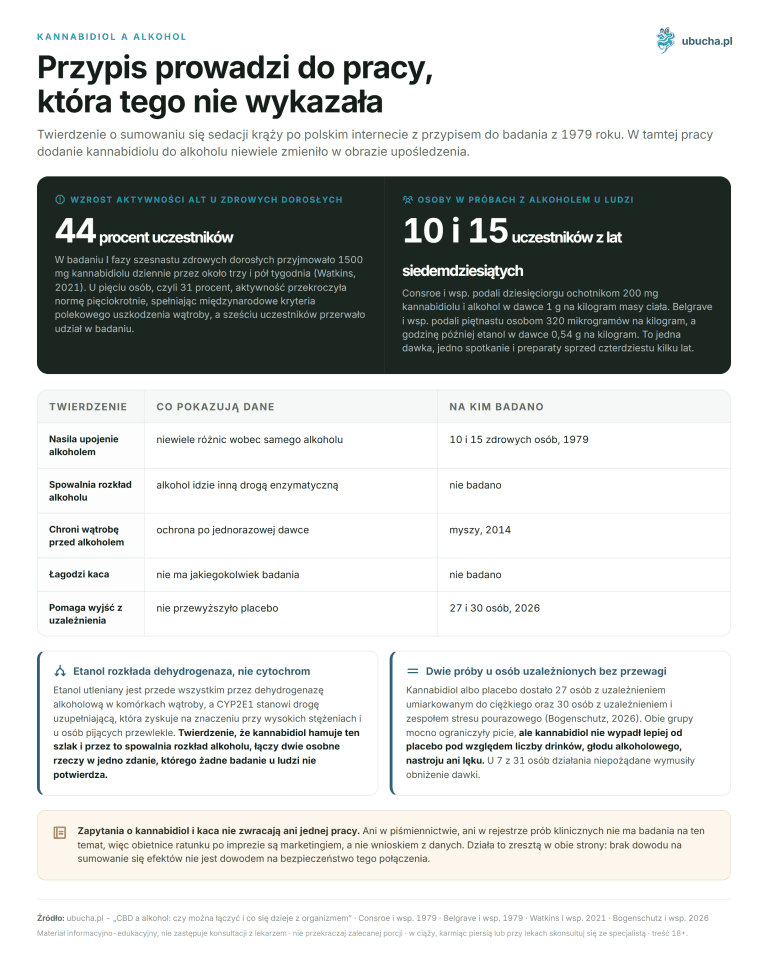
What it measurably helps with: blood pressure, mainly in people who have it elevated. In the Cochrane review, the decrease in systolic blood pressure was about 4 mmHg in those with hypertension, while there was no difference in people with normal blood pressure. The effect requires regular consumption, not just one cup.
The rest of the promises on the label, such as calmness, immunity, and better sleep, are based on trials with capsules. The amount of extract in a serving is usually not stated, and the doses from the cited studies can be an order of magnitude larger than a teaspoon of powder. We separately broke down one clinical trial on cocoa flavanols and cognitive functions in seniors.
Which adaptogens are studied in combination with cocoa?
None of them have been studied in cocoa. All data comes from trials where the adaptogen was administered separately, in a capsule or extract, and usually in amounts greater than a teaspoon of powder in a drink. The table compares the four most frequently cited studies along with what makes them verifiable.
| Raw Material | Study | Who, how many, and for how long | What was measured |
|---|---|---|---|
| Reishi | Gao 2003, Immunological Investigations | 34 patients with advanced cancer, 1800 mg three times daily for 12 weeks, without a control group | NK cell activity increased from 26.6% to 34.5%, higher concentrations of interleukin 2 and interferon gamma |
| Reishi | Kwok 2005, Anesthesia and Analgesia | 20 healthy volunteers and 20 on placebo, 1.5 g daily for 4 weeks | no difference in coagulation parameters, all results within normal range |
| Ashwagandha | Chandrasekhar 2012, Indian Journal of Psychological Medicine | 64 individuals under chronic stress, 300 mg twice daily for 60 days, with placebo | serum cortisol dropped by 27.9% compared to 7.9% on placebo |
| Maca | Gonzales 2002, Andrologia | men aged 21-56, 12 weeks, with placebo | increase in reported desire from the eighth week, with no change in testosterone and estradiol |
Two notes you won’t see in advertisements. The extract used in the study by Chandrasekhar et al. is KSM-66, provided by the product manufacturer, Ixoreal Biomed, and standardized to at least 5% withanolides by HPLC. The result remains valid, but the reader has the right to know this. The study by Gao et al. had no control group and involved cancer patients, so it says nothing about the immunity of a healthy person drinking cocoa. Chaga is the least studied of this quartet in humans, and we did not find a placebo trial that could be fairly compared here. More about reishi itself can be found in our post about the properties of the immortal mushroom.
How does cocoa with adaptogens taste?
The base is bitter chocolate flavor, more intense with raw cocoa, milder with alkalized. On top of that, there is a note from the addition, and each of the four behaves differently and requires a different flavor adjustment.
Reishi brings a distinct herbal bitterness, somewhere between an herbal infusion and forest mushrooms. It can be surprising with the first cup, but after a few servings, it becomes less bothersome. Ashwagandha gives a warm, spicy bitterness that pairs well with cinnamon and vanilla. Maca tastes like a sweet nut with a hint of carob and is the only one of the four that improves the taste of cocoa rather than masking it. Chaga is the most neutral: in a small portion, it is almost imperceptible, while in a larger one, it brings a delicate earthiness.
We noticed in the kitchen that the final effect is determined by the temperature of the milk, not the addition itself. Milk heated to the point where it starts to steam but is not boiling provides the smoothest base. Boiling it extracts bitterness from both the cocoa and the adaptogen, making the drink astringent. This is an observation from our kitchen, not a research result, and should be read as such.
How to make cocoa with adaptogens at home?
You need a pot or a milk frother and five minutes. The base is 200-250 ml of cow’s or plant-based milk, 1-2 tablespoons of natural cocoa without sugar, a pinch of cinnamon, and a pinch of sea salt to enhance the chocolate flavor. Measure the adaptogen according to the serving size on the packaging, as extracts can vary significantly, and one teaspoon does not mean the same in two jars.
The order of steps is practically significant. Heat the milk until it starts to steam. Pour cocoa and adaptogen into a dry cup, add half of the milk, and mix into a smooth paste, then add the rest. The reverse order leaves lumps that no frother can break down. If you don’t have a frother, close everything in a thermos and shake for half a minute.
The evening and morning versions differ in the addition, not the technique. For the evening, reishi with cinnamon is suitable, while for the morning, maca, which brings sweetness. Oat milk provides the creamiest consistency, while almond milk is thinner and more distinctly nutty. Ready functional cocoa with adaptogens is available at Bucha in the cocoa category.
Does cocoa really lower blood pressure?
A little, measurably, and less than most headlines claim. The current Cochrane review by Ried et al. (2017) covered 35 trials and 1804 participants. The average decrease in blood pressure was 1.76 mmHg systolic and the same for diastolic, with trial durations ranging from 2 to 18 weeks.
Three things from this review change the picture. First, the effect depended on the starting point: in people with hypertension, systolic blood pressure dropped by about 4 mmHg, while there was no significant difference in people with normal blood pressure. Second, sensitivity analysis excluding trials where authors were employed by sponsors showed a smaller effect, which the authors of the review considered a sign of reporting bias. Third, the quality of evidence was downgraded from high to moderate due to unexplained heterogeneity between trials.
It is worth noting how much the year of publication matters here. An earlier version of the same review from 2012 included 20 trials and 856 participants and reported a decrease of 2.77 mmHg systolic and 2.20 mmHg diastolic. These numbers still circulate online as current, although they have been replaced by a larger dataset in which the effect turned out to be smaller. The mechanism remains the same: cocoa flavanols stimulate the production of nitric oxide in the endothelial cells of blood vessels, which dilates them and lowers blood pressure.
How does theobromine differ from caffeine?
It stays in the body longer. Lelo et al. (British Journal of Clinical Pharmacology, 1986) administered each methylxanthine separately to six healthy men and measured the half-life: 7.2 hours for theobromine compared to 4.1 hours for caffeine.
This same study provides the total plasma clearance: 1.20 ml per minute per kilogram for theobromine compared to 2.07 for caffeine. The body therefore eliminates it more slowly, which explains the longer half-life. This is one study on six individuals, so read the numbers as an order of magnitude, not as a value applicable to everyone.
A longer half-life is sometimes described as an advantage, but it is a double-edged sword. Theobromine indeed does not provide the sharp stimulation typical of coffee, but it stays in the body longer. A sensitive person who drinks a large cup of strong cocoa late in the evening may feel it at night, and this is not contrary to the opinion of the mildness of this compound.
Natural cocoa without sugar is also a reasonable source of magnesium, although the content varies between products enough that the only reliable number is the one from a specific package. We wrote about other aspects of daily cocoa consumption in our post about why cocoa promotes memory and longevity.
What is known about mushrooms in cocoa and immunity?
Less than the packaging suggests, and this is based on studies conducted on a different population. Beta-glucans from reishi and chaga stimulate macrophages and NK cells through the Dectin-1 receptor, while cocoa flavanols have anti-inflammatory effects by inhibiting the NF-kappa B pathway. Both mechanisms are described separately.
The only human data for reishi in this context comes from the study by Gao et al. from 2003: 34 cancer patients, 12 weeks, NK cell activity higher by a few percentage points, without a control group. Transferring this result to a healthy person drinking evening cocoa is an overreach, as both the population and the amount of extract and duration of use differ.
There is also not a single clinical trial that has evaluated the cocoa and mushroom mixture itself. The additivity of both mechanisms is biologically plausible and remains a hypothesis until someone tests it with a control group. It is worth remembering that the amount of extract in a teaspoon of powder can be an order of magnitude lower than that in the cited trials, so even if the mechanism worked, the scale of the effect would be different. We explain how beta-glucans work in a separate post about beta-glucans for immunity.
For whom does such a drink make sense, and for whom does it not?
It makes sense for people looking for an evening alternative to coffee, who enjoy the ritual of a warm drink, and prefer to take adaptogens in a form other than a capsule. It also makes sense when you want to regularly provide cocoa flavanols, as the Cochrane review shows an effect with continuous use, not just one-off.
It does not make sense as a substitute for treatment. In cases of hypertension requiring therapy, a drop of a few millimeters of mercury is an addition to treatment, not an alternative. Plain cocoa without adaptogens is safe for children, while adaptogens should not be given to children without consultation.
Separately about coagulation, as a warning circulates in a stronger version than the data justifies. In vitro studies suggested that reishi inhibits platelet aggregation, but a randomized double-blind study in 40 healthy volunteers showed no effect on coagulation after four weeks of use. This does not mean the topic is closed: the study involved healthy individuals not taking medications. If you are taking anticoagulant or immunosuppressive medications, leave the decision about reishi to your doctor, as the same effect on NK cells that the manufacturer calls an advantage works against the goal of immunosuppressive therapy.
Frequently Asked Questions
What is cocoa with adaptogens?
It is a natural cocoa powder without sugar, enriched with an adaptogen or mushroom extract: reishi, ashwagandha, maca, or chaga. It tastes like bitter chocolate with a herbal note. It contains theobromine, a methylxanthine with milder effects than caffeine, and cocoa flavanols.
Does cocoa lower blood pressure?
A Cochrane review from 2017, covering 35 trials and 1804 participants, showed a decrease in systolic blood pressure by an average of 1.76 mmHg. In people with hypertension, the effect reached about 4 mmHg, while no significant difference was found in people with normal blood pressure. The quality of evidence was rated as moderate.
Does ashwagandha in cocoa lower cortisol?
The studies concerned capsules, not the drink. Chandrasekhar et al. administered 300 mg of extract twice daily to 64 individuals under chronic stress for 60 days and noted a decrease in cortisol by 27.9% compared to 7.9% in the placebo group. The extract was provided by the product manufacturer.
Does cocoa with reishi help with sleep?
There is no study that verifies this. Reishi is studied for immunity, not sleep, and the effect of the cocoa and mushroom mixture has not been evaluated in any clinical trial. An evening cup primarily serves as a ritual, and it is worth treating it as such.
How to make cocoa with adaptogens at home?
Heat 200-250 ml of milk until it starts to steam. Pour 1-2 tablespoons of cocoa and adaptogen into a dry cup, add half of the milk, and mix into a smooth paste, then add the rest. Measure the amount of adaptogen according to the packaging, as extracts can vary significantly in strength.
Is cocoa with adaptogens safe?
For healthy adults in normal amounts, yes. Reishi at a dose of 1.5 g daily for 4 weeks did not affect coagulation in 20 healthy volunteers in a study by Kwok et al. from 2005. For anticoagulant and immunosuppressive medications, leave the decision to your doctor.
This article is for informational and educational purposes and does not constitute medical advice. Before starting supplementation, consult your doctor, especially if you are taking medications regularly, are pregnant or breastfeeding, or have a chronic illness.
Author: Michał Waluk · Published: 2026-05-29 · Updated: 2026-08-24