
Zinc for Male Fertility and Semen Quality: What Studies Say
Zinc and semen quality: a meta-analysis of 20 studies says one thing, the largest randomized trial on 2370 couples says another. We compare both results and explain the difference.
Zinc is one of the most commonly added ingredients in products marketed to men trying to conceive. The basis for this practice was small studies from the 1990s and early 2000s that appeared promising. However, in 2020, a randomized trial involving 2370 couples was published, and its result was completely different. This article contrasts both sides of this dispute, rather than choosing the more convenient one, and directly shows what the difference between them is. You will find out what is known about the role of zinc in sperm production, what a meta-analysis of twenty studies on zinc concentration in semen showed, why a large trial did not confirm benefits, and where the safe intake limit lies according to European and American institutions.
KEY INFORMATION
• The zinc concentration in the plasma of infertile men is significantly lower than in fertile men (Zhao et al., Scientific Reports 2016).
• The largest randomized trial, involving 2370 couples, showed no improvement in semen or an increase in birth rates.
• In the same trial, DNA fragmentation in sperm slightly increased.
• The upper limit of intake is 25 mg per day according to EFSA and 40 mg according to American institutions.
What do sperm need zinc for?
Zinc is involved in over three hundred enzymatic reactions, in regulating gene expression, in apoptosis, and in modulating immunity (Schoofs et al., Molecules, 2024). It is the second most abundant trace element in humans and is not stored in the body, which means it must be continuously supplied through diet (Fallah et al., Journal of Reproduction and Infertility, 2018).
In the male reproductive system, several distinct roles are attributed to it. A review published in Journal of Reproduction and Infertility lists antioxidant action, protection against heavy metals and inflammatory components of cigarette smoke, participation in maintaining the epithelium lining the reproductive organs, and a probable influence on the processes of capacitation and the acrosome reaction, which are two stages preparing the sperm for fertilization (Fallah et al., Journal of Reproduction and Infertility, 2018). The authors also note that zinc deficiency disrupts spermatogenesis and negatively affects serum testosterone levels.
However, this is a review describing mechanisms, not a study measuring the effects of supplementation. The distinction is important because most promotional materials are based precisely on the mechanistic layer, directly transferring it to the promise of results. A similar discrepancy between mechanism and hard endpoint also concerns coenzyme Q10 and its effect on semen.
Does zinc supplementation improve semen quality?
Observational studies and small trials say yes, while the largest randomized trial says no. This discrepancy is the most important thing that can be said today about zinc and male fertility.
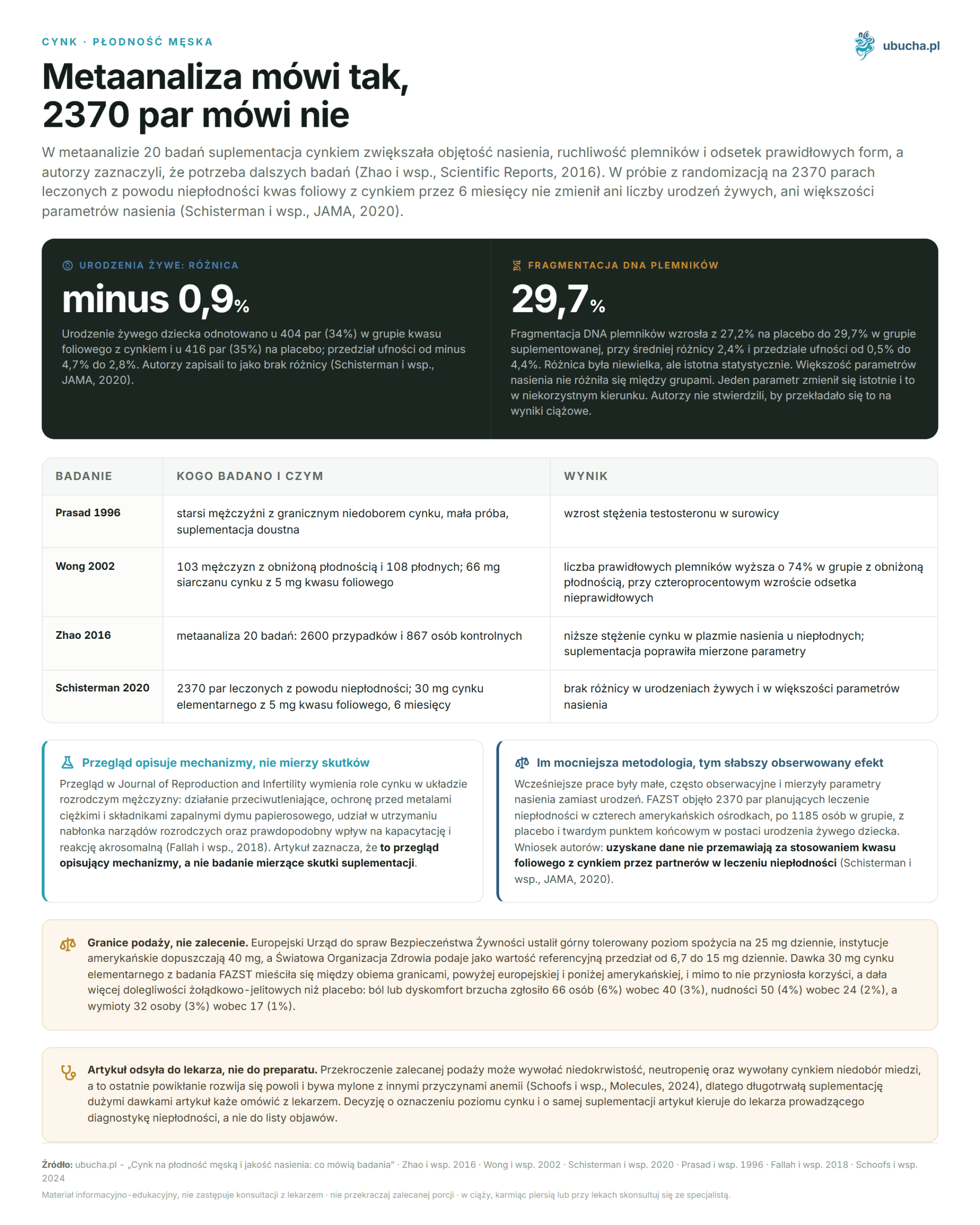
On the side of benefits is a meta-analysis from 2016 that included twenty studies, 2600 cases, and 867 controls. The zinc concentration in the plasma of infertile men was found to be significantly lower than in fertile men, with a standardized mean difference of minus 0.64 and a confidence interval from minus 1.01 to minus 0.28. In the same study, zinc supplementation significantly increased semen volume, sperm motility, and the percentage of normal forms (Zhao et al., Scientific Reports, 2016). The authors themselves noted that further research is needed.
An older pillar of this thesis is a Dutch trial from 2002. Wong et al. randomly assigned 108 fertile men and 103 with reduced fertility to one of four schemes for 26 weeks: folic acid alone, zinc sulfate alone, both together, or two placebos. Folic acid was given at a dose of 5 mg per day, zinc sulfate at a dose of 66 mg per day. In men with reduced fertility, the total number of normal sperm increased by 74%, with a slight, four percent increase in the percentage of abnormal sperm (Wong et al., Fertility and Sterility, 2002). A similar direction of changes was also observed in fertile men, and the baseline concentrations of zinc and folates did not differ significantly between the two groups.
| Study | Participants | Research Protocol | Duration | Outcome |
|---|---|---|---|---|
| Prasad et al., 1996 | 9 older men with borderline zinc deficiency | oral zinc supplementation | 3-6 months | testosterone increased from 8.3 to 16.0 nmol/l |
| Wong et al., 2002 | 108 fertile men and 103 with reduced fertility | 66 mg zinc sulfate with 5 mg folic acid vs placebo | 26 weeks | number of normal sperm higher by 74% in the reduced fertility group |
| Zhao et al., 2016 | 2600 cases and 867 controls from 20 studies | meta-analysis of zinc concentration in semen plasma | varied | lower concentration in infertile; supplementation improved measured parameters |
| Schisterman et al., 2020 | 2370 couples treated for infertility | 5 mg folic acid with 30 mg elemental zinc vs placebo | 6 months | no difference in live births and semen parameters |
What did the largest randomized trial show?
It showed a lack of effect. The study marked FAZST involved 2370 couples planning infertility treatment at four American centers. The authors note that before it, no large trial had tested the effectiveness of this scheme. Its result did not confirm previous promises in either of the two main endpoints.
Men received 5 mg of folic acid with 30 mg of elemental zinc or placebo daily for six months, with 1185 individuals in each group. A live birth was recorded in 404 couples (34%) in the supplementation group and in 416 couples (35%) in the placebo group, with a risk difference of minus 0.9% and a confidence interval from minus 4.7% to 2.8%. Most semen parameters, including concentration, motility, morphology, and volume, did not differ between groups after six months (Schisterman et al., JAMA, 2020).
One parameter changed significantly and in an unfavorable direction. The percentage of DNA fragmentation in sperm averaged 29.7% in the supplemented group compared to 27.2% in the placebo group, with an average difference of 2.4% and a confidence interval from 0.5% to 4.4%. Gastrointestinal complaints were also more frequent: abdominal pain or discomfort was reported by 66 individuals (6%) compared to 40 (3%), nausea by 50 (4%) compared to 24 (2%), and vomiting by 32 individuals (3%) compared to 17 (1%).
The authors’ conclusion is clear: the data obtained do not support the use of folic acid with zinc by partners in infertility treatment. This does not mean that zinc is neutral for the body. It means that in men seeking help for infertility, which is the group this supplementation is most often directed at, adding it to the treatment did not improve anything.
Does zinc raise testosterone?
With deficiency, yes; with proper intake, there is no evidence from the same source. The classic work of Prasad from 1996 shows both within one study, and that is why it is cited by both sides of the dispute.
The authors studied 40 healthy men aged 20 to 80 years and found a significant correlation between zinc concentration in cells and testosterone concentration in serum: for zinc in lymphocytes, the coefficient was 0.43, for zinc in granulocytes 0.30. Then, in four young men, zinc intake was restricted in the diet. After twenty weeks of such restriction, testosterone levels dropped from an average of 39.9 to 10.6 nmol/l (Prasad et al., Nutrition, 1996).
In the third part of the same work, nine older men with borderline zinc deficiency were given zinc for three to six months. Testosterone levels increased from an average of 8.3 to 16.0 nmol/l. The direction is therefore clear, but the studied population each time had confirmed deficiency or was deliberately induced to it. The conclusion about the action of zinc in a man who is normally nourished does not arise from this data. Similarly, it is worth reading cautiously the promises made around adaptogenic plants, as shown by the review of studies on ashwagandha and semen parameters.
How much zinc is too much?
The limits set by European and American institutions differ by almost double. The European Food Safety Authority has established the upper tolerable intake level at 25 mg per day, while the American Food and Drug Administration allows 40 mg per day. The World Health Organization provides a reference value ranging from 6.7 to 15 mg per day.
Exceeding the recommended intake can lead to anemia, neutropenia, and zinc-induced copper deficiency (Schoofs et al., Molecules, 2024). Zinc-induced copper deficiency is a sneaky complication, as it develops slowly, and its hematological symptoms can be confused with other causes of anemia.
The same work reminds us that zinc does not enter the body solely through the oral route. Inhalation of fumes and the use of topical preparations can also contribute to poisoning, which is important when working professionally with this element. The dose of 30 mg used in the FAZST study fell between both limits and still did not bring benefits, but caused more gastrointestinal complaints than placebo.
Frequently Asked Questions
Does zinc improve semen quality?
It depends on which studies you take. A meta-analysis of twenty studies showed an improvement in semen volume, motility, and percentage of normal forms. The largest randomized trial, involving 2370 couples, showed no difference compared to placebo after six months of use.
Why are study results contradictory?
Earlier studies were small, often observational, and measured semen parameters instead of births. The 2020 trial had over two thousand couples, a placebo group, and a hard endpoint of live birth. The stronger the methodology, the weaker the observed effect.
Can zinc supplementation harm sperm?
In the FAZST study, the percentage of DNA fragmentation in sperm was higher in the supplemented group than in the placebo group, 29.7% vs 27.2%. The difference was small but statistically significant. The authors did not find that it translated into pregnancy outcomes, but this is not the expected effect of a supportive supplement.
Does zinc raise testosterone?
In men with deficiency, testosterone levels increased after supplementation, and with intentional dietary zinc restriction, it clearly decreased. Both observations come from a study involving a total of a dozen individuals with confirmed deficiency. There is no conclusion for men who are properly nourished.
How much zinc is safe daily?
The European Food Safety Authority indicates 25 mg per day as the upper tolerable intake level, American institutions 40 mg, and the World Health Organization provides a reference value from 6.7 to 15 mg. These are supply limits, not recommendations to take such amounts.
What are the risks of long-term high-dose intake?
Exceeding the recommended intake can cause anemia, neutropenia, and zinc-induced copper deficiency. The latter complication develops slowly, and its symptoms can be confused with other causes of anemia, so long-term supplementation with high doses should be discussed with a doctor.
Is it worth measuring zinc levels before supplementation?
Studies that showed benefits were conducted in men with confirmed or induced deficiency, and those in individuals without deficiency did not show benefits. The decision to measure and to supplement should be made with the doctor conducting infertility diagnostics, not based on symptoms.
Products with zinc and other ingredients discussed in this article can be found in the supplements category.
This article is for informational and educational purposes and does not constitute medical advice. Before starting supplementation, consult with a doctor, especially if you are taking medications regularly, are pregnant or breastfeeding, or have chronic illnesses.
Author: Michał Waluk · Published: 2026-08-09 · Updated: 2026-08-11