
Akuamma (Picralima nitida): what is known, what is not known, and what to watch out for
The alkaloids of akuamma act on opioid receptors, but the latest study undermines its analgesic effect. What do the measurements say and what is the legal status of the seeds.
Akuamma is the seeds of the West African tree Picralima nitida, sold online as a plant alternative to opioids and kratom. The alkaloids contained in them do indeed bind to opioid receptors, which has been confirmed in the laboratory. The problem is that the latest and most accurate pharmacological study of these compounds undermines their analgesic effect, and there are no studies involving humans. There are also several claims circulating around this raw material regarding its composition and legal status that could not be confirmed in any document, and which only refer back to themselves on the internet. This text shows what exactly has been measured and by what method, what has not been measured at all, what we have not confirmed at the source, and why you will not find any doses or number of seeds here.
KEY INFORMATION
• The alkaloids in the seeds bind to opioid receptors, but at micromolar concentrations; the authors of the measurement stated directly that they have neither high affinity nor selectivity.
• A 2021 study, which isolated six alkaloids and tested them on a panel of over 40 receptors, showed limited analgesic efficacy and directly undermines earlier reports and the traditional use of the seeds as a pain-relieving agent.
• There is no randomized clinical trial of akuamma in humans.
• We have not confirmed in documents that the seeds are approved for trade as food in the European Union.
• Do not combine akuamma with opioids, benzodiazepines, or alcohol. Alarm symptoms: slow or shallow breathing, drowsiness from which it is difficult to awaken, blue lips. This is a life-threatening condition; call for help.
• This article does not provide doses because there is no source on which to base them.
What is akuamma and where does it come from?
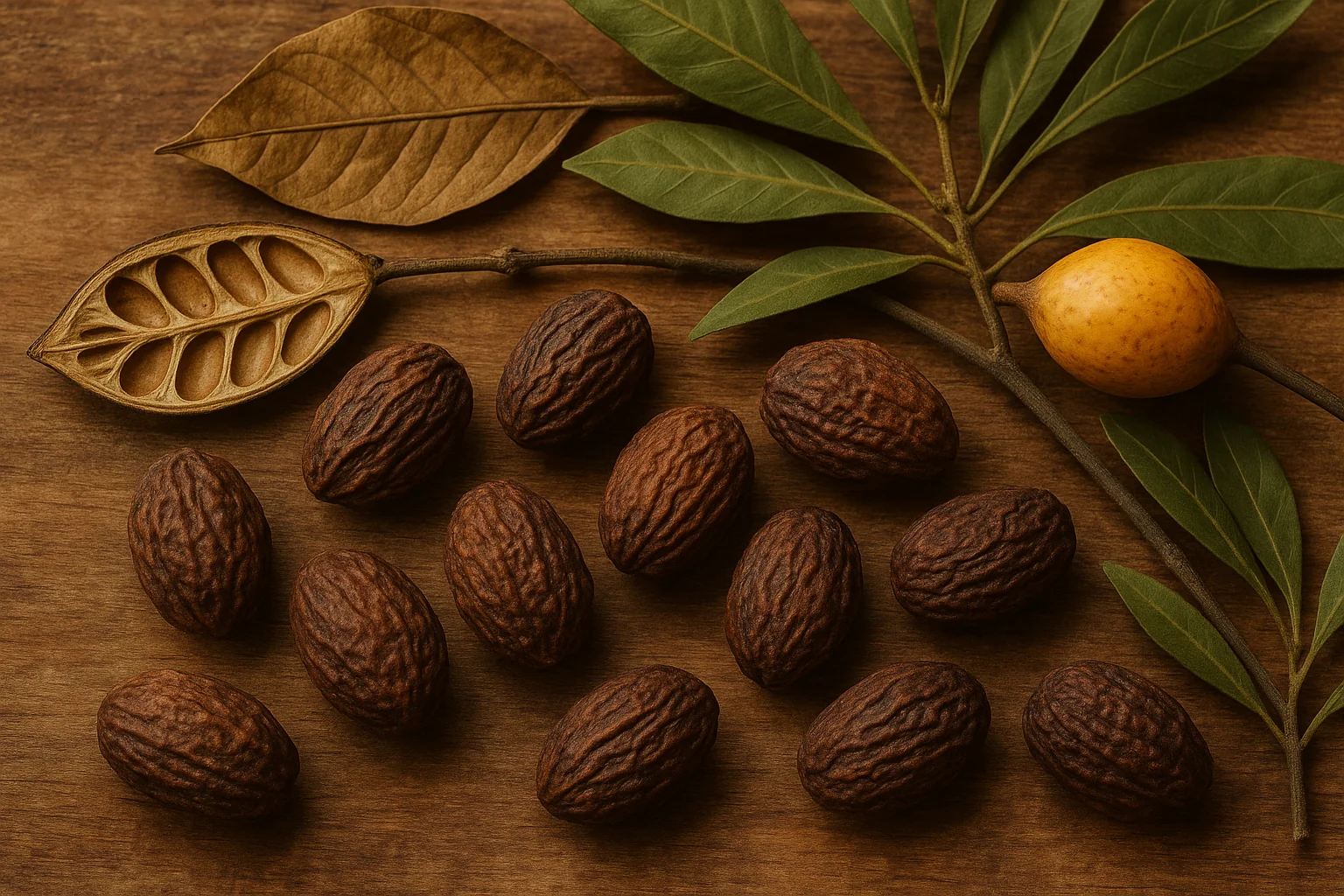
Picralima nitida is a tree from the family Apocynaceae, growing in the humid equatorial forests of West and Central Africa. Its fruits contain seeds that have been used in traditional medicine in Ghana, Nigeria, and Cameroon for pain, fever, and malaria. The commercial name akuamma refers specifically to these seeds, usually sold as a ground powder.
This tradition is real and well-documented ethnographically, but it is not evidence of efficacy in itself. A plant used for centuries may work, may work weakly, or may work completely differently than those who used it assumed. Measurements determine this, and those for akuamma only appeared at the end of the twentieth century and provided a less clear picture than tradition suggested.
The raw material reached Europe and North America much later, in the segment of plants described as natural substitutes for opioids, alongside kratom. In 2026, an online survey describing the use of akuamma seeds in the United States was published in the Journal of Psychoactive Drugs, authored by Timmons and colleagues (DOI 10.1080/02791072.2026.2618033). The mere fact that such a work was created speaks to the scale of interest. However, it is not a study of efficacy or safety, but a description of what users declare.
Which alkaloids of akuamma act on opioid receptors?
The answer comes from two studies, and their common conclusion is more cautious than the commercial narrative suggests. In 1998, Menzies and colleagues isolated five alkaloids from the seeds and tested them using radioligand binding and on isolated tissues (Menzies et al., European Journal of Pharmacology 1998, PMID 9683021). This is a test in vitro and on animal tissue, not in humans.
| Alkaloid | What was measured | Method |
|---|---|---|
| Akuammidine | Preference for mu receptor, Ki 0.6 micromolar; agonist, action blocked by naloxone | Radioligand binding, mouse vas deferens |
| Akuammine | Highest affinity for mu receptor, Ki 0.5 micromolar, but acts as a antagonist | Radioligand binding, isolated tissue |
| Akuammicine | Highest affinity for kappa receptor, Ki 0.2 micromolar; full agonist in guinea pig intestine, partial in vas deferens | Radioligand binding, isolated tissues |
| Akuammigine and pseudoakuammigine | Minimal efficacy or lack thereof in opioid tests | Isolated tissues |
Two conclusions from this table are often overlooked. First, akuammine and akuammicine are different compounds with opposing effects on the mu receptor, so confusing their names changes the meaning of the description to the opposite. Second, the Ki values here are micromolar, and the authors concluded their work with the statement that the studied alkaloids have neither high affinity nor selectivity for mu, delta, and kappa receptors. The statement about affinity comparable to morphine has no basis in this work. The compound sometimes mentioned, pericine, was detected in cell suspension culture of Picralima nitida, not isolated from the seeds.
Does akuamma really relieve pain?
The best answer we have today is: probably not as the tradition claims. In 2021, Creed’s team developed an isolation method that allowed obtaining six alkaloids of akuamma in high purity and in amounts sufficient for extensive studies. Five of them were tested on a panel of over 40 central nervous system receptors and confirmed that their main target is opioid receptors. Akuammicine turned out to be a strong agonist of the kappa receptor, and three other alkaloids showed micromolar activity against the mu receptor.
However, the decisive next step is crucial. The alkaloids acting on the mu receptor were subjected to pain tests and showed limited efficacy in thermal nociception models. The authors stated directly that their results contradict earlier reports of the analgesic properties of alkaloids from Picralima nitida and the traditional use of the seeds as a pain-relieving agent (Creed et al., Journal of Natural Products 2021, PMC7932029).
This does not mean that the seeds do nothing. It means that the most accurate available measurement does not confirm the reason people reach for them, and any perceived effect may result from kappa receptor stimulation, which causes sedation and dysphoria, rather than pain relief. All of this was measured in vitro and in animals. Nothing has been measured in humans.
Is it allowed to sell akuamma as food in the European Union?
We have not been able to read a document that would allow this, and that is an honest answer. The seeds of Picralima nitida are not on the list of plant raw materials prohibited in dietary supplements maintained by the Chief Sanitary Inspectorate, but the absence on the list of prohibitions is not permission. In EU food law, an ingredient without a documented history of significant consumption before May 15, 1997, requires separate approval as a novel food, and we have not confirmed the presence of akuamma among the approved novel foods.
Separately, two claims circulating around this raw material need to be clarified. The lists of controlled substances in Poland are an annex to the regulation of the Minister of Health, not to the Act on Counteracting Drug Addiction, so referring to the Act as the source of the list is inaccurate. We have also not found confirmation in the materials of the European Monitoring Centre for Drugs and Drug Addiction that akuamma is included in its early warning system; the only references led back to content repeated on the internet. Until such a document is read at the source, we do not claim that akuamma is legal or that it is being monitored.
What do we not know about the safety of akuamma and when to seek help?
We know practically nothing for sure. There are no randomized clinical trials, no data on toxic doses in humans, no studies on chronic use, and no assessment of the potential for addiction in humans. There is also no data on use during pregnancy and breastfeeding. The absence of reported harm with a raw material that no one has systematically studied is not evidence of safety.
Call for medical help if anyone experiences slow, shallow, or interrupted breathing, drowsiness from which they cannot be awakened, blue or gray lips and fingertips, or muscle flaccidity after taking akuamma. These are symptoms of respiratory depression, which is the mechanism by which opioids kill. The risk increases sharply when combined with other substances that depress the central nervous system, so akuamma should not be combined with opioids, benzodiazepines, or alcohol. The direction of this interaction is additive: each of these substances individually suppresses breathing, and together they do so more strongly.
You will not find any milligram numbers or number of seeds in this text, even though the title of the entry promises dosing. The reason is simple. Providing a dose requires a source that has established what is safe, and there is no such source for akuamma. The values circulating on forums are user reports, not measurements, and with a substance acting on opioid receptors, the difference between one and the other can be the difference between discomfort and respiratory arrest.
Frequently Asked Questions
What is akuamma and where does it come from?
Akuamma is the commercial name for the seeds of the tree Picralima nitida from the family Apocynaceae, which grows in the equatorial forests of West and Central Africa. In traditional medicine in Ghana and Nigeria, they were used for pain, fever, and malaria. The seeds contain several indole alkaloids, some of which bind to opioid receptors.
How does akuamma work for pain?
The alkaloids in the seeds bind to mu and kappa opioid receptors, but at micromolar concentrations and without selectivity. A 2021 study showed limited analgesic efficacy and directly stated that the results contradict earlier reports and the traditional use of the seeds as a pain-relieving agent.
What is a safe dose of akuamma?
It has not been established, and there is no source that defines it. No randomized clinical trials have been conducted in humans, there is no data on toxic doses or chronic use. For this reason, we do not provide any values. The numbers circulating on forums are user reports, not measurements.
Is akuamma addictive?
This has not been studied in humans. Substances acting on opioid receptors carry a theoretical risk of addiction, but in the case of akuamma, there is no data to confirm or exclude this. We have also not confirmed reports that akuamma is included in the European early warning system for new psychoactive substances.
What symptoms after taking akuamma require seeking help?
Slow, shallow, or interrupted breathing, drowsiness from which one cannot be awakened, blue or gray lips and fingertips, and muscle flaccidity. These are symptoms of respiratory depression and a life-threatening condition. The risk increases when combined with opioids, benzodiazepines, or alcohol.
Is akuamma legal in Poland?
We have not confirmed this in any document, and therefore we do not claim it. The seeds are not on the list of banned substances in dietary supplements, but the absence of a ban does not imply permission for trade. An ingredient without a history of significant consumption in the EU before May 15, 1997, requires separate approval as a novel food.
A comparison of the efficacy and safety of opioids with alternatives is described in more detail in the text about cannabis and opioids in pain treatment. We discuss how the composition of substances from an uncertain source is examined in the material about drug checking in Europe.
This article is for informational and educational purposes and does not replace consultation with a doctor. If you are pregnant, breastfeeding, taking medications, or have chronic conditions, consult the use of supplements or herbs with a specialist.
Author: Michał Waluk · Published: 2026-07-06 · Updated: 2026-08-16