
CBD and Autoimmune Diseases: A Review of Research and Inflammatory Conditions
What has really been demonstrated in studies on CBD in RA, MS, Crohn's disease, and lupus, how strong is this evidence, and why are interactions with drugs significant.
Autoimmune diseases occur when the immune system attacks its own tissues: joints in rheumatoid arthritis, myelin sheaths in multiple sclerosis, the intestine in Crohn’s disease. CBD raises interest in this context because laboratory studies suppress the immune response. However, the path from test tube phenomena to human treatment is long and still untraversed in this case. This text organizes what has been demonstrated in specific diseases, at what level of evidence it has been shown, and where popular compilations present unsupported numbers. It separately discusses interactions with immunosuppressive drugs, as this is the only part of the puzzle where the risk is documented better than the benefit.
KEY INFORMATION
• No autoimmune disease has a registered treatment with CBD alone.
• Reviews consistently describe CBD as an immunosuppressive substance, which is both a basis for hope and a source of risk.
• The only randomized study with CBD alone in Crohn’s disease was negative: the preparation was found to be safe but ineffective.
• In multiple sclerosis, Sativex, a combination of THC and CBD, is registered, not CBD alone.
• CBD inhibits the enzymes CYP3A4 and CYP2C19 and interacts with P-glycoprotein, which can raise the levels of immunosuppressive drugs in the blood.
How common are autoimmune diseases?
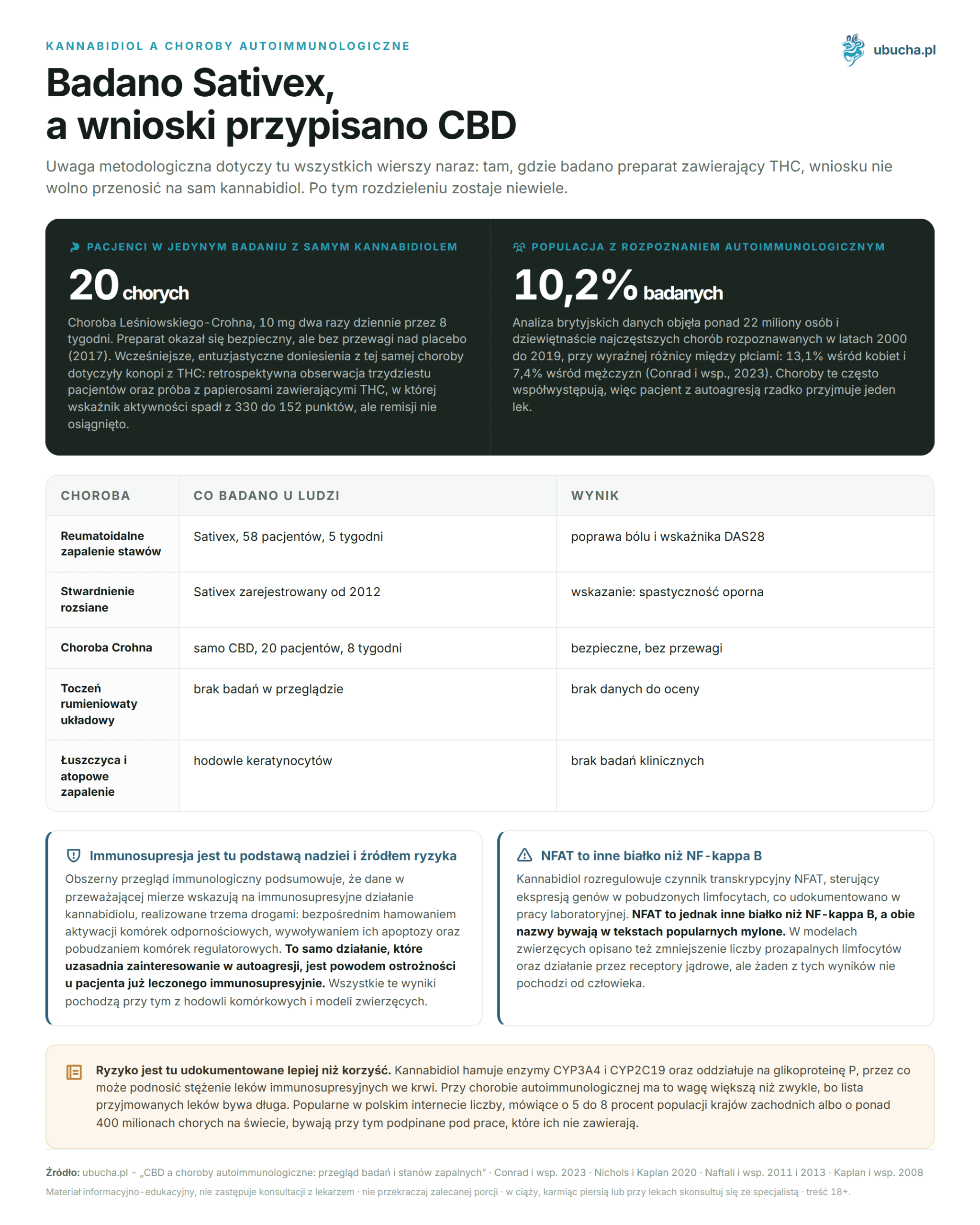
More often than older estimates suggest. An analysis of British data from primary and hospital healthcare covered over 22 million people and the nineteen most common autoimmune diseases diagnosed from 2000 to 2019. They affected 10.2% of the population, with a clear difference between genders: 13.1% among women and 7.4% among men (Conrad et al., The Lancet, 2023).
This same work shows that incidence is rising, most notably in celiac disease, Sjögren’s syndrome, and Graves’ disease, and that autoimmune diseases often co-occur. A person with one such diagnosis has a significantly increased likelihood of another, particularly within connective tissue diseases and endocrine disorders. This has practical implications for the topic of this text: a patient with autoimmunity rarely takes just one medication, and the longer the list of medications, the greater the importance of questions about interactions.
Popular numbers in the Polish internet, stating 5 to 8% of the population in Western countries or over 400 million sick worldwide, are sometimes linked to works that do not contain them. An American estimate from 1997, often cited in this context, spoke of 8.5 million people in the United States, or roughly one American in thirty-one, and concerned twenty-four disease entities.
How does CBD affect the immune system?
It suppresses it. A comprehensive immunological review from 2020 summarizes that data predominantly indicate the immunosuppressive action of CBD, realized through three pathways: direct inhibition of the activation of various types of immune cells, inducing their apoptosis, and stimulating regulatory cells that suppress the others (Nichols and Kaplan, Cannabis Cannabinoid Res, 2020). More about the inflammatory mechanism itself can be found in the text about how CBD works in inflammatory conditions.
At the molecular level, several points of action have been described. CBD dysregulates the transcription factor NFAT, which controls gene expression in activated lymphocytes, as documented in a laboratory study from 2008 (Kaplan et al., Biochem Pharmacol, 2008). It is worth being cautious about a common mistake in popular texts: NFAT is a different protein than NF-κB, and both names are sometimes used interchangeably.
In animal models of multiple sclerosis and type 1 diabetes, CBD reduced the number of pro-inflammatory Th1 and Th17 lymphocytes and the production of interleukins 1, 12, and 17, gamma interferon, and tumor necrosis factor. Its action through nuclear receptors PPAR-alpha and PPAR-gamma has also been described (Rodríguez Mesa et al., Cannabis Cannabinoid Res, 2021). Separate studies indicate that CBD promotes the formation of functional regulatory T lymphocytes with weak lymphocyte activation (Dhital et al., Cell Immunol, 2017). All these results come from cell cultures and animal models.
In which diseases has CBD been best studied?
In none well, and the differences concern rather how far research has progressed. The following summary organizes five areas according to what has actually been measured in humans. A methodological note applies to all rows at once: where a preparation containing THC has been studied, the conclusion cannot be transferred to CBD alone.
| Disease | What was studied in humans | Result |
|---|---|---|
| Rheumatoid arthritis | Sativex (THC and CBD), 58 patients, 5 weeks | Improvement in pain at rest and with movement, sleep quality, and DAS28 score; no effect on morning stiffness |
| Multiple sclerosis | Sativex registered in Poland since 2012 | Indication: spasticity resistant to other treatment; prescribed on Rpw prescription, not reimbursed |
| Crohn’s disease | CBD alone, 20 patients, 10 mg twice daily, 8 weeks | Safe, but no advantage over placebo |
| Systemic lupus erythematosus | No studies meeting the criteria of the 2021 review | No data for assessment |
| Psoriasis and atopic dermatitis | Studies on keratinocyte cultures | Inhibition of keratinocyte proliferation in vitro; no clinical studies |
Two rows require elaboration. In Crohn’s disease, earlier enthusiastic reports concerned cannabis with THC, not CBD: a retrospective observation of thirty patients showed improvement in twenty-one of them (Naftali et al., Isr Med Assoc J, 2011), and a later trial with cigarettes containing THC reduced the disease activity index from 330 to 152 points in ten of eleven subjects, although the primary endpoint, remission, was not achieved (Naftali et al., Clin Gastroenterol Hepatol, 2013). Only a study from 2017 tested CBD alone and was negative (Naftali et al., Dig Dis Sci, 2017). In the case of lupus, a literature review from 2000 to 2020 found not a single paper meeting the inclusion criteria, so circulating surveys about the percentage of patients using cannabinoids have no support in the literature. A separate topic is the thyroid, described in the text about CBD in Hashimoto’s.
Does CBD help with psoriasis and atopic dermatitis?
For now, it is unknown, as there is a lack of clinical studies. The biological rationale is solid: the skin has its own endocannabinoid system, and CB1, CB2, and TRPV1 receptors have been described on keratinocytes, fibroblasts, and skin immune cells (Bíró et al., Trends Pharmacol Sci, 2009).
In psoriasis, the problem is excessive proliferation of keratinocytes driven by pro-inflammatory cytokines. A 2007 study showed that cannabinoids inhibit the proliferation of human keratinocytes, with the mechanism not proceeding through CB1 or CB2 receptors (Wilkinson and Williamson, J Dermatol Sci, 2007). This is an observation from cell culture, not from treating patients, and should be read as such. Practical consequences for atopic skin are described separately in the text about CBD oil in AD.
One difference from the other diseases in this summary is real. Topically applied preparations do not reach blood concentrations comparable to oral doses, so the risk of interactions with systemically taken medications is significantly lower with them. This does not mean it is zero, nor that the ointment addresses the cause of the disease.
How strong is this evidence really?
Weak, and this results from the level of research, not from their results. The hierarchy of evidence in medicine ranks from strongest to weakest as follows: systematic reviews of randomized trials, single randomized trials, cohort studies, open studies without a control group, animal studies, cell culture studies. Almost everything known about CBD in autoimmunity lies at the last two levels.
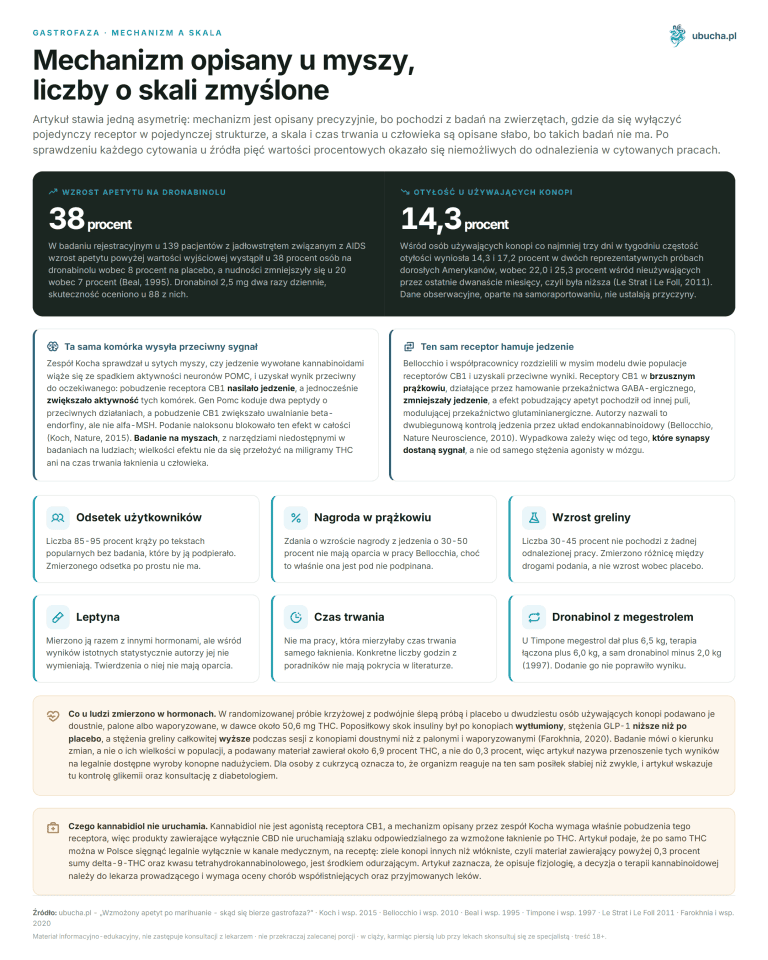
The second difficulty concerns concentrations. Many laboratory studies use amounts of CBD that cannot be achieved in tissues after a reasonable oral dose. A systematic review of CBD pharmacokinetics in humans found twenty-four studies with pharmacokinetic parameters and established that bioavailability was measured only after smoking, where it was 31%. No study has been conducted to determine absolute bioavailability for the oral route (Millar et al., Front Pharmacol, 2018).
It is worth pausing over this second conclusion, as it undermines the number repeated in hundreds of guides. The range of 6 to 19% oral bioavailability, usually cited without a source, does not come from measurements in humans. Translating results from the test tube to a capsule dose is therefore burdened with greater uncertainty than the precision of such numbers suggests.
Can CBD interact with immunosuppressive drugs?
Yes, and this is the best-documented part of the entire topic. A safety review from 2019 established that adverse effects occurred in nearly half of the people taking CBD, with a clear dose-dependent relationship. The most common included increased aminotransferase activity, drowsiness, sleep disturbances, anemia, and infections (Brown and Winterstein, J Clin Med, 2019).
The mechanism of interaction is known. CBD interacts with the enzymes CYP3A4 and CYP2C19, responsible for the metabolism of many drugs, and with P-glycoprotein, a transport protein involved in their excretion. The authors of the review assess the likelihood of interactions with commonly used drugs as high and recommend considering lowering the dose of the primary drug, monitoring adverse effects, or changing therapy, especially in patients burdened with multiple conditions.
Practically, this means particular caution with cyclosporine and tacrolimus, whose levels depend on CYP3A4, and exceeding the therapeutic range risks kidney damage. Methotrexate requires attention for another reason: it is excreted by the kidneys with the involvement of transport proteins, not primarily metabolized by cytochrome P450. The World Health Organization in a 2018 report recognized CBD as a substance generally well tolerated with a good safety profile, adding that reported adverse effects may indeed result from interactions with medications already taken by the patient.
What have studies not yet resolved?
The most important thing: whether the immunosuppression observed in the laboratory translates to anything clinically significant in either direction in humans. This question has a double-edged nature. An immunosuppressive substance may alleviate autoimmunity, but it may also increase susceptibility to infections, just like immunosuppressive drugs used in these diseases.
Additionally, questions remain open about the effective dose in specific disease entities, whether CBD sums with biological drugs or interferes with them, how long it needs to be used before assessing the effect, and whether full-spectrum extract behaves differently than isolate. The negative study in Crohn’s disease also shows a third possibility that is rarely discussed: a dose of 20 mg per day may simply have been too low, rather than the preparation being ineffective.
Until these questions are resolved, the practical position is unequivocal. CBD does not replace treatment conducted by a rheumatologist, neurologist, or gastroenterologist, and for a person taking immunosuppressive drugs, the decision to include it should be made by the attending physician, preferably with monitoring of drug levels after starting supplementation.
Frequently Asked Questions
Does CBD cure autoimmune diseases?
No. No autoimmune disease has a registered treatment with CBD alone. Laboratory and animal studies show immunosuppressive effects, but the only randomized trial with CBD alone in Crohn’s disease did not show an advantage over placebo. CBD does not replace medications prescribed by a specialist.
Can CBD interact with immunosuppressive drugs?
Yes. CBD interacts with the enzymes CYP3A4 and CYP2C19 and with P-glycoprotein, which can raise the levels of cyclosporine or tacrolimus in the blood to toxic values. In a 2019 review, adverse effects occurred in nearly half of the people taking CBD. A conversation with the attending physician is necessary before starting it.
In which autoimmune disease is the evidence strongest?
In multiple sclerosis, but it concerns a preparation combining THC and CBD, not CBD alone. Sativex has been registered in Poland since 2012 for spasticity resistant to other treatments, prescribed on Rpw prescription and not reimbursed. In rheumatoid arthritis, there is one randomized trial with the same preparation involving 58 patients.
How does CBD affect cytokines and inflammation?
In cell and animal models, it reduces the number of pro-inflammatory Th1 and Th17 lymphocytes and the production of interleukins 1, 12, and 17, gamma interferon, and tumor necrosis factor. It dysregulates the transcription factor NFAT and promotes the formation of regulatory lymphocytes. The translation of these mechanisms to patients has not been demonstrated.
Are CBD ointments or creams safer than capsules?
In terms of drug interactions, yes, because topically applied preparations do not reach blood concentrations comparable to oral doses. This does not mean efficacy: studies on CBD in psoriasis and atopic dermatitis are limited to cell cultures, and no clinical trials have been conducted for these indications.
CBD and CBG oils available in the store are gathered in the oils category along with the declared concentration of each preparation.
This article is for informational and educational purposes and does not constitute medical advice. Before starting to use cannabis or CBD for therapeutic purposes, consult a doctor, especially if you are taking other medications, are pregnant, or breastfeeding.
Author: Michał Waluk · Published: 2026-08-09 · Updated: 2026-08-10