CBD 99% Crystal: what it is, whether it’s worth buying, and how to use it
CBD 99% isolate is pure CBD without THC and terpenes. How it is made, how to measure a dose, when it wins over full-spectrum oil, and what studies have shown.
A white, odorless powder containing over 99% cannabidiol looks more like a laboratory reagent than a supplement in a jar. CBD crystal, or isolate, is the purest form of cannabidiol legally available in Poland. Manufacturers sell it as a product for advanced users: without THC, without terpenes, without a hemp aftertaste, but with a dose measured to the milligram. But does purity really mean effectiveness? Animal studies suggest otherwise, while also indicating situations where the isolate has no competition: doping tests, workplace controls, and self-preparation of products. Below you will find the production process, methods of use, practical dosing, and a fair comparison with full-spectrum oil, based on what has actually been measured, along with the legal status as of August 2026.
KEY INFORMATION
• CBD 99% crystal is an isolate: pure cannabidiol without THC, terpenes, and other cannabinoids.
• In mice, purified CBD produced a bell-shaped dose-response curve, while full-spectrum extract produced a linear one (Gallily et al., Pharmacology & Pharmacy, 2015).
• After pure CBD, none of the 218 urine samples exceeded the confirmation threshold for the THC metabolite (Spindle et al., 2020).
• A fatty meal increased the maximum concentration of pure CBD by 14 times (Birnbaum et al., Epilepsia, 2019).
• The provisional safe dose according to EFSA is 0.0275 mg/kg per day, which is about 2 mg for a 70 kg person (EFSA Journal, 2026).
How is CBD 99% crystal made?
The crystal is produced in four steps: extraction of raw oil from hemp flowers, winterization of waxes, fractional distillation, and crystallization from a solvent. Each stage removes another group of components from the extract until only cannabidiol with a purity above 99% remains. The result is a white powder that is odorless and practically tasteless.
| Stage | What it involves | What remains after the stage |
|---|---|---|
| Extraction | Supercritical CO2 or ethanol extracts raw extract from the flowers | CBD, THC, CBG, CBN, CBDa, terpenes, waxes, chlorophyll |
| Winterization | Ethanol solution cooled to -40°C, precipitated sediment filtered out | Extract without waxes and fats, with chlorophyll removed |
| Distillation | Short-path distillation separates fractions by boiling point | Fraction with 80-90% CBD purity, already without terpenes |
| Crystallization | Distillate dissolved in pentane, slow cooling, filtration, drying | White powder above 99% CBD, THC below the detection threshold |
A reliable manufacturer attaches a certificate of analysis (COA) from an independent laboratory to the batch: percentage of cannabidiol, THC measurement result, residual solvents, pesticides, and heavy metals. Pentane from the crystallization stage must disappear during drying, so the “residual solvents” position is checked in such a document first. Without a certificate, you are buying white powder on the seller’s word.
How does CBD crystal differ from full-spectrum oil?
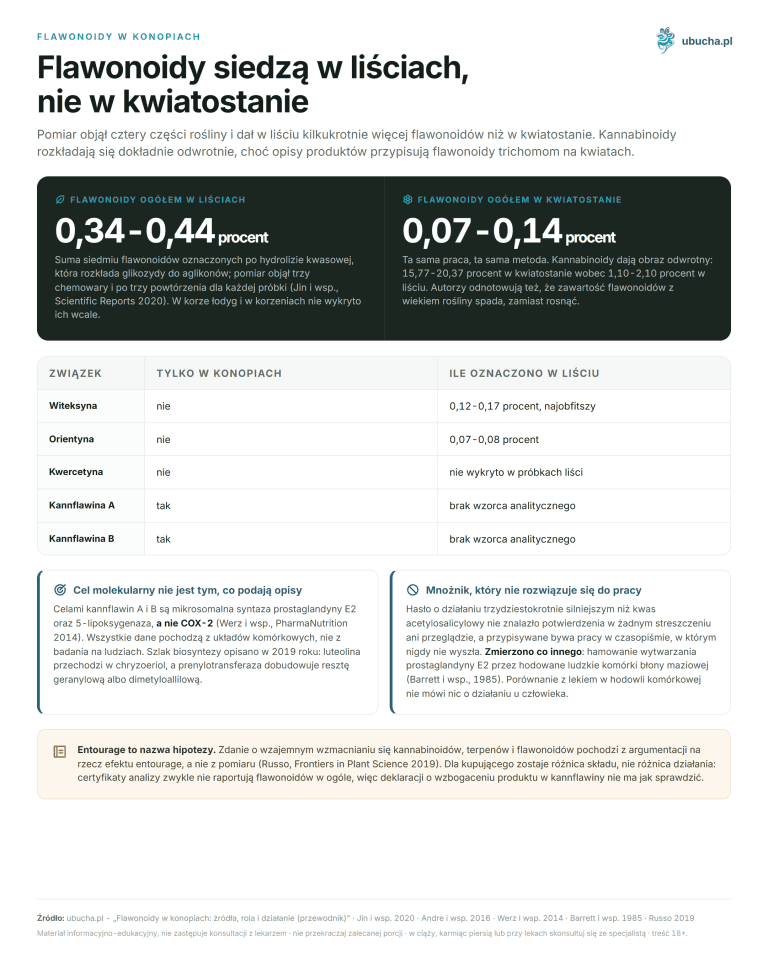
The difference is not in the amount of cannabidiol, but in what accompanies it. Full-spectrum oil additionally contains CBG, CBN, CBDa, terpenes, flavonoids, and trace THC. The isolate contains nothing but CBD, so it cannot produce the entourage effect, which is the mutual enhancement of the plant’s components.
The very concept of the entourage effect was developed by Ethan Russo in a review on the synergy of phytocannabinoids and terpenoids (Russo, British Journal of Pharmacology, 2011). The work conditionally formulates this synergy as a hypothesis to be tested and proposes methods for its study. Specifics only appeared in animal models.
Gallily and colleagues administered purified cannabidiol and extract from a CBD-rich strain to mice, equalizing the dose of the active substance (Pharmacology & Pharmacy, 2015). Purified CBD produced a bell-shaped curve: the anti-inflammatory and analgesic effect increased to a certain dose, then began to decline. The extract behaved linearly, so a higher dose meant stronger inhibition of paw swelling and TNF-alpha production. This is an animal study, one inflammation model, in a journal outside the European PMC index, so do not directly transfer it to your own supplement shelf. However, it is enough to treat the slogan “the cleaner means stronger” as a marketing assumption rather than a fact.
The practical conclusion is simple. If you care about potency, the isolate is not inherently a better choice than full-spectrum oil at the same CBD content. The advantages of the crystal lie entirely elsewhere. How the third form of the raw material compares, we outlined in the text hemp distillate vs isolate.
For whom is CBD 99% crystal a better choice?
The isolate wins when the presence of THC is a problem or when you need a precisely weighed dose. This applies to athletes and employees subject to testing, those preparing their own products, and those who dislike the hemp taste of oils. In none of these cases does potency decide.
Athletes competing in anti-doping controlled competitions, professional drivers, pilots, and energy sector workers share a common problem. Full-spectrum products carry trace THC, and measurements show that even a one-time exposure to a few milligrams is enough to exceed the screening threshold in urine. A crystal with THC marked below the detection threshold removes this issue from the equation.
The second group is those making their own products. The isolate is the only CBD raw material that can be precisely weighed, as it contains no carrier or filler: a gram of powder is a gram of cannabidiol. You dissolve it in MCT oil or olive oil and get an oil with a concentration you set yourself, without guessing how much active substance is actually in the finished bottle.
The third group is often overlooked: people who do not like the taste and smell of hemp. The bitterness and herbal note of oils are due to terpenes and chlorophyll, and the crystal contains neither. The powder is odorless, so under the tongue, you mainly taste the carrier oil.
We have noticed that experienced users rarely choose between one or the other. A more common pattern looks like this: full-spectrum oil as a daily base, and crystal as a boost when you need to add cannabidiol without adding another dose of THC. This combination does not appear in manufacturers’ descriptions but solves the real problem of dosage ceiling.
How to use CBD crystal?
The crystal needs fat or high temperature, as it does not dissolve in water. Hence, there are five sensible routes of administration: dissolving in carrier oil, sublingual administration, homemade capsules, vaporization in a concentrate device, and adding to a fatty meal. The choice changes the speed of action and how much substance enters the bloodstream.
| Form | How to prepare | When it makes sense |
|---|---|---|
| Homemade oil | 1 g of crystal in 20 ml of MCT oil, mix in a water bath at about 60°C until dissolved, pour into a dark bottle | Daily supplementation, full control of concentration |
| Sublingual | Hold the weighed portion under the tongue for 60-90 seconds, then swallow | When you don’t want to prepare anything |
| Capsules | Empty HPMC capsules filled with weighed powder, the rest of the volume filled with MCT oil | Repeatable dose, travel |
| Vaporization | Insert into concentrates, temperature 160-180°C | Fastest action, not for people with respiratory issues |
| With a meal | Add to a fatty dish: yogurt, salad with oil, peanut butter | Best absorption orally |
One thing you should not do: do not add the crystal to hot coffee or tea. Cannabidiol does not dissolve in water, and the melting point is 66-67°C, so the powder will clump together and settle on the cup’s wall. The result is a loss of raw material, not a stronger drink.
How to measure a portion of CBD crystal?
The most accurate way is with a jewelry scale with a resolution of 0.01 g. For portions over 100 mg, a kitchen scale with an accuracy of 0.1 g is sufficient. If you dissolve the crystal in oil, you return to convenient dosing with a dropper: at a 5% concentration, one drop is about 2.5 mg of CBD.
Do not treat home measures as measurements. A pinch on the tip of a toothpick does not have a constant mass, and the difference between one pinch and another can be double. For repeatable use, this is definitely too little, and with a substance sold in pure form, a mistake by an order of magnitude is easier than with oil.
How much you actually take is determined with your doctor or pharmacist, not from an article. The limit that is not worth exceeding is provided by the regulator, and we return to it in the safety section. A comparison with ready-made products can be found in the text What CBD concentration to choose.
However, absorption is influenced by something that manufacturers remain silent about. In eight patients with drug-resistant epilepsy, the same capsule with 99% pure cannabidiol after a fatty meal of 840-860 kilocalories produced an average of 14 times higher maximum concentration in the blood and 4 times greater area under the curve than when fasting (Birnbaum et al., Epilepsia, 2019). The ninety percent confidence intervals for these ratios were 7.47-31.86 and 3.42-7.82, so the group was small, and the spread was large. The timing of administration can change effective exposure more than the size of the dose.
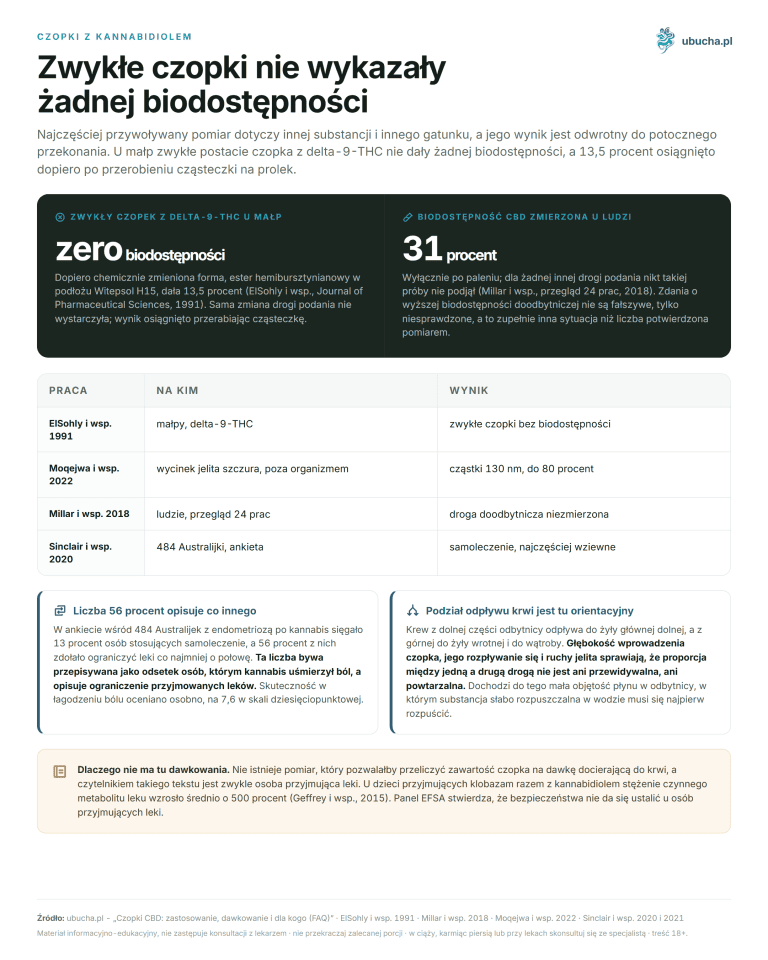
Be cautious with bioavailability tables circulating on blogs. A systematic review of 24 studies on the pharmacokinetics of CBD in humans provides only one absolute bioavailability, 31 percent after smoking, and notes that no study included in the review attempted to determine it for other routes of administration (Millar et al., Frontiers in Pharmacology, 2018). The value “13-19% orally” is indeed stated in this paper, but in the introduction, as background from earlier studies involving animal research. Numbers like “sublingually 35%” are estimates, not measurements in humans.
Will CBD crystal show up on a drug test?
Pure isolate will not. In a study where six volunteers took 100 mg of pure cannabidiol orally and inhaled, only 1 of 218 urine samples gave a positive result in the screening test, and none exceeded the confirmation threshold for the THC metabolite (Spindle et al., Journal of Analytical Toxicology, 2020).
The same experiment showed the other side of the coin. When instead of pure CBD, participants vaporized dried cannabis rich in cannabidiol, delivering the same dose of 100 mg plus 3.7 mg of THC, nine samples tested positive in the screening at the threshold of 20 ng/ml, two also at 50 ng/ml, and four confirmed in mass spectrometry above 15 ng/ml. A few milligrams of THC given together with cannabidiol was enough to exceed the threshold after a one-time exposure. Caveat: the study examined vaporized flower, not oil, so the measurement does not indicate how much THC will accumulate after a month of taking a full-spectrum product.
The authors conclude directly: a one-time dose of pure CBD will not yield a positive result according to federal guidelines for employee testing, but products containing delta-9-THC may. For a person subject to testing, what matters is not the manufacturer’s declaration but the laboratory test result of a specific batch, and the batch number on the label must match the number in the header of the certificate. You can read more about the tests and detection windows in the article Does CBD show up on drug tests.
How to store CBD crystal to maintain its quality?
In a sealed, dark container, away from heat and moisture. Under such conditions, the isolate retains its declared purity for 1-2 years from the production date. A refrigerator at a temperature of 2-8°C extends this period, but it requires warming the jar before opening to prevent condensation on the cold powder.
- Dark glass or mylar bag, always tightly closed.
- Room temperature or lower, never near a heater or in a car in summer.
- As rare opening of the container as possible, as each allows moisture in.
- Measuring with a dry spoon, never one that has previously touched oil.
Clumping of the powder into a hard lump looks alarming but is not a quality defect. It is a result of moisture or slight melting, and it is enough to crush the lump before weighing. Cannabidiol does not change its chemical structure and does not lose potency in this process.
The melting point of CBD is 66-67°C, so under normal conditions, the crystal remains solid. In summer, in a closed car, this limit can be exceeded, and the powder turns into a glassy mass stuck to the bottom. It still works, but measuring becomes a lottery. Slow oxidation is not visible to the naked eye, so the production date on the certificate says more about freshness than the appearance of the powder itself.
Is CBD crystal legal in Poland?
It is legal as long as the raw material comes from industrial hemp. Cannabidiol itself does not appear in the list of psychotropic substances or narcotics: the word “cannabidiol” does not occur in the consolidated text of the Minister of Health’s regulation (Dz.U. 2024 poz. 1139, with changes from Dz.U. 2025 poz. 598 and Dz.U. 2026 poz. 934) even once.
The threshold of 0.3% is sometimes incorrectly described in this context, so it is worth breaking it down. It is not a limit for the product, but for the plant: it refers to the sum of delta-9-THC and tetrahydrocannabinolic acid in flowering or fruiting tops from which resin has not been removed, calculated on a dry mass basis, rounded to one decimal place (art. 4 pkt 5 of the Act on Counteracting Drug Addiction, t.j. Dz.U. 2023 poz. 1939, as amended by the Act of March 24, 2022, Dz.U. 2022 poz. 763). How much THC is in a specific package of isolate is stated only by the certificate of analysis for that batch, not by the percentage given for the raw material. Separate limits, expressed in mg/kg, apply to food from hemp seeds.
Is CBD isolate safe?
The final word here belongs to the regulator, not the manufacturer. The EFSA panel established a provisional safe dose in 2026 of 0.0275 mg per kilogram of body weight per day, which is about 2 mg daily for a person weighing 70 kg, and reserved it only for supplements with CBD purity of at least 98 percent, without nanoparticles (EFSA NDA Panel, EFSA Journal, 2026). The same document states that previous data gaps have not been closed: animal studies show consistent liver toxicity, and in humans, there is potential hepatotoxicity, especially in combination with medications, and the safety of CBD cannot be established in individuals under 25 years of age, pregnant and breastfeeding women, and those taking medications. A purity of 99% does not remove anything from this list: the provisional dose was derived specifically for products with a purity of at least 98 percent.
A separate issue is interactions. In studies on human liver microsomes and recombinant enzymes, cannabidiol inhibited the activity of CYP3A4 and CYP3A5 (Yamaori et al., Life Sciences, 2011) and CYP2C19 (Jiang et al., Drug Metabolism and Pharmacokinetics, 2013). These are in vitro measurements, not in patients, so do not translate them to your own medications. In the case of antiepileptic, anticoagulant, or immunosuppressive therapy, a conversation with a doctor is no longer a formality.
A practical caveat applies only to the crystal and arises from its concentration. A heaping teaspoon is several hundred milligrams of cannabidiol, which is a multiple of what is contained in a drop of oil. Weigh instead of estimating, especially during the first weeks.
Frequently Asked Questions
What is CBD 99% crystal?
It is a cannabidiol isolate: a white, odorless powder obtained through extraction, winterization of waxes, distillation, and crystallization. It contains 99% or more pure CBD, without THC, terpenes, and other cannabinoids. Purity and lack of contaminants are confirmed by a certificate of analysis attached to a specific batch.
How does CBD crystal differ from CBD oil?
Oil is CBD dissolved in fat, often together with other cannabinoids and terpenes. Crystal is pure cannabidiol, without a carrier. Hence, more precise weighing and zero THC on the isolate side, and the entourage effect and readiness for use on the full-spectrum oil side.
How to make CBD oil from crystal?
Weigh 1 g of crystal and add it to 20 ml of MCT oil or olive oil. Heat in a water bath to about 60°C, stirring until completely dissolved, then pour into a dark bottle with a dropper. You will get a 5% oil, which is about 2.5 mg of CBD per drop.
Is CBD crystal better than full-spectrum oil?
Not in terms of potency. In mice, purified CBD produced a bell-shaped dose-response curve, while full-spectrum extract produced a linear one at the same dose of cannabidiol (Gallily et al., 2015). Isolate wins where the absence of THC and precise weighing matter.
Can CBD crystal show up on a drug test?
Practically not with the isolate alone. In the study by Spindle et al. (2020), after 100 mg of pure CBD, none of the 218 urine samples exceeded the confirmation threshold for the THC metabolite. The risk only arises with full-spectrum products containing trace THC.
Does CBD crystal dissolve in water?
It does not dissolve. Cannabidiol is a lipophilic compound, so it needs fat or alcohol; in hot coffee or tea, the powder will clump together and settle on the cup’s wall. The melting point is 66-67°C, which also explains why the crystal melts in a heated car.
Does CBD isolate have a daily upper limit?
The EFSA panel established a provisional safe dose in 2026 of 0.0275 mg per kilogram of body weight per day, which is about 2 mg for a person weighing 70 kg, and referred it specifically to products with a purity of at least 98 percent. No safety limit has been established for individuals under 25 years of age, pregnant women, and those taking medications.
Ready-made oils, with which it is worth comparing your own preparation, can be found in the hemp oil category.
This article is for informational and educational purposes only and does not constitute medical advice. Before starting to use cannabis or CBD for therapeutic purposes, consult your doctor, especially if you are taking other medications, are pregnant, or breastfeeding.
Author: Michał Waluk · Published: 2026-06-08 · Updated: 2026-08-15