
Betaine TMG on Homocysteine and Methylation: What Studies Say (Table)
Betaine TMG and homocysteine: how much does it really lower it, how does it compare to folic acid, what did the trial in NAFLD show, and why do high doses raise lipids.
Betaine, or trimethylglycine (TMG), has been known for decades mainly as a feed additive. Today, it is sold in three roles at once: as a remedy for elevated homocysteine, as support for methylation processes, and as a supplement for exercisers. Each of these roles has clinical studies behind it, but they say less and something different than is usually cited. Below you will find each of these trials outlined separately: who conducted it, on whom, how long it lasted, and what the result was. You will also see three places where Polish descriptions of TMG provide a result directly opposite to what the authors of the cited study wrote in their conclusions.
KEY INFORMATION
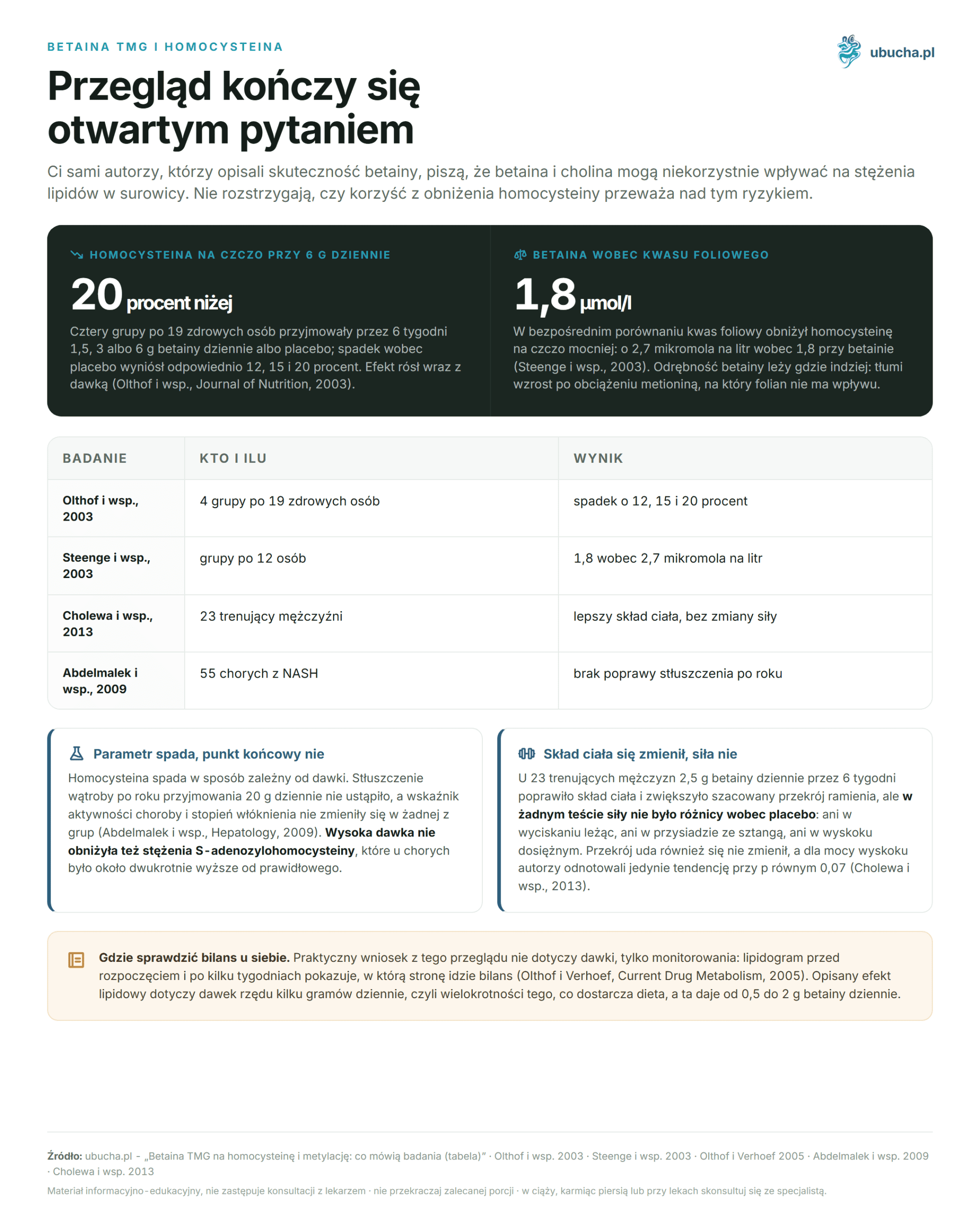
• Olthof et al. (Journal of Nutrition, 2003) administered 1.5, 3, or 6 g of betaine daily for 6 weeks to four groups of 19 healthy individuals; fasting homocysteine was lower than in the placebo group by 12, 15, and 20 percent, respectively.
• Betaine does not work faster than folic acid: folate lowers homocysteine more strongly, and the advantage of betaine concerns the rise after methionine loading, where folate has no effect at all.
• In a randomized trial of patients with NASH, betaine 20 g daily for a year did not improve fatty liver (Abdelmalek et al., Hepatology, 2009).
• Betaine and choline may adversely affect serum lipid levels.
What is betaine TMG and how does it work in the methylation cycle?
Trimethylglycine is a zwitterion with three methyl groups attached to a nitrogen atom, naturally present in beets, spinach, quinoa, and wheat germ. The name itself comes from the beet, Beta vulgaris, from which it was first isolated. In the human body, it serves two distinct functions.
The first is osmoprotection. Betaine is an organic osmolyte that accumulates in the cells of the kidney, liver, and brain, stabilizing them during fluctuations in osmotic pressure. This role has no direct connection to supplementation but explains why the compound is found in these tissues.
The second function is donating a methyl group. In a reaction catalyzed by the enzyme BHMT, betaine donates one of its methyl groups to homocysteine, converting it back to methionine; it itself is converted to dimethylglycine. This pathway runs parallel to another remethylation route based on 5-methyltetrahydrofolate, the active form of folate. Both pathways lead to the same goal but use different enzymes, so betaine can lower homocysteine even when the folate pathway is functioning poorly. Methionine, in turn, is a substrate for the synthesis of SAMe, the main methyl group donor in the body.
How much does betaine TMG lower homocysteine?
The most precise answer comes from the study by Olthof et al. (Journal of Nutrition, 2003). Four groups of 19 healthy individuals took betaine for 6 weeks at doses of 1.5, 3, or 6 g daily or placebo. Fasting homocysteine was lower than in the placebo group by 12, 15, and 20 percent, respectively, after this time.
A separate trial, published in the same year and co-authored by the same researcher, compared betaine directly with folic acid (Steenge et al., Journal of Nutrition, 2003). Groups of twelve individuals with slightly elevated homocysteine received either 6 g of betaine, 800 micrograms of folic acid, or placebo for 6 weeks. In relation to the change in the placebo group, fasting homocysteine decreased by 1.8 micromoles per liter in the betaine group and by 2.7 micromoles per liter in the folic acid group.
This clarifies the statement repeated in Polish descriptions of TMG. Betaine does not lower fasting homocysteine either faster or more strongly than folate; in this study, it performed worse. Its distinctiveness lies elsewhere: after methionine loading, betaine reduced the area under the homocysteine curve, while folic acid had no effect on this increase. A review of this data (Olthof and Verhoef, Current Drug Metabolism, 2005) summarizes it as follows: folate lowers homocysteine by a maximum of 25 percent, betaine at a dose of 6 g daily by 20 percent, and the increase after methionine loading is suppressed by even half.
Does betaine TMG raise cholesterol?
This caveat has been present in the literature for a long time and comes from the same authors who described the effectiveness of betaine. In the review from Current Drug Metabolism, Olthof and Verhoef state directly that betaine and choline may adversely affect serum lipid levels, which in itself increases cardiovascular risk.
The authors do not resolve the balance. Their conclusion is that it is unknown whether the potential benefit of lowering homocysteine outweighs the possible adverse effect on lipids. This is a rare situation in this field where a review ends with an open question rather than a recommendation.
The practical conclusion is one and does not concern the dose, but monitoring. If your doctor considers betaine for you due to elevated homocysteine, a lipid profile before starting and after a few weeks shows which way the balance is going for you. Individuals with diagnosed hypercholesterolemia have the most to lose here, as they lower one risk factor at the cost of a possible increase in another. It is worth remembering that the described lipid effect concerns doses on the order of several grams daily, which is multiples of what the diet provides.
Does betaine TMG help with fatty liver?
The answer is: in a randomized trial of patients with this diagnosis, it did not help, although something different was expected. This is one of the places where Polish descriptions of TMG provide a result opposite to what was published.
Abdelmalek et al. (Hepatology, 2009) conducted a randomized, placebo-controlled study of 55 patients with biopsy-confirmed non-alcoholic steatohepatitis. Participants took 20 g of betaine daily or placebo for 12 months; 35 individuals completed the study, and 34 had a repeat biopsy. The authors’ conclusion: compared to placebo, betaine did not improve fatty liver, although it may have protected against its worsening. The disease activity index and degree of fibrosis did not change in either group.
The study also checked the mechanism, and it was equally clear there. A high dose of betaine did not lower the concentration of S-adenosylhomocysteine, which in patients was about twice as high as normal, and did not improve any of the inflammatory parameters or insulin and glucose levels. The authors conclude with a note that transferring results from animals to humans with this disease proves difficult. A related topic is addressed in the entry on choline, from which betaine is formed in the body, as well as a review of other ingredients described in the context of the liver.
Does betaine TMG improve sports performance?
One small trial involving trained men showed changes in body composition but not in strength. This difference gets lost in summaries, yet it is the most important aspect of this study.
Cholewa et al. (Journal of the International Society of Sports Nutrition, 2013) randomly assigned 23 men with training experience to a placebo group or a group taking 2.5 g of betaine daily, after which both groups underwent a six-week training program. In the betaine group, the estimated arm cross-section increased, and body composition improved, measured by body fat percentage, fat mass, and lean mass. The volume of work in bench pressing also increased.
What this study did not show: the thigh cross-section did not differ between groups, and in none of the strength tests, namely in bench pressing, barbell squats, and vertical jumps, was there a difference between groups. For jump power, the authors noted only a tendency at a p level of 0.07. The statement from Polish descriptions that betaine “increased lower limb strength” is therefore a reversal of what the authors wrote. They also did not provide any value in kilograms for the increase in lean mass.
| Study | Who and how many | Dose and duration in the study | Result |
|---|---|---|---|
| Olthof et al., 2003 | 4 groups of 19 healthy individuals | 1.5 / 3 / 6 g daily, 6 weeks | fasting homocysteine lower than placebo by 12, 15, and 20 percent |
| Steenge et al., 2003 | groups of 12 individuals with slightly elevated homocysteine | 6 g of betaine or 800 µg of folic acid, 6 weeks | decrease of 1.8 µmol/l with betaine and 2.7 µmol/l with folate; betaine suppressed the rise after methionine loading, folate did not |
| Cholewa et al., 2013 | 23 trained men | 2.5 g daily, 6 weeks | better body composition and larger arm cross-section; no difference in strength and thigh cross-section |
| Abdelmalek et al., 2009 | 55 patients with biopsy-confirmed NASH | 20 g daily, 12 months | no improvement in fatty liver compared to placebo; no changes in fibrosis and S-adenosylhomocysteine |
Where to get betaine and when does supplementation make sense?
Regular diet provides a lot of it. The review by Olthof and Verhoef estimates betaine intake from food at 0.5 to 2 g daily. Sources include beets, spinach, quinoa, and whole grain wheat products. The body also produces it from choline.
Our observations from the compilation of these studies are as follows: betaine is one of the few supplements whose effect on a selected laboratory parameter is described precisely and reproducibly, yet it does not translate into a hard endpoint. Homocysteine decreases in a dose-dependent manner. Fatty liver did not resolve after a year of high doses. Strength did not increase after six weeks. This discrepancy is not visible in commercial descriptions, as only the first part is quoted.
A reasonable conclusion is that betaine is a component to discuss with a doctor regarding a specific, measured problem, not for prophylaxis just in case. If the reason is elevated homocysteine, the status of folate and vitamin B12 supply should also be checked, as both act on the same parameter via different pathways; differences between forms of folate are described in the entry folic acid or methylfolate. Products from this group can be found in the supplements category.
Frequently Asked Questions
How much does betaine TMG lower homocysteine?
In the study by Olthof et al. (2003), in four groups of 19 healthy individuals, fasting homocysteine after 6 weeks was lower than in the placebo group by 12 percent at 1.5 g daily, by 15 percent at 3 g, and by 20 percent at 6 g. The effect increased with the dose.
Does betaine work faster than folic acid?
No. In a direct comparison, folic acid lowered fasting homocysteine more than betaine, by 2.7 versus 1.8 micromoles per liter (Steenge et al., 2003). Betaine wins in another area: it suppresses the rise of homocysteine after methionine loading, which folate does not affect.
Does betaine TMG treat fatty liver?
In a randomized trial of 55 patients with NASH, betaine at a dose of 20 g daily for 12 months did not improve fatty liver compared to placebo, although it may have protected against its worsening (Abdelmalek et al., Hepatology, 2009). Fibrosis and disease activity index remained unchanged.
What is the difference between betaine TMG and betaine HCl?
These are two different products. Trimethylglycine donates a methyl group in the conversion of homocysteine to methionine. Betaine hydrochloride is an acid used to acidify stomach contents and does not participate in methylation nor affect homocysteine. The full name on the label determines the purchase.
Does betaine TMG raise cholesterol?
Olthof and Verhoef (Current Drug Metabolism, 2005) state that betaine and choline may adversely affect serum lipid levels, and they do not determine whether the benefit of lowering homocysteine outweighs this risk. When using betaine, a lipid profile is a test worth asking your doctor about.
Does betaine improve strength in exercisers?
In the study by Cholewa et al. (2013), involving 23 trained men, 2.5 g of betaine daily for 6 weeks improved body composition and increased arm cross-section, but there was no difference in any strength test compared to placebo. The thigh cross-section also did not change.
This article is for informational and educational purposes only and does not constitute medical advice. Before starting supplementation, consult your doctor, especially if you are taking medications regularly, are pregnant or breastfeeding, or have chronic illnesses.
Author: Michał Waluk · Published: 2026-08-05 · Updated: 2026-08-11