
Drug-checking and substance testing: how harm is reduced in Europe
Drug-checking, or anonymous analysis of substance composition. What studies from festivals in Portugal, England, and Canada have shown, and what is the legal status in Poland.
A tablet sold as one substance may be completely different. A powder described as cocaine may contain adulterants that the buyer is unaware of. Drug-checking, or anonymous analysis of the composition of a sample provided by the user, was created as a response from harm reduction communities to this very problem. However, there are many unsupported numbers circulating around this service, repeated from article to article. How much of what is said about this service withstands contact with the source? The following text is based solely on studies that could be opened and read in full. It shows three things: what drug-checking really changes in people’s behavior, what individual analytical methods cannot detect, and what the legal status is in Poland, where such a service does not exist.
KEY INFORMATION
• At a festival in Portugal, among those who received an unexpected result, 94.3% declared they would refrain from using the sample (Valente et al., International Journal of Drug Policy, 2019).
• A systematic review included 90 studies, of which 65 were from Europe (Maghsoudi et al., Addiction, 2022).
• Colorimetric tests indicate the class of the compound, not the composition or purity of the sample.
• In Poland, possession of narcotic drugs remains punishable under Article 62 of the Act on Counteracting Drug Addiction, and institutional drug-checking has no legal basis.
What exactly is drug-checking?
It is a service in which the user anonymously submits a small sample of a substance, the laboratory determines its composition, and the result is returned to them along with a discussion about the risks. The assumption is pragmatic, not approving: since some people will reach for substances anyway, less harm will occur when they know what they are holding in their hands.
Services operate in three places at once. At music festivals, in fixed outpatient points, and in a mail-in form, where the sample is sent by post, and the result is returned electronically. The festival model is the most studied, as it provides a sample size counted in hundreds of people over a few days.
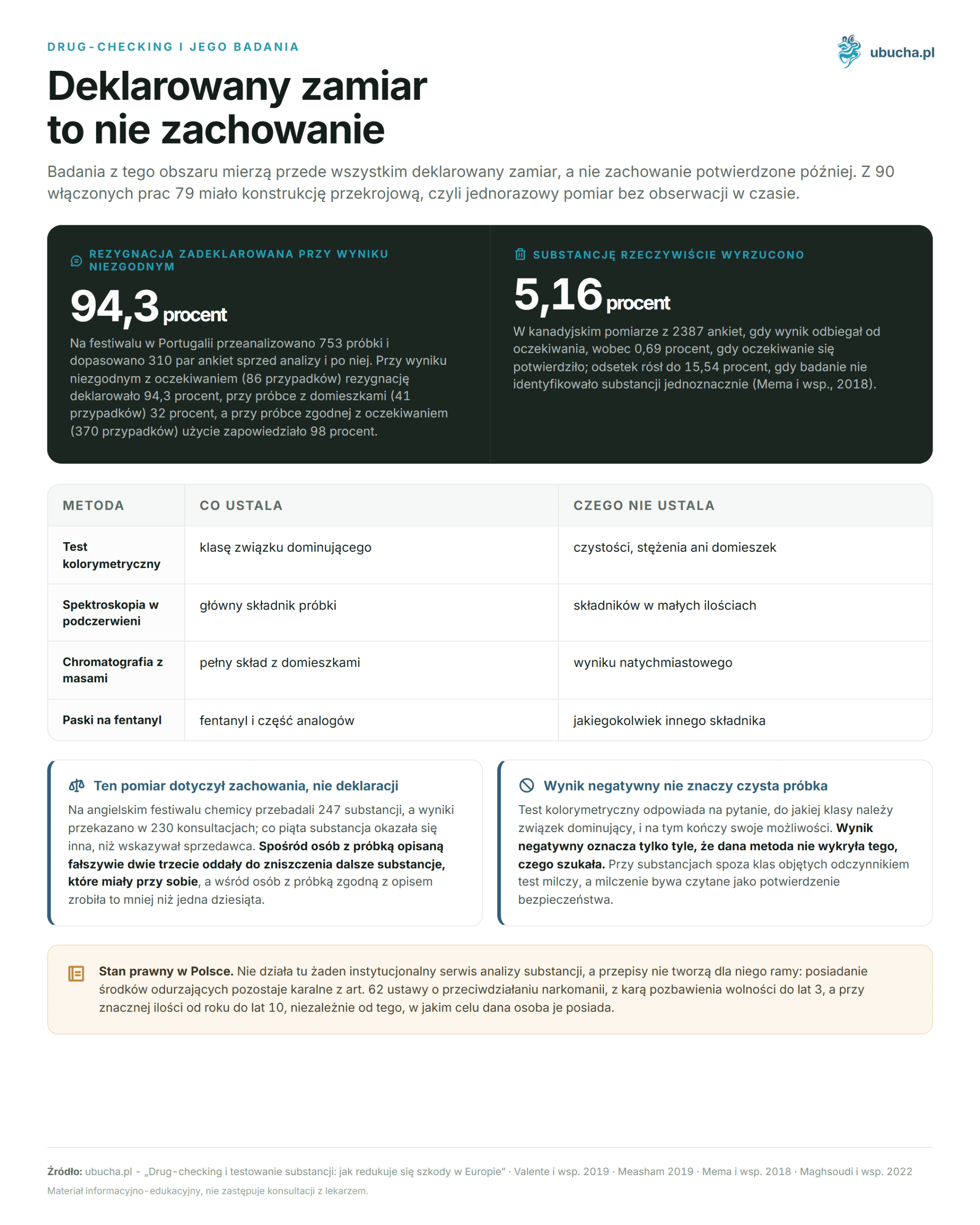
We noticed while organizing the literature that there is something that changes the way these data are read. Studies in this area primarily measure declared intention, not behavior confirmed later. The systematic review by Maghsoudi et al. included 90 studies, of which 79 had a cross-sectional design, meaning a one-time measurement without observation over time (Addiction, 2022). The authors’ conclusion is cautious: services influence intentions and behavior, most strongly when the result is unexpected.
What do studies show about the effectiveness of drug-checking?
The effect is clear, but it depends on whether the result surprised the respondent. At the Boom festival in Portugal, 753 samples were analyzed, and 310 pairs of surveys filled out before and after the analysis were matched. When the result was unexpected (86 cases), 94.3% of people declared they would refrain from use. When the sample contained the expected substance with adulterants (41 cases), 32% declared they would refrain. When it contained only the expected substance (370 cases), 98% of respondents announced they would use it (Valente et al., International Journal of Drug Policy, 2019).
A study from an English festival in July 2016 measured behavior, not declaration. Chemists tested 247 substances over four days, and results were provided in 230 consultations. One in five substances turned out to be different from what the seller indicated. Among those whose sample was falsely described, two-thirds disposed of further substances they had with them; among those with a sample consistent with the description, less than one-tenth did so (Measham, International Journal of Drug Policy, 2019).
A Canadian measurement from a festival in British Columbia provides lower numbers and is worth knowing for balance. Of 2387 surveys containing both expectation and result, 5.16% of people disposed of the substance when the result deviated from expectation, compared to 0.69% when the expectation was confirmed. The percentage rose to 15.54% when the test did not clearly identify the substance (Mema et al., Canadian Journal of Public Health, 2018).
Which analytical methods detect what?
The difference between them is greater than the common name of the service suggests. A simple reagent test answers the question of which class the dominant compound in the sample belongs to, and that is where its capabilities end. Laboratory methods answer the question of what exactly and in what proportion is present in the sample, including trace adulterants.
| Method | What it determines | What it does not determine | Where it is available |
|---|---|---|---|
| Colorimetric test | class of the dominant compound | purity, concentration, or adulterants | reagent kits for personal use |
| Infrared spectroscopy | main component of the sample | components present in small amounts | mobile services at events |
| Chromatography with mass spectrometry | full composition including trace adulterants | immediate result | laboratories of stationary services |
| Fentanyl test strips | presence of fentanyl and some analogs | any other component | harm reduction programs, mainly outside Europe |
The practical consequence is that a negative result from a simple test does not mean a pure sample. It only means that the method did not detect what it was looking for. For substances outside the classes covered by the reagent, the test is silent, and silence can be read as confirmation of safety. The same problem with recognizing composition was described in the text about synthetic cannabinoids.
Where in Europe does drug-checking operate and who supervises it?
Services are run by non-governmental organizations and health care facilities in some European countries, and aggregate data on the drug market is sent to the EU agency. As of July 2, 2024, this agency will be the European Union Drugs Agency, which replaced the European Monitoring Centre for Drugs and Drug Addiction. The basis is Regulation (EU) 2023/1322, which repeals Regulation 1920/2006.
The date is of organizational significance because the year 2023 often appears in texts about harm reduction as the moment of the name change. The regulation was indeed adopted on June 27, 2023, but the agency under the new name and with a new mandate has only been operating since July 2024. Documents issued earlier are signed with the old name and should not be attributed to the new agency.
The geography of the research is clearly European. In the review by Maghsoudi et al., 65 out of 90 included studies were from Europe, and the monitoring of the market by analytical services is considered well-established in this part of the world. As barriers on the user side, the authors mention lack of concern about composition, trust in the seller, unavailability of the service, and legal and privacy concerns.
Is drug-checking legal in Poland?
No institutional substance analysis service operates in Poland, and the regulations do not create a framework for it. It is decisive that the very act that such a service handles remains punishable. Anyone who possesses narcotic drugs or psychotropic substances in violation of the provisions of the Act is subject to imprisonment for up to 3 years (Article 62, paragraph 1 of the Act on Counteracting Drug Addiction). For significant amounts, the penalty ranges from 1 to 10 years (Article 62, paragraph 2), and in the case of lesser importance, a fine, restriction of liberty, or imprisonment for up to 1 year (Article 62, paragraph 3).
Article 62a allows for the discontinuation of proceedings when the subject of the act under Article 62, paragraph 1 or 3 is a small amount intended for personal use, and a penalty would be inappropriate due to the circumstances of the act and the degree of its social harmfulness. The provision mentions discontinuation “also before the issuance of a decision to initiate an investigation or inquiry,” so the possibility also exists later. It does not refer to paragraph 2. The consolidated text of the Act is available in the ELI legal acts register under the signature Dz.U. 2023 poz. 1939.
In Poland, the Social Initiative for Drug Policy conducts educational activities in this area, publishing materials on the composition of substances, adulterants, and substitutes (sin.org.pl). This is education, not chemical analysis on commission, and does not change the legal status described above. The broader regulatory context for clinically tested substances is described in the text about the American regulator’s decision regarding MDMA therapy.
Frequently asked questions
What is drug-checking?
The user anonymously submits a small sample of a substance, the service determines its composition using analytical methods, and the result is returned to them along with a discussion about the risks. The service does not evaluate the user’s decision and does not carry legal consequences in countries that have allowed it.
Does drug-checking really change user behavior?
It does, most strongly when the result is unexpected. At the Boom festival in Portugal, 94.3% of those with such a result declared they would refrain from using the sample, compared to 32% with a sample containing adulterants (Valente et al., 2019). A review of 90 studies confirms the impact on intentions and behavior, noting the predominance of cross-sectional designs.
Is a simple reagent test sufficient?
No. A colorimetric test indicates the class of the dominant compound in the sample and does not provide any information about purity, concentration, or the presence of small amounts of adulterants. A negative result only means that the method did not react, not that there is no dangerous substance in the sample.
Which EU agency collects data on the drug market?
As of July 2, 2024, the European Union Drugs Agency, which replaced the European Monitoring Centre for Drugs and Drug Addiction. The basis is Regulation (EU) 2023/1322, adopted on June 27, 2023, which repeals Regulation 1920/2006. Older documents are signed with the previous name.
Is there a legal drug-checking service in Poland?
No. There is no institutional substance analysis service, and the regulations do not create a legal framework for it. Possession of narcotic drugs remains punishable under Article 62 of the Act on Counteracting Drug Addiction, regardless of the purpose for which a person possesses them.
Can proceedings be discontinued for a small amount?
Yes, but not automatically. Article 62a of the Act on Counteracting Drug Addiction allows for discontinuation when the subject of the act under Article 62, paragraph 1 or 3 is a small amount intended for personal use, and a penalty would be inappropriate given the circumstances of the act and the degree of its social harmfulness. The provision does not cover significant amounts.
This article is for informational and educational purposes and does not constitute legal advice. The legal status described in the article is valid as of the date of publication: regulations regarding controlled substances may change. Consult a lawyer or current legal acts before making decisions.
Author: Michał Waluk · Published: 2026-08-09 · Updated: 2026-08-16