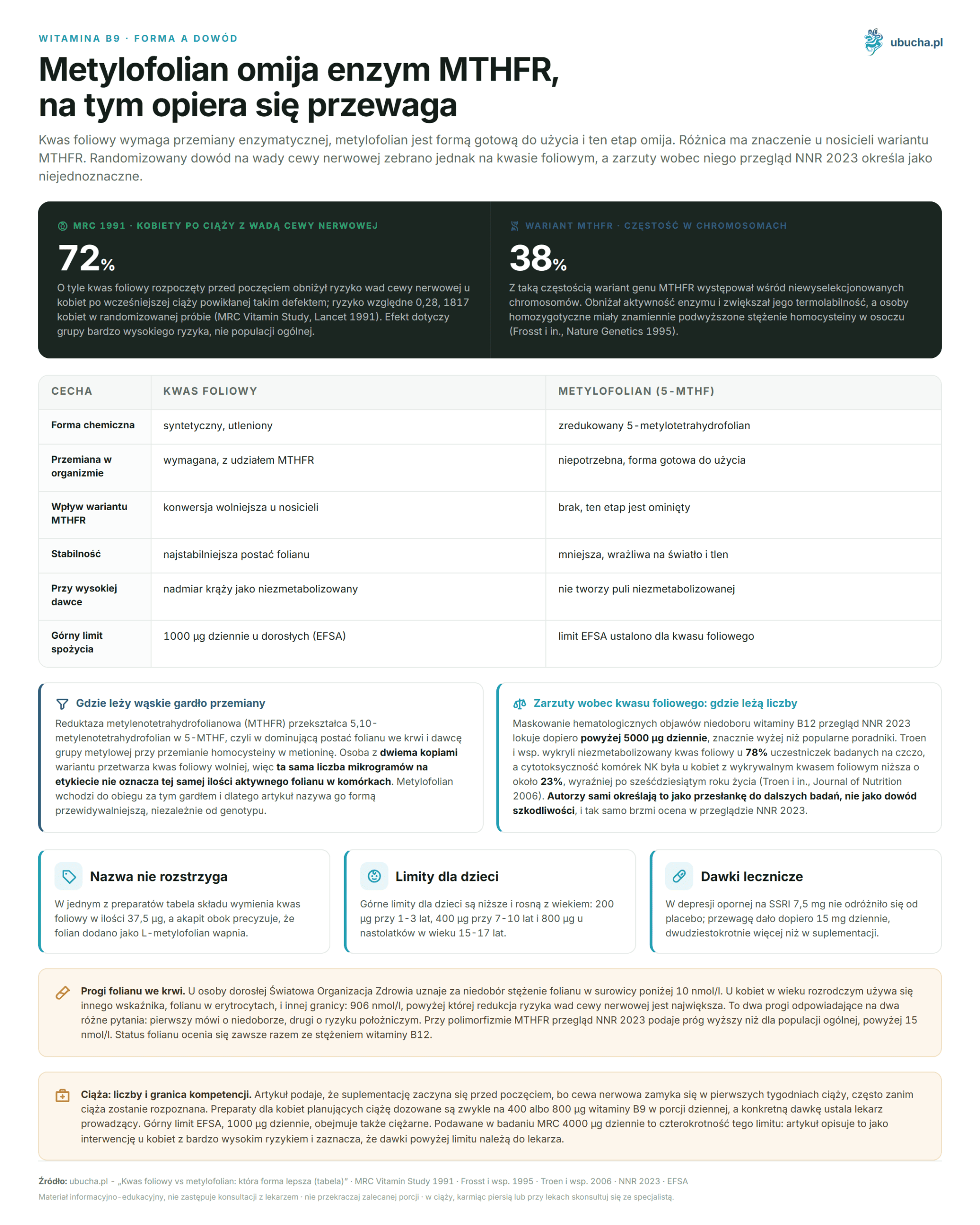

Folic Acid vs Methylfolate: Which Form is Better (Table)
Folic acid or methylfolate: table of differences, thresholds of folate in the blood, upper limit of intake, dose from the MRC study, and cost per portion of vitamin B9 preparations.
Vitamin B9 participates in DNA synthesis, cell division, and methylation. In a randomized study by the Medical Research Council in 1991, supplementation with folic acid started before conception reduced the risk of neural tube defects in women with a previous pregnancy complicated by such a defect by 72%. This is one of the strongest effects that has been demonstrated in nutrition. The problem begins at the supplement shelf because vitamin B9 is sold in two forms that the body treats differently. Folic acid is synthetic and requires enzymatic transformation. Methylfolate is a ready-to-use form. Below you will find a table of differences, verified thresholds of folate in the blood, the upper limit of intake, and the cost of daily portions of vitamin B9 preparations that are actually available.
KEY INFORMATION
• Folic acid before conception reduced the risk of neural tube defects by 72% (MRC Vitamin Study, Lancet 1991).
• Methylfolate bypasses the MTHFR-dependent stage, whose variant has a frequency of about 38% of alleles (Frosst et al., 1995).
• The upper limit of folic acid intake for adults is 1000 µg per day (EFSA).
• Six preparations declare vitamin B9 in the catalog, two in methylated form.
What is the difference between folic acid and methylfolate?
Folic acid is a synthetic, oxidized form of vitamin B9 that the body must first reduce and methylate before the cell can use it. Methylfolate, or 5-methyltetrahydrofolate, is an already active form that enters metabolism without this transformation. The entire practical difference boils down to one enzyme on this pathway.
This enzyme is methylenetetrahydrofolate reductase, abbreviated as MTHFR. It converts 5,10-methylenetetrahydrofolate into 5-MTHF, which is the dominant form of folate in the blood and a methyl group donor in the conversion of homocysteine to methionine. Frosst and colleagues described a common mutation of the MTHFR gene in 1995, changing a highly conserved amino acid residue. In their material, this variant occurred with a frequency of about 38% of unselected chromosomes, reduced enzyme activity, and increased its thermolability, and homozygous individuals had significantly elevated homocysteine levels in plasma (Frosst et al., Nature Genetics 1995).
What does this mean when purchasing a supplement? A person with two copies of the variant processes folic acid more slowly, so the same number of micrograms on the label does not mean the same amount of active folate in the cells. Methylfolate enters circulation beyond this bottleneck. It is therefore a more predictable form, regardless of genotype, and this is the entire advantage attributed to it in manufacturers’ materials.
Folic acid or methylfolate: what does the comparison table show?
The table below organizes these differences that really matter when choosing a preparation: chemical form, dependence on genotype, and behavior at high doses. The data comes from the folate review prepared for Nordic Nutrition Recommendations 2023 and from the works cited later in the text.
| Feature | Folic Acid | Methylfolate (5-MTHF) |
|---|---|---|
| Chemical form | synthetic, oxidized pteroylmonoglutamic acid | reduced 5-methyltetrahydrofolate |
| Transformation in the body | required, multi-step, involving MTHFR | not needed, ready-to-use form |
| Impact of MTHFR variant | slower conversion in carriers | none, this stage is bypassed |
| Stability | most chemically stable form of folate | lower, reduced form is sensitive to light and oxygen |
| At high doses | excess circulates as unmetabolized folic acid | does not create an unmetabolized pool |
| Upper limit of intake | 1000 µg per day for adults and pregnant women (EFSA) | EFSA limit set for folic acid, not for this form |
| Masking symptoms of B12 deficiency | described above 5000 µg per day | not described |
| Occurrence in food | fortified food and supplements | natural folates in liver, green vegetables, and legumes |
| Raw material price | low | higher, especially in patented forms |
One row of this table is often overinterpreted. The lack of an unmetabolized pool is a biochemical fact, but not proof that folic acid in an acceptable dose harms anyone. The NNR 2023 review states directly that observations indicating adverse effects of high folic acid intake remain ambiguous (Bjørke-Monsen and Ueland, NNR 2023).
Who really needs the methylated form?
The methylated form is most needed by carriers of the MTHFR variant, especially homozygotes, and individuals with elevated homocysteine levels. The same review states that with MTHFR polymorphism, serum folate levels should exceed 15 nmol/l, which is more than the threshold accepted for the general population.
The general threshold is 10 nmol/l: below this value, the World Health Organization considers folate deficiency in an adult. In women of childbearing age, a different indicator is used, namely folate in erythrocytes, with a different threshold of 906 nmol/l. Above this level, the reduction of the risk of neural tube defects is greatest. These are two thresholds answering two different questions: the first speaks of deficiency, the second of obstetric risk. The authors of the review add that folate status is always assessed together with vitamin B12 levels, as both vitamins work in the same cycle. How to test the latter and why a normal result does not close the matter is described in the text about vitamin B12 and energy.
We checked how this difference appears on the labels of the preparations in our catalog, and the conclusion is inconvenient for the buyer. The chemical form may be stated in a completely different place in the description than the amount. In one of the preparations, the composition table lists folic acid at 37.5 µg, while the paragraph next to it specifies that folate was added as calcium L-methylfolate. The name in the composition table does not determine the form. The full list of ingredients does.
How much folate to take during pregnancy and from when?
Supplementation begins before conception because the neural tube closes in the first weeks of pregnancy, often before the pregnancy is recognized. Preparations for women planning pregnancy are usually dosed at 400 or 800 µg of vitamin B9 per daily portion. The specific dose is determined by the attending physician.
The evidence on which this entire practice is based comes from the Medical Research Council study. A randomized trial in 33 centers in seven countries included 1817 women with a history of a previous pregnancy with a neural tube defect. Among 1195 completed pregnancies, a defect was found in 27 children: six in the groups receiving folic acid and twenty-one in the others. This gives a protective effect of about 72%, with a relative risk of 0.28 (MRC Vitamin Study Research Group, Lancet 1991). The set of the remaining seven vitamins did not yield a significant effect.
Note the dose given there: 4000 µg per day, which is four times the upper limit of intake that EFSA sets at 1000 µg per day also for pregnant women. This is not a contradiction, but a boundary between population prevention and intervention in a woman at very high risk. Doses above the limit belong to the doctor, not to self-selection from the shelf.
Does excess folic acid harm?
For adults and for pregnant women, EFSA sets the upper limit of folic acid intake at 1000 µg per day. For children, the limits are lower and increase with age: from 200 µg at ages 1-3, through 400 µg at ages 7-10, to 800 µg in teenagers aged 15-17.
The most frequently repeated accusation against folic acid concerns masking vitamin B12 deficiency. The NNR 2023 review places this effect much higher than popular guides suggest: masking hematological symptoms of cobalamin deficiency has only been described with intake exceeding 5000 µg per day. The authors also note that adverse effects have been reported only for synthetic folic acid, never for folates from food.
A separate issue is unmetabolized folic acid circulating in the blood. Troen and colleagues detected it in 78% of fasting study participants, and the cytotoxicity of NK cells was about 23% lower in women with detectable folic acid. The relationship intensified with concentration and was more pronounced in women over sixty (Troen et al., Journal of Nutrition 2006). The authors themselves describe the conclusion as a premise for further research, not as proof of harm, and the same assessment appears in the NNR 2023 review.
What does folate do with homocysteine, stroke, and mood?
Folate lowers homocysteine, and homocysteine is a marker of vascular risk. In an analysis of 1160 participants in the Framingham Heart Study aged 67-96, homocysteine levels showed a strong inverse relationship with plasma folate levels, and elevated values were found in 29.3% of the subjects.
This same work attributes vitamin B deficiencies to 67% of cases of elevated homocysteine in this population (Selhub et al., JAMA 1993). Does this translate into hard endpoints? A meta-analysis of eight randomized studies showed that folic acid supplementation reduces the risk of stroke by 18%, with the effect being more pronounced with treatment longer than 36 months and in populations without grain fortification, where the relative risk was 0.75 (Wang et al., Lancet 2007). Poland belongs to such populations, as fortifying flour is voluntary here.
The psychiatric thread requires a more cautious statement than is usually attributed to it. In two double-blind studies, L-methylfolate was added to the treatment of SSRI-resistant depression. A dose of 7.5 mg did not differ from placebo. Only 15 mg per day showed a significant advantage, with a number needed to treat of about six (Papakostas et al., American Journal of Psychiatry 2012). These are therapeutic doses, twenty times higher than supplemental ones.
Which preparations in the Bucha offer contain vitamin B9?
We searched the entire store catalog, 386 items, by name and by full description of the composition. No product has folate in the name. Six preparations declare vitamin B9, and two of them have the methylated form, namely calcium L-methylfolate. Below are five vitamin preparations; the sixth is gummies with apple cider vinegar, where B9 is a secondary ingredient.
| Preparation | Form and amount of B9 | What distinguishes it | Price | Cost per portion |
|---|---|---|---|---|
| Vitamin B Complex, 120 tablets | folic acid, amount not specified | eight B vitamins, vegan formula, cheapest option | 18.59 zł | 0.15 zł |
| Navigator B-50 Complex, 120 capsules | folic acid, amount not specified | concentrated B-50 complex, one capsule per day | 85.90 zł | 0.72 zł |
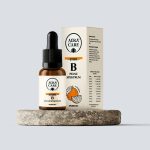
| Aura Care Vitamin B Full Spectrum, 15 ml | folic acid, 75 µg (37.5% RWS) | drops for adults, manufacturer states non-methylated forms | 79.00 zł | 2.63 zł |
| Aura Care Kids Vitamin B Full Spectrum, 15 ml | calcium L-methylfolate, 100 µg (50% RWS) | methylated formula, dosing drops according to child’s age | 99.00 zł | 3.30 zł |
| Aura Care Collagen Beauty Power, 500 ml | calcium L-methylfolate, 37.5 µg (19% RWS) | fish collagen with vitamins in active forms, portion 25 ml | 139.00 zł | 6.95 zł |
Prices are from the store, as of 2026-08-08, and may change. We calculated the cost per portion as the price divided by the number of daily portions declared by the manufacturer in the product description. All these items fall into the Supplements category.
How to compare the cost per portion and read the label?
The price on the label says nothing until you reduce it to the daily portion. The range in this group of preparations is over forty-fold: from 15 groszy to nearly seven zlotys per day. The chart below shows this difference in store prices.
The chart also shows what the cost per portion does not measure. The most expensive item is collagen with a set of vitamins, in which B9 constitutes a fraction of the formula, so comparing it with a B Complex tablet is comparing two different purchases. It makes sense to compare preparations with the same purpose. When is it worth having a complex preparation, and when a single vitamin, we resolve in the text about multivitamins.
On the label, look for the chemical form, not the marketing slogan. The entries “calcium L-methylfolate”, “5-MTHF” or “(6S)-5-methyltetrahydrofolate” indicate the active form. The word “folate” or “folate” alone does not determine anything. Also check if the manufacturer even states the amount in micrograms: two of the five preparations in the table above mention vitamin B9 in the composition, but do not declare the content per portion, and without this number, it is impossible to assess how much of the requirement you are covering.
Frequently Asked Questions
What is the difference between folic acid and methylfolate?
Folic acid is a synthetic, oxidized form of vitamin B9 that the body must reduce and methylate before the cell can use it. Methylfolate, or 5-methyltetrahydrofolate, is an already active form that bypasses the MTHFR-dependent stage. The difference matters for carriers of the MTHFR variant, which reduces the activity of this enzyme.
Who should choose methylfolate instead of folic acid?
Primarily individuals with a confirmed MTHFR variant, especially homozygotes, and those with elevated homocysteine levels. The folate review for Nordic Nutrition Recommendations 2023 states that with MTHFR polymorphism, serum folate levels should exceed 15 nmol/l, compared to the threshold of 10 nmol/l accepted for the general population.
How much folate should be taken during pregnancy?
The dose is determined by a doctor. Preparations for women planning pregnancy are usually dosed at 400 or 800 µg of vitamin B9 per daily portion. The upper limit of folic acid intake is 1000 µg per day according to EFSA, which also includes pregnant women, so higher doses require medical supervision.
Can folic acid be overdosed?
The upper limit of intake for adults is 1000 µg per day according to EFSA. Masking hematological symptoms of vitamin B12 deficiency has only been described with intake exceeding 5000 µg per day. Data on other adverse effects of high folic acid intake are described in the NNR 2023 review as ambiguous.
How to check folate levels in the blood?
In adults, the World Health Organization considers a serum folate level below 10 nmol/l as deficiency. In women of childbearing age, a separate indicator is used, namely folate in erythrocytes, with a threshold of 906 nmol/l. Folate status is always assessed together with vitamin B12 levels.
Does cooking destroy folate in vegetables?
Partially yes. Natural folates occur in reduced forms, sensitive to light and oxidation, and are partially destroyed by cooking. The bioavailability of folate from food is estimated to be approximately 50% of the bioavailability of folic acid, with data ranging from 30 to 98%.
If you are looking for a vitamin B9 preparation for yourself, start by comparing forms and daily portions in the Supplements category, as all B complex products available in the store are there.
This article is for informational and educational purposes only and does not constitute medical advice. Before starting supplementation, consult a doctor, especially if you are taking medications regularly, are pregnant or breastfeeding, or have a chronic illness.
Author: Michał Waluk · Published: 2026-08-05 · Updated: 2026-08-08