
Neurobiology of addiction - how CBD suppresses the reward pathway and cue-induced craving
Neurobiology of addiction — the mechanism explained simply, based on research. u Bucha.
Addiction is not a matter of willpower - it is a change in the structure and function of the brain, particularly the dopamine-based reward system. The first well-designed clinical study showed that CBD (400-800 mg at once) significantly reduced cue-induced craving in individuals addicted to heroin, and the effect lasted for at least seven days (Hurd et al., American Journal of Psychiatry, 2019). This article explains the neurobiological mechanism behind this effect.
KEY INFORMATION
• CBD does not directly block dopamine receptors but modulates the reward pathway through 5-HT1A and increases anandamide.
• Clinical study by Hurd et al. (2019): CBD 400-800 mg reduced cue-induced craving in individuals addicted to heroin for at least 7 days.
• The mechanism of "cue-induced craving" is one of the main relapse factors - CBD directly targets it.
• CBD does not replace addiction therapy - it is being studied as an adjunct to reduce craving and anxiety during withdrawal.
• Preliminary evidence relates to opioids and alcohol; studies on cocaine and nicotine addiction are ongoing.
Neurobiology of addiction - what is the reward pathway and why is it so hard to overcome
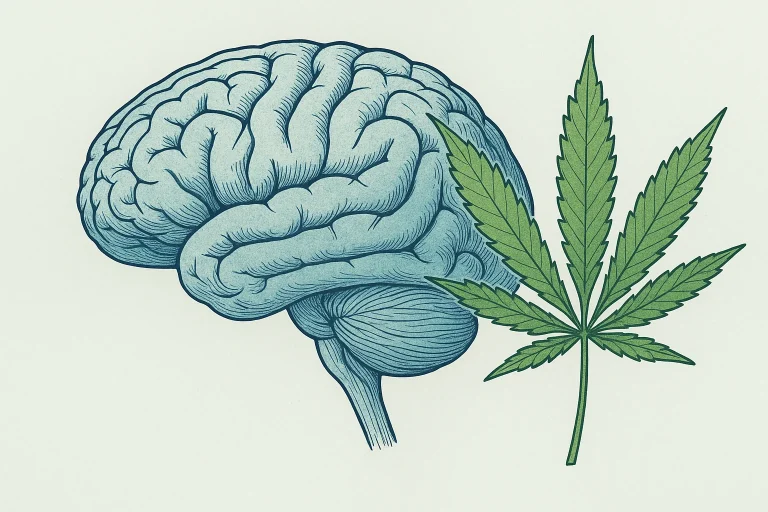
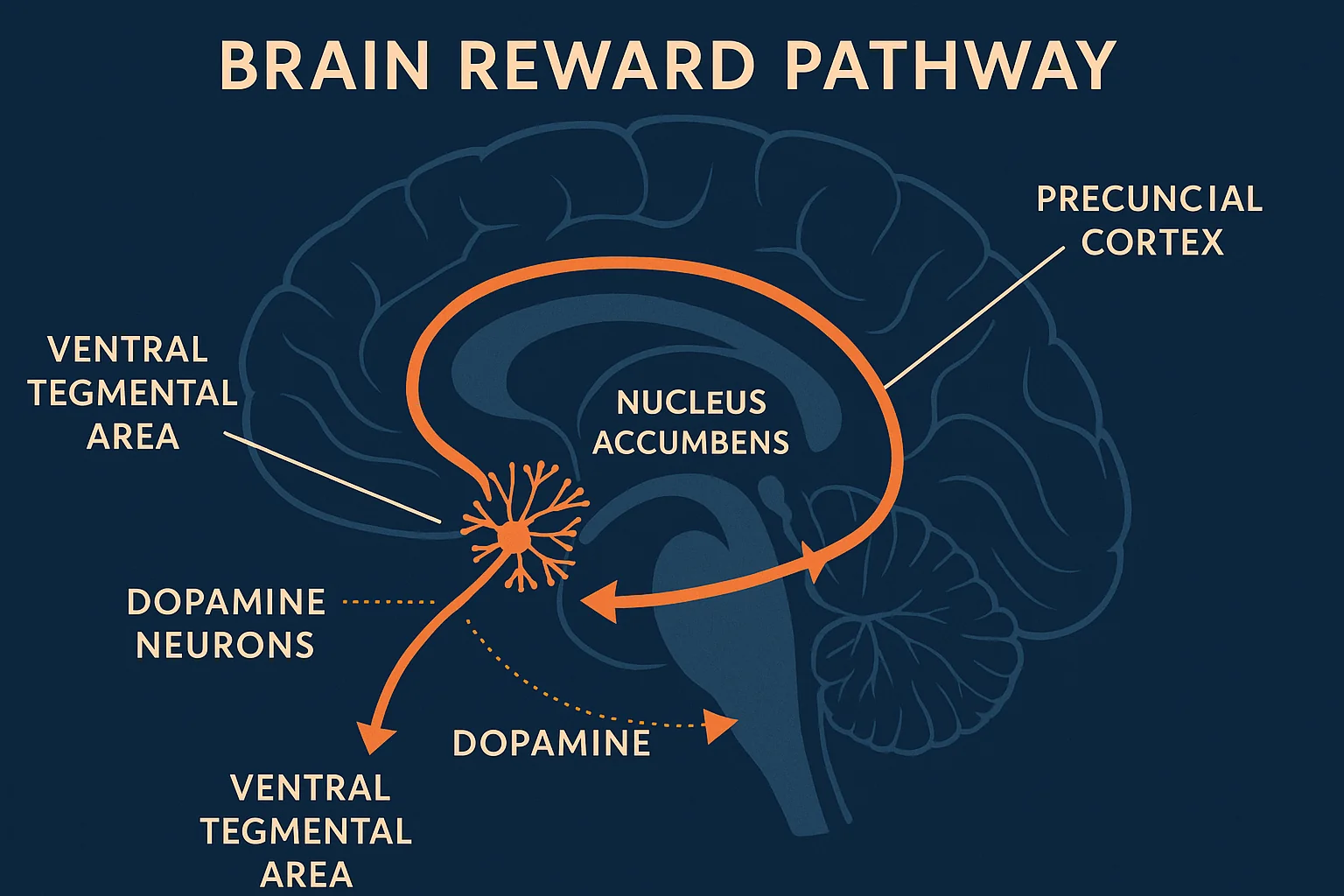
Addiction arises from the pathological hijacking of the evolutionary reward system by psychoactive substances. The mesocorticolimbic pathway - encompassing the nucleus accumbens, the ventral tegmental area (VTA), the prefrontal cortex, and the amygdala - serves as the neurological basis for motivation, reward, and learning. Dopamine released from the VTA to the nucleus accumbens encodes the "reward signal" that drives behaviors essential for survival (eating, sex, social contact).
Addictive substances - opioids, cocaine, alcohol, nicotine - release dopamine in the nucleus accumbens in amounts 2 to 10 times higher than natural rewards. The brain "learns" that the substance is more important than anything else and adapts its circuits: D2 dopamine receptors undergo downregulation (their number decreases), the prefrontal cortex loses inhibitory control over impulses (reflected in poor decision-making), and the amygdala builds strong associations between environmental cues (smell, place, people) and the reward.
It is the cue-induced craving that is the greatest factor in relapses - not the physical need for the substance, but the associative triggering of desire by neutral environmental cues. A person who has been abstinent for months sees a lighter, and a sensory "flash" of dopamine can trigger a cascade leading to relapse. CBD, as shown in the study by Hurd et al., targets exactly this mechanism.
Jak CBD moduluje szlak nagrody - mechanizmy molekularne
CBD is not a classic antagonist of dopamine receptors. It does not block D1 or D2 like antipsychotic drugs. Its effect on the reward pathway is indirect, multi-faceted, and ultimately more selective - it targets the pathological hyperactivity of the system, not the neurotransmitter itself.
The 5-HT1A pathway - serotonin suppresses dopamine.
CBD is an agonist of the 5-HT1A serotonin receptor. Activation of 5-HT1A in the raphe nucleus inhibits serotonin release, which seems paradoxical - but 5-HT1A is an autoinhibitory receptor, and its activation by CBD plays a modulatory role in the serotonin-dopamine relationship. Studies have shown that activation of 5-HT1A in the VTA and nucleus accumbens reduces the dopaminergic response to rewarding stimuli (Russo et al., Neuropsychopharmacology, 2005). For an addict, this means a dulling of the "dopamine signal" triggered by environmental cues - a smaller "flash" when seeing a lighter.
FAAH i anandamid - endokannabinoidowa bramka nagrody
Anandamide is an endogenous CB1 ligand and acts as a retrograde messenger - it is released by postsynaptic neurons and acts backward on presynaptic neurons, modulating neurotransmitter release. In the dopaminergic system, anandamide regulates dopamine release from dopaminergic terminals in the nucleus accumbens via CB1. CBD inhibits FAAH (the enzyme that degrades anandamide), raising its level - which adjusts the dopaminergic response of the reward system towards homeostasis instead of hyperactivity (Hurd et al., Am J Psychiatry, 2019).
HPA stress axis and abstinence anxiety
Abstinence from addictive substances is often painful not physically, but emotionally: anxiety, irritability, anhedonia (the inability to feel pleasure), and a strong need for relief dominate. The HPA axis (hypothalamic-pituitary-adrenal) is hyperactive during abstinence - high cortisol and CRH (corticotropin-releasing hormone) enhance the reactivity of the amygdala to stress and addiction-related stimuli. CBD reduces HPA axis activity and lowers amygdala reactivity, decreasing the emotional component of craving (Hindocha et al., Neuropsychopharmacology, 2020).
Table: CBD mechanisms and addiction - clinical and preclinical studies.
The table below summarizes key CBD mechanisms relevant to addiction and the corresponding evidence from clinical and preclinical studies. It provides the type of study, outcome, and strength of evidence - as there is still a significant gap between animal models and human studies in this field.
| Mechanism / application | Type of addiction | Type of study | Outcome | Strength of evidence |
|---|---|---|---|---|
| Reduction of cue-induced craving | Opioids (heroin) | RCT in humans | Significant reduction of hunger and anxiety for 7 days | High (RCT, 2019) |
| Reduction of alcohol self-administration | Alcohol | Preclinical studies (rats) | Reduction of voluntary alcohol consumption | Moderate (no RCT) |
| Reduction of nicotine craving | Nicotine | Small RCT (Morgan et al., 2013) | Reduction of the number of cigarettes smoked by ~40% vs placebo | Preliminary (small trials) |
| Reduction of opioid withdrawal symptoms | Opioids | RCT (Hurd et al., 2019) | Reduction of anxiety and abstinence dysphoria | High |
| Modulation of amygdala reactivity | General (addiction-related stress) | Neuroimaging fMRI | Reduction of amygdala reactivity to stress | Moderate |
| Neuroprotective effects against methamphetamine/cocaine | Stymulanty | Animal models | Reduction of reinstatement (return to seeking) | Preliminary (animals) |
Badanie Hurd et al. (2019) - pierwsze solidne RCT na ludziach
The study by Yasmin Hurd and colleagues published in American Journal of Psychiatry in 2019 is the first well-designed, randomized, placebo-controlled trial regarding CBD and opioid addiction in humans. The study involved 42 individuals with a history of heroin addiction who had been abstinent for at least 7 days. Participants received CBD (400 mg or 800 mg) or placebo.
Cue exposure protocol: participants watched neutral films and heroin-related films (syringes, powder, preparation rituals) - a classic cue-induced craving paradigm. The result was statistically and clinically significant: CBD at both doses (400 and 800 mg) significantly reduced craving triggered by heroin cues and the accompanying anxiety compared to placebo. The effect did not appear with neutral cues - CBD did not "dull" overall reactivity, but selectively suppressed addiction-related reactivity. Notably, the effect lasted for at least 7 days after the last dose of CBD - indicating a mechanism more durable than the substance concentration in the blood (Am J Psychiatry, 2019).
Limitations of the studies and what we know for sure
Despite promising results, several significant limitations must be honestly articulated. First, the study by Hurd et al. used very high doses of CBD (400-800 mg at once) - many times higher than typical supplemental doses (10-50 mg). The effectiveness of lower doses in the context of addiction has not been studied. Second, the study involved individuals abstinent from heroin, not actively addicted - application in the active phase of addiction has not been investigated. Third, most studies on alcohol, cocaine, and stimulants come from animal models - translation to humans requires its own RCT.
The long-lasting effect of CBD (>7 days post-administration) suggests that the mechanism of action is not limited to pharmacological blockade of receptors during CBD concentration in the blood. It likely involves synaptic plasticity - lasting modifications of connections in stress and addiction circuits. This is an active field of research, but it exceeds what we know for certain today.
Frequently Asked Questions
How does CBD affect the dopamine reward pathway?
CBD modulates the reward pathway indirectly by activating 5-HT1A (inhibiting excessive dopaminergic activity in the nucleus accumbens), increasing anandamide by inhibiting FAAH (retrograde dopaminergic modulation via CB1), and reducing reactivity of the amygdala and HPA axis. It does not directly block D1/D2 receptors. The effect is to blunt pathological hyperactivity of the reward pathway, not to block it (Hurd et al., Am J Psychiatry, 2019).
Can CBD reduce drug cravings?
Yes - the clinical study by Hurd et al. (2019) showed that CBD 400-800 mg at once significantly reduced craving and anxiety triggered by heroin cues for at least 7 days. This is the first well-designed RCT documenting this effect in humans. Data on other substances (alcohol, nicotine) come from small studies or animal models and require confirmation in larger trials.
Does CBD help with alcohol addiction?
The evidence is preliminary - mainly preclinical studies on rat models showing a reduction in alcohol self-administration and reinstatement behaviors after exposure to alcohol cues. The mechanism involves CB1 modulation in the striatum and protection of the liver from oxidative stress. Several phase 2 clinical trials are underway. The WHO listed addiction as an area of potential CBD activity in its 2018 report.
How long does CBD work in reducing cravings in addicts?
In the study by Hurd et al. (2019), the effect of a single dose of CBD on craving reduction lasted at least 7 days. This is surprisingly long for a single dose and suggests lasting synaptic plasticity as a mechanism, not just pharmacological receptor blocking during blood concentration (Am J Psychiatry, 2019). The mechanism of this long-lasting effect is actively being researched.
Can CBD replace addiction therapy?
No - CBD is being studied as an adjunct, not a replacement for therapy. Treating addiction requires a comprehensive approach: psychotherapy (CBT), pharmacotherapy (methadone, buprenorphine, naltrexone for opioids), and social support. CBD may play an auxiliary role - reducing craving, withdrawal anxiety, and reactivity to environmental cues - but it does not replace any of these elements of standard addiction therapy.
This article is for informational and educational purposes and does not replace consultation with a doctor. If you are pregnant, breastfeeding, taking medications, or have chronic conditions, consult the use of supplements or herbs with a specialist.
Author: Michał Waluk · Published: 2026-05-04 · Updated: 2026-05-04