
Which supplements are dangerous in excess: a guide to upper limits (UL)
Which supplements are dangerous in excess? Current upper limits set by EFSA for vitamins and minerals, with the effect on which each limit is based, and changes from 2023-2024.
Upper intake limits are one of the few numbers in the supplement world that are not a seller’s recommendation, but a boundary set by a risk assessment body. In 2023 and 2024, the EFSA panel recalculated them for several ingredients, and some values repeated in product descriptions are no longer current. The most notable example: the limit for vitamin B6 was reduced by more than half, and for selenium, it was lowered by 45 micrograms. In the case of iron, the panel concluded that a limit cannot be established at all and instead provided a value with a different status. This guide collects the applicable values in one place, providing the health effect on which each is based and indicating the opinion from which it originates.
KEY INFORMATION
• EFSA lowered the limit for vitamin B6 to 12 mg per day in 2023 (EFSA, 2023).
• The limit for selenium was lowered in the same year to 255 micrograms per day.
• No limit was established for iron; a safe intake level of 40 mg per day was provided.
• There is no limit for beta-carotene in supplements, and smokers should avoid it.
What is the upper limit (UL) and who sets it?
The Tolerable Upper Intake Level (UL) is the highest daily amount of a nutrient from all sources combined, at which no adverse health effects are observed in nearly the entire adult population. In the European Union, it is set by the EFSA panel on nutrition, novel foods, and food allergens, and previously by the Scientific Committee on Food (SCF) (EFSA, reference values).
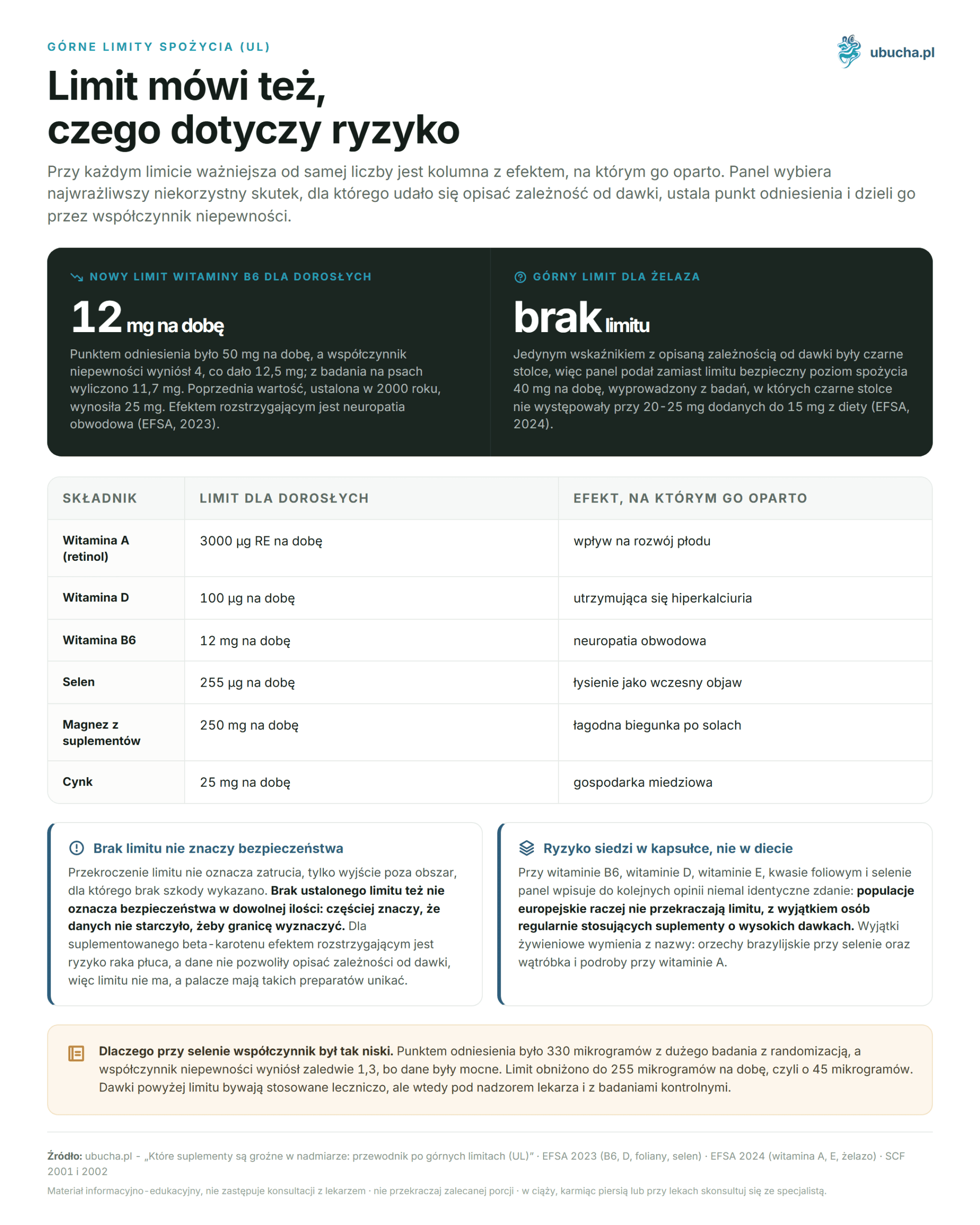
The value does not come from a single experiment. The panel selects the most sensitive adverse effect for which a dose-response relationship has been described, establishes a reference point, and divides it by an uncertainty factor. For vitamin B6, the reference point was 50 mg per day, and the uncertainty factor was 4. For selenium, the reference point was 330 micrograms from a large randomized study, and the uncertainty factor was only 1.3, as the data were strong.
From this arise two things that are easy to forget. Exceeding the limit does not mean poisoning, only going beyond the area for which no harm has been demonstrated. The absence of an established limit also does not mean safety at any amount: it more often means that there was not enough data to set a boundary. Doses above the limit may be used therapeutically, but then under medical supervision and with monitoring.
Which limits has EFSA changed in recent years?
The table below collects the applicable values for adults along with the year of the opinion and the health effect that served as the basis. The column with the effect is more important than the number itself, as it indicates what the risk actually pertains to.
| Ingredient | Upper limit for adults | Opinion | Effect on which the limit is based |
|---|---|---|---|
| Vitamin A (retinol) | 3000 µg RE per day | EFSA 2024 | Teratogenicity, i.e., harmful effects on fetal development |
| Beta-carotene from supplements | No limit established | EFSA 2024 | Risk of lung cancer; data did not allow for a dose-response relationship to be described. Smokers should avoid such supplements |
| Vitamin D | 100 µg per day | EFSA 2023 | Persistent hypercalciuria, an earlier signal of excess than hypercalcemia |
| Vitamin E (alpha-tocopherol) | 300 mg per day | EFSA 2024 | Impaired coagulation and risk of bleeding. The limit does not apply to those on anticoagulant and antiplatelet medications |
| Vitamin B6 | 12 mg per day | EFSA 2023 | Peripheral neuropathy |
| Folic acid | 1000 µg per day | EFSA 2023 | Exacerbation of neurological symptoms in individuals with vitamin B12 deficiency |
| Selenium | 255 µg per day | EFSA 2023 | Alopecia as an early and well-documented symptom of excess |
| Iron | No limit established; safe intake level 40 mg per day | EFSA 2024 | Black stools, the only indicator with a described dose-response relationship |
| Calcium | 2500 mg per day | EFSA 2012 | Value maintained; the panel did not confirm a link to kidney stones or cardiovascular disease |
| Magnesium from supplements | 250 mg per day | SCF 2001 | Mild diarrhea after magnesium salts |
| Zinc | 25 mg per day | SCF 2002 | Worsening of copper metabolism indicators |
Note the recurring statement that the panel includes in subsequent opinions. For vitamin B6, vitamin D, vitamin E, folic acid, and selenium, it is almost identical: European populations are unlikely to exceed the limit, except for those regularly taking high-dose supplements. The risk rarely lies in a normal diet, but more often in a capsule. The panel names exceptions: Brazil nuts for selenium and liver and offal for vitamin A. If you take one supplement, you are likely far from the limit. If you take three, and one of them is a multivitamin, it is worth summing the labels.
Why is the limit for vitamin B6 now more than twice as low?
Because the evidence base has changed, not the ingredient itself. In 2023, the panel accepted a reference point of 50 mg per day from a clinical-control study, supported by case descriptions and safety monitoring data. After applying an uncertainty factor of 4, it resulted in 12.5 mg. Separately, from a subchronic study on beagle dogs, 11.7 mg was calculated. From the middle of this range, after rounding down, the applicable limit of 12 mg per day for adults, including pregnant and breastfeeding women, was established (EFSA, 2023).
The effect on which the limit is based is peripheral neuropathy, i.e., damage to peripheral nerves manifested by numbness, burning, and sensory disturbances in the limbs. The panel describes the relationship between excess vitamin B6 and this complication as well established. The previous limit, set by the SCF in 2000, was 25 mg per day, so the reduction is just over twofold. It is important to know both numbers, as the older one is still encountered in product descriptions.
The practical consequence is easy to check in your own cabinet. Check how much pyridoxine is in a serving of your B vitamin supplement and compare it to 12 mg. If you are above, talk to your doctor or pharmacist, especially with chronic use. What each of the vitamins in this group actually does, we outlined in the text about B complex.
Does iron have an upper limit at all?
No, and this is a determination from 2024, not a gap in knowledge from decades ago. The panel states directly that systemic iron overload leads to organ damage, but a limit could not be established. The only indicator for which a dose-response relationship could be described was black stools, indicating a large amount of unabsorbed iron in the intestine. This is a conservative indicator and harmless in itself.
Instead of a limit, the panel provided a safe intake level: 40 mg per day for adults, including pregnant and breastfeeding women. This was derived from studies in which black stools did not occur with supplementation of 20-25 mg per day added to 15 mg from diet. For infants aged 7-11 months, the safe level of iron from supplements and fortified foods is 5 mg per day (EFSA, 2024).
The difference between the two concepts is not a formality, and the panel itself emphasizes it: the safe intake level is applied more narrowly than a limit because it is unknown at what amount the risk begins to increase. Additionally, the human body does not have an efficient mechanism for excreting excess iron, so excess accumulates in tissues. Individuals with undiagnosed hereditary hemochromatosis may accumulate it for years before symptoms appear. Therefore, iron is supplemented with confirmed deficiency, not preventively. We write more broadly about this in the text on iron excess.
What are the risks of excess vitamin A and vitamin D?
For vitamin A, the decisive effect for the limit is teratogenicity, i.e., harmful effects on fetal development. The limit of 3000 µg RE per day was maintained by the panel in 2024 and applies to men and women, including those of childbearing age, pregnant, breastfeeding, and postmenopausal women. The panel adds a dietary condition: European populations are unlikely to exceed the limit if liver, offal, and products made from them are limited to once a month or less. Women planning pregnancy and pregnant women are explicitly advised not to eat liver products (EFSA, 2024).
Beta-carotene is sometimes presented as a safe substitute for retinol, but the same opinion presents the matter differently. For supplemented beta-carotene, the decisive effect is the risk of lung cancer, and the data did not allow for a dose-response relationship to be described, so no limit was established at all. The panel recommends that smokers avoid beta-carotene supplements, and others use them only to meet their vitamin A needs.
For vitamin D, the limit is 100 µg per day and applies to adults and youth aged 11-17; for children aged 1-10, it is 50 µg. The reference point was persistent hypercalciuria, i.e., excessive calcium excretion in urine, which appears earlier than elevated blood calcium levels. The lowest level at which this effect was observed was 250 µg per day in two randomized studies, and the uncertainty factor was set at 2.5 (EFSA, 2023). Doses above the limit require medical supervision with monitoring of 25(OH)D and calcium levels.
Frequently Asked Questions
What is the upper limit (UL) for supplements?
It is the highest daily amount of a nutrient from all sources combined, at which no adverse effects are observed in nearly the entire adult population. In the European Union, it is set by the EFSA panel. Exceeding the limit does not mean poisoning, only going beyond the area for which no harm has been demonstrated. The absence of a limit does not mean safety at any amount.
What is the current limit for vitamin B6?
12 mg per day for adults, including pregnant and breastfeeding women. This value was established in 2023 with a reference point of 50 mg per day and an uncertainty factor of 4, supplemented by calculations from a study on dogs. The previous value, set by the SCF in 2000, was 25 mg. The decisive effect is peripheral neuropathy.
Can you overdose on vitamin D?
The limit is 100 µg per day for adults and youth from the age of 11. It is based on persistent hypercalciuria observed in two randomized studies at 250 µg per day, with an uncertainty factor of 2.5. Doses above the limit should only be used under medical supervision, with monitoring of 25(OH)D and calcium levels.
Does iron have an upper limit?
No. In the 2024 opinion, the EFSA panel was unable to set it and instead provided a safe intake level of 40 mg per day for adults. The panel notes that such a determination is narrower than a limit because it is unknown at what amount the risk begins to increase.
Can magnesium be overdosed?
The limit for magnesium from supplements is 250 mg per day and comes from the SCF opinion from 2001. It is based on mild diarrhea occurring after magnesium salts, not on organ damage. This value applies to added magnesium, not that naturally present in food.
Does folic acid increase the risk of colorectal cancer?
The EFSA panel assessed this data in 2023 and deemed it insufficient to establish a causal link with colorectal cancer, prostate cancer, or cognitive decline. The limit of 1000 µg per day was maintained on a different basis: the risk of exacerbating neurological symptoms in individuals with vitamin B12 deficiency.
Before adding another supplement, sum the doses from the labels of everything you are already taking, including items from the supplements category.
This article is for informational and educational purposes only and does not constitute medical advice. Before starting supplementation, consult your doctor, especially if you are taking medications regularly, are pregnant or breastfeeding, or have a chronic illness.
Author: Michał Waluk · Published: 2026-08-05 · Updated: 2026-08-16