
Bromelain for Inflammation and Digestion: What Studies Show (Table)
How much enzyme from pineapple really reaches the blood, what studies showed with placebo for the knee and sinuses, and why GDU cannot be converted to milligrams.
Bromelain, a mixture of proteases from the pineapple stem, has a history of seventy years of research and a very uneven layer of evidence. Laboratory reports of anti-edema and anti-inflammatory effects are numerous, but when it comes to randomized controlled trials, the picture becomes much more modest. Additionally, the two figures most often repeated in Polish guides refer to something different than they seem: one comes from a study on rats, the other is a unit of enzyme activity, not the mass of the preparation. This text separates what has been measured in humans from what has been transferred from animals and test tubes. For each indication, we provide the sample size, observation time, and whether the study had a control arm, because without this trio, the percentage number means nothing. Instead of a dosage table, you will find a table of studies, and in the last section, we explain why it is structured this way.
KEY INFORMATION
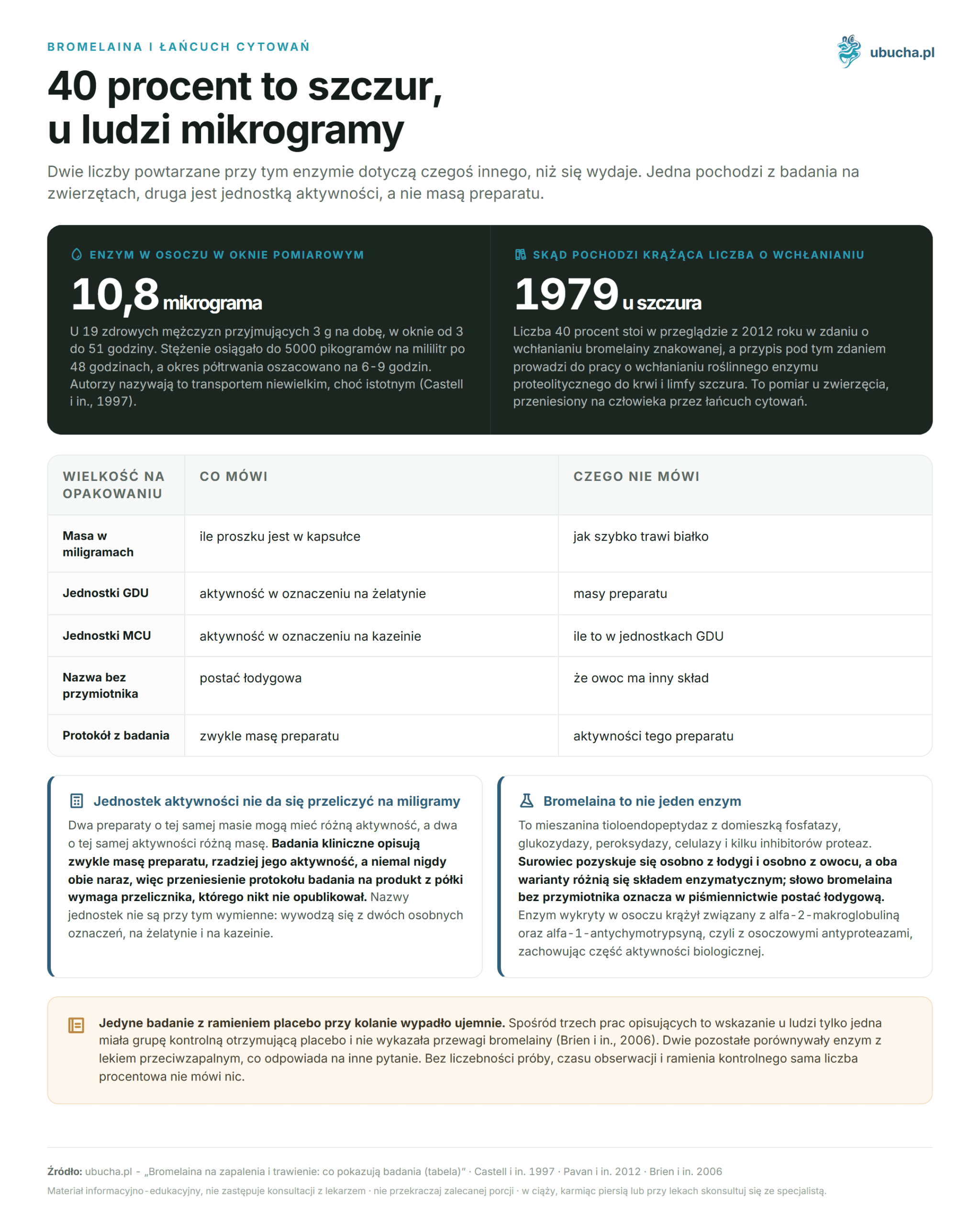
• In 19 healthy men taking 3 g of bromelain daily, the plasma averaged 10.8 micrograms of enzyme over a window of 3 to 51 hours, which the authors call a small but significant transport (Castell et al., American Journal of Physiology, 1997).
• The circulating figure of 40 percent absorption comes from a rat study from 1979, cited in a later review.
• A randomized controlled trial in knee osteoarthritis did not show an advantage for bromelain (Brien et al., QJM, 2006).
• GDU activity units cannot be converted to milligrams of the preparation.
What is bromelain and what do the units on the package measure?
Bromelain is not a single enzyme but a mixture of thiolendopeptidases with a mix of phosphatase, glucosidase, peroxidase, cellulase, and several protease inhibitors. The raw material is obtained separately from the stem and separately from the fruit, and both variants differ in enzymatic composition; the word bromelain without an adjective refers in the literature to the stem form (Pavan et al., Biotechnology Research International, 2012).
Manufacturers describe the preparation with two different sizes, and this is the source of most misunderstandings. The mass in milligrams indicates how much powder is in the capsule. The activity units, marked as GDU or MCU, indicate how quickly this powder digests standard protein under assay conditions. Two preparations of the same mass can have different activity, and two of the same activity can have different mass.
The practical conclusion is inconvenient for anyone who would like to compare products in a table. Clinical studies usually describe the mass of the preparation, less often its activity, and almost never both at the same time, so transferring a study protocol to a shelf product requires a conversion factor that no one has published. The names of the units are not interchangeable: GDU and MCU derive from two separate assays, on gelatin and on casein.
How much bromelain passes from the intestine to the blood?
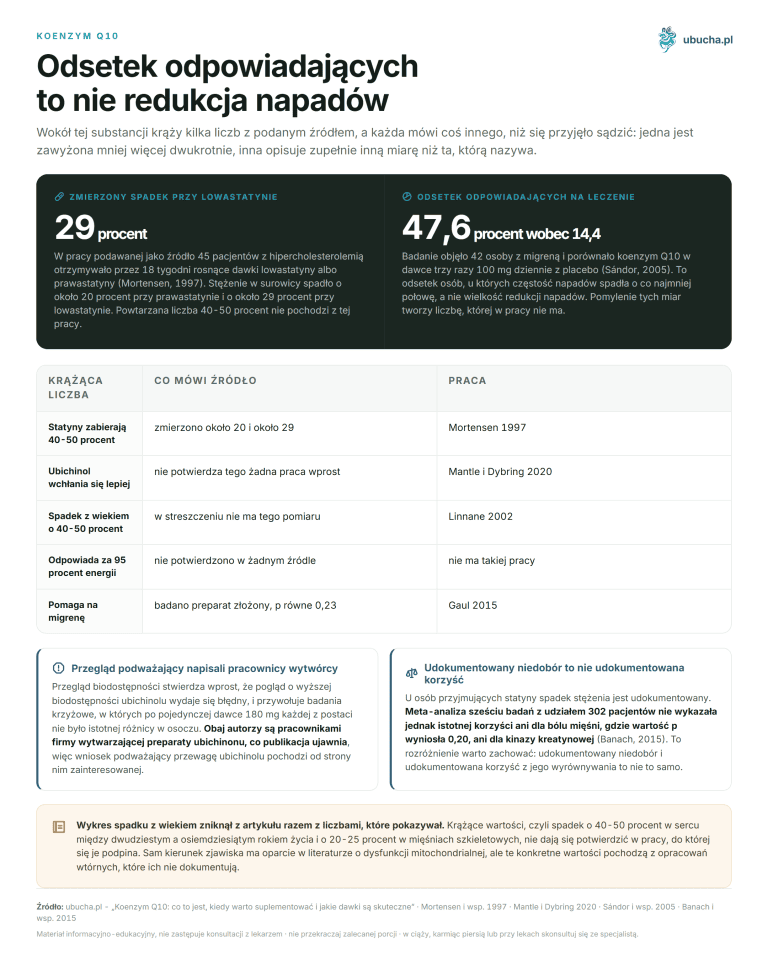
Very little, and the measurement in humans provides a value in micrograms. In a study involving 19 healthy men, bromelain was detected in plasma using immunological methods and based on its proteolytic activity. With multiple dosing at a dose of 3 g per day, the concentration reached up to 5000 picograms per milliliter after 48 hours, and the total amount present in plasma over a window of 3 to 51 hours averaged 10.8 micrograms. The half-life was estimated at 6-9 hours (Castell et al., American Journal of Physiology, 1997).
The authors summarize this as evidence of a small but significant transport of undigested proteins across the intestinal epithelium. The enzyme retained some biological activity and circulated bound to alpha-2-macroglobulin and alpha-1-antichymotrypsin, i.e., with plasma anti-proteases.
So where does the 40 percent figure come from, which is mentioned in almost every Polish guide? It stands in a 2012 review in a sentence about the absorption of labeled bromelain, and the footnote under that sentence leads to a 1979 study by Seifert and colleagues on the absorption of the plant proteolytic enzyme into the blood and lymph of rats. This is a measurement in an animal, transferred to humans through a chain of citations. Placing both numbers side by side changes the meaning of the entire chapter on systemic action: we do not have a human measurement showing that oral bromelain reaches blood concentrations comparable to those at which it acts in vitro.
What did studies show about bromelain in knee osteoarthritis?
Of the three studies that describe this indication in humans, only one had a placebo arm and came out negative. The other two compared the enzyme with an anti-inflammatory drug. It is worth looking at them side by side, along with the sample sizes and observation times.
| Study | Who and how many participants | Study design | Result |
|---|---|---|---|
| Brien et al., QJM, 2006 | 47 randomly assigned, 31 completed; moderate to severe form | double-blind, placebo, 12 weeks, 800 mg per day | no significant difference in total WOMAC score: coefficient 11.16, p = 0.27, 95% CI from -8.86 to 31.18 |
| Akhtar et al., Clinical Rheumatology, 2004 | 103 people with knee osteoarthritis | bromelain, trypsin, and rutin mixture versus diclofenac, 6 weeks, no placebo | similar decrease in pain and inflammatory response in both arms |
| Kasemsuk et al., Clinical Rheumatology, 2016 | 40 people, mild to moderate form | pilot, single-blind, active control with diclofenac, 16 weeks | after 4 weeks no difference between arms; improvement after 16 weeks compared to baseline |
Two things become apparent only in such a comparison. First, the 2016 study is sometimes described as evidence of effectiveness, although it compared bromelain with a drug, not with a placebo, so the improvement compared to baseline does not resolve how much the preparation itself contributed. Second, the mixture studied by Akhtar contains trypsin, which is another proteolytic enzyme, and not tryptamine, which is sometimes confused in Polish descriptions; these are two completely different substances. How the comparable layer of evidence looks for another joint pain remedy is described in our post about CBD for back and joint pain.
Does bromelain shorten sinus inflammation?
The most frequently cited study says something different than it is summarized. It involved 116 children under 11 years of age with acute sinusitis, treated in 19 centers in Germany, and was a cohort study of a pharmacoepidemiological nature, not a randomized trial (Braun et al., In Vivo, 2005).
The distribution of results is the opposite of the popular summary. Symptoms lasted the shortest in children receiving the bromelain preparation alone, averaging 6.66 days. Standard therapy resulted in 7.95 days, and the combination of the preparation with standard therapy performed the worst, at 9.06 days. Statistical significance, p equals 0.005, was achieved by the monotherapy group compared to the others. The statement about bromelain as an effective supplement to standard treatment has no support in this work; on the contrary, it was the combined group that performed the worst.
The limitations of such a setup are obvious to anyone reading observational studies. The doctor decided on the assignment, so children with a more severe course may have more often ended up in the combined group, and there is no blinding or placebo here. A mild, self-limiting allergic reaction occurred in one ten-year-old with a known allergy to pineapple. We discuss the mucolytic, whose action in the respiratory tract has been evaluated in Cochrane reviews, separately in our post about NAC in chronic bronchitis and COPD.
What drugs does bromelain interfere with and in which direction?
Two directions are described in the literature, and both go towards enhancing the drug’s action. Bromelain reversibly inhibits platelet aggregation, which with anticoagulant and antiplatelet drugs means summation of effects, i.e., higher risk of bleeding. The second direction concerns antibiotics: a review describes increased absorption of drugs, especially antibiotics, when the enzyme is administered simultaneously (Pavan et al., 2012).
It is worth knowing what is not in this review. Neither amoxicillin nor tetracycline is mentioned, although Polish descriptions list both as examples. There is also no mention of inhibiting prostaglandin synthesis, and the described effect on cytokines goes in the opposite direction to the common perception of an anti-inflammatory agent: in vitro experiments showed that bromelain stimulated peripheral blood mononuclear cells to secrete interleukin 1 beta, interleukin 6, and tumor necrosis factor alpha. This is an observation from cell culture, so it does not say what happens in humans after swallowing a capsule.
Separately, it is worth checking your own tolerance to pineapple. Allergic reactions in people allergic to this fruit are described, and the most common side effects concern the gastrointestinal tract. If you are taking anticoagulant, antiplatelet, or antibiotic medications, leave the decision to use the enzyme simultaneously to your doctor. Enzymatic support for digestion is also attributed to bitter herbs, which we discuss in our post about wormwood and its digestive properties.
Why won’t you find a dosage table here?
Because there is nothing to place in it. The title of this post promises a dosage table, and upon checking the literature, it turned out that such a table would have to be a compilation of numbers without backing. There is neither an officially established daily intake of bromelain, nor a conversion factor between the mass of the preparation and its activity units, nor a common dose repeated in studies: the cited works used 800 mg per day, 500 mg per day, and a mixture of enzymes with different compositions.
Instead of a dosage table, you get a table of studies. It shows who was given the preparation, how many participants there were, how long the observation lasted, and what the result was compared to the control group. Such a table answers the question of whether evidence exists, not how much to measure, because the second answer is not provided by the literature today.
If you still want to try, treat the enzyme like any other preparation with an uncertain basis. Consult with your doctor or pharmacist whether it conflicts with what you are already taking, and do not replace it with treatment that has evidence, especially in the case of a bacterial infection requiring antibiotics.
Frequently Asked Questions
How much bromelain from a capsule reaches the blood?
In 19 healthy men taking 3 g daily, the total amount of enzyme in plasma over a window of 3 to 51 hours averaged 10.8 micrograms, with a half-life of 6-9 hours (Castell et al., 1997). The authors call this transport small, yet significant.
Where does the 40 percent absorption figure come from?
From a 1979 study on rats, cited in a 2012 review as the absorption of labeled bromelain. It reached humans through a chain of citations, without measurement in humans. The published measurement in humans provides values in micrograms, not a percentage of the administered dose.
Does bromelain help with knee osteoarthritis?
A randomized controlled trial did not show an advantage: coefficient 11.16, p equals 0.27, confidence interval from -8.86 to 31.18 (Brien et al., 2006). The other two studies compared the enzyme with diclofenac, without a placebo arm, so they do not resolve this issue.
Does bromelain shorten sinus inflammation in children?
In a cohort study of 116 children, those who received the bromelain preparation alone had the shortest illness duration, averaging 6.66 days. Standard therapy resulted in 7.95 days, and the combination of both performed the worst, at 9.06 days (Braun et al., 2005). There was no randomization or placebo, and the combined group performed the worst.
Can GDU units be converted to milligrams?
No. Milligrams describe the mass of the powder, while GDU and MCU describe the rate of digestion of standard protein in assays on gelatin or casein. Preparations of equal mass can have different activity. No conversion factor has been published that would allow transferring a dose from a study to a shelf product.
What drugs does bromelain interact with?
It reversibly inhibits platelet aggregation, so with anticoagulant and antiplatelet drugs, the effects sum, increasing the risk of bleeding. Increased absorption of drugs, especially antibiotics, has also been described (Pavan et al., 2012). Both directions enhance the drug’s effect, not weaken it.
This article is for informational and educational purposes and does not constitute medical advice. Before starting supplementation, consult with a doctor, especially if you are taking medications regularly, are pregnant or breastfeeding, or have chronic illnesses.
Author: Michał Waluk · Published: 2026-08-09 · Updated: 2026-08-16