
Multivitamin: is it worth it or is it better to take single vitamins (FAQ)
What did large trials on multivitamins show: a meta-analysis of 91,074 people, a cohort of 390,124 people, and one trial with a positive result. Upper limits from EFSA and interactions.
A multivitamin is the most commonly purchased compound supplement and at the same time one of the least documented. An American preventive panel cites a survey study showing that 52 percent of adults have taken any supplement in the last thirty days, and 31 percent have taken a multivitamin-mineral supplement. The question most of them ask themselves is the same: does this one tablet make any difference, or is it better to spend that money on a single supplement tailored to the results of a blood test? The answer is not one-size-fits-all, as clinical trials and observational studies recruited healthy people, and a compound supplement makes sense where something specific is lacking. Below are the results of large trials and reviews, regulatory limits named, and two drug interactions that have solid backing in the literature.
KEY INFORMATION
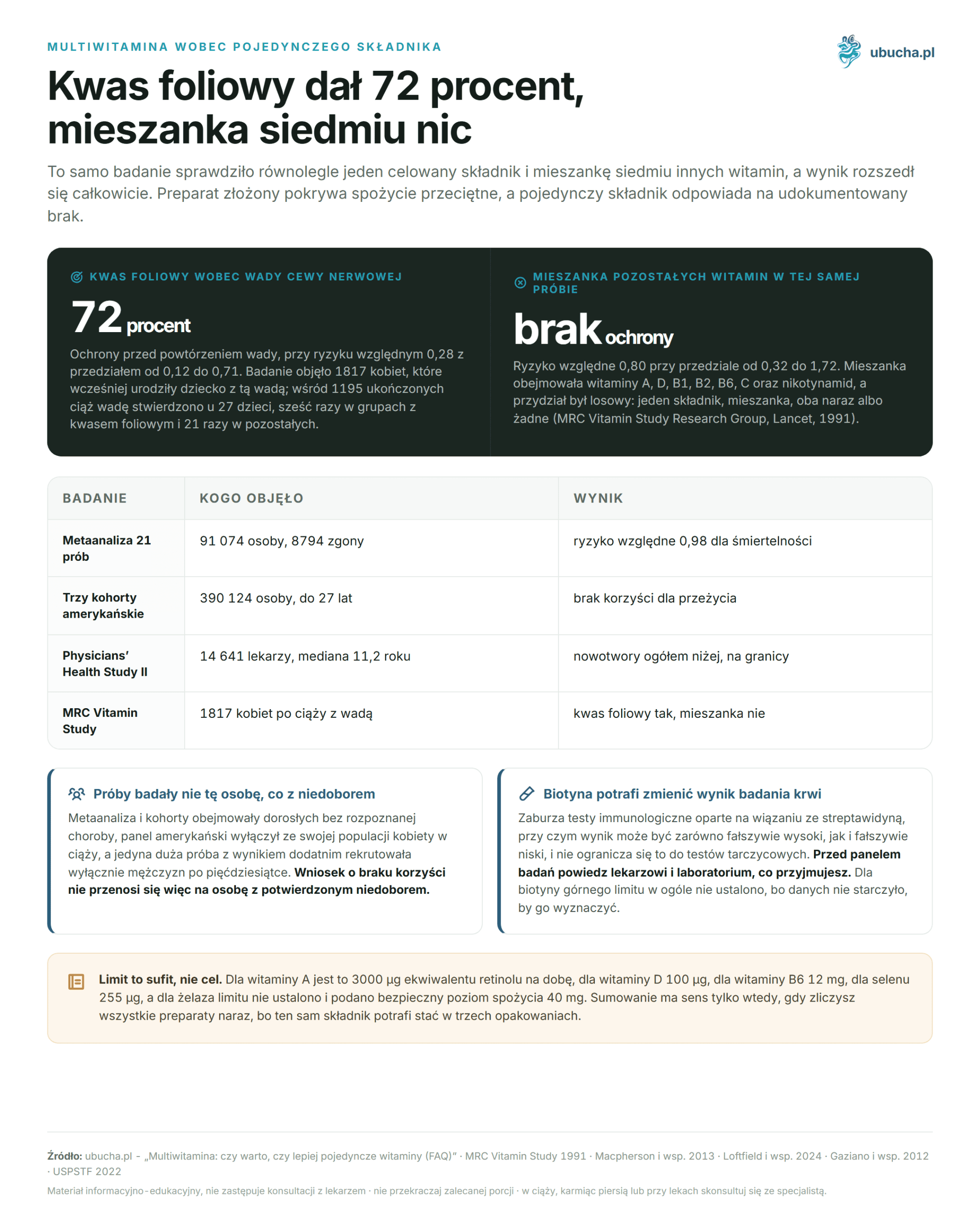
• A meta-analysis of 21 randomized trials (91,074 people, 8,794 deaths) found no effect of multivitamin-mineral supplements on overall mortality: relative risk 0.98 with a confidence interval of 0.94 to 1.02.
• Observation of 390,124 people over a period of up to 27 years also found no benefits for survival.
• The USPSTF panel deemed the evidence for multivitamins insufficient in 2022, and directly advised against beta-carotene and vitamin E.
• In the MRC trial, folic acid provided 72 percent protection against recurrence of neural tube defects, while a mixture of seven other vitamins provided none.
• The upper limit is a ceiling, not a goal: for vitamin A, it is 3000 µg retinol equivalent per day, for vitamin B6 12 mg, and for biotin, no limit has been established.
Does a multivitamin extend life and protect against disease?
The answer from large trials is: no for the general population of healthy adults. A meta-analysis of 21 randomized studies, involving a total of 91,074 people and 8,794 deaths, found no effect of multivitamin-mineral supplements on overall mortality. The relative risk was 0.98, and the confidence interval from 0.94 to 1.02 includes one.
The average age of the participants was 62 years, and the average duration of supplementation was 43 months. Deaths from vascular causes and cancer were counted separately: also with no difference compared to placebo (Macpherson et al., American Journal of Clinical Nutrition, 2013).
Observation of three large American cohorts included 390,124 people who at the time of enrollment had no diagnosed cancer or chronic disease. During the observation period of up to 27 years, 164,762 deaths were recorded, and daily use of a multivitamin was not associated with a lower risk of death; the hazard ratio in the first half of the observation was 1.04 (Loftfield et al., JAMA Network Open, 2024).
The American preventive panel summarized this material by stating that the evidence is insufficient to assess the balance of benefits and harms of multivitamins in preventing cardiovascular disease and cancer. In the same document, the panel directly advised against two components: beta-carotene, considering the harms to outweigh the benefits, and vitamin E, for which no net benefits were found (US Preventive Services Task Force, JAMA, 2022).
One large trial had a different outcome and it is fair to mention it. In the Physicians’ Health Study II, 14,641 physicians aged at least 50 took either a multivitamin or placebo for a median of 11.2 years. The overall cancer incidence was lower in the treatment group: 17.0 versus 18.3 events per 1,000 person-years, with a hazard ratio of 0.92 with the upper limit of the confidence interval at 0.998 and a p-value of 0.04. However, there was no effect for prostate cancer or colorectal cancer, and the difference in cancer deaths did not reach significance (Gaziano et al., JAMA, 2012).
What is the difference between a compound supplement and a single ingredient tailored to the result?
The difference is the target audience. A compound supplement covers average consumption, while a single ingredient addresses a documented deficiency. The clearest evidence of this difference comes from a trial where the same study simultaneously tested one targeted ingredient and a mixture of seven other vitamins, and the outcome diverged completely.
The MRC Vitamin Study included 1,817 women who had previously given birth to a child with a neural tube defect and randomly assigned them to folic acid, a mixture of other vitamins (A, D, B1, B2, B6, C, and niacinamide), both at once, or neither. Among 1,195 completed pregnancies, a defect was found in 27 children: six times in the groups with folic acid and 21 times in the others. This provided 72 percent protection with a relative risk of 0.28 and a confidence interval from 0.12 to 0.71. The mixture of other vitamins provided no protection: relative risk 0.80 with a range from 0.32 to 1.72 (MRC Vitamin Study Research Group, Lancet, 1991).
The form of the ingredient can also matter, but less than the label promises. A meta-analysis of studies directly comparing vitamin D2 with D3 showed an advantage for D3 in raising blood levels of 25-hydroxyvitamin D. However, this advantage occurred with a single large dose, and with daily administration, it disappeared (Tripkovic et al., American Journal of Clinical Nutrition, 2012). This is a level of detail that is not visible in the advertising of the supplement.
Who realistically benefits from supplementation, since trials have been neutral?
Groups that these trials did not study. The meta-analysis and cohorts included adults without diagnosed disease, the American panel excluded pregnant women from its population, and the only large trial with a positive result recruited only men over fifty. Therefore, the conclusion of no benefits does not transfer to a person with a confirmed deficiency.
Among vegetarians and vegans, the best-documented problem is vitamin B12. A review of eighteen studies, in which deficiency was diagnosed by measuring methylmalonic acid or holotranscobalamin, rather than just vitamin levels, reported deficiency rates: 62 percent among pregnant women on a plant-based diet, 25 to 86 percent among children, 21 to 41 percent among teenagers, and 11 to 90 percent among older adults. Rates were higher among vegans than vegetarians and among those on such a diet from birth. The authors conclude with a recommendation for regular intake of a supplement with this vitamin (Pawlak et al., Nutrition Reviews, 2013).
The second group with solid evidence is women planning pregnancy after a previous pregnancy with a neural tube defect, described above in the MRC trial. In both cases, one specific ingredient works, not a compound supplement as such. What each of the B vitamins does and who has a reason to check them is detailed in the text about B vitamin complex, and deficiencies typical for a plant-based diet in the text about supplements for vegetarians and vegans.
What should you really check on the label?
Three things, none of which is a marketing slogan: the form of the ingredient, the total dose from all taken supplements, and how far that total is from the upper limit. The limit is not a recommendation or a goal to achieve. It is a ceiling, above which the assessing authority does not consider chronic intake to be safe.
| Ingredient | Upper limit for adults | What this number is |
|---|---|---|
| Vitamin A (retinol and retinyl esters) | 3000 µg retinol equivalent per day | tolerable upper intake level, EFSA opinion from 2024 |
| Vitamin D | 100 µg per day | tolerable upper intake level, EFSA opinion from 2023 |
| Vitamin B6 | 12 mg per day | tolerable upper intake level, EFSA opinion from 2023 |
| Selenium | 255 µg per day | tolerable upper intake level, EFSA opinion from 2023 |
| Iron | no limit established; safe intake level 40 mg per day | safe intake level, used more narrowly than limit |
| Biotin | no limit established | insufficient data to set a value |
The values come from the list of upper limits maintained by EFSA, in the version from August 2025 (EFSA, Overview on Tolerable Upper Intake Levels), and the source opinions for vitamin A and vitamin B6 are available separately (EFSA, 2024, EFSA, 2023). Summing makes sense only when you count all supplements at once, as the same ingredient can be in three packages. A complete guide to these limits is gathered in the text about which supplements are dangerous in excess.
What documented drug interactions are there?
The best-described one concerns calcium and levothyroxine, with its mechanism being the binding of the drug in the gastrointestinal tract, not systemic action. The second is the interference with laboratory test results by biotin. Both are based on specific publications and can be circumvented by timing or discussing with your doctor before blood collection.
In a prospective study, twenty people chronically treated with levothyroxine took 1200 mg of elemental calcium in the form of calcium carbonate together with the drug for three months. Free and total thyroxine levels dropped, and the average concentration of thyrotropin increased from 1.6 to 2.7 mIU/l and returned to 1.4 after stopping calcium. In 20 percent of the subjects, thyrotropin exceeded the reference range, peaking at 7.8 mIU/l. A laboratory test included in the same study showed that thyroxine adsorbs to calcium carbonate in an acidic environment (Singh et al., JAMA, 2000).
Biotin, on the other hand, interferes with immunoassays based on the binding of biotin to streptavidin. A literature review included in the case report of alleged hyperthyroidism shows that the interference can yield both falsely high and falsely low results, and is not limited to thyroid tests (Elston et al., Journal of Clinical Endocrinology and Metabolism, 2016). The practical conclusion is one: before the panel of tests, inform your doctor and the laboratory about what you are taking.
Separately, it is worth looking at vitamin B6, as its ceiling is one of the lower values in the entire table. It is 12 mg per day and was lowered in 2023 due to peripheral neuropathy. The same vitamin can be present in both a compound supplement and a separate B group supplement, so the total can easily be overlooked.
Frequently Asked Questions
Can a multivitamin replace a balanced diet?
There is no study that has shown this, and large randomized trials have found no benefits for mortality or cardiovascular events in healthy adults. The supplement provides selected micronutrients in established portions, but does not replicate fiber or the composition of whole foods in which these components occur together.
Do studies confirm the effectiveness of multivitamins?
The result depends on the endpoint. For mortality, a meta-analysis of 21 trials involving 91,074 people found no difference. For overall cancer incidence, the Physicians’ Health Study II trial showed an eight percent decrease in men, at the margin of significance. The USPSTF panel assessed the overall evidence as insufficient.
When does a single vitamin make more sense?
When there is documented deficiency or a known risk group. The MRC trial demonstrated this most clearly: folic acid provided 72 percent protection against recurrence of neural tube defects, while a mixture of seven other vitamins in the same study provided none. Targeting the outcome beats targeting the average.
Can a multivitamin be harmful?
The risk increases when the total from all supplements approaches the upper limit. The USPSTF panel advises against beta-carotene, considering its harms to outweigh benefits, and vitamin E due to lack of net benefits. For vitamin A, the ceiling is 3000 µg retinol equivalent per day.
What to look for on a multivitamin label?
Look at the form of the ingredient, the daily dose, and how much of the same ingredient you are getting from other packages. Compare the total to the upper limit, not to the reference value for labeling, as these are two different numbers with different purposes. Resolve doubts with a pharmacist.
Can a multivitamin change blood test results?
Yes, and the best-documented case is biotin. It interferes with immunoassays based on binding to streptavidin, with results potentially being both falsely high and falsely low, and this does not apply only to thyroid tests. Inform your doctor about supplementation before blood collection.
Single vitamin and mineral supplements mentioned above can be found in the supplements category.
This article is for informational and educational purposes only and does not constitute medical advice. Before starting supplementation, consult your doctor, especially if you are taking medications regularly, are pregnant or breastfeeding, or have a chronic illness.
Author: Michał Waluk · Published: 2026-08-09 · Updated: 2026-08-16