
Which Rolling Papers to Choose for CBD and THC Herb? Complete Guide to Materials, Thickness, and Brands
Materials, weight, sizes, glues, and certifications of rolling papers without made-up market data. Plus what no rolling paper can change: combustion chemistry.
Rolling paper seems like the least important element of a joint and partly it is: the herb, not the paper, decides the taste and what reaches the lungs. However, the choice matters where it is usually not considered, namely in the evenness of burning, amount of ash, and whether the paper will even withstand rolling. This guide organizes materials, weights, sizes, glues, and certifications, and also dispels numbers circulating in industry texts without any source. You will also find the legal status of the herb you buy these papers for, because the THC content threshold is counted differently than the popular abbreviation suggests. At the end, I describe what no rolling paper can change: combustion chemistry and the only alternative backed by clinical study data.
KEY INFORMATION
• Dioxins form in combustion processes, including burning wood, coal, and oil (US EPA).
• Weight divides rolling papers into four classes, from 13 g/m2 to over 20 g/m2.
• King Size Slim, about 108 by 44 mm, fits 6 and 7 mm filters.
• No rolling paper removes combustion products of the herb.
Why does the choice of rolling paper even matter?
Rolling paper burns together with the herb, so it adds its own decomposition products to the smoke. The less paper per portion, the less of this contribution. Hence the whole difference between thin plant paper and thick wood paper: not in the chemical composition of the herb, but in how much foreign material burns alongside it.
The second thing rolling paper really controls is the burning rate. Thicker paper holds shape and forgives rolling mistakes but leaves more ash and often goes out halfway. Thinner paper burns more evenly but unravels under strong pressure and does not tolerate moisture.
The third issue is the glue on the edge, the only part of the paper that reaches the mouth with each puff. Brands using gum arabic mention it on the packaging as a selling point. Lack of such information proves nothing bad but leaves you unable to verify.
The rest of the differences are smaller than producers’ descriptions suggest. Claims like “burns one third slower” or “40% less ash” come from marketing materials without measurement method descriptions, so I do not repeat them here.
What are the main rolling paper materials and how do they differ?
On the market you will find five paper types: hemp, rice, flax, wood, and blends of these fibers. They differ in durability and how noticeable they are in taste. Despite the name, hemp paper contains no cannabinoids or terpenes because the fiber goes into cellulose production stripped of resin.
| Material | Made from | Behavior |
|---|---|---|
| Hemp | Hemp fiber, often mixed with cellulose | Durable when rolling, slight herbal note, usually unbleached |
| Rice | Rice fiber, sometimes with sisal | Thinnest and most neutral in taste, little ash, slippery to touch |
| Flax | Flax fiber | Golden mean: stronger than rice, thinner than wood |
| Wood | Cellulose from coniferous or deciduous wood | Cheapest, usually thicker, more noticeable taste |
| Mixed | Flax with hemp or rice with hemp | Compromise between ease of rolling and clean burning |
Rice paper is considered the most neutral and indeed leaves the least ash but is also the most demanding to handle. It slips in fingers and cracks under strong pressure, so thicker paper is better for beginners. Wood paper is the opposite: easy to roll, clearly present in taste.
A separate branch is non-flat sheet formats, i.e. wraps and pre-rolled cones. Deciding when each format makes sense required a separate text, which I collected in comparison of rolling papers with wraps and pre-rolled cones.
How does rolling paper thickness affect smoking?
Thickness is given in grams per square meter and divided into four classes. Ultra thin starts at 13 g/m2, thin covers 14-16, medium reaches 20, and slow-burn starts above that. The lower the weight, the less foreign material per joint.
| Class | Weight | Practical effect |
|---|---|---|
| Ultra thin | 13-14 g/m2 | Least interferes with taste and gives least ash; breaks easily and requires skill |
| Thin | 14-16 g/m2 | Most popular class, reasonable compromise for most uses |
| Medium | 17-20 g/m2 | Forgives rolling mistakes but paper taste is more noticeable |
| Slow-burn | 20 g/m2 and more | Burns slower but produces more smoke from the paper itself |
In practice, thin class covers most situations and is a good starting point if you are not yet skilled. Ultra thin makes sense when you care about the flavor profile of good herb and roll in calm conditions without wind or moisture.
Slow-burn is a different philosophy: thicker paper, sometimes perforated, that burns slower at the cost of more paper smoke. Producers specify how much longer it burns but do not publish measurement methods, so treat these claims as directional, not numeric.
What rolling paper size to choose?
Rolling paper sizes are standardized and come in five formats. Dimensions are printed on the package, so this is the only specification you can check without trusting anyone. For hemp herb, two sizes matter most: King Size Slim and the one marked 1 and 1/4.
| Size | Sheet dimensions | Fits |
|---|---|---|
| Single Wide | about 68-70 by 34-36 mm | Cigarette size, too small for herb joint |
| 1 and 1/4 | about 76-78 by 45-46 mm | American classic, holds about 0.3-0.5 g |
| 1 and 1/2 | about 76-78 by 60-62 mm | Wider version of previous, popular mainly in USA |
| King Size | about 100-110 by 55-60 mm | Long and wide, sometimes too big for solo smoking |
| King Size Slim | about 108-110 by 44 mm | Dominant format in Europe, fits 6 and 7 mm filters well |
King Size Slim is the default format in Europe and is included in most filter sets. It holds about 0.5-0.8 g of herb, roughly what is shared between two people, and its 44 mm width works well with 6 and 7 mm tips.
1 and 1/4 format is shorter and holds about 0.3-0.5 g, so it can be more convenient for solo smoking and wastes less herb. Single Wide is for loose tobacco; for herb joints you would need to add a second sheet.
Which glue on the rolling paper edge is safe?
The standard in branded papers is gum arabic, a natural resin from acacia used for decades in the food industry. Premium producers declare it directly on the package as a sales advantage. Cheaper series without a name usually provide no glue information.
There is a claim circulating that cheap rolling papers contain synthetic polyvinyl acetate, whose burning releases aldehydes. I found no verifiable source for this and no study measuring smoke composition from rolling paper glue. Therefore, I do not repeat this number or list of compounds.
The buying rule remains that requires no belief in any number. If the producer does not declare the glue type, you cannot verify what you inhale, and the price difference between an anonymous booklet and a branded one is a few zlotys. For a product touching the mouth, this is not a place to save.
The “vegan” label on the package resolves one doubt: it excludes gelatin glues still found in cheap series. It does not say whether gum arabic or another plant glue was used, so it does not replace composition declaration.
A practical tip concerns the glue strip itself. If it dissolves unevenly or leaves lumps after wetting, the paper was stored in too moist a place and the whole booklet will cause trouble. This is not a batch defect but a storage effect, affecting cheap and expensive series alike.
Which certifications on the package mean something?
On rolling papers you will find four verifiable marks: FSC, unbleached, organic, and vegan. Each answers a different question and none says anything about how the paper burns. This distinction is important because they are sometimes presented as a quality mark for smoking.
| Mark | What exactly it confirms | When it matters |
|---|---|---|
| FSC | Cellulose comes from forests under certified forest management | Mainly concerns wood and mixed paper |
| Unbleached | Paper was not bleached, hence natural brown shade | Simplest way to avoid bleaching agents |
| Organic | Fiber comes from cultivation without synthetic pesticides | Makes sense for hemp and rice paper |
| Vegan | Glue and coatings without animal ingredients | Excludes gelatin glues found in cheap series |
FSC certification concerns cellulose origin, not finished sheet properties. The system covers 175 million hectares of forest and nearly 70 thousand product origin control certificates as of July 1, 2026, according to Forest Stewardship Council data. The certificate number on the package can be checked in a public database.
Unbleached label solves the bleaching agent topic simply because the paper was not bleached. Hence the natural brown color of series like RAW Classic or Smoking Brown. The taste difference compared to bleached paper is small, but the lack of an additional processing step is a fact, not a claim.
How do the most popular rolling paper brands differ?
Below are eight brands most often seen in Polish hemp stores. Each has a recognizable profile: one focuses on unbleached paper, another on ultra-thin rice, another on aromas. The comparison has no point scores because the choice depends on what you are looking for.
| Brand | What stands out | Recognizable lines |
|---|---|---|
| RAW | Unbleached paper with brown tint | Classic, Organic Hemp, Black in ultra thin version |
| OCB | French school of thin flax paper | Premium, Organic Hemp, Virgin |
| Zig-Zag | Tobacco heritage, wood paper | Original, Silver in slim version |
| Elements | Specializes in ultra-thin rice paper | Ultra Thin Rice |
| Mascotte | Dutch thickness standard, neutral flax | King Size Slim, Combi with filters, magnetic versions |
| Smoking | Spanish production with wide range | Gold from rice, Brown unbleached, De Luxe from flax |
| Juicy Jay’s | Flavored rolling papers | Fruit and dessert series on hemp paper |
| Purize | Filter brand expanded into rolling papers | King Size Slim papers, activated carbon filters |
Choice rarely comes down to paper quality because differences in this segment are small. More often it depends on availability of specific weight and size and whether tips are included in the booklet. Dutch and Spanish brands can be more convenient in this regard than American ones.
If you want a comparison of specific lines with ratings, I prepared a separate rolling papers comparison. Here the general rule is: a brand that provides material, weight, and glue type gives you something to check, a brand without description gives nothing.
What is the purpose of a filter and what types of tips exist?
Tips primarily serve a mechanical function. They stiffen the joint end, prevent it from collapsing, protect the mouth from herb particles, and allow smoking the rest without burning fingers. Filtration is a separate matter and concerns only activated carbon inserts.
| Type | What it is | What it really does |
|---|---|---|
| Paper tip | Roll of cardboard or unbleached paper | Does not filter; protects mouth, stiffens joint, allows smoking to the end |
| Activated carbon filter | Carbon insert in plastic or paper casing | Manufacturers claim to trap some tar; also absorbs some terpenes |
| Cellulose tip | Cellulose insert, usually 5.5 mm | Found in ready sets, more neutral than tobacco cotton |
| Glass or ceramic mouthpiece | Reusable element | Does not chemically filter but produces no waste and allows smoking the rest |
Activated carbon filter producers claim to trap some tar substances and lower smoke temperature. These claims are hard to verify because measurements come from producers without method descriptions. What is noticeable without numbers is smoother draw and weaker aroma because carbon also absorbs terpenes.
Diameter choice matters more than brand. Tips come in 5.5, 6, 7, and 8 mm versions, and King Size Slim format works best with 6 and 7 mm. Too narrow filter lets air in from the side, too wide prevents paper closure.
What mistakes most often ruin rolling?
Most complaints about bad rolling paper turn out to be complaints about something else. Paper gets blamed for too moist herb, wrong filter choice, or bathroom storage. The five situations below recur most often and none is solved by changing paper brand.
| Mistake | Why it bothers |
|---|---|
| Anonymous cheap rolling paper | Producer does not declare material or glue type, so nothing to check |
| Filter mismatched to width | Tips come in 5.5, 6, 7, and 8 mm; wrong choice causes side draw or clogging |
| Flavored rolling paper for good herb | Fruit aroma covers terpene profile you paid for |
| Storage in bathroom or on windowsill | Moisture softens paper, sun dries it; both cause cracking |
| Rolling too moist herb | Joint clogs and goes out, blame falls on paper |
Herb moisture is the primary issue. Too moist herb clogs and extinguishes the joint, too dry crumbles and burns fast. Humidity control bags cost less than a lost portion of good herb and solve the problem for months.
The second issue is filter choice matching paper width, easy to forget when buying tips separately. The third, less obvious, concerns flavored papers: they have their place but not with herb whose terpene profile you paid for.
What does the law say about the herb you buy rolling papers for?
Legal in Poland is fiber hemp herb. The definition is numeric and precise: the sum of delta-9-THC and tetrahydrocannabinolic acid in flower or fruiting tops, from which resin was not removed, must not exceed 0.3% dry weight, rounded to one decimal place.
Based on Art. 4 point 5 of the Act of July 29, 2005 on counteracting drug addiction (consolidated text Journal of Laws 2023 item 1939) as amended by the Act of March 24, 2022 (Journal of Laws 2022 item 763), effective from May 7, 2022. Previously the threshold was 0.20%. The national value corresponds to the EU threshold but results from a separate provision, not an EU regulation.
Two nuances are worth remembering because they change lab test results. The threshold concerns the sum of delta-9-THC and THCA, not delta-9-THC alone, so raw material with low decarboxylated form content can still exceed the limit. Above the threshold it is cannabis other than fiber hemp, whose trade and possession are prohibited.
Regarding substances, cannabidiol is not listed in any controlled substance lists. Hexahydrocannabinol (HHC) is controlled in Poland, so products with it are not legal regardless of description.
Rolling paper, vaporizer, or pipe: which harms less?
The answer depends not on rolling paper choice but on method choice. Anything involving open ember leads to pyrolysis of the herb, and combustion products form regardless of what the herb is wrapped in. The US Environmental Protection Agency lists burning wood, coal, and oil explicitly as processes producing dioxins (US EPA).
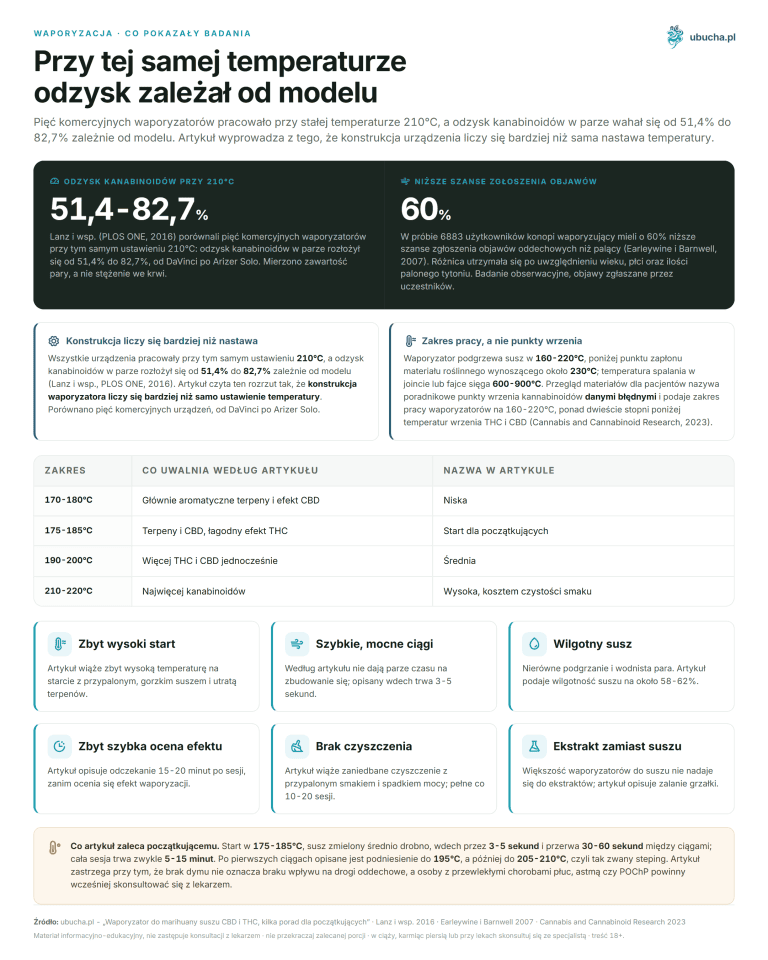
The only comparison backed by clinical data concerns vaporization. In a trial with eighteen people, a vaporizer was compared to a marijuana cigarette at three THC concentrations: plasma THC levels were similar, but carbon monoxide in exhaled air after vaporization was lower, with no adverse events (Abrams et al., 2007).
A second indication comes from a large online survey where vaporizer use was associated with fewer reported respiratory symptoms, adjusting for age, sex, cigarette smoking, and cannabis use (Earleywine and Barnwell, 2007). This is self-reported data, so weaker than measurement, but the direction matches the previous result.
Glass pipe does not change the picture because it still relies on open ember, just without paper. Vaporizer works around 180-210 degrees Celsius, below combustion threshold, and that is the whole difference. How to set temperature for specific raw material I described in the vaporization temperature post.
How to choose rolling paper consciously?
A sensible buying path involves four decisions. Choose a brand that provides material, weight, and glue type. Take King Size Slim because it fits the most filters. Start with thin class and move to ultra thin when skilled. Pick 6 or 7 mm tips and keep the booklet in a dry place.
Keep proportions in mind. The difference between good hemp and good rice paper is a matter of preference, not health. The difference between smoking and vaporizing is a matter of exposure to combustion products and that is what matters measurably. If you look for a place to think carefully, it is here, not in paper brand choice.
Finally, a note on numbers. Texts about rolling papers are full of percentages: market shares, tar reduction, percentages of smokers who do not check something. During preparation of this version, none of these numbers could be linked to a source confirming them, so they were removed. What remains is what can be checked on the package, in public certification databases, or in published studies.
Frequently Asked Questions
Hemp or rice rolling papers for CBD herb?
Both materials work well. Hemp paper is more durable when rolling and adds a slight herbal note, rice paper is thinner and more neutral in taste. Beginners find hemp easier to work with, while those paying attention to the terpene profile usually choose rice.
What size rolling paper to choose at the start?
King Size Slim, about 108 by 44 mm. This format holds roughly 0.5-0.8 g of herb, works well with 6 and 7 mm filters, and is the most widely available in Polish stores. Single Wide size is too small for a typical herb joint.
Can rolling paper reduce the harm of smoking?
Not significantly. Combustion products come from the herb itself, not the paper, so changing the rolling paper brand does not remove them. The only comparison with clinical data concerns vaporization: at similar THC plasma levels, carbon monoxide in exhaled air was lower.
How much does a booklet of rolling papers cost?
In the rolling papers category at u Bucha store, prices currently range from 5 to 42 PLN, with the upper limit for bulk packs of several hundred sheets, catalog status as of August 10, 2026. A typical booklet of 32-50 sheets costs a few zlotys.
Does rolling paper affect the potency of CBD or THC in the herb?
No. Cannabinoid content is a property of the herb and the paper does not change it. Rolling paper affects taste, ash amount, and evenness of burning, not how much CBD or THC ends up in the smoke. Moisture and quality of the raw material matter much more.
Is it worth adding a carbon filter?
Carbon filter manufacturers claim to trap some tar substances, but independent measurements for joints are scarce. The filter definitely protects the mouth from herb particles, stiffens the joint, and allows it to be smoked to the end. Activated carbon also absorbs some terpenes, so it can be noticeable on aromatic herb.
How to store rolling papers so they don’t crack?
Keep them in a dry place, away from moisture and sunlight. Damp paper unravels when rolling, and overly dry paper crumbles. Booklets with magnetic closure and metal cases solve the problem cheaper than replacing a damp pack. Bathroom and windowsill are the two worst places.
Is the hemp herb I buy rolling papers for legal in Poland?
Legal is hemp herb from fiber hemp where the sum of delta-9-THC and THCA does not exceed 0.3% dry weight, rounded to one decimal place. Above this threshold it is cannabis other than fiber hemp, whose trade and possession are prohibited.
You can find rolling papers and rolling accessories in the rolling papers category, and activated carbon inserts in the filters category.
This article is informational and educational. It contains internal links to product categories available at u Bucha store. Prices and specifications may change: check current data on the product page before purchase.
Author: Michał Waluk · Published: 2026-05-06 · Updated: 2026-08-10