
Papers vs wraps vs ready cones: what to choose
Paper, hemp wrap, or ready cone? A comparison of three formats, real prices of nine papers at Bucha, and a cost calculator for one piece.
Three formats, one decision before each roll: a thin paper to roll yourself, a thick hemp wrap, or a ready cone that just needs to be filled. They differ not only in convenience. They change the burning rate, the amount of material in one piece, and how much paper actually goes into the smoke. An analysis of 26 elements in commercially available papers showed that the composition of this paper is mostly unregulated in most jurisdictions (Wright et al., PMC, 2024). Below, we break down each of the three formats into their components, provide real prices from Bucha’s offer as of August 8, 2026, and calculate them into the cost of one paper so that the comparison actually means something.
KEY INFORMATION
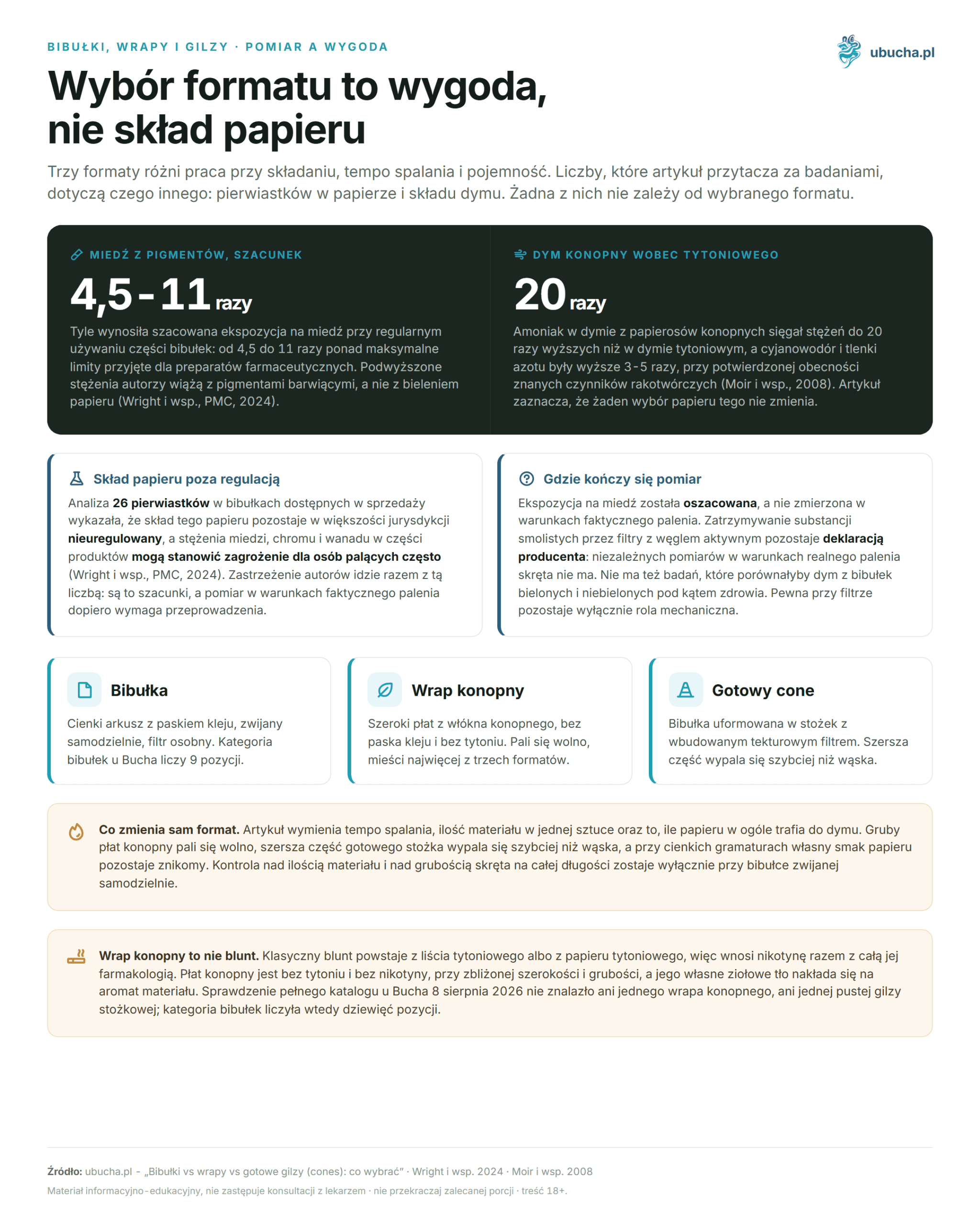
• Copper from coloring pigments raises estimated exposure in some papers 4.5-11 times above pharmaceutical limits (Wright et al., PMC 2024).
• Paper gives control, cone offers convenience, wrap provides the most space for material.
• The paper category at Bucha has 9 items, ranging from 5.00 PLN to 42.00 PLN (2026-08-08).
• One paper costs 0.10-0.18 PLN, depending on the package size.
What are the differences between paper, wrap, and ready cone?
A paper is a thin sheet of paper with a glue strip that you roll yourself. A hemp wrap is a wide and thick sheet made from hemp fiber, rolled like a cigar. A ready cone is a paper already shaped into a cone with a cardboard filter at the end. The difference comes down to how much work you take on yourself.
A paper requires skill, but in return, it gives you full control. You decide how much material goes inside and how tightly you pack it. The thickness of the roll along its entire length also depends solely on you. Thin paper practically adds no flavor of its own, so you only feel the material. This control comes at a price: in too dry or too humid air, the sheet tears in your fingers, and uneven distribution of the contents results in a roll that burns on one side.
A cone eliminates the entire rolling stage. The cone is already factory glued, the filter is in place, and the user’s task is to fill and close the tip. The cost is the lack of influence on the shape and the fact that the wider part burns faster than the narrow one.
A hemp wrap is closest to a blunt. The sheet is wide enough to hold significantly more material than a standard paper and thick enough to burn slowly. There is no glue strip, so it holds together with moisture applied to the edge. Rolling is more difficult than with thin paper because the material is stiffer and less forgiving.
Which format to choose for your smoking style?
The answer depends on one thing: does rolling bring you joy, or is it a hindrance? People who roll daily usually stick to papers because they offer the most control at the lowest cost per piece. Those who reach for a roll occasionally more often choose a ready cone because there is no need to practice anything. A wrap is chosen less frequently and usually for a specific reason: for greater capacity or for a more pronounced herbal character of the smoke. The table below collects these differences in one place, along with information on what of the three formats is actually on the shelf at Bucha today.
| Feature | Paper | Hemp wrap | Ready cone |
|---|---|---|---|
| Work involved in assembly | Full rolling from scratch | Rolling the sheet, no glue | Only filling and twisting the tip |
| Paper material | Plant fibers, hemp, cellulose | Hemp fiber | Same as base paper |
| Capacity | Depends on sheet format | Largest of the three | Determined by cone size |
| Own paper flavor | Minimal at thin grammages | Clearly herbal | Same as base paper |
| Burning rate | Even with good rolling | Slow, paper is thick | Faster in the wide part |
| Filter | Added separately | Added separately | Factory built-in |
| Availability at Bucha | 9 items in the paper category | None in the catalog | No empty cones in the catalog |
Which papers are available at Bucha and how much do they cost?
The paper category has nine items, with prices starting at 5.00 PLN per package and reaching 42.00 PLN for a package of 420 pieces. Eight out of nine are Purize, one is Mascotte, and one is Babcia Marysia’s hemp papers with a tray and filters included. The sizes and grammages of each, along with filter selection, are compared in the ranking of papers. All prices come from the store API and are valid as of August 8, 2026.
| Product | What stands out | Price | Cost per paper |
|---|---|---|---|
| Purize x Rollmops KS Slim brown papers | 32 pcs., 109 x 44 mm, unbleached brown | 5.00 PLN | 0.16 PLN |
| Mascotte Magnetic Brown Slim Paper + Filters | 32 pcs., grammage 13.8 g/m2, filters included | 5.90 PLN | 0.18 PLN |
| Purize King Size ultra-thin brown papers | Format 110 x 52 mm, gum arabic glue | 6.00 PLN | Description states bulk packaging, we do not calculate |
| Purize Inside Out King Size Slim Papers | Glue strip on the outside, grammage 14 g/m2 | 7.00 PLN | Description states bulk packaging, we do not calculate |
| Purize Brown KS Slim 32+10 free Papers | 42 pcs. in the package, unbleached brown | 7.00 PLN | 0.17 PLN |
| Purize Pink KS Slim 32+10 free Papers | 42 pcs., grammage 14 g/m2, colored paper | 7.00 PLN | 0.17 PLN |
| Purize Rainbow KS Slim 32+10 free Papers | 42 pcs., unbleached brown, colorful package | 7.00 PLN | 0.17 PLN |
| Babcia Marysia’s KS Slim Hemp Papers | Hemp paper; includes filters and tray | 16.00 PLN | Description does not state the number of sheets |
| Purize 420 King Size Slim Papers | 420 pcs. in one package, fits 6 mm filters | 42.00 PLN | 0.10 PLN |
How much does one paper really cost?
From 0.10 PLN to 0.18 PLN per piece, with the difference being made by the package size, not the brand or material. A package of 420 sheets costs 0.10 PLN per paper, while packages of 32-42 pieces fall within the range of 0.16-0.18 PLN. This is almost a twofold difference for the same paper from the same manufacturer.
Calculating makes sense only when you know the number of sheets. For two Purize items, the product description states bulk packaging for forty packs, and the price corresponds to a single pack, so stating the cost per piece would be guessing. Babcia Marysia’s papers do not declare the number of sheets at all, as their value lies elsewhere: in the set with filters and a tray.
We noticed when compiling these numbers that the designation “32+10 free” is sometimes read as a promotion, but in practice, it is simply a fixed content of the package. Forty-two pieces for 7.00 PLN come out slightly more expensive per piece than thirty-two for 5.00 PLN. If you are calculating costs, look at the price divided by the content, not at the word “free” on the package.
A set with filters changes the calculation even more. Mascotte for 5.90 PLN adds filters to the same thirty-two sheets, while separate carbon filters from the filter category cost from 10.00 PLN for ten pieces. In such a comparison, paper ceases to be the largest item in the budget.
Does the composition of the paper matter for health?
It does, although not in the way it is usually discussed. An analysis of 26 elements in commercially available papers showed that the composition of this paper remains unregulated in most jurisdictions, and concentrations of copper, chromium, and vanadium in some products may pose a risk for frequent smokers (Wright et al., PMC, 2024).
The authors pointed out a specific source of the problem, and it is not the bleaching of the paper. Elevated copper concentrations are associated with coloring pigments used by some manufacturers. With regular use of such products, the estimated exposure reached according to this work from 4.5 to 11 times the maximum limits accepted for pharmaceutical preparations. The authors also note that these are estimates, and measurement under actual smoking conditions still needs to be conducted.
The practical conclusion is simple: unbleached and uncolored paper simply brings fewer unknowns than colored paper. In Bucha’s offer, four papers belong to the first group: Purize Brown, Purize Rollmops, Purize Rainbow, and Mascotte Magnetic Brown, all described as unbleached natural brown. The Pink version is colored paper.
A separate issue is the smoke itself, regardless of what it is wrapped in. A comparison of smoke from hemp and tobacco cigarettes showed that in the former, ammonia was present at concentrations up to 20 times higher and cyanide and nitrogen oxides at levels 3-5 times higher than in tobacco smoke, with confirmed presence of known carcinogens (Moir et al., 2008). No choice of paper changes this.
How to fill a ready cone for an even burn?
In layers of about 0.3 g, with a light packing after each portion. Pouring in the whole amount at once and packing at the end leaves air pockets in the narrow part of the cone, through which the roll goes out or draws unevenly. The material should be ground to a medium-fine consistency, without dust and without larger pieces.
Too fine grinding clogs the narrow tip and the roll stops drawing. Too coarse leaves empty spaces and allows the fire to wander sideways instead of going down evenly. A simple test: after filling, gently squeeze the cone between your fingers. It should yield slightly and return to shape, not be hard as a pencil.
The moisture of the material determines the rest. Too dry crumbles to dust already in the grinder and spills through the tip, too moist sticks to the walls and burns unevenly. Dried material can still be moistened, but not by every method. Humidity-regulating sachets and airtight containers with a hygrometer can be found in the accessories category, and the grinders themselves in a separate grinder category.
Finally, there is the closure of the cone. Twist the excess paper over the material into a loose braid, not a tight knot. A tightly wrapped tip makes it difficult to light and encourages the first centimeter to burn on one side.
What is the difference between a hemp wrap and a blunt?
The absence of tobacco. A classic blunt is made from a tobacco leaf or tobacco paper, thus bringing nicotine along with all its pharmacology. A hemp wrap is a sheet made from hemp fiber without tobacco and without nicotine, with similar width and thickness. The experience is similar, the composition is completely different.
This difference translates into flavor. A hemp wrap has a distinct herbal background that overlays the aroma of the material instead of masking it. To those accustomed to sweet, flavored blunts, it may seem raw. For those who want to feel only the material, a thin paper is still better, as a wrap always adds something of its own.
Rolling requires a different technique than with paper. The sheet is stiffer, so you start by moistening the edge to soften it and make it formable. The closure holds with moisture, not glue, so too dry a wrap cracks at the fold, and too wet falls apart in your fingers. More skill is needed here than with regular paper.
A review of the full catalog on August 8, 2026 found not a single hemp wrap in Bucha’s offer. The format closest to a ready piece is the prerolls from Babcia Marysia, available in the flower category, which are five pre-formed and already filled pieces in a package.
What is the purpose of a filter for a roll and when is it useful?
A filter, also called a tip or kip, serves three mechanical purposes: it does not allow material into the mouth, maintains the shape of the tip, and allows you to smoke the roll without burning your fingers. Ready cones have it factory built-in. When rolling with paper, you add it yourself, and that is your decision.
The simplest version is a strip of cardboard rolled into an accordion and then into a roll. It costs pennies and works, although it requires a moment of work with each roll. Ready-made cardboard tips are already rolled and inserted immediately. Carbon filters are a separate category, clearly more expensive.
Be cautious with promises regarding carbon filters. Manufacturers claim to trap some tar substances, but there are no independent measurements under actual smoking conditions, so treat such claims as manufacturer information, not as a fact confirmed by research. Only the mechanical function described above remains certain.
Choosing the diameter matters practically. Purize XTRA Slim filters have a diameter of 6 mm and are described as fitting King Size Slim papers from the same line, including the package of 420 sheets. Pairing a filter thicker than the paper ends with a tip that cannot be properly closed.
Frequently Asked Questions
Are there ready cones and hemp wraps available at Bucha?
No. A review of the entire catalog from August 8, 2026 found not a single empty cone or hemp wrap. The paper category has 9 items, and the filter category has 5. The ready equivalent available on-site is the prerolls from Babcia Marysia in the flower category, which are already filled pieces.
What is the difference between hemp paper and cellulose paper?
Hemp paper is made from hemp fiber. It has a slightly herbal flavor background and is more resistant to tearing during rolling. Cellulose paper is smoother and more neutral, but at thin grammages, it is easier to tear. u Bucha, the hemp paper is from Babcia Marysia’s papers, the rest are unbleached plant fibers from Purize.
What does the Inside Out label on the paper package mean?
Inside Out is a paper with a glue strip placed on the outside of the sheet. You roll it the opposite way than usual, so the excess paper tears off with the edge, leaving only one layer in the roll. Purize Inside Out King Size Slim has a grammage of 14 g/m2.
How many papers are in a package marked 32+10 free?
Forty-two pieces: thirty-two in the standard portion plus ten added by the manufacturer. This content is found in three items from the offer, namely Purize Brown, Purize Pink, and Purize Rainbow in King Size Slim format. At a price of 7.00 PLN, this gives about 0.17 PLN for one paper.
Are unbleached papers healthier than bleached ones?
There are no studies comparing the smoke from bleached and unbleached papers in terms of health. An analysis of 26 elements in commercial papers links elevated copper concentrations to coloring pigments, not to the bleaching itself (Wright et al., 2024). Unbleached paper without dyes simply brings fewer unknowns.
Does a carbon filter trap harmful substances?
Carbon filter manufacturers claim to trap some tar substances, but there are no independent studies measuring this under real smoking conditions. Only the mechanical role remains certain: the filter does not allow material into the mouth and stabilizes the shape of the tip, allowing you to smoke the roll to the end without burning your fingers.
A full, up-to-date list of the nine items along with prices can be found in the paper category, and matching tips in the filter category.
This article is for informational and educational purposes. It contains internal links to product categories available in the Bucha store. Prices and specifications may change: check the current data on the product page before purchasing.
Author: Michał Waluk · Published: 2026-06-27 · Updated: 2026-08-08