
CBD Oils - Everything You Want to Know (Guide 2026)
CBD oil without marketing: what is really known about absorption, dosing, interactions with medications, quality, and the Polish THC threshold. With sources and dates.
CBD oil is now on the shelf in every drugstore, yet basic questions about it still lack good answers on the internet. How much of what you swallow is actually absorbed? From what dose should you start, and how can you tell if it’s too high? Is it permissible to combine oil with prescription medications? This guide answers these questions only where there is a verifiable source and directly names places where there is none. You will also see which numbers circulating in product descriptions have no backing in research, including the popular bioavailability table repeated by half of Polish internet. We separately outline the legal status, as outdated information has been circulating in this area for four years.
KEY INFORMATION
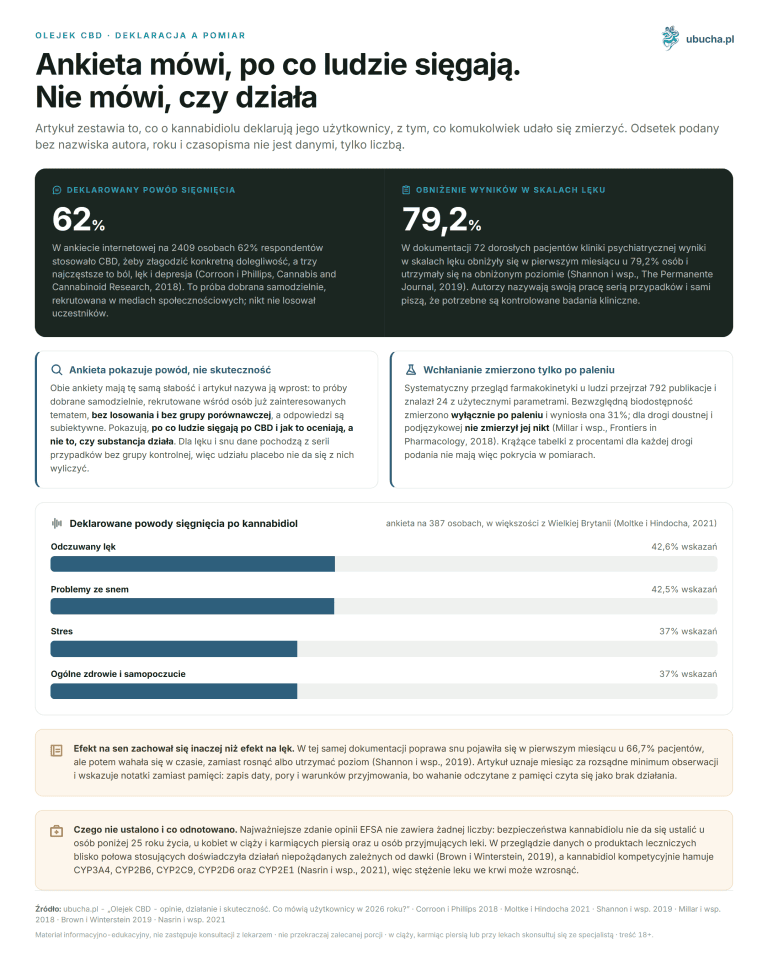
- The only route of CBD administration with solidly measured absolute bioavailability in humans is the inhalation route, about 31 percent; for oral and sublingual routes, the systematic review states a lack of sufficient data (Millar et al., 2018).
- A high-fat meal increased CBD exposure by 4.85 times for maximum concentration and 4.2 times for the area under the curve (Taylor et al., 2018).
- The most commonly reported adverse effects are drowsiness, diarrhea, and changes in appetite and body weight (Iffland and Grotenhermen, 2017).
- In a study of 84 CBD products sold online, only 31 percent had content consistent with the label (Bonn-Miller et al., JAMA 2017).
- The Polish threshold of 0.3 percent is calculated as the sum of delta-9-THC and THCA, not just delta-9-THC (Article 4 point 5 of the Act on Counteracting Drug Addiction).
What exactly is CBD oil?
CBD oil is an extract from hemp dissolved in a fat carrier. Cannabidiol is a poorly water-soluble molecule, so it cannot be administered in drops without fat. Manufacturers most often use MCT fraction from coconut oil, less often hemp seed oil or olive oil.
Cannabidiol itself does not produce intoxication and does not cause the effect commonly referred to as a high. This distinguishes it from THC, which is often confused with by people encountering cannabis for the first time. Both compounds come from the same plant and have a similar structure, but they bind to receptors in the body in a completely different way.
Plant cannabinoids act on the endocannabinoid system, which the body has regardless of whether it has ever encountered cannabis. CBD and THC are metabolized in the liver, which has further consequences when combined with medications; we will return to this in a separate section (Lucas et al., 2018).
It is worth immediately distinguishing between two products that stand next to each other in stores. CBD oil is an extract containing cannabidiol at the declared concentration. Hemp seed oil, also sold as hemp seed oil, is a pressed food oil and contains virtually no cannabidiol. The names are similar, the content is completely different, and the price of both can be similar.
How is CBD oil made?
Most often by extraction with supercritical carbon dioxide, less often with ethanol or plant oil. In the method with carbon dioxide, the gas under pressure behaves like a solvent and extracts cannabinoids along with terpenes from the biomass, and after decompression, it evaporates, leaving no residue.
Ethanol extraction is cheaper and efficient, but requires careful evaporation of the solvent. It is not worse by definition: the result of the analysis of solvent residues in the batch analysis certificate determines it. If the manufacturer does not publish such a study, the extraction method ceases to be information and becomes a declaration.
The third method is fat extraction, usually with olive oil. It is considered a low-efficiency artisanal method, but it has a surprising advantage shown by measurement. In an annual stability study, olive oil was found to be the carrier that best preserved the natural composition of phytocannabinoids among the tested solvents (Milay et al., 2020).
The carrier thus affects not only the taste but also how long the product remains what the label declares. The choice of MCT is convenient because it provides a neutral taste and fluidity at low temperatures, while the industry’s opinion on its unquestionable superiority over other carriers has no backing in this particular measurement.
For the buyer, the conclusion is practical and short. The extraction method itself guarantees nothing, and the difference is made only by the document describing a specific batch: cannabidiol content, THC content, solvent residues, heavy metals, and pesticides.
What is the difference between full spectrum and isolate?
The number of compounds that remain in the finished product. Full spectrum retains the natural set of cannabinoids, terpenes, and other plant components, along with a trace amount of THC. Broad spectrum is the same extract after THC removal. Isolate is pure cannabidiol, without smell and without other components.
The argument for full spectrum is the entourage effect, which is the hypothesis that cannabinoids and terpenes work together differently than separately. However, it is important to know how the author formulated it. Russo concluded his review with a conditional statement: the synergy of phytocannabinoids and terpenoids, if proven, increases the chance of a new family of drugs (Russo, 2011).
This conditional mode disappears in product descriptions, where the entourage effect is often presented as an established mechanism. The work proposes mechanisms and methods for studying synergy in future experiments, not its confirmation. The sensory difference between full spectrum and isolate is, however, obvious from the first drop, as isolate has no smell or taste.
Practically, the choice between forms depends on the situation, not on which is better. Broad spectrum or isolate makes sense where trace THC may be a problem, for example, in workplace testing. Full spectrum is usually chosen by those who care about the least processed extract, and this is a justified choice, although so far based on a hypothesis.
What exactly terpenes bring to such an extract and how to read their profile on the certificate is detailed in a separate guide on types of CBD oils.
What concentration of CBD oil should I choose at the beginning?
The lowest available, as it allows for small steps. Concentration is given in percentage by weight, and converting to milligrams is simple arithmetic: a 5 percent oil in a 10 ml bottle contains about 500 mg of cannabidiol, a 10 percent oil about 1000 mg, a 20 percent oil about 2000 mg.
In the category of oils at Bucha, available as of August 10, 2026, are concentrations of 5, 10, 15, and 20 percent. This well reflects the Polish market: variants below 5 percent and above 20 percent are rare. A lower concentration means more drops for the same dose, which means more accurate dosing at the start.
When converting the dose to drops, be cautious with the number of drops in the pipette. It is commonly assumed that there are 200 drops in 10 ml, which with 5 percent oil gives about 2.5 mg per drop, but pipettes vary in diameter and the viscosity of the oil also matters. Check the number of drops provided by the manufacturer instead of assuming it from a table.
A higher concentration only pays off when you already know your daily dose and it is high enough that counting drops becomes cumbersome. Before that, it mainly poses the risk of exceeding the dose: with 20 percent oil, a single drop is four times more cannabidiol than with 5 percent oil, so a mistake of one drop costs correspondingly more.
How much CBD does the body actually absorb?
For oral and sublingual routes, it is unknown, and that is an honest answer. A systematic review of cannabidiol pharmacokinetics in humans covered 24 studies and states directly: the only route for which absolute bioavailability was measured is the inhalation route, and it is about 31 percent (Millar et al., 2018).
For other routes of administration, despite the availability of intravenous preparations, no study has undertaken to measure absolute bioavailability. The tables circulating in Polish internet, stating 6-19 percent orally and 13-19 percent sublingually, therefore have no source. They have been repeated from one service to another, and the reference was added to a work that does not contain bioavailability data at all.
What the review actually provides is less impressive but verifiable. Maximum concentration increases after a meal and with fatty preparations. The time to maximum concentration ranges from zero to four hours. The half-life ranges from 1.4 to 10.9 hours after aerosol administered to the oral mucosa and reaches 2-5 days with chronic oral administration.
The review concludes with a statement worth remembering before reading any product description: data on the pharmacokinetics of cannabidiol are poor and partially divergent, despite the widespread use of this substance in humans. Any table of percentages given without indicating the study from which it comes is suspicious in this light.
A separate issue is the consequence for comparing products. Since it is unknown what portion of the oral dose is absorbed, the declared content in milligrams speaks about the product, not about how much substance reaches the blood. Comparing two oils based solely on milligrams makes sense economically, not pharmacologically.
Does fat in a meal change the action of CBD?
It does, and this is one of the few effects on this topic measured in humans in a controlled study. In the arm of the study assessing the impact of food, a high-fat meal increased the maximum concentration of cannabidiol by 4.85 times, and the area under the curve by 4.2 times, compared to fasting administration (Taylor et al., 2018).
This same work provides an important clarification: the meal did not change either the time to maximum concentration or the final half-life. Fat increases the amount of substance that enters the bloodstream but does not speed up the action. The statement “take on an empty stomach for it to work faster” has no support in this measurement.
The scale of this effect has a direct impact on practice. The same number of drops taken after a fatty dinner and taken in the morning on an empty stomach is practically two different doses, differing several times. If you are dosing, always take the oil in the same relation to meals; otherwise, you are comparing days that cannot be compared.
The study also provides a reference point for doses. Participants received single doses from 1500 to 6000 mg and 750 or 1500 mg twice a day for a week. Cannabidiol was generally well tolerated, and all reported adverse events were of mild or moderate severity; no serious events or deaths occurred.
How to dose CBD oil?
The principle formulated by the authors of the cannabinoid pharmacology review is to start with a small dose and increase slowly, observing the patient for desired and undesired effects. The reason is not ritual caution but the fact that available pharmacokinetic data are too poor to predict the reaction (Lucas et al., 2018).
In practice, this means a scheme without impressive numbers. Choose one time of day and one relation to meals, start with the smallest dose that can be measured, and maintain it for several days without changes. Record observations, as memory after a week smooths out differences. Only then increase, one step at a time.
You will find ready-made dosage tables for specific ailments online, for example, so many milligrams for sleep and so many for tension. Such compilations have no backing in clinical studies in healthy individuals and are usually signed with a source that does not contain them. The doses used in studies are also orders of magnitude higher than typical retail doses, so they cannot be simply transferred.
A separate note concerns the pace. Cannabidiol reached a steady state after about two days of administration twice a day, and its final half-life after a week was about 60 hours (Taylor et al., 2018). Changing the dose every other day mainly measures noise, not the effect of the change.
A practical starting scheme is detailed step by step in the guide on dosing CBD for beginners.
Does CBD oil interact with medications?
Yes, and this is the most important information in this entire guide. Cannabidiol and THC are metabolized in the liver, so there is a real possibility of pharmacokinetic interactions through inhibition or induction of enzymes and transporters. A documented example is the inhibition of clobazam metabolism by cannabidiol (Lucas et al., 2018).
This same review indicates a second type of interaction that is less often mentioned. Pharmacodynamic interactions will occur when cannabinoids are taken together with other drugs that act depressively on the central nervous system. The authors also mention cardiovascular risks when combined with sympathomimetic drugs, due to the summation of increased blood pressure and heart rate.
The safety review of cannabidiol formulates the same from the perspective of gaps in knowledge. The authors state directly that more clinical studies are needed on the action of cannabidiol on liver enzymes, drug transporters, and interactions with other substances, as it is unknown whether the effects are mainly beneficial or adverse (Iffland and Grotenhermen, 2017).
The practical conclusion is clear. If you are taking any prescription medication, ask your doctor or pharmacist before adding CBD oil to it. A pharmacist in a pharmacy has access to interaction databases, and such a conversation costs nothing. The popular advice to simply separate the intake by two hours does not eliminate metabolic interactions, as they occur at the enzyme level, not in the stomach.
Lucas’s review also lists situations in which cannabinoids are contraindicated: significant psychiatric, cardiovascular, kidney, or liver disease. Older individuals may experience symptomatic benefits but are also more susceptible to adverse effects.
What are the side effects of CBD oil?
The most commonly reported are drowsiness, diarrhea, and changes in appetite and body weight. This summarizes the clinical literature in the safety review of cannabidiol, which confirms the favorable safety profile of this substance and notes that compared to drugs used for the same indications, its adverse effect profile is better (Iffland and Grotenhermen, 2017).
A phase one study in healthy volunteers gives a very similar list: diarrhea, nausea, headache, and drowsiness. All events were of mild or moderate severity, none were severe, and no one dropped out of the study (Taylor et al., 2018). The convergence of two independent sources is a rarity in this topic.
Diarrhea can be misleading, as it does not always stem from cannabidiol itself. The fat carrier, especially the MCT fraction, can cause gastrointestinal discomfort in some individuals. If the symptom appears from the first dose and does not depend on its size, it is worth checking another carrier before discontinuing the product.
Drowsiness is a dose-dependent effect and the simplest signal that the dose is too high. Morning grogginess after an evening dose is information, not a symptom requiring treatment; reduce the dose and observe. Treat atypical symptoms much more seriously: dizziness, rash, swelling, or changes in the action of the medication you are taking regularly.
More broadly about what is documented in this area and what is repeated without backing, we write in the text on the safety of CBD.
How to check the quality of CBD oil before purchase?
By the certificate of analysis for a specific batch, and there is no second equally effective method. The scale of the problem is shown by a study of 84 cannabidiol products purchased online from 31 companies: 31 percent of them had content consistent with the label (Bonn-Miller et al., JAMA 2017).
The distribution of errors in this work is as interesting as the number itself. Almost 43 percent of products contained less cannabidiol than declared on the label, and over 26 percent more. In 18 out of 84 samples, or 21 percent, THC was detected, in concentrations reaching up to 6.43 mg/ml. This refers to products that did not declare THC in their composition.
This work is from 2017 and pertains to the American market, so it does not directly describe the situation in Poland in 2026. However, it describes a mechanism that has not disappeared: without independent testing of the batch, the manufacturer’s declaration remains a declaration. This is an argument for the certificate, not a forecast for a specific bottle.
On the certificate, check four things. The batch number must match the number on the packaging, otherwise, the document describes a different product. The cannabidiol content should be stated in milligrams per milliliter, not just in percentages. The THC content must be within the threshold described in the legal section. There should also be results of tests for heavy metals, pesticides, and solvent residues.
Finally, check who performed the testing. A certificate from an external laboratory weighs more than a result from the manufacturer’s laboratory, as in the latter case, the tester and the tested are the same party. The lack of a certificate for a product with declared cannabidiol content is a sufficient reason to look further.
How much should CBD oil cost?
Instead of a price threshold, a more sensible operation is one arithmetic calculation: divide the price of the package by the number of milligrams of cannabidiol stated on the label. Only this result can be compared between products, as the price of the bottle speaks only about the bottle, not about the content.
For an order of magnitude: in the category of oils at Bucha, the prices of 10 ml bottles ranged from 65 to 240 PLN as of August 10, 2026, depending on the concentration and type of cannabinoid. The catalog changes faster than the article, so treat this range as a snapshot from one day, not as a binding table.
Circulating ranges on the internet like “a quality oil costs this much per milligram” have no source and it is not worth basing decisions on them. There is no study that would link the price of a cannabidiol product with its quality, and the only hard data on quality concern compliance with the label and come from the study described in the previous section.
A very low price should, however, raise caution for a different reason than the amount itself. A product with a declared high content of cannabidiol and a price glaringly different from the rest of the market most often either does not have that content or comes from production without batch testing. The certificate determines this, not the label.
When calculating, remember two traps. A 30 ml bottle looks more expensive than a 10 ml one, but can be cheaper when converted to milligrams. Products combining several cannabinoids are priced as a whole, so comparing them with pure cannabidiol oil based on the price per milligram of cannabidiol inflates their cost.
Are CBD oils legal in Poland?
Yes, cannabidiol is not listed in any of the controlled substances lists. The condition for the legality of the raw material is the THC content threshold: industrial hemp is a plant in which the sum of delta-9-THC and tetrahydrocannabinolic acid in the flowering tops or fruiting does not exceed 0.3 percent when calculated on a dry mass basis.
Three details of this threshold are often stated incorrectly. First, the sum of delta-9-THC and THCA is counted, not just delta-9-THC, and this changes the result of the laboratory test. Second, the sum is rounded to one decimal place. Third, the basis is Article 4 point 5 of the Act of July 29, 2005 on Counteracting Drug Addiction (consolidated text Dz.U. 2023 poz. 1939), as amended by the Act of March 24, 2022 (Dz.U. 2022 poz. 763), in force since May 7, 2022.
Until May 6, 2022, the national threshold was 0.20 percent. The statement “the THC limit in Poland is 0.2 percent” is therefore true only as a statement about the past, with a date. Without a date, it is simply outdated, yet it still circulates in product descriptions.
A separate mistake is deriving the Polish threshold from EU law. As of January 1, 2023, varieties of hemp eligible for support under the Common Agricultural Policy may contain up to 0.3 percent THC based on Article 4 paragraph 4 of Regulation (EU) 2021/2115; previously, the EU threshold was 0.2 percent based on the repealed Regulation 1307/2013. These are two separate regulations with the same numerical value. The correct formulation is: the national threshold corresponds to the EU threshold.
Two final notes. Hexahydrocannabinol, which is sometimes sold as an alternative to CBD, is a controlled substance in Poland and should not be confused with cannabidiol. The amendment to the Act on Counteracting Drug Addiction coming into force on August 27, 2026, does not change the THC threshold, substance classification, or retail sales rules.
How to store CBD oil?
In a cool place, in the dark, in a tightly closed bottle. An annual stability study of secondary metabolites of hemp showed that storage at 25 degrees Celsius resulted in the greatest changes in phytocannabinoid concentrations among the tested conditions, while the most favorable for extracts was 4 degrees (Milay et al., 2020).
Room temperature, which most labels recommend, is therefore a compromise of convenience, not an optimal condition. The refrigerator performs better, although the oil may become cloudy or thicken in it; just hold the bottle in your hand before use. The freezer is not a better solution: in the same study, temperatures below minus 20 degrees were among the least favorable for the terpene fraction.
Dark glass is not just a decoration of the packaging. Light accelerates the degradation of cannabinoids, which is why manufacturers use amber or orange bottles. Keep the oil away from windows, stoves, and bathrooms, where temperature and humidity change several times a day.
Hygiene of the pipette extends the life of the product more than one might think. Do not touch it with your tongue or lips, as any contact introduces microorganisms into the bottle along with saliva. After dosing, wipe the pipette with a clean tissue and close the bottle tightly; air in the bottle oxidizes the contents with each opening.
A noticeable darkening in color or an unpleasant rancid smell indicates that the product has oxidized. It is not dangerous at that point, but it no longer corresponds to the declaration on the label, as part of the content has undergone transformation.
Can CBD be given to dogs or cats?
Yes, to dogs, under the supervision of a veterinarian, and there is solid clinical research in this area. In a randomized, blinded study conducted at Cornell University, dogs with degenerative joint disease received cannabidiol oil at a dose of 2 mg/kg every 12 hours for four weeks (Gamble et al., 2018).
The results were unequivocal in both assessment scales. The pain questionnaire filled out by owners and the activity scale showed a significant reduction in pain and an increase in activity, and veterinary assessment confirmed a reduction in pain during treatment. The half-life was 4.2 hours at both doses studied, justifying twice-daily administration.
The work also noted a signal that sellers usually do not mention. Owners did not report adverse effects, but biochemical tests showed an increase in alkaline phosphatase activity during the use of cannabidiol. This is a liver parameter and a reason why longer administration should be done under veterinary supervision, not on your own.
For cats, the situation is different and requires greater caution, as cats metabolize some plant substances differently than dogs. Do not give the animal a product intended for humans: it differs in carrier, concentration, and the content of flavor additives that the animal’s body may not tolerate.
The conversion of the dose to body weight is detailed in a separate text on CBD oil for dogs and cats.
What does this mean in practice
The most certain information about cannabidiol oils concerns things that marketing says the least about: absorption, interactions with medications, and compliance of content with the label. The least certain concerns what is promised the loudest, namely doses for specific ailments and the advantages of full spectrum over isolate.
Three numbers from this text are worth remembering. Absolute bioavailability measured in humans exists only for the inhalation route and is about 31 percent. A fatty meal increases exposure nearly fivefold. Compliance of content with the label was found in 31 percent of the tested products purchased online.
The rest of the decisions are simple and do not require any specialized knowledge. Start with a small dose and change it slowly. Always take the oil in the same relation to meals. Ask your pharmacist if you are taking anything on prescription. Buy a product with a batch analysis certificate, the number of which matches the packaging, and keep the bottle in a cool and dark place.
Finally, one tip for reading texts about cannabidiol, including this one. If a sentence provides a number, check whether it leads to a specific work, not to the homepage of a journal or to the name of an organization without an address. A link to the homepage under a statistic is the most common way to support claims that no one has measured, and when reading superficially, it looks exactly like citing.
We have gathered the full offer of oils in the hemp oils category.
Frequently Asked Questions
What is CBD oil and how is it made?
It is an extract from hemp dissolved in a fat carrier, most often MCT fraction from coconut oil. It is produced by extraction with supercritical carbon dioxide, ethanol, or fat. In an annual stability study, olive oil was found to be the best carrier for preserving the composition of phytocannabinoids (Milay et al., 2020).
How much CBD does the body actually absorb?
For oral and sublingual routes, it is unknown. A systematic review of pharmacokinetics in humans states that absolute bioavailability was measured only for the inhalation route and is about 31 percent; for other routes of administration, such measurements have not been performed (Millar et al., 2018).
Does fat in a meal affect CBD absorption?
Yes. A high-fat meal increased the maximum concentration of cannabidiol by 4.85 times, and the area under the curve by 4.2 times compared to fasting administration. However, it did not change the time to maximum concentration or the final half-life (Taylor et al., 2018).
What dose of CBD oil should I start with?
From the smallest amount that can be measured, slowly increasing and observing the reaction. This principle is formulated by the authors of the cannabinoid pharmacology review, indicating poor pharmacokinetic data as the reason (Lucas et al., 2018). Ready-made dosage tables for specific ailments have no source.
Does CBD oil interact with medications?
Yes. Cannabidiol is metabolized in the liver and can inhibit or induce enzymes and drug transporters; a documented example is the inhibition of clobazam metabolism (Lucas et al., 2018). Before combining with prescription medications, ask your doctor or pharmacist.
What are the side effects of CBD oil?
The most commonly reported are drowsiness, diarrhea, and changes in appetite and body weight (Iffland and Grotenhermen, 2017). In a phase one study in healthy volunteers, nausea and headache were also reported, all with mild or moderate severity.
Is CBD oil legal in Poland?
Yes. Cannabidiol is not listed in controlled substances, and the raw material must meet the threshold of 0.3 percent calculated as the sum of delta-9-THC and THCA, rounded to one decimal place. The basis is Article 4 point 5 of the Act on Counteracting Drug Addiction in the wording in force since May 7, 2022.
Can CBD be given to dogs?
Yes, under the supervision of a veterinarian. In a study from Cornell University, dogs with degenerative joint disease received 2 mg/kg every 12 hours for four weeks and showed less pain and increased activity, with an increase in alkaline phosphatase activity (Gamble et al., 2018).
This article is for informational and educational purposes only and does not constitute medical advice. Before starting to use cannabis or CBD for therapeutic purposes, consult your doctor, especially if you are taking other medications, are pregnant, or breastfeeding.
Author: Michał Waluk · Published: 2026-04-27 · Updated: 2026-08-10