
Reishi Mushroom (Lingzhi, Ganoderma Lucidum) - How Does It Affect the Human Body?
Reishi, or lakownica żółtawa. What do Cochrane reviews confirm, what doses were tested, who the mushroom harms, and why it does not cure cancer. Status as of 2026.
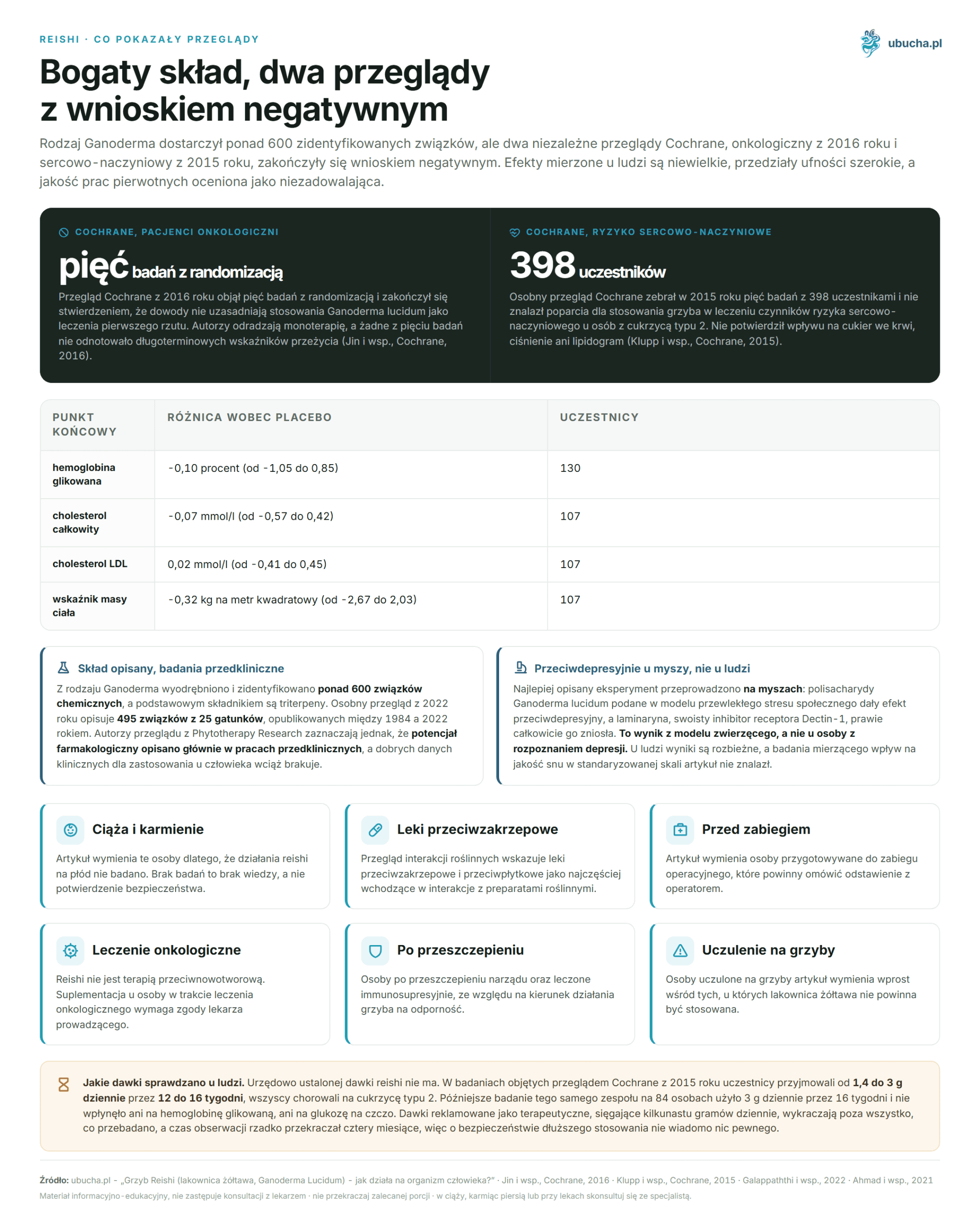
Reishi, known in Polish as lakownica żółtawa, and botanically as Ganoderma lucidum, is one of the best-researched medicinal mushrooms and also one of those surrounded by the most unsupported claims. A monograph from the American National Institutes of Health states that beliefs about the health effects of this species are largely based on anecdotal evidence, tradition, and custom, and only newer works provide partial confirmation. Two independent Cochrane reviews, one oncology-related from 2016 and one cardiovascular from 2015, concluded negatively, yet the market for supplements containing this mushroom is growing. This text separates one from the other: it shows what results from systematic reviews and studies involving humans, what doses have actually been tested, where knowledge ends, and who may be harmed by reishi. Numbers without a verifiable source have been removed from the article.
KEY INFORMATION
• Reishi does not cure cancer. The Cochrane review from 2016 included five randomized studies and found no evidence for using the mushroom as a first-line treatment (Jin et al., Cochrane, 2016).
• The genus Ganoderma has provided over 600 identified compounds, with triterpenes being the main component (Galappaththi et al., 2022).
• A separate Cochrane review involving 398 participants did not confirm any effect on blood sugar, blood pressure, or lipid profile in individuals with type 2 diabetes (Klupp et al., Cochrane, 2015).
• Doses in clinical studies ranged from 1.4 to 3 g daily for 12-16 weeks (Klupp et al., 2015).
• There is a lack of studies on the safety of chronic use, interactions with medications, and effects on the fetus (Ahmad et al., Phytotherapy Research, 2021).
What is the reishi mushroom?
Lakownica żółtawa is a mushroom from the family Ganodermataceae that grows on hardwood trees, known in Far Eastern medicine by the Chinese name lingzhi and the Japanese name reishi. In the Chinese sense, the name combines spiritual power with the element of immortality, and the mushroom symbolizes success and longevity.
Among cultivated mushrooms, Ganoderma lucidum occupies a unique position because its pharmaceutical value is considered rather than its nutritional value. Commercial preparations are made from various parts of the organism: from mycelium, spores, and the fruiting body, and their attributed uses include controlling blood glucose levels, modulating immunity, protecting the liver, and exhibiting bacteriostatic effects. This is how the species is described in the monograph by Wachtel-Galor et al. from 2011.
This same monograph raises a caveat worth reading before any list of properties. Various beliefs about the health benefits of lingzhi are mainly based on anecdotal evidence, traditional use, and cultural norms, while newer reports provide scientific support only for some of the old claims.
Nomenclature itself can be a source of misunderstandings. A 2021 review describes the taxonomic chaos surrounding Ganoderma lucidum and related species as a problem requiring resolution, as research material from different regions of the world can be different organisms under the same name. More about the entire group can be found in our guide on medicinal mushrooms and their clinical studies.
What compounds does lakownica żółtawa contain?
Over 600 chemical compounds have been isolated and identified from the genus Ganoderma, with triterpenes being the primary component. This is summarized in a review of Ganoderma triterpenoids published in 2022, which itself describes 495 compounds from 25 species, published between 1984 and 2022.
| Group | Examples | What the studies concern |
|---|---|---|
| polysaccharides | alpha- and beta-D-glucans | immune response, animal models of depression |
| triterpenoids | ganoderic acids, ganoderenic acids, ganoderol, ganoderiol, lucidenic acids | main group of components, mostly preclinical studies |
| proteins | LZ-8, LZ-9 | mitogenic activity against lymphocytes, studies from the 1980s |
| sterols | ergosterol | precursor of vitamin D2, preclinical data |
| nucleosides and nucleotides | adenosine, inosine, uridine, guanine, adenine | described components, no clinical data |
The composition is compiled based on a review by Ahmad et al. from Phytotherapy Research in 2021, which, alongside polysaccharides and triterpenoids, also mentions alkaloids and trace elements. The authors emphasize that the pharmacological potential has been described mainly in preclinical works, burdened with numerous limitations, and good clinical data for human use is still lacking.
How does reishi affect the immune system?
Immunomodulation is the best-documented area of research on lakownica żółtawa, but the measured effects in humans are small. The Cochrane review from 2016 found a simultaneous increase in the percentage of CD3 lymphocytes by 3.91 percentage points, CD4 by 3.05, and CD8 by 2.02 in cancer patients.
The confidence intervals for these three values range from 1.92 to 5.90, from 1.00 to 5.11, and from 0.21 to 3.84 percentage points, respectively. The activity of NK cells and the CD4 to CD8 ratio increased slightly in these studies. The authors of the review rated the methodological quality of the primary studies as generally unsatisfactory, and the reporting of results as incomplete in many aspects.
The oldest lead goes to the protein LZ-8, isolated from mycelium extract in 1989. The work by Kino et al. in the Journal of Biological Chemistry describes it as a protein with mitogenic activity in laboratory conditions and immunomodulating in animals. The molecular weight depends on the measurement method and ranges from 13,100 to 17,500, the isoelectric point is 4.4, and the sugar content is only 1.3 percent. In mice, repeated administration of LZ-8 prevented the occurrence of systemic anaphylactic reactions.
More than thirty years have passed since that work, and there is still no study that translates this mechanism into a measured health effect in healthy humans. This discrepancy is typical of the entire literature on reishi: mechanisms are described in detail, but endpoints in humans are rare.
Does reishi cure cancer?
No. The Cochrane review published in 2016 included five randomized studies in cancer patients and concluded that the evidence does not support the use of Ganoderma lucidum as a first-line treatment. It is also unknown whether the mushroom prolongs survival.
Patients who received reishi alongside chemotherapy or radiotherapy responded to treatment more often than those who underwent chemotherapy or radiotherapy alone, with a relative risk of 1.50 and a confidence interval from 0.90 to 2.51. Reishi alone, without conventional treatment, did not provide such regression. None of the five studies recorded long-term survival rates. In four studies, patients in the group receiving the mushroom had a better quality of life than those in the control group. The full text of the review is available in the Cochrane Library.
A separate small pilot study from 2012 investigated something other than cancer: fatigue associated with treatment. Zhao et al. randomly assigned 48 breast cancer patients undergoing hormone therapy to a group receiving powdered spores or a control group. After four weeks, the experimental group had better results in physical well-being and fatigue subscale, reported less anxiety and depressive symptoms, and lower levels of inflammatory markers. No serious adverse events were recorded.
IMPORTANT DISCLAIMER
Reishi is not a cancer therapy. The authors of the Cochrane review advise against its use in monotherapy, and any supplementation in a person undergoing cancer treatment requires the consent of the attending physician.
What do studies show about heart disease and diabetes?
Here the result is unequivocally negative and comes from the second Cochrane review. Klupp’s team collected five studies with 398 participants in 2015 and found no support for the use of Ganoderma lucidum in treating cardiovascular risk factors in individuals with type 2 diabetes.
| Endpoint | Difference from placebo | Participants |
|---|---|---|
| glycated hemoglobin | -0.10 percent, confidence interval from -1.05 to 0.85 | 130 |
| total cholesterol | -0.07 mmol/l, interval from -0.57 to 0.42 | 107 |
| LDL cholesterol | 0.02 mmol/l, interval from -0.41 to 0.45 | 107 |
| body mass index | -0.32 kg per square meter, interval from -2.67 to 2.03 | 107 |
For blood pressure and triglycerides, the review also found no significant differences between groups. Individuals taking the mushroom for four months reported adverse events with a relative risk of 1.67 and a confidence interval from 0.86 to 3.24, although these were not serious events. The entire review by Klupp et al. is available in open access.
A year later, the same team published their own double-blind study on 84 individuals with type 2 diabetes and metabolic syndrome. Participants took 3 g of reishi daily, either alone or with cordyceps, for 16 weeks. The intervention did not affect glycated hemoglobin, fasting glucose, or any of the secondary endpoints, and did not increase the risk of adverse events.
Does reishi help with stress, sleep, and mood?
Data comes almost exclusively from animals. In humans, clinical trial results on reishi are inconsistent, as stated directly in a review of edible mushrooms as a component of dietary interventions in depression, published in 2022.
The best-described experiment was conducted on mice. Li et al. administered polysaccharides from Ganoderma lucidum to animals in a model of chronic social stress and obtained an antidepressant effect visible after one hour in the tail suspension test and lasting after five days of administration in the forced swimming test. After five days, the expression of pro-inflammatory cytokines decreased in the animals, the expression of the anti-inflammatory cytokine and neurotrophic factor increased, and microglial activation in the hippocampus was inhibited.
The mechanism was attributed to a specific receptor. Administration of laminarin, a specific Dectin-1 receptor inhibitor, almost completely abolished the antidepressant effect, indicating this receptor as a mediator of the effect. This is an elegant result, but it pertains to mice and a model, not to a person diagnosed with depression.
It is worth stating directly what is missing here. We did not find a study involving humans that measured the impact of reishi on sleep quality using a standardized scale. Numbers circulating in the Polish internet on this topic, including improvements in the PSQI score by several points, have no verifiable source and have been removed from this article. The review by Fijałkowska et al. summarizes the state of knowledge about reishi in depression as ambiguous.
What are the differences between reishi forms?
Preparations are made from three different parts of the organism: from mycelium, from spores, and from the fruiting body. The method of preparation determines which fraction of components ends up in the product, as polysaccharides dissolve in water, while triterpenoids dissolve in organic solvents.
| Form | What goes into the preparation | Trace in studies |
|---|---|---|
| powdered fruiting body | full raw material without separating fractions | the form most often described in the literature |
| water extract | water-soluble polysaccharides | fraction studied in immune and animal models |
| ethanol extract | triterpenoids | group described in the review of 495 compounds |
| powdered spores | spore material, often after wall disruption | the form used in the study on fatigue in breast cancer |
Trade uses many terms that cannot be verified on the label: the degree of spore wall disruption, the extraction ratio, the declared content of the active fraction. None of these values has a counterpart in a comparative clinical study that would compare forms among themselves in humans. The choice of form is therefore today a decision based on chemical premises, not on evidence of effectiveness.
The practical consequence is that doses from different preparations do not translate into each other. A gram of powdered fruiting body and a gram of water extract are two different products in terms of active fraction content, even though the same unit appears on the packaging. When comparing preparations, look at what they are made from and how they were prepared, not just the mass in the capsule.
What doses were used in studies?
There is no officially established dose of reishi. In the studies included in the Cochrane review from 2015, participants took between 1.4 to 3 g daily, and interventions lasted from 12 to 16 weeks. All participants in these three analyzed works had type 2 diabetes.
A later study by the same team used the upper limit of this range, namely 3 g daily for 16 weeks. A pilot study on fatigue in breast cancer lasted four weeks and used powdered spores. This is essentially the entire range in which reishi has been tested in controlled conditions.
From this summary, two practical conclusions arise. First, doses advertised as therapeutic, reaching several grams daily, exceed everything that has been tested. Second, the observation period in studies rarely exceeded four months, so nothing certain is known about the safety of year-long or multi-year supplementation.
The review from Phytotherapy Research states the same in research language: there is a lack of clinical studies on safety and efficacy, interactions with food and beverages, chronic use, and effects on the fetus and genetic material. This is a gap in knowledge, not proof of harmlessness.
Who should not use reishi?
The answer arises more from what has not been studied than from a list of documented harms. Since there is a lack of data on interactions, chronic use, and effects on the fetus, caution applies everywhere where a mistake costs the most.
- pregnant and breastfeeding individuals, as effects on the fetus have not been studied
- individuals taking anticoagulant or antiplatelet medications: a systematic review of plant interactions indicates these two groups of drugs as the most frequently interacting with herbal preparations
- individuals preparing for surgery, who should discuss discontinuation with the operator
- individuals undergoing cancer treatment, only with the consent of the attending physician
- individuals who have undergone organ transplantation and are being treated immunosuppressively, due to the mushroom’s effect on immunity
- individuals allergic to mushrooms
It is worth separating two levels of certainty. A review of systematic reviews from 2013 included 46 herbal products and found that most were not associated with interactions with serious consequences, with the most serious documented for St. John’s wort and mistletoe. The same document cautions that poor quality and lack of primary data do not allow for strong conclusions.
From studies on reishi itself, it is known that in the Cochrane review from 2015, the percentage of reported adverse events was higher in the group taking the mushroom, although the difference did not reach significance, and the events were not serious. In the oncology review from 2016, one study reported nausea and insomnia, with no hematological or liver toxicity.
How to choose a reishi preparation?
Two things can be verified on the label, while the rest requires trust in the manufacturer. The species name and the part of the mushroom used as raw material can be checked, and these two pieces of information are indeed significant for reishi.
The species name is important because a review from 2021 describes the taxonomic chaos surrounding Ganoderma lucidum and related species. Material from different regions, sold under the same commercial name, can be different organisms, undermining the comparability of studies and products. A label with a vague designation of the genus says nothing.
The part of the mushroom matters because preparations are made from mycelium, spores, or the fruiting body, and clinical studies have used different ones. The declaration of the type of extract, whether water or ethanol, indicates which fraction of components has passed into the product.
Beyond that, there is the issue of raw material quality. A review by Venturelli et al. from 2021 indicates that the growing interest in mycotherapy requires the scientific community to expand clinical research and offer supplements with safe origins and genetic purity. This statement summarizes the market problem better than any product ranking. If you are looking for a reference point for other species, we have separately described chaga, or Inonotus obliquus, and compared adaptogenic mushrooms in terms of which to choose and when.
Summary: What is known for sure about reishi
Lakownica żółtawa has a rich and well-described chemical composition. Over 600 compounds, with triterpenes at the forefront, provide a real basis for research and explain why the species has attracted the attention of pharmacologists for decades. This part of the picture is solid.
The second part is weaker. Two independent Cochrane reviews, one oncology-related and one cardiovascular, concluded negatively: reishi is not suitable for first-line treatment in cancers and does not improve metabolic parameters in individuals with type 2 diabetes. The effects observed in studies are small, confidence intervals are wide, and the quality of primary works is rated as unsatisfactory.
The practical conclusion is moderate, and it should be so. Reishi can be a reasonable dietary supplement for a healthy person, at doses within the tested range of 1.4-3 g daily, and with the awareness that no one has verified the safety of long-term use. It is not a medicine and does not replace the treatment of any chronic disease. Any serious diagnosis, especially oncological, requires a conversation with a doctor before reaching for a supplement.
Frequently Asked Questions
Does reishi cure cancer?
No. The Cochrane review from 2016 included five randomized studies and found that the evidence does not support the use of reishi as a first-line treatment. The authors advise against monotherapy. No data was recorded on the mushroom’s impact on long-term survival of patients.
How long can reishi be used?
Clinical studies lasted from four to sixteen weeks, so longer use has not been tested. A review from Phytotherapy Research lists chronic use among areas without clinical data. The lack of studies is a lack of knowledge, not a confirmation of safety.
How much reishi was used in clinical studies?
In the studies included in the Cochrane review from 2015, participants took between 1.4 to 3 g daily for 12 to 16 weeks. A later study by the same team used 3 g daily for 16 weeks. Higher doses have not been tested in humans.
Does reishi lower blood pressure or cholesterol?
No such effect has been demonstrated. A Cochrane review involving 398 participants found no significant differences compared to placebo in total cholesterol, LDL cholesterol, blood pressure, or triglycerides. The authors concluded that the data do not support the use of the mushroom for this indication.
Does reishi help with depression?
Evidence comes from studies on mice, where the mushroom’s polysaccharides acted antidepressantly via the Dectin-1 receptor. In humans, results are inconsistent. Reishi does not replace depression treatment, and symptoms should be addressed with a doctor.
Can reishi be combined with anticoagulant medications?
Not without a doctor’s consent. No systematic study has examined reishi’s interactions with medications, and a review of plant interactions indicates anticoagulant and antiplatelet drugs as the most frequently interacting group with herbal preparations. The decision to combine is made by the attending physician.
What is the difference between Lingzhi and reishi?
These are three names for the same mushroom: Polish, Chinese, and Japanese. The issue complicates at the species level, as literature describes taxonomic chaos surrounding Ganoderma lucidum and related species. Material from different regions of the world can be different organisms under the same commercial name.
Are reishi spores better than the fruiting body?
There is no study comparing these forms among humans. It is only known that preparations are made from mycelium, spores, and the fruiting body, and a pilot study on fatigue in breast cancer used powdered spores. The superiority of one form remains unproven.
Extracts from reishi and other adaptogenic mushrooms and plants can be found in the herbs category.
This article is for informational and educational purposes and does not replace consultation with a doctor. If you are pregnant, breastfeeding, taking medications, or have chronic conditions, consult the use of supplements or herbs with a specialist.
Author: Michał Waluk · Published: 2026-05-06 · Updated: 2026-08-10