
Dry Mouth After Cannabis: Why It Occurs and How to Alleviate It
Where does dry mouth after cannabis come from, on which species the mechanism was measured, how often it affects people, and when the symptom requires a visit to the dentist.
Dry mouth after cannabis is one of the most commonly reported side effects, so prevalent that it has its own name in English: cottonmouth. Most guides treat it as an annoying detail and refer you to a glass of water, while also describing the mechanism with certainty that the data does not allow. An earlier version of this entry attributed the discovery of receptors in salivary glands to a study on humans, although the work concerned rats, and provided thresholds in milligrams that do not exist in the literature. Below, we separate the layers: what was measured in the laboratory and on which species, what is visible in population studies in humans, what really brings relief, and when a dry mouth stops being a detail and starts being a matter for a dentist.
KEY INFORMATION
• CB1 and CB2 receptors in the submandibular gland have been shown in rats, after submandibular administration of anandamide (Prestifilippo et al., Experimental Biology and Medicine, 2006).
• In humans, the rate of saliva secretion was significantly negatively correlated with the concentration of the substance in plasma in a double-blind trial of 57 people (Mattes et al., Chemical Senses, 1994).
• In a study of 29,721 adults, daily cannabis use was associated with a higher chance of xerostomia (Chaffee, JDR Clinical and Translational Research, 2026).
• Systematic reviews of CBD side effects do not mention dry mouth even once.
• Chronically dry mouth promotes cavities and requires a conversation with a dentist, not just water.
Why do mouths dry out after cannabis?
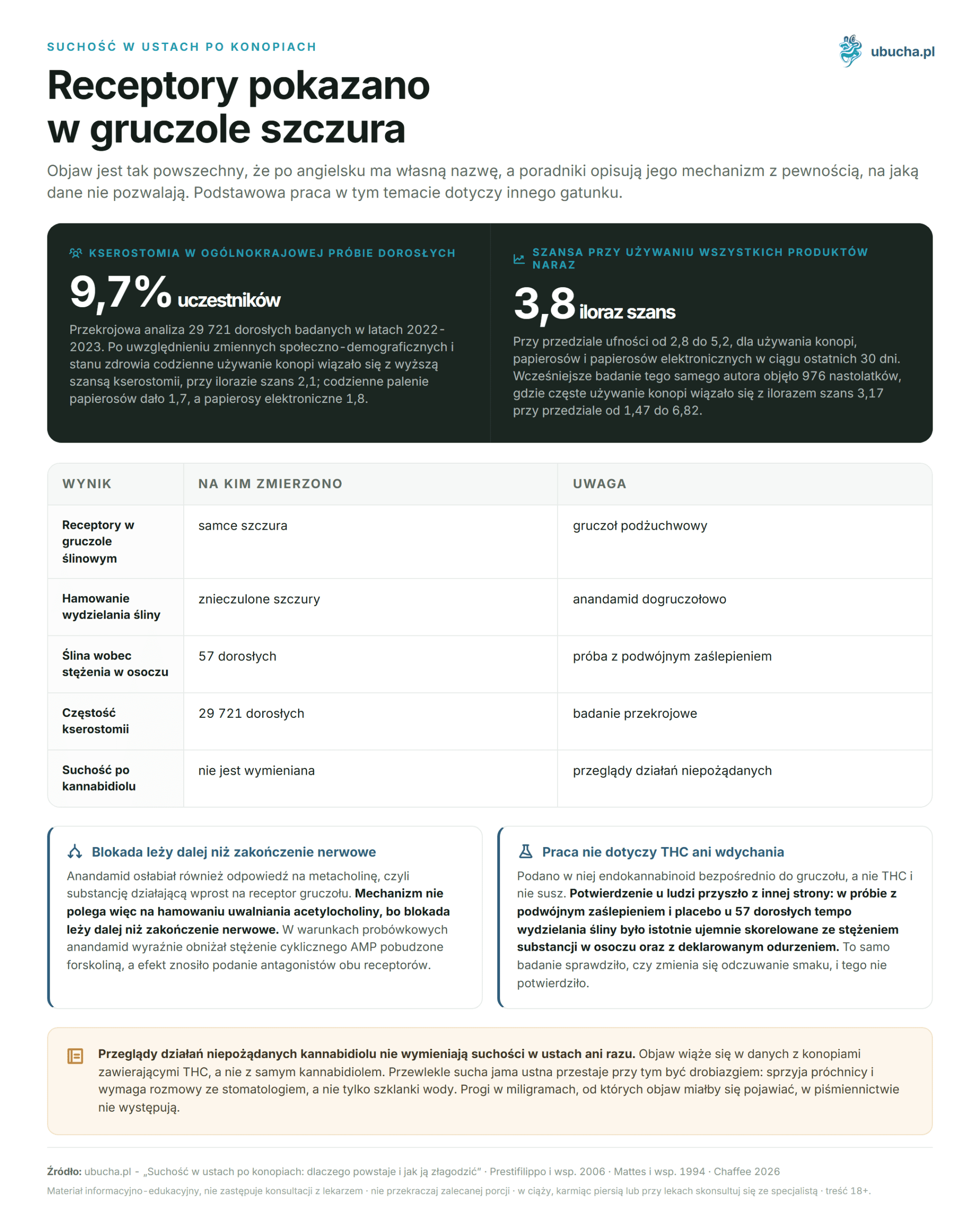
The fundamental work on this topic is by Prestifilippo and colleagues from 2006 in Experimental Biology and Medicine, and it must be said right away what it was performed on. They studied the submandibular gland of male rats. The authors demonstrated the presence of CB1 and CB2 receptors with distinct localization. Anandamide, the body’s endocannabinoid, clearly reduced cyclic AMP levels stimulated by forskolin in vitro, and the effect was abolished by the administration of antagonists of both receptors. Administered submandibularly to anesthetized rats, anandamide inhibited saliva secretion stimulated by norepinephrine and methacholine.
Three things are worth reading from this. The work does not concern human salivary glands, contrary to what was stated here earlier. It does not concern THC either, but the endocannabinoid administered directly to the gland, so neither inhalation nor dry herb. And it does not show the mechanism by inhibiting the release of acetylcholine: since anandamide also weakened the response to methacholine, a substance that acts directly on the gland receptor, the blockade lies further than the nerve ending. True confirmation in humans came from another side: in a double-blind trial with placebo in 57 adults, the rate of saliva secretion was significantly negatively correlated with the concentration of the substance in plasma and with reported intoxication. The same study checked whether the perception of taste changes, and this was not confirmed, which we discuss in relation to wolf appetite after cannabis.
How often does dryness affect cannabis users?
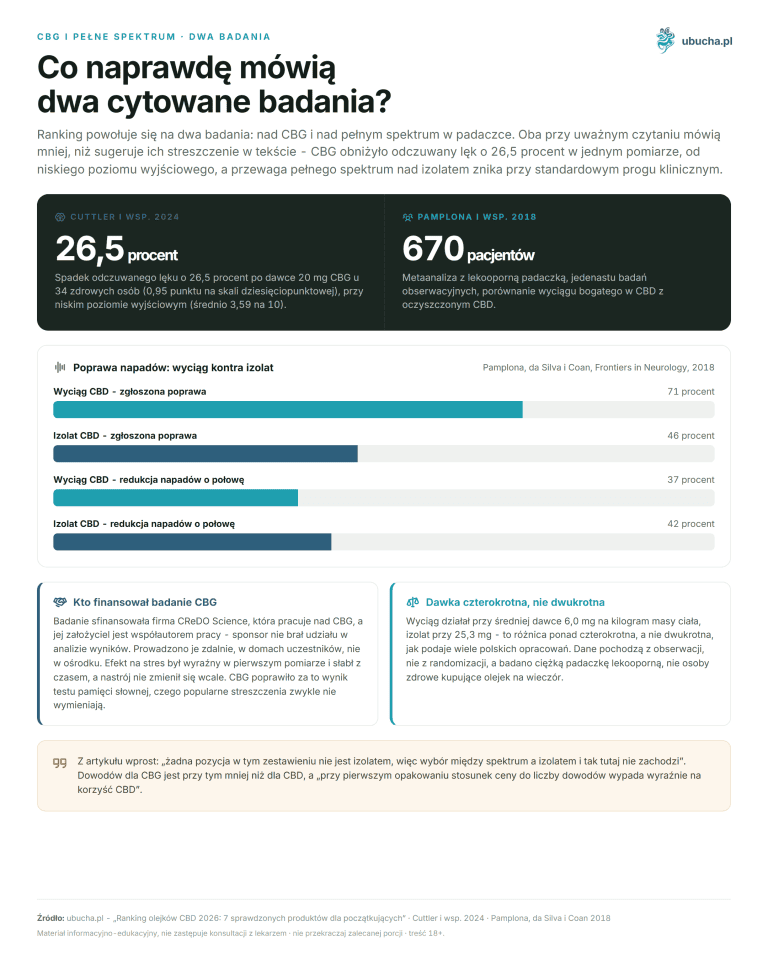
This question is answered by population studies, not physiology. In a cross-sectional analysis of a nationwide sample of 29,721 adults in the United States, surveyed in 2022-2023, xerostomia, understood as dry mouth experienced often or constantly, was reported by 9.7% of participants. After adjusting for socio-demographic variables and health status, daily cannabis use was associated with a higher chance of xerostomia (adjusted odds ratio 2.1; 95% CI 1.7-2.7), similar to daily smoking of cigarettes (1.7) and daily use of electronic cigarettes (1.8). The highest chance was recorded when using all three products in the last 30 days (3.8; 95% CI 2.8-5.2).
An earlier study by the same author included 976 teenagers from schools in Northern California. After adjusting for confounding variables, frequent cannabis use was associated with a higher chance of frequent dry mouth (odds ratio 3.17; 95% CI 1.47-6.82), while the use of electronic cigarettes became statistically insignificant after correction (Chaffee et al., Community Dentistry and Oral Epidemiology, 2023). Both studies are cross-sectional and based on participants’ declarations, so they show co-occurrence, not proving causation. However, they show something that cannot be read from studies on rats: the scale of the phenomenon in humans is real and measurable.
Does CBD and legal cannabis dry out mouths too?
Here, the earlier version of the entry went much further than the data allows. It stated that at higher doses of isolated CBD, reduced saliva secretion was reported, and indicated thresholds in milligrams. We checked this in two systematic reviews of randomized studies on the side effects of CBD: in a meta-analysis of twelve trials involving 803 participants and in an update of the review of oral CBD studies from 2022. In the full texts of both works, terms indicating dry mouth, xerostomia, and salivary glands do not appear even once. This does not prove that the effect does not exist, but it means that in the literature to which such statements refer, it does not exist at all.
This aligns with pharmacology. Cannabidiol does not stimulate the CB1 receptor like THC: in measurements on cell cultures, it behaved as a non-competitive negative allosteric modulator, meaning it weakened the action of THC and the endocannabinoid 2-AG on the receptor (Laprairie et al., British Journal of Pharmacology, 2015). This is a measurement in a test tube, so it does not directly describe what happens in the body. A fair summary would therefore be: the mechanism of dryness described in studies is associated with the stimulation of cannabinoid receptors, not with the mere belonging of the plant to the cannabis species. Attributing the same intensity of the symptom to legal dry herb or oil as to THC-rich strains has no support in any study today.
What really helps with dry mouth?
Methods of alleviation are divided into those that act on the mechanism and those that provide temporary relief. Nothing simple works on the mechanism: as long as the substance is in the body, saliva secretion remains reduced, and the effect subsides with its elimination. Temporarily, what makes sense is anything that mechanically stimulates the glands or moisturizes the mucous membrane. Chewing sugar-free gum triggers the salivary reflex regardless of receptor inhibition. Drinking water in small sips maintains moisture better than drinking a large amount at once, as the problem is the contact time, not the volume. Sucking on a piece of ice works similarly.
It is worth knowing what to avoid. Alcohol and caffeine exacerbate the feeling of dryness, so combining them with cannabis worsens the symptom. A separate group are products for xerostomia available in pharmacies, such as sprays, gels, and so-called artificial saliva, usually based on carboxymethylcellulose or hyaluronic acid. They were created for people with chronic dryness, for example after head and neck radiotherapy or in Sjögren’s syndrome, and in the symptom after cannabis, they only act symptomatically. We do not provide doses or time intervals, as there is no study measuring their effectiveness specifically for this indication. We discuss sublingual forms, which have direct contact with the mucous membrane, separately in relation to CBD oral spray.
When does dry mouth require a doctor’s visit?
An episode that passes with intoxication does not require consultation. A signal to talk to a doctor or dentist is dryness present regardless of cannabis: in the morning, throughout the day, also on days without contact with the product. Such dryness may be due to dehydration, anticholinergic, diuretic, and some psychiatric medications, diabetes, thyroid diseases, or Sjögren’s syndrome. A doctor should also be consulted if there are accompanying symptoms: difficulty speaking or swallowing, burning of the tongue, recurrent oral fungal infections, simultaneous dry eyes, and the appearance of new cavities despite unchanged hygiene.
It is also worth mentioning why a dentist is the right address here. Saliva not only moisturizes: it buffers acids, provides calcium and phosphate ions for enamel remineralization, and limits bacterial growth. A review work from 2025 in the journal of the Canadian Dental Association summarizes that cannabis use may be associated with xerostomia, may promote the development of cavities, may adversely affect periodontal health, and increase the frequency of changes in the oral cavity, while the authors emphasize that the data is inconclusive and requires further research (Reyad et al., Journal of the Canadian Dental Association, 2025). The practical conclusion is moderate but specific: if you use cannabis regularly, tell your dentist about it, as it will determine how often they schedule check-ups.
How does Polish law define legal cannabis dry herb?
An earlier version of this entry stated the threshold as THC content below 0.3%, which is misleading in two places. According to Article 4 point 5 of the Act of July 29, 2005 on Counteracting Drug Addiction (t.j. Dz.U. 2023 poz. 1939, as amended by the Act of March 24, 2022, Dz.U. 2022 poz. 763), industrial hemp is defined as plants in which the sum of delta-9-THC and tetrahydrocannabinolic acid in flowering or fruiting tops, from which the resin has not been removed, does not exceed 0.3% when calculated on a dry mass basis, rounded to one decimal place.
The first misleading aspect is the omission of the word sum: the threshold does not apply to delta-9-THC alone, and the difference changes the result of the laboratory test. Certificates stating “Total THC” convert tetrahydrocannabinolic acid using a factor of 0.877, while the law sums without a factor, so the statutory value for the same sample comes out higher. The second misleading aspect is the omission of the measurement location, which is the tops of the plant, not the material as a whole. Material above the threshold is cannabis other than industrial hemp, which is a narcotic substance. The value of 0.2% was in effect until May 6, 2022, and is now outdated. We discuss other consequences of contact with THC in relation to paranoia and anxiety after THC.
Frequently Asked Questions
Why do cannabis cause dry mouth?
The mechanism was described in the submandibular gland of rats: there are CB1 and CB2 receptors present, and the administered anandamide inhibited saliva secretion stimulated by norepinephrine and methacholine. In humans, the effect itself has been confirmed, not the mechanism: in a double-blind trial, the rate of saliva secretion decreased with increasing concentration of the substance in plasma.
Is dry mouth after cannabis harmful?
Short-term it is not, but chronically reduced saliva secretion promotes cavities and oral infections, as saliva buffers acids and remineralizes enamel. A review dental work from 2025 indicates a possible link between cannabis use and cavities and periodontal condition, noting that the data is inconclusive.
Does CBD also cause dry mouth like THC?
There is no evidence for this. In the full texts of two systematic reviews of randomized studies on the side effects of CBD, terms indicating dry mouth and xerostomia do not appear even once. Cannabidiol does not stimulate the CB1 receptor like THC, as shown in measurements on cell cultures.
How to quickly alleviate dry mouth after cannabis?
Temporarily, what helps is anything that mechanically stimulates the glands or moisturizes the mucous membrane: chewing sugar-free gum, drinking water in small sips instead of a large amount at once, sucking on a piece of ice. It is worth limiting alcohol and caffeine, which exacerbate the symptom. Nothing simple works on the mechanism itself, as it subsides with the elimination of the substance.
How often does xerostomia affect cannabis users?
In a cross-sectional analysis of 29,721 adults in the United States, 9.7% of respondents reported experiencing dry mouth often or constantly, and daily cannabis use was associated with an adjusted odds ratio of 2.1 (95% CI 1.7-2.7). The study is cross-sectional and based on declarations, so it shows co-occurrence, not causation.
When does dry mouth require a doctor’s visit?
When it persists regardless of cannabis: in the morning and throughout the day, also on days without contact with the product. A doctor should also be consulted if there are difficulties in swallowing or speaking, burning of the tongue, recurrent fungal infections, simultaneous dry eyes, and new cavities despite unchanged oral hygiene.
If you are looking for plant material that falls below the legal THC threshold, you can find it in the cannabis dry herb category.
This article is for informational and educational purposes and does not constitute medical advice. Before starting to use cannabis or CBD for therapeutic purposes, consult a doctor, especially if you are taking other medications, are pregnant, or breastfeeding.
Author: Michał Waluk · Published: 2026-08-09 · Updated: 2026-08-16