
Seniors, polypharmacy and CBD oil: can cannabis reduce the number of medications
Can cannabinoids reduce the number of medications for seniors? Data from a study of 2736 patients over 65 and the real risk of drug interactions.
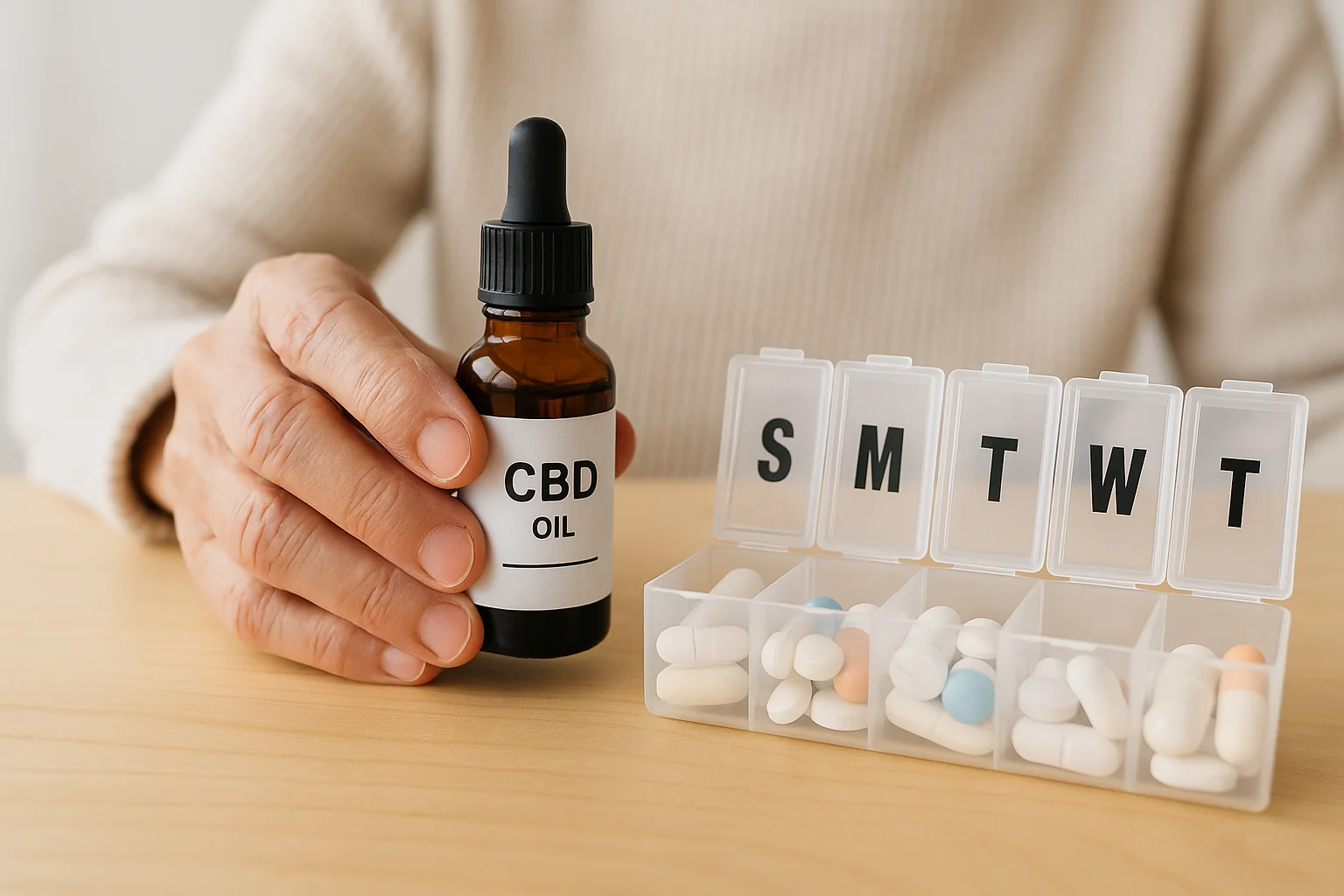
The question about CBD is increasingly being asked in offices, usually stemming from the same problem: a list of medications that has only grown over the years. A person over sixty taking five or more preparations simultaneously fits the definition of polypharmacy, and each additional item on that list adds the risk of interactions. Cannabinoids appear in this conversation as a hope to shorten the list, usually after another medication has added drowsiness or constipation instead of relief. Below, we check what the data from studies say about this, how significant they actually are, where the limits of what can be inferred from them lie, and why in this group, a conversation with a doctor is a condition, not a formality.
KEY INFORMATION
• Polypharmacy, or taking five or more medications simultaneously, affects between 26.3 and 39.9 percent of individuals over 65 in Europe (Midao et al., Archives of Gerontology and Geriatrics, 2018).
• In a study of 2736 patients over 65 treated with medical marijuana, 93.7 percent reported an improvement in their condition after six months, and 18.1 percent discontinued or reduced their opioid pain medication (Abuhasira et al., European Journal of Internal Medicine, 2018).
• Nearly half of those using CBD experienced side effects, and the risk of drug interactions is high (Brown and Winterstein, Journal of Clinical Medicine, 2019).
• EFSA states that the safety of CBD cannot be established in individuals under 25, pregnant or breastfeeding women, and those taking medications.
• CBD is not a medication and does not replace pharmacotherapy; the decision to change treatment belongs to the attending physician.
What is polypharmacy and how often does it affect seniors?
Polypharmacy is the simultaneous use of five or more medications. In an analysis of data from the SHARE study, which included individuals over 65 from seventeen European countries and Israel, the prevalence of this phenomenon ranged from 26.3 to 39.9 percent, depending on the country (Midao et al., 2018).
The authors of this work link polypharmacy to a whole series of adverse consequences: higher mortality, more frequent falls and hospitalizations, adverse drug reactions, drug interactions, and poorer adherence to recommendations. Higher healthcare costs are a derivative of this, not a separate problem.
Among the factors associated with polypharmacy are age, gender, number of chronic diseases, limitations in daily functioning, lack of physical activity, depression, poorer quality of life, difficulties in taking medications, years of education, and lack of money. This set well explains why the list of medications rarely shortens on its own. It did not arise from the negligence of one doctor, but from the sum of individual, reasonable decisions made by various specialists at different times. Practical tips on what to watch out for when adding anything to such a list can be found in our post about supplements for seniors.
What did the cannabinoid study on 2736 seniors show?
The work most often referenced in this context is an Israeli prospective study that included 2736 patients over 65 who began treatment at a specialized medical cannabis clinic between January 2015 and October 2017. The average age of participants was 74.5 years. The most common indications were pain, in 66.6 percent, and cancer, in 60.8 percent (Abuhasira et al., 2018).
After six months, 93.7 percent of respondents reported an improvement in their condition, and the reported pain level decreased from a median of 8 to a median of 4 on a scale from 0 to 10. The most common side effects were dizziness, in 9.7 percent, and dry mouth, in 7.1 percent. During the same period, 18.1 percent of participants discontinued or reduced their opioid pain medication.
Two things must be stated clearly about this work, as they often get lost in marketing summaries. First, the study concerned medical marijuana managed by a clinic, not CBD oil purchased independently; these are not interchangeable things. Second, it was an observational study without a control group, and the authors themselves conclude that collecting data from randomized and double-blind trials in this population is necessary.
Why are drug interactions the number one problem here?
Because CBD affects the same mechanisms that determine the fate of most medications in the body. A review of data from products containing CBD indicates interaction with biological targets involved in drug metabolism, including CYP3A4 and CYP2C19, and in their excretion, including P-glycoprotein. The authors assess that the potential for interactions with commonly used medications is therefore high (Brown and Winterstein, 2019).
The substance itself is also not neutral. In the same review, nearly half of those using CBD experienced side effects, with a general dependence on dosage. Reported side effects include elevated transaminase activity, drowsiness, sleep disturbances, infections, and anemia. The authors emphasize that CBD can be both a victim and a perpetrator in interactions.
The recommendations derived from this are specific: consider reducing the doses of medications that are substrates of the same pathways, monitor adverse effects, and seek alternative therapies. The authors note that this particularly applies to medically complex patients, precisely those discussed in this article. Additionally, there is EFSA’s position: the safety of CBD cannot be established in individuals under 25, pregnant or breastfeeding women, and those taking medications. We discuss this more broadly in our post about CBD oil interactions in seniors.
Can CBD reduce the number of medications taken?
The data allow for a cautious “maybe,” and only in one area. The percentage of 18.1 percent of patients who discontinued or reduced their opioid use after six months is a real and noteworthy result, as long-term opioid treatment carries its own risks for seniors. However, the authors frame this as an observation, not a recommendation: cannabinoid treatment may reduce the use of other prescription medications, including opioids.
Three caveats determine how far this conclusion can be taken. The observation comes from a study without a control group, so it does not determine what caused the change. It concerned medical marijuana, not CBD itself. And it describes decisions made within clinical care, not the independent discontinuation of medication by the patient.
This last difference is practically the most important. Discontinuing chronic medications has its rules, pace, and supervision, and attempting to shorten the list on one’s own turns a potential benefit into a new risk. If the thought of reducing pharmacotherapy arises in conversation, its place is in the office, and the starting point is a review of all medications being taken.
What to do before a senior reaches for CBD oil?
The order can be reversed, and this is usually the source of trouble. The patient starts using the oil independently and only then considers whether to tell the doctor about it. The proper sequence is the opposite: first, a review of pharmacotherapy, then a discussion about what symptoms should improve, and only at the end, possibly introducing it under supervision.
The first step is a complete list of everything you take, with doses and times: prescription medications, over-the-counter preparations, supplements, and herbs. Many people omit the last category; however, popular plant materials also interact with medications, and without a complete list, no risk assessment makes sense.
The second step is to verify interactions with a doctor or pharmacist before anything goes into the medicine cabinet. The third, if the decision to include it is made, is to establish with the doctor what specifically you are observing and when you will return to this conversation; drowsiness and sleep disturbances are among the more common side effects, so they are a good control point. Those accompanying this process may find our post about caring for a loved one using CBD helpful.
Frequently Asked Questions
Can a senior taking multiple medications safely use CBD?
Only after consulting with a doctor. CBD interacts with pathways responsible for the metabolism and excretion of medications, including CYP3A4, CYP2C19, and P-glycoprotein, which increases the potential for interactions with commonly used medications. EFSA states directly that the safety of CBD cannot be established in individuals taking medications.
What is polypharmacy and how common is it?
It is the simultaneous use of five or more medications. In data from seventeen European countries and Israel, it affected between 26.3 and 39.9 percent of individuals over 65 years of age. It is associated with higher mortality, more frequent falls and hospitalizations, and drug interactions.
What symptoms improved in the study among seniors?
After six months of treatment with medical marijuana, 93.7 percent of patients over 65 reported an improvement in their condition, and the reported pain level decreased from a median of 8 to 4 on a scale from 0 to 10. The most common indications for treatment were pain and cancer.
Can CBD replace medications prescribed by a doctor?
No. CBD is not a medication or a substitute for pharmacotherapy, and discontinuing chronic medications on one’s own can be more dangerous than the problem it was meant to solve. Any changes to the treatment regimen should be made by the attending physician, who knows the entire list of medications being taken.
What side effects have been reported with the use of CBD?
In a review of data from products containing CBD, nearly half of users experienced side effects, with a general dependence on dosage. Reported side effects include elevated transaminase activity, drowsiness, sleep disturbances, infections, and anemia. This is an argument for supervision, not for self-experimentation.
This article is for informational and educational purposes only and does not constitute medical advice. Before starting to use cannabis or CBD for therapeutic purposes, consult with a doctor, especially if you are taking other medications, are pregnant, or breastfeeding.
Author: Michał Waluk · Published: 2026-08-09 · Updated: 2026-08-11