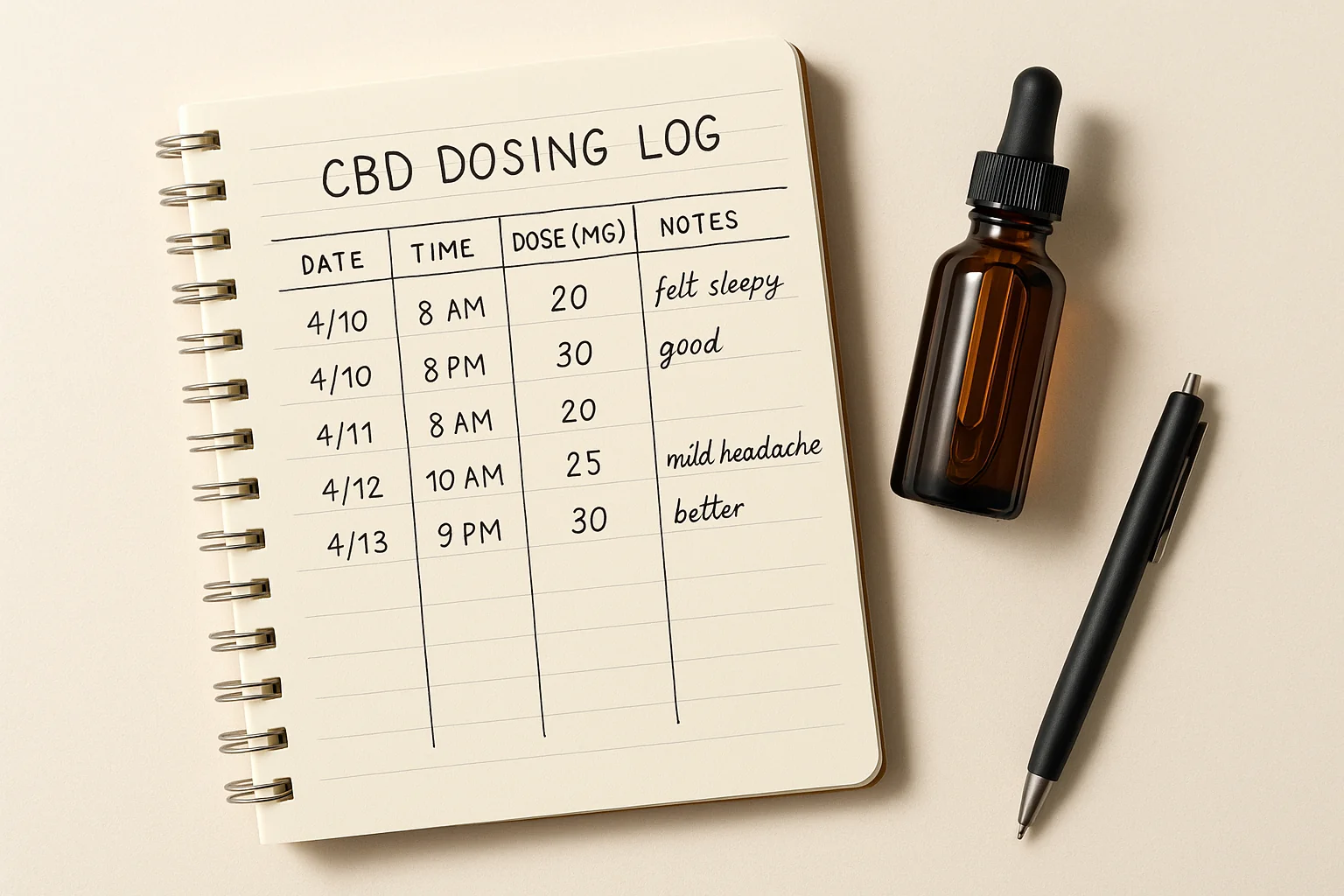

Cannabinoid Journal: How to Keep a Log of Doses, Symptoms, and Effects (Template)
How to keep a cannabinoid journal: what to record in each entry, why to note milligrams instead of drops, and what studies say about the impact of meals.
Finding your own CBD dose is a process measured in weeks, not days. A significant portion of people who say that CBD did not work for them changed the product, the time of day, and the amount simultaneously, and evaluated the effect from memory several days later. In such a mode, it is impossible to say what worked and what was coincidental. The cannabinoid journal precisely solves this problem: it turns impressions into a record that can be compared between days. Below you will find a ready-made entry template, an explanation of why milligrams are recorded instead of the number of drops, and what published clinical studies say about the relationship between dose, meal, and effect. You will also learn how to recognize in the records that the effect is starting to weaken and how to prepare the journal for a conversation with a doctor or pharmacist.
KEY INFORMATION
• The effect of CBD does not increase with the dose. In Zuardi’s study, 60 healthy volunteers received a placebo, clonazepam, or CBD at doses of 100, 300, or 900 mg before a public speaking event; anxiety was reduced only by the middle dose of 300 mg (Zuardi et al., Frontiers in Pharmacology, 2017).
• The absorption of CBD depends on whether you take it with food: in eleven volunteers, a fatty meal increased total exposure by 9.7 times compared to fasting (Saals et al., Scientific Reports, 2025).
• Therefore, the journal records not just the amount, but also the time, method of administration, and whether there was a meal.
• EFSA derived a provisional safe dose of 0.0275 mg per kg of body weight per day, which is about 2 mg for a person weighing 70 kg, and only for supplements with a purity of CBD of at least 98% (EFSA, EFSA Journal, 2026).
• The safety of CBD cannot be established in individuals under 25 years of age, in pregnant and breastfeeding women, and in individuals taking medications.
Why do records beat memory when searching for your own dose?
Because the effect of CBD does not form a simple line where more means stronger. This is best illustrated by Zuardi’s study: sixty healthy volunteers aged 18 to 35 were randomly assigned to five groups that received a placebo, clonazepam at a dose of 1 mg, or CBD at doses of 100, 300, or 900 mg, after which each of them gave a speech in front of the other participants. Anxiety measured after the speech was reduced only by the 300 mg dose. Neither 100 mg nor 900 mg differed significantly from placebo (Zuardi et al., Frontiers in Pharmacology, 2017).
The practical consequence is inconvenient: lack of effect does not tell you in which direction you went wrong. Without a record, there is guesswork, and guesswork often leads to increasing the amount, as that is our reflex with pain medications. The journal allows you to distinguish a day when there was no effect from a day when there was an effect, but it appeared later than you managed to evaluate it.
The second weakness of memory concerns slow and subtle changes. Sleep quality or stress levels throughout the day are things that cannot be reliably compared to a week ago without a note. An assessment made from memory follows the mood at the moment of evaluation, not what actually happened over the past few days. A record made in real-time does not have this distortion.
What to record in each journal entry?
An entry does not need to take more than two or three minutes, and its value comes from repeatability, not volume. The rule is simple: you record immediately after intake, and you write the effect assessment after the full duration of action, not the next day. The table below collects the minimum that allows you to read anything from this data later.
| Parameter | What to enter | Why |
|---|---|---|
| Date and time | DD.MM.YYYY and HH:MM | Without the hour, you cannot calculate the time to effect |
| Product and concentration | Name and percentage given on the label | Allows comparison of different products with each other |
| Amount in milligrams | Value from the label, not the number of drops | The only unit comparable between products |
| Method of administration | Sublingual, capsule, other | The method changes the absorption rate |
| Meal | On an empty stomach, light meal, fatty meal | A variable with a measured, significant impact |
| Symptom before and after | Your main symptom on a scale from 0 to 10 | Provides a difference that can be compared |
| Time to effect | Minutes from intake to first feeling | Indicates when it makes sense to assess the effect |
| Notes | Drowsiness, stomach discomfort, other medications | This is where the explanation for deviations is most often found |
To assess the symptom, a simple numerical scale from 0 to 10 is sufficient, where 0 means no symptom and 10 means maximum severity. More important than the choice of scale is consistently using the same one. If you change the way you assess in the middle of the month, the data before the change will no longer be comparable to those after it.
Does a meal change the potency of CBD?
It does, and more than most people expect. In a pharmacokinetic study, eleven healthy volunteers, five men and six women, took a single dose of an extract corresponding to 70 mg of CBD in an alternating regimen: once on an empty stomach, once after a standardized fatty meal. After the meal, total CBD exposure was 9.7 times greater, and peak concentration was 17.4 times higher than on an empty stomach. The authors also described a double peak concentration after eating (Saals et al., Scientific Reports, 2025). The variability of absorption depending on the matrix and food is also confirmed by the EFSA review (EFSA, EFSA Journal, 2026).
For the journal keeper, this leads to a simple conclusion. The same number of milligrams taken in the morning on an empty stomach and in the evening after dinner are practically two different events. If you record only the amount in the field and omit the meal, sooner or later you will see variability in the data that you will not be able to explain, and you will start attributing it to the product or yourself.
For the same reason, it is worth noting how many milligrams you actually take, not how many drops. The number of drops means nothing without the product’s concentration, so two entries from different packages become non-comparable. The value in milligrams per serving is provided by the manufacturer on the label, and that is what you should record in the journal. If you are just choosing a product, the topic of concentrations is covered in a separate text about which concentration of CBD oil to choose.
What to do with the journal after a few weeks?
First of all, read it as a whole, not day by day. A single entry says little, as it includes sleep, stress, and the time of day. Only a few weeks of records show whether there is a repeatable relationship between what you take and what you note in the effect column. Look for not just individual good days, but repetitions under the same conditions.
The second benefit is early detection that something is changing over time. When the same amount at the same time, method, and meal starts to yield a weaker record than before, the journal shows this as a trend, not as an impression. What to do about it is described in separate texts about signals that it’s time for a tolerance break and about whether a tolerance break from THC and CBD makes sense (FAQ).
The third benefit is a conversation with a doctor or pharmacist. A few weeks of records provide concrete data that can be shown: dates, amounts, method of administration, symptom assessment. This is incomparably better material than a statement that “it probably helped.” This is especially important when you are taking medications, as EFSA indicates that the safety of CBD cannot be established when medications are used simultaneously.
Frequently Asked Questions
What should a cannabinoid journal contain?
At a minimum, it should include the date and time of intake, the product along with its concentration, the amount in milligrams, the method of administration, information about meals, an assessment of the main symptom before and after, the time to first effect, and notes on side effects and other medications taken. Eight fields are sufficient, and each additional one decreases the likelihood that an entry will be made daily.
Why record milligrams instead of the number of drops?
Because a drop is not a unit. The same number of drops from packages with different concentrations represents a different amount of substance, making entries non-comparable between products and periods. The value in milligrams per serving is provided by the manufacturer on the label and should be recorded in the journal.
Do you need to note what you ate before taking it?
It is enough to indicate whether it was on an empty stomach, after a light meal, or after a fatty meal. In Saals’ study, a fatty meal increased total CBD exposure by 9.7 times compared to fasting, and peak concentration by 17.4 times, so omitting this field introduces variability into the data that cannot be explained later.
How long should you keep a journal to derive meaningful results?
Long enough for the same conditions to repeat several times, as only repetition distinguishes correlation from coincidence. A single successful day is not a result. It is also worth recording a few days without intake to have a reference point for your own variability.
Is an app better than paper?
An app calculates and draws charts for you, while paper and spreadsheets won’t disappear when you change phones or discontinue a service. The choice is a matter of convenience, as the value of the record depends on regularity, not the medium. Health data should be kept where you can maintain control over it.
Does the journal replace a consultation with a doctor?
No, but it makes it much easier, as it turns impressions into dates and numbers. Consultation is especially important if you are taking medications, are pregnant or breastfeeding, or are under 25 years old. For these groups, EFSA states directly that the safety of CBD cannot be established.
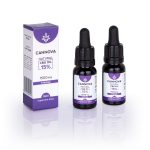
Products related to such records can be found in the oils category.
This article is for informational and educational purposes only and does not constitute medical advice. Before starting to use cannabis or CBD for therapeutic purposes, consult a doctor, especially if you are taking other medications, are pregnant, or breastfeeding.
Author: Michał Waluk · Published: 2026-08-09 · Updated: 2026-08-11