
Tuna Spread with Hemp Oil
Tuna spread with hemp oil instead of mayonnaise: proportions, order of steps, and calculated omega acids per sandwich. Ready in five minutes, without a blender.
A classic tuna spread is based on mayonnaise. Simply replace it with cold-pressed hemp oil to get a sandwich with a different fat profile and without emulsifiers. Hemp oil has a ratio of omega-6 to omega-3 usually between 2:1 and 3:1, while mayonnaise is about 7:1. Tuna adds EPA and DHA acids, which are absent in any plant oil. The whole thing comes together in five minutes, without a blender and without cooking, and lasts two to three days in the fridge. Below you will find the proportions, the order of steps, and three flavor variations. You will also find calculated numbers: how many omega acids actually make it to one sandwich and where they come from.
KEY INFORMATION
• Hemp oil is over 80% polyunsaturated fatty acids, and the omega-6 to omega-3 ratio is usually between 2:1 and 3:1 (Callaway, Euphytica, 2004).
• Mayonnaise has this ratio around 7:1 (USDA FoodData Central, record 171009).
• A drained can of light tuna in water contains about 0.3 g of EPA and DHA, while the same can in albacore version contains about 1.2 g (USDA 334194 and 175158).
• Do not heat hemp oil: the spread is a cold snack.
Why use hemp oil instead of mayonnaise?
Because it changes the ratio of fatty acids in the entire sandwich. Mayonnaise primarily contributes linoleic acid from the vegetable oil it was made from: USDA record 171009 states that regular mayonnaise has 38.9 g of omega-6 and 5.33 g of omega-3 per 100 g, which is about 7:1. In hemp oil, this ratio usually falls between 2:1 and 3:1 (Callaway, Euphytica, 2004).
Callaway himself states that this range is considered optimal for human health. This is his formulation, not a recommendation from an institution. Neither WHO nor FAO has announced a numerical standard for the omega-6 to omega-3 ratio, although this number is sometimes attributed to them in texts about hemp oil. If you see “WHO recommends 4:1” somewhere, that statement is not supported by any document.
The ratio in the Western diet has shifted significantly. Simopoulos (Nutrients, 2016) describes an increase from about 1:1 in the diet of ancestors to 20:1 or more today and links it to the rising prevalence of obesity. Two tablespoons of oil in one spread will not reverse the balance of the entire diet, but in this particular sandwich, the difference is clear.
You can also feel the difference in taste. Mayonnaise is fatty and smooth, while hemp oil is more nutty and plant-like. This nutty tone enhances the marine flavor of the tuna instead of covering it up.
How many omega acids does one sandwich provide?
One sandwich from this portion contains about 1.2 g of alpha-linolenic acid from hemp oil and about 0.08 g of EPA and DHA from light tuna. With albacore tuna, this second number increases to about 0.3 g. These are two different families of omega-3 acids, and one does not replace the other.
Where do these numbers come from? USDA record 170148 for hulled hemp seeds states 8.68 g of alpha-linolenic acid per 48.8 g of fat, which is about 18% of the fat mass. Two tablespoons of oil is about 27 g, so about 4.8 g of this acid for the entire portion of the spread and about 1.2 g per sandwich. Light tuna in water has, according to record 334194, only 0.22 g of EPA and DHA per 100 g, so 35 g of fish in the sandwich gives less than 0.1 g.
The USDA database does not maintain a separate record for edible hemp oil in the reference set, so values for the oil are calculated from the seed record and from Callaway’s work. You will not find magnesium or vitamin E content “from hemp oil” here: plant fats practically do not contain magnesium, and any such number in a spread recipe comes from a mistake, not from measurement.
Ingredients: what do you need?
Proportions for about 200 g of spread, which is four sandwiches. Preparation time: five minutes. The choice of can is more important here than anything else on the list, as the EPA and DHA acids come from the tuna.
- 1 can of tuna in water (160-185 g, about 140 g drained)
- 2 tablespoons of cold-pressed hemp oil
- 1 tablespoon of fresh lemon juice
- 1/4 small red onion or 2 stalks of chives
- pinch of smoked paprika
- salt and freshly ground pepper to taste
- optional: 1 teaspoon of Dijon mustard, 2 tablespoons of capers, 1 small pickled cucumber
Tuna in water provides better control over the amount of fat than tuna in oil. If you care about EPA and DHA acids, choose the white version, or albacore: USDA record 175158 states it has 0.86 g of these acids per 100 g compared to 0.22 g in light tuna (record 334194). However, albacore tuna accumulates more mercury, so pregnant women and small children usually choose the light version.
How to prepare the spread step by step?
All it takes is a bowl and a fork. It takes five minutes, without a blender, without fire, and without any prior preparation.
- Drain the tuna. Pour off the liquid through a strainer and press the fish with a lid. The more thoroughly you do this, the less watery the spread will be. If you are using tuna in oil, reduce the hemp oil to one tablespoon.
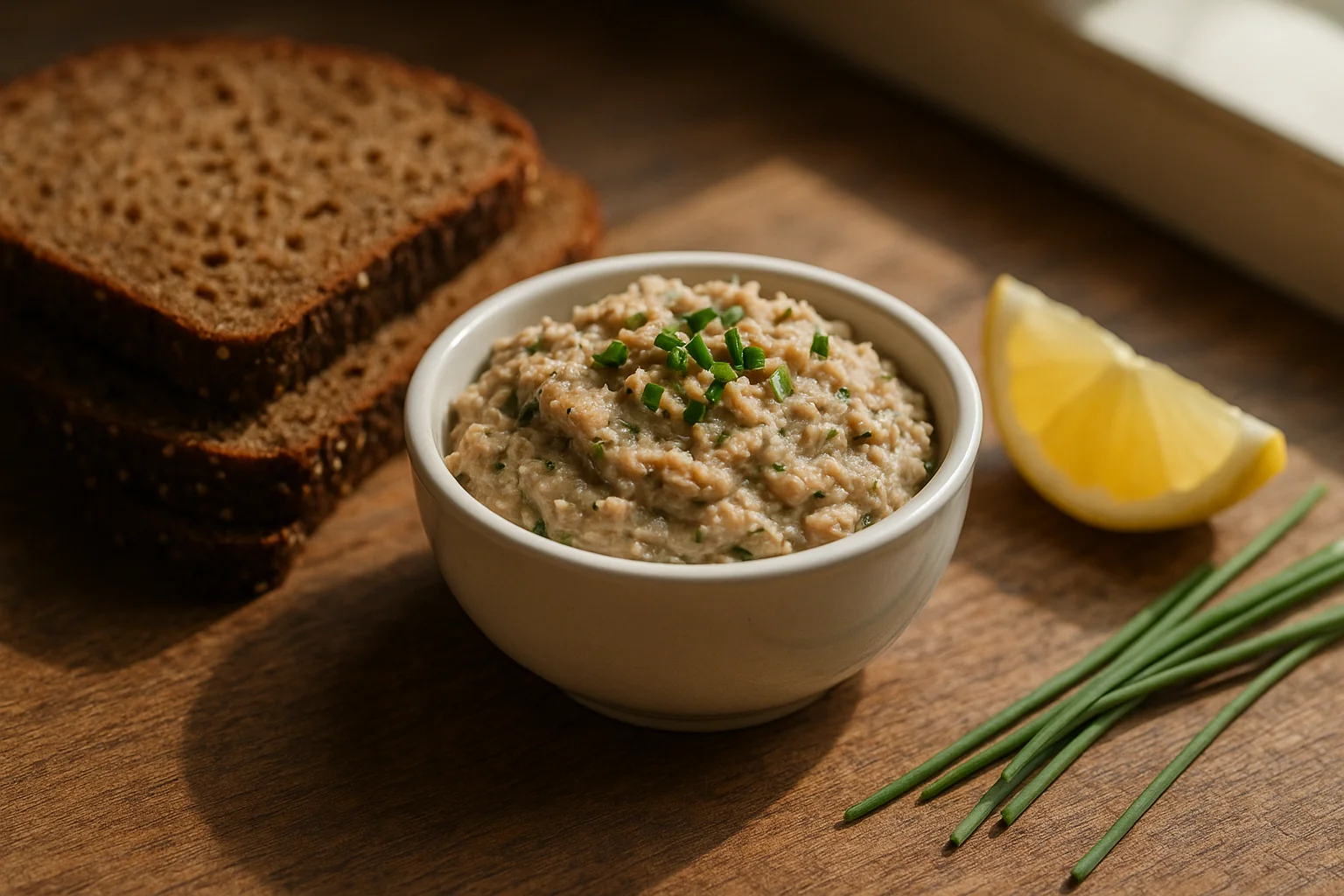
- Shred the fish with a fork. A coarser texture with visible pieces carries the taste of tuna more strongly, while a smooth texture spreads more easily. Both variations work equally well with hemp oil.
- Add two tablespoons of hemp oil and lemon juice, mix with a fork. The mixture will seem dry at this stage because the oil needs a few minutes to blend into the fish structure.
- Add finely chopped onion or chives, smoked paprika, and pepper. Capers add a salty accent, pickled cucumber adds crunch, and Dijon mustard binds the oil with the fish.
- Mix everything, then taste and season. Refrigerate for 15-20 minutes before serving: chilled spread has a more even consistency and a calmer flavor.
Serve on dark bread, with slices of cucumber or radish. This same spread works well as a filling for tortillas and as a dip for raw vegetables.
What flavor variations are worth trying?
The base of tuna and hemp oil accepts additions without resistance. Three directions that change the character of the spread the most look like this:
- Mediterranean variant: 2 tablespoons of chopped black olives, 1 tablespoon of capers, and a pinch of oregano. Served on ciabatta with basil leaves, it gives something like bruschetta.
- Avocado variant: half a mashed avocado instead of part of the oil. Then only one tablespoon of hemp oil is needed, and the spread becomes noticeably more filling.
- Spicy variant: half a teaspoon of harissa or sambal oelek. The spiciness breaks the nuttiness of the oil and works well in a tortilla.
We noticed in tests that the spread with hemp oil needs less fat than the one with mayonnaise to give a creamy impression. Do not add oil immediately after mixing; wait fifteen minutes in the fridge and then assess the consistency. It almost always turns out that no additional oil is needed.
If you are looking for other uses for this oil in the kitchen, check out cold brew with hemp oil or tomato soup with hemp oil. A fish-free version can be found in the recipe for vegan hemp seed spread.
Frequently Asked Questions
Why use hemp oil instead of mayonnaise in tuna spread?
Because it has a different ratio of fatty acids. USDA record 171009 states that mayonnaise has about 7 g of omega-6 for every 1 g of omega-3, while in hemp oil this ratio is usually between 2:1 and 3:1 (Callaway, Euphytica, 2004). The oil also adds a nutty flavor that mayonnaise lacks.
How many omega acids does one sandwich with this spread provide?
About 1.2 g of alpha-linolenic acid from two tablespoons of hemp oil spread over four sandwiches and about 0.08 g of EPA and DHA from light tuna. With albacore tuna, this second value increases to about 0.3 g. Numbers calculated from USDA records 170148, 334194, and 175158.
Can the spread with hemp oil be heated?
It’s not worth it. Hemp oil is over 80% polyunsaturated fatty acids (Callaway, Euphytica, 2004), and this fraction oxidizes the fastest under heat. Serve the spread cold or at room temperature. For a warm casserole, use canola oil.
How long does the spread stay fresh in the fridge?
Two to three days in a sealed container, just like any spread from an opened can of fish. Hemp oil does not shorten or extend this period. Avoid freezing: thawed tuna loses its structure and the spread becomes mushy.
Which canned tuna has more omega-3 acids?
White, or albacore. USDA record 175158 states it has 0.86 g of EPA and DHA per 100 g, while record 334194 for light tuna only has 0.22 g. The reverse order, found in many recipes, is not supported by the database data.
Does hemp seed oil contain THC?
Trace amounts may be detected, which is why the law sets an upper limit for them. Commission Regulation (EU) 2023/915, effective from May 25, 2023, allows for 7.5 mg of total delta-9-THC and THCA per kilogram in hemp seed oil, and 3.0 mg/kg in the seeds themselves.
Hulled hemp seeds and edible hemp oil are not currently available in the store at Bucha. Among hemp products for the kitchen, you will find hemp teas.
This article is for informational and educational purposes and does not replace consultation with a doctor. If you are pregnant, breastfeeding, taking medications, or have chronic conditions, consult the use of supplements or herbs with a specialist.
Author: Michał Waluk · Published: 2026-06-22 · Updated: 2026-08-16