
Cold brew with hemp oil: coffee with character
Cold brew with hemp oil: coffee and water ratios, maceration time, a method for emulsification, and what measurements say about caffeine and acidity of the cold brew.
Cold brew is coffee macerated in cold water for several hours, with not a single second of contact with boiling water. The result is a brew smoother in taste than espresso, and it is this that serves as the proper base for hemp seed oil. The reason is chemical, not culinary: this oil consists of over 80 percent polyunsaturated fatty acids, which react to heating much more vigorously than saturated or monounsaturated fats. In cold brew, nothing threatens them. Below you will find the ratios of coffee to water, maceration time, a method for combining oil with coffee into a uniform emulsion, and some measurements that clarify what is usually read about the strength and acidity of cold brew.
KEY INFORMATION
• Hemp seed oil contains over 80% polyunsaturated fatty acids, and the omega-6 to omega-3 ratio typically ranges from 2:1 to 3:1 (Callaway, Euphytica, 2004).
• Caffeine in cold brew reaches equilibrium between the sixth and seventh hour of maceration (Fuller and Rao, Scientific Reports, 2017).
• The pH of cold brew and hot brewed coffee is comparable, differing in the pool of titratable acids (Rao and Fuller, 2018).
• Add oil to the finished, cold brew.
Why is hemp oil added to cold coffee and not to hot?
Because it is one of the most heat-sensitive fats in the kitchen. Callaway, Euphytica, 2004 states that hemp seed oil contains over 80% polyunsaturated fatty acids, and the omega-6 to omega-3 ratio typically falls between 2:1 and 3:1. Cold brew does nothing to these acids, while hot brewing does.
How much heat can take away, was measured by Özdemir et al., J Food Sci Technol, 2021. They roasted hemp seeds at 140, 160, and 180 degrees for up to an hour, and then examined the oil extracted from them. The content of tocopherol isomers, i.e., vitamin E, decreased with temperature and roasting time, while oxidation indicators increased: the peroxide value reached 3.09 meq of oxygen per kilogram, and the p-anisidine value reached 43.27. The hemp seed oil contained in their measurement 54.85% linoleic acid, 18.13% alpha-linolenic acid, and 707 mg of gamma-tocopherol per kilogram.
In coffee, you do not roast the seeds, you simply add the ready oil, so the question is narrower: is there any reason to expose it to heat. There is none. The oil does not need to dissolve or bind with anything while hot; it serves as a fat and flavor additive, and cold brew provides the same effect without any cost. More about where this oil makes sense and where it loses its value can be found in our article on hemp oil in the kitchen.
How does cold brew differ from hot brewed coffee?
Less than the popular version suggests. Rao and Fuller, Scientific Reports, 2018 measured the pH of cold brew and hot brewed coffee from the same light-roasted beans: both brews ranged from 4.85 to 5.13. Hot coffee had a higher concentration of titratable acids and higher antioxidant activity.
This distinction is worth understanding because it is usually boiled down to a statement about the lower acidity of cold brew. The concentration of hydrogen ions practically does not change. What changes is the total pool of acids that can be titrated, and it is this that is responsible for the sensation on the tongue. The authors explain the difference by stating that the hot method extracts more acids in undissociated form, and it is these that may account for the higher antioxidant activity of the hot brew. If you drink coffee for antioxidants, you do not gain anything by switching.
The second measurement concerns time. Fuller and Rao, Scientific Reports, 2017 compared four combinations of roast degree and grind size, and then found that the concentrations of caffeine and 3-chlorogenic acid reach equilibrium between the sixth and seventh hour of maceration, not after 10-24 hours as described in typical instructions. Grind size did not significantly affect the result, while medium roast yielded higher concentrations of both compounds than dark roast.
We noticed exactly the same in our trials, only from the taste perspective. Between the sixth and twelfth hour, the brew changes noticeably, while between the twelfth and eighteenth hour, it changes only slightly. Since caffeine levels stabilize after seven hours, longer maceration buys depth of flavor, not strength. If time is a concern, twelve hours is more than enough.
What do you need for cold brew with hemp oil?
Ratios for about 500 ml of brew, or four glasses after dilution. Active work here takes five minutes; the rest happens on its own in the fridge. A coffee-to-water ratio of 1:6 gives a concentrate for dilution, while 1:8 yields a brew ready to drink straight, without adding anything.
- 60-80 g of whole or coarsely ground coffee, suitable for French press
- 500 ml of cold, filtered water
- one teaspoon of cold-pressed hemp seed oil per glass, added when serving
- ice
- optionally for dilution: plant milk or water
- optionally: one teaspoon of maple syrup
- optionally: a pinch of sea salt to enhance the sweetness of the coffee
When it comes to the beans, remember Fuller and Rao’s result: medium roast yielded higher concentrations of caffeine and 3-chlorogenic acid in their measurement than dark roast, so dark roasting does not enhance anything here. Choose cold-pressed oil and keep it in the fridge. The reason is the same as with coffee: Özdemir’s measurements showed that oxidation indicators increased with temperature and time, while cold works in the opposite direction.
How to prepare cold brew with hemp oil step by step?
The order matters in one place: the oil goes in at the very end, into the cold glass, not into the jar with the macerating coffee. Other than that, it is hard to mess anything up, as maceration happens without your involvement and forgives deviations of even a few hours.
- Grind the coffee coarsely. Grind 60-80 g of coffee to a coarseness suitable for a French press, into large and irregular pieces. Finely ground coffee results in a cloudy and astringent brew. When buying pre-ground coffee, choose one described as coarse or French press.
- Combine coffee with water. Pour the coffee into a jar with a capacity of at least 700 ml. Add 500 ml of cold filtered water and stir for 30 seconds until all the coffee is wet. Seal the jar or cover the pitcher.
- Macerate in the fridge. Place the sealed jar in the refrigerator for 12-18 hours. A shorter time results in a milder brew, while a longer time yields a stronger concentrate. Do not macerate at room temperature, as higher temperatures accelerate the extraction of bitter compounds.
- Filter the brew. Pour the contents of the jar through a fine sieve lined with cheesecloth or through a paper coffee filter. Paper takes 10-15 minutes but yields a clear brew without sediment. Pour the finished cold brew into a clean jar and store it in the fridge.
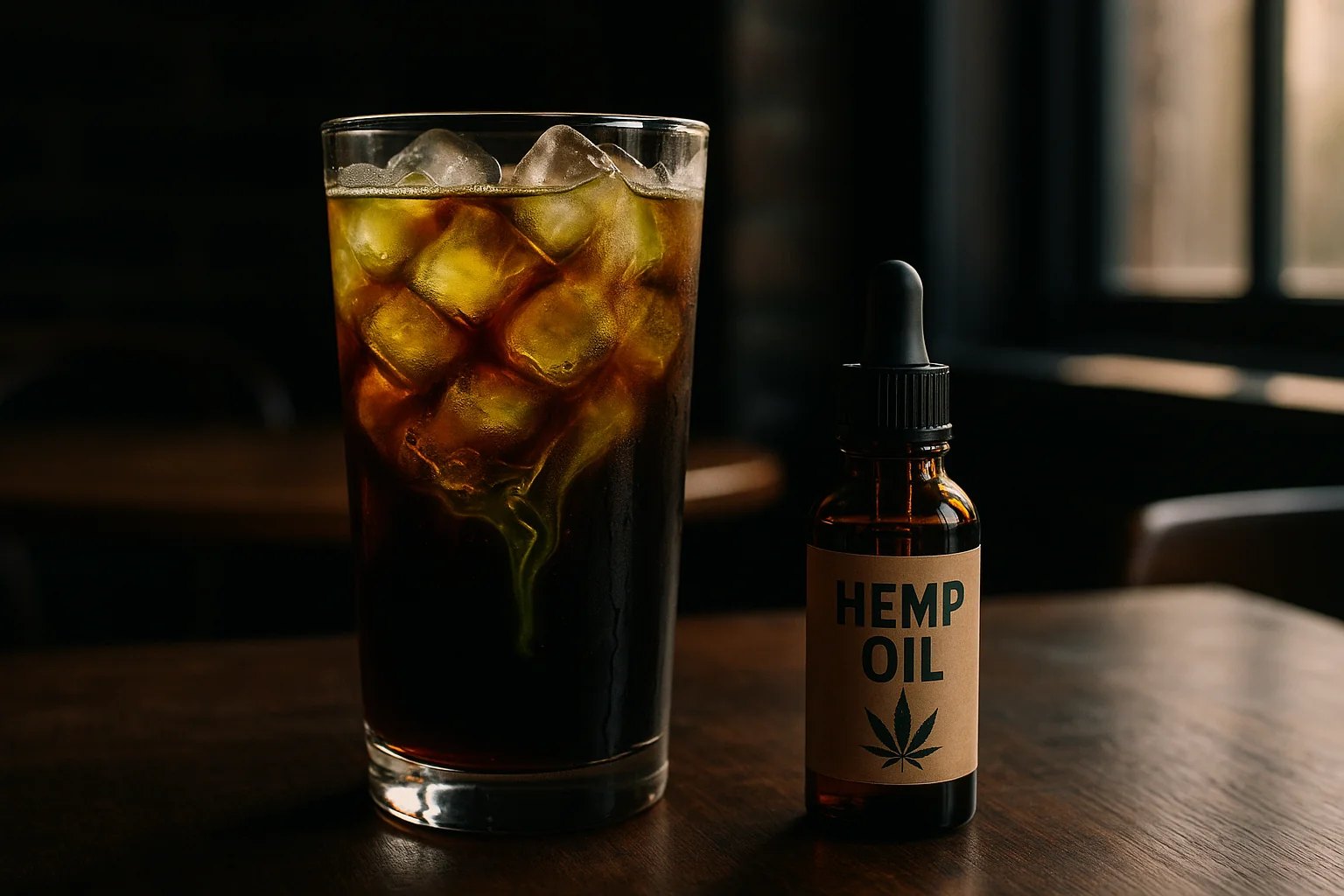
- Add oil and serve. Fill a glass with ice, pour in 120-150 ml of the brew, and optionally dilute with water or plant milk in a 1:1 ratio. Add a teaspoon of cold-pressed hemp seed oil and shake in a shaker for 10 seconds. Drink immediately.
What variations of this drink make sense?
The base is neutral enough to withstand several modifications without losing character. The best ones are those that do not require heating anything.
Using plant milk instead of water makes the drink hold together more easily, as such milks are emulsions themselves and usually contain an emulsifier. Adding a teaspoon of MCT oil results in a warm equivalent of fat coffee, thicker and more filling. If you prefer a hot version, we have a separate recipe for hot cocoa with hemp oil; the same rule applies, meaning add the oil only after removing the pot from the heat.
To the finished glass, you can add CBD oil, which is a preparation, not a culinary ingredient, so different rules apply than for food oil. Zgair et al., Am J Transl Res, 2016 demonstrated in rats that administering cannabinoids together with fats increases systemic exposure to CBD about threefold compared to fat-free preparations; in the accompanying in vitro lipolysis study, over 30% of the dose passed into the micellar fraction. The fat from hemp oil serves exactly this role as a carrier in the glass. Choose the amount solely according to the manufacturer’s labeling: EFSA, 2026 states that the safety of CBD cannot be established in individuals under 25 years of age, in pregnant and breastfeeding women, and in those taking medications. You can find such preparations in the oils category.
Hemp oil works well everywhere there is no fire, including at a grill usually handled by a barbecue. We have gathered more such cold applications in the article on hemp grilling and marinades.
Frequently asked questions
Why is hemp oil added to the finished brew and not during brewing?
Because there is no reason to expose it to heat. Hemp seed oil contains over 80% polyunsaturated fatty acids (Callaway, Euphytica, 2004), and Özdemir’s measurements show that with temperature and processing time, the content of tocopherols decreases while oxidation indicators increase. In cold brew, this cost does not occur at all.
How much hemp oil should be added to a glass of cold brew?
A teaspoon, or about 5 ml, for a 200-250 ml glass. This culinary ratio is chosen for taste: the buttery-nutty profile of this oil comes through more strongly in cold coffee than in hot dishes. A tablespoon makes the drink noticeably more filling but also greasier in perception.
How to combine oil with coffee so that it does not separate?
Oil and water will not emulsify on their own. Shake the contents of the glass in a shaker for 10 seconds or use an electric frother for 20 seconds. The emulsion is still temporary and will separate after a minute or two, so drink immediately after shaking or stir with a spoon while drinking.
How long does cold brew maintain quality in the fridge?
Store the filtered brew without oil in a sealed jar in the fridge and use it within a few days, guided by smell and taste. The pH of cold brew measured by Rao and Fuller ranged from 4.85 to 5.13, so the acidity of the coffee is not a preservative. Add oil only when serving.
Does cold brew have more caffeine than hot brewed coffee?
With coarse grinding, yes. Fuller and Rao measured caffeine concentrations in cold brew made from coarsely ground coffee that were clearly higher than in hot counterparts, and both studied compounds reached equilibrium concentrations between the sixth and seventh hour of maceration, not after 10-24 hours as described in typical instructions.
This article is for informational and educational purposes and does not replace consultation with a doctor. If you are pregnant, breastfeeding, taking medications, or have chronic conditions, consult a specialist before using supplements or herbs.
Author: Michał Waluk · Published: 2026-06-22 · Updated: 2026-08-16