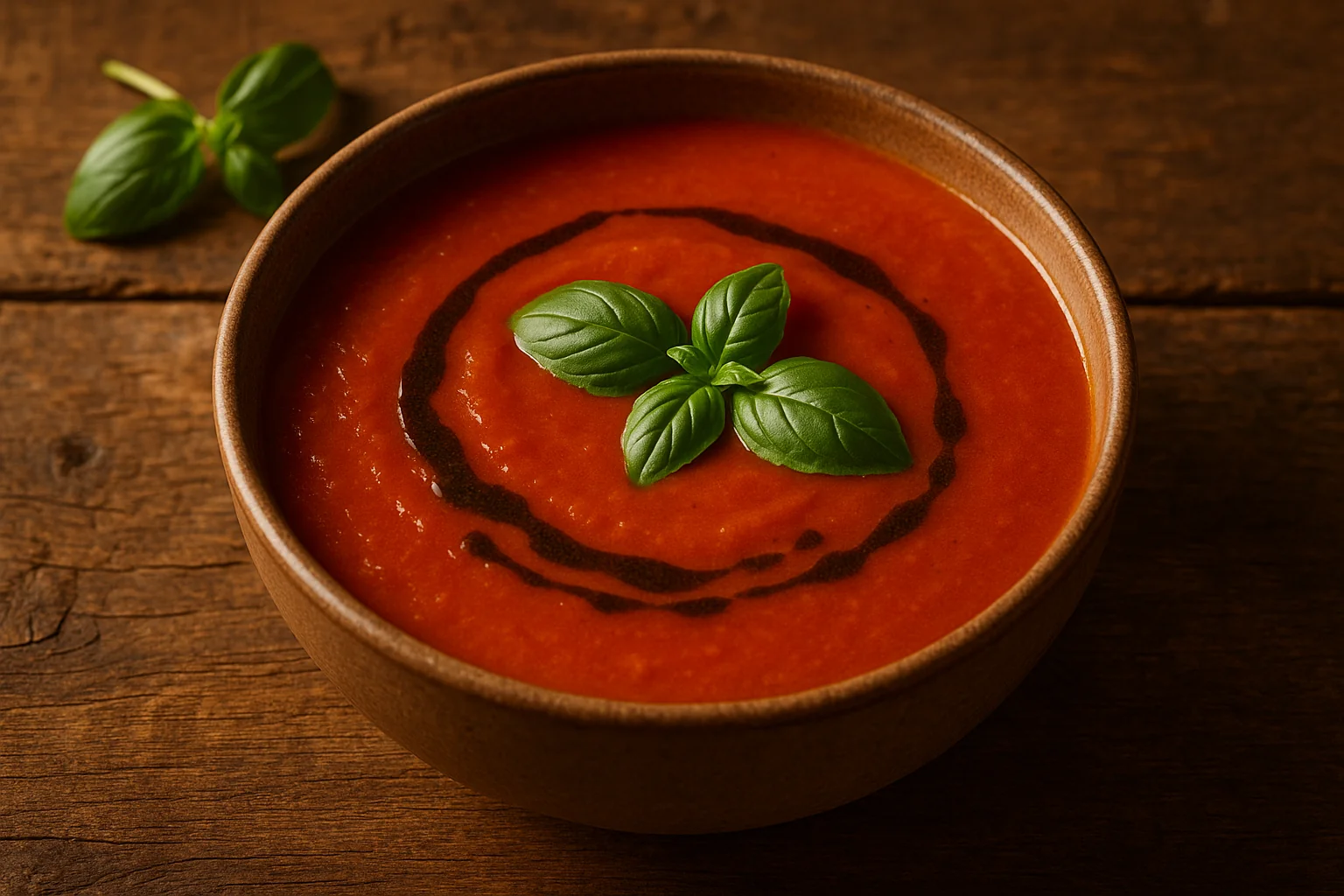

Tomato Soup with Hemp Oil: A Homemade Classic with a Twist
Tomato soup with a teaspoon of hemp oil instead of cream. Recipe for four servings and what studies say about lycopene absorption in the presence of fat.
Tomato soup is a recipe that everyone knows and everyone makes in their own way. This version differs in one detail: instead of a dollop of cream on top, a teaspoon of cold-pressed hemp oil is added. The difference is not just aesthetic. Cream mutes the acidity of tomatoes and thickens the soup, while oil does neither, so the flavor remains sharp and clean. There is also a nutritional reason, which is less often mentioned: lycopene from tomatoes needs fat to be absorbed, and the soup itself has almost none. Below you will find a recipe for four servings, data from studies on carotenoid absorption, and what cannot be said about hemp oil.
KEY INFORMATION
• Adding fat to a meal with tomatoes increased lycopene absorption by 4.4 times in eleven healthy individuals (Unlu, Journal of Nutrition, 2005).
• Hemp oil contains over 80% polyunsaturated fatty acids, and the omega-6 to omega-3 ratio is usually between 2:1 and 3:1 (Callaway, Euphytica, 2004).
• Canned and raw tomatoes have similar lycopene content: 2.54 and 2.57 mg per 100 g (USDA FoodData Central, records 170051 and 170457).
• No nutritional institution recommends one specific omega-6 to omega-3 ratio.
What does hemp oil provide instead of cream?
A different fat profile and unaltered acidity of the soup. Cream serves two functions in tomato soup: it softens the acid and thickens. Hemp oil does neither, so the soup remains vibrant, and the consistency is thinner. In return, it brings fat with a completely different composition.
Callaway (Euphytica, 2004) states that hemp seed oil contains over 80% polyunsaturated fatty acids and is a rich source of both essential fatty acids: linoleic and alpha-linolenic. The omega-6 to omega-3 ratio is usually between 2:1 and 3:1. Callaway himself calls this ratio optimal for human health, and this is his formulation, not a recommendation from any institution. None of them, neither WHO nor EFSA, indicates one correct value for this ratio, so any statement like “WHO recommends below 4:1” is false.
The context for this number is provided by a review by Simopoulos (Nutrients, 2016). The author describes that in Western diets, the omega-6 to omega-3 ratio has increased from about 1:1 during evolution to 20:1 or more today, parallel to the increase in the prevalence of overweight and obesity. The prospective studies she compares link a higher proportion of omega-6 fatty acids in red blood cell membranes to a greater risk of obesity, while a higher proportion of omega-3 is associated with a lower risk. The conclusion of the review is general: a balanced ratio matters, not one magic number. In this context, hemp oil is simply one of the few vegetable oils where omega-3 is not a trace contaminant.
One thing needs clarification. We found no measurement of the smoke point of hemp oil in the literature or in the USDA food composition database, so the repeated value of 165 degrees circulating in recipes has no source. The recommendation to not heat the oil remains, but we base it on composition: it is over 80% polyunsaturated oil, and such fats are treated as cold additions.
Does fat really improve lycopene absorption?
Yes, and the effect is significant. It was measured by the team of Unlu (Journal of Nutrition, 2005) in two crossover studies with eleven healthy volunteers. Adding 150 g of avocado to tomato salsa increased the area under the curve of lycopene concentration in triglyceride-rich lipoprotein fraction by 4.4 times within 9.5 hours after the meal, and beta-carotene by 2.6 times.
For the kitchen, another result of this work is significant: avocado flesh and avocado oil worked the same way, and doubling the portion of avocado from 75 to 150 g, that is, fat from 12 to 24 g, changed nothing. In other words, a small amount of any fat is enough, and a teaspoon of oil in a bowl serves this role just as well as a dollop of cream.
It is worth clarifying another popular statement that canned tomatoes have significantly more lycopene than raw ones. The USDA FoodData Central database lists 2.54 mg of lycopene per 100 g for canned tomatoes in juice (record 170051) and 2.57 mg for raw ones (record 170457). The content is practically the same. However, this database measures content, not bioavailability, which is determined by the presence of fat in the meal. You can find more about the pigment itself in the text about lycopene and its sources.
We noticed in tests that the same oil tastes different depending on the temperature of the soup. In very hot soup, the aroma hits immediately and can be dominant; in lukewarm soup, it is mild and nutty. If the hemp note seems too strong to you, wait two minutes before pouring in the oil. This is an observation from the kitchen, not a measurement.
What do you need for four servings?
The list is short, and the taste is determined by two things: the quality of the tomatoes and patience with the onion. Canned pelati tomatoes are more reliable than fresh ones for most of the year because they are picked ripe. Only take fresh ones in season and only soft, deeply red ones.
- 2 cans of chopped pelati tomatoes, totaling 800 g, or 1 kg of ripe fresh tomatoes
- 4 teaspoons of cold-pressed hemp oil, one for each serving
- 1 large onion
- 3 cloves of garlic
- 1 tablespoon of tomato paste
- 500 ml of vegetable or chicken broth
- 2 tablespoons of olive oil for sautéing the base
- 1 sprig of fresh thyme or basil
- 1 bay leaf
- a pinch of sugar, salt, and pepper
- half a teaspoon of smoked paprika, optional
- croutons or whole grain bread for serving
The pinch of sugar is not to make the soup sweet, but to reduce the acidity of canned tomatoes. Add it at the beginning of cooking and taste before seasoning with salt. Smoked paprika is optional, but it changes the character of the soup more than any other addition on this list.
How to cook tomato soup with hemp oil?
The whole process takes about forty minutes, of which thirty is cooking unattended. Hemp oil is added at the very end and only to the bowl, never to the pot.
Safety when blending: do not pour hot soup into a blender with a tight lid, as steam can explode the container and eject boiling liquid. Use an immersion blender or wait until the soup cools to below 60 degrees.
- Heat oil in a large pot over medium heat. Add finely chopped onion and sauté for 5-6 minutes until golden. Add garlic and sauté for another minute.
- Add tomato paste and sauté for 2 minutes, stirring. The paste caramelizes and deepens the flavor of the entire soup.
- Add canned tomatoes or fresh ones cut into quarters. Add thyme, bay leaf, and a pinch of sugar. Cook on low heat for 20-25 minutes, stirring every few minutes until the tomatoes break down.
- Pour in the broth and cook together for 10 minutes. Remove the bay leaf and herb sprigs.
- Blend with an immersion blender until smooth. For a silky consistency, strain through a fine sieve to remove seeds and skins. Return to low heat for 3-4 minutes and season with salt, pepper, and smoked paprika.
- Pour the soup into bowls. For each serving, add a teaspoon of hemp oil and stir or leave it as a pattern on the surface. Serve immediately with croutons.
What can be changed in this recipe?
The most interesting change is roasting instead of boiling. Cut a kilogram of fresh tomatoes in half, place them on a baking sheet with unpeeled garlic, and roast for 25-30 minutes at 200 degrees. Roasted tomatoes are sweeter and deeper in flavor, and hemp oil nicely balances this sweetness with its nutty bitterness.
The spicy version is based on half a teaspoon of chili flakes added to the onion base. The oil poured on top softens the heat, as capsaicin dissolves in fat. If you want a heartier soup, sprinkle it with a tablespoon of toasted hulled hemp seeds; the toasting method is described in the recipe for pumpkin cream with hemp seeds. The same oil also works well in cold soups, such as in cucumber cold soup, where there is no heating stage at all.
The last change concerns thickness. If you prefer a heartier soup, cook two peeled potatoes cut into cubes or a handful of red lentils together with the tomatoes; both will blend with the rest and thicken the soup without cream. Lentils also add protein, making the soup a complete meal.
Frequently Asked Questions
Why does hemp oil go well with tomato soup?
Because it provides fat, which tomato soup lacks, and without which lycopene is poorly absorbed. In a 2005 study by Unlu, adding fat to tomato salsa increased lycopene absorption by 4.4 times in eleven healthy individuals. Additionally, oil does not mute the acidity of tomatoes like cream does.
Can hemp oil be added to boiling soup?
It’s better not to. This oil contains over 80% polyunsaturated fatty acids (Callaway, 2004), and such fats are treated as cold additions. We could not find a reliable measurement of the smoke point of hemp oil, so we do not repeat the circulating value of 165 degrees. Pour the oil into the bowl.
Do canned tomatoes have more lycopene than raw ones?
Practically the same. The USDA FoodData Central database lists 2.54 mg of lycopene per 100 g for canned tomatoes in juice (record 170051) and 2.57 mg for raw ones (record 170457). The database measures content, not the bioavailability of lycopene, which is determined by the presence of fat in the meal.
How much hemp oil should be added to the soup?
A teaspoon per serving is enough, and this is not being stingy. In the Unlu study, doubling the amount of fat in a meal did not increase carotenoid absorption, so a larger portion of oil will not improve anything here. However, it will change the taste: above two teaspoons, the hemp note begins to dominate over the tomatoes.
How does tomato soup with oil differ from that with cream?
In consistency and fat profile. Cream thickens the soup and mutes the acidity, making the flavor round and mild. Hemp oil leaves the soup thinner and sharper, and brings omega-3 and omega-6 fatty acids in a ratio of 2:1 to 3:1 instead of saturated dairy fats (Callaway, Euphytica, 2004).
Can tomato soup with hemp oil be frozen?
The soup itself can be frozen, without the oil. It lasts in the freezer for about three months and can be reheated in a pot in a few minutes. Add hemp oil only to the reheated portion, just before serving. If frozen together with the soup, it separates upon thawing and collects on the surface.
There is no cold-pressed hemp oil in our store. Among hemp food products, you will find in the food category hemp teas and sweet snacks.
This article is for informational and educational purposes and does not replace consultation with a doctor. If you are pregnant, breastfeeding, taking medications, or have chronic conditions, consult the use of supplements or herbs with a specialist.
Author: Michał Waluk · Published: 2026-06-15 · Updated: 2026-08-16