
Schisandra (Chinese magnolia vine) for the liver and endurance
Chinese magnolia vine and the liver, endurance, and drugs. We check which data comes from humans and which from animals, and how schisandra changes drug concentrations.
Chinese magnolia vine is often described as a plant with dual action: on the liver and on endurance. However, these two areas have completely different evidence bases, and the material circulating in the Polish internet mixes results obtained on animals with results in humans. Moreover, under the commercial name “schisandra” are two different pharmacopoeial species, and the best-documented observation in humans has been measured only for one of them. This text separates these layers and shows where human measurement exists and where it does not. We checked every number at the source, as versions circulating online attribute results to schisandra that the cited works do not contain. It is worth starting with a statement that usually appears at the end of such texts or does not appear at all: the strongest data on schisandra concern not its effectiveness, but how it changes the concentration of concurrently taken medications.
KEY INFORMATION
• The only meta-analysis of schisandra and liver damage included 54 studies on animals, not humans (Huang et al., Frontiers in Pharmacology, 2025).
• In 12 healthy volunteers, the extract of Schisandra sphenanthera increased the area under the curve of tacrolimus by 164 percent and the maximum concentration by 227 percent (Xin et al., British Journal of Clinical Pharmacology, 2007).
• The name Wu Wei Zi refers to the fruits of two species: Schisandra chinensis and Schisandra sphenanthera, with different lignan profiles.
• We did not find a study involving humans that would check the effect of schisandra alone on physical endurance.
• The European Medicines Agency has not issued a herbal monograph for schisandra. Status of the list checked on August 16, 2026.
What is Chinese magnolia vine and which species are included under this name?
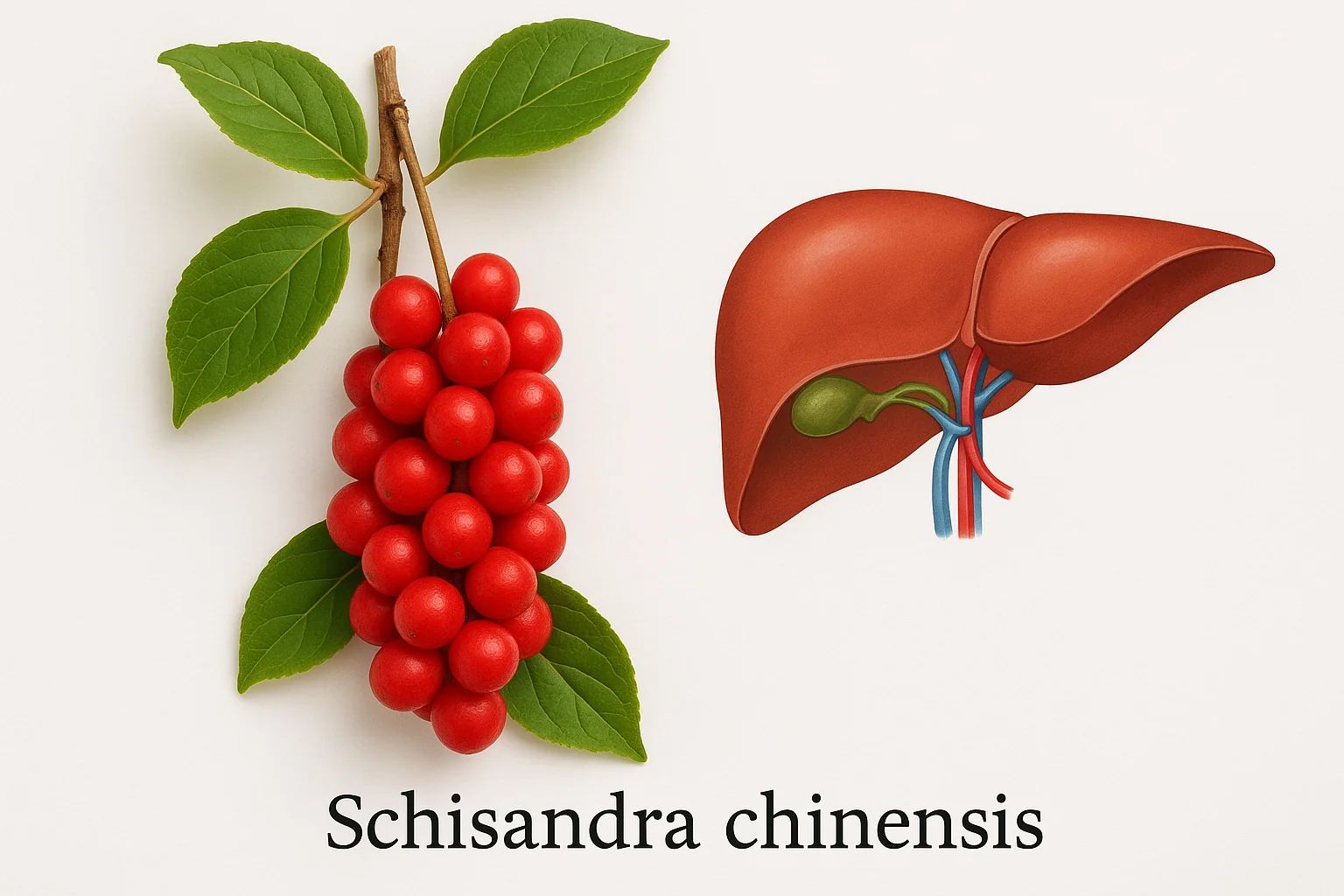
Chinese magnolia vine is a climbing plant whose red fruits are harvested and dried as a herbal raw material. The Chinese name Wu Wei Zi means “fruit of five flavors” and refers to the taste of the raw material, not its action on organs. The species distinction has practical significance here, as literature reviews treat this raw material as a collective: a summary work on the use of schisandra fruits in drug-induced liver damage in China defines it directly as the fruits of Schisandra chinensis or Schisandra sphenanthera (Zhu et al., Phytomedicine, 2019).
This is not a taxonomic detail. A separate review dedicated to the main lignans of both species was created precisely because they differ in composition, and these differences translate into effects on liver enzymes and a transporter called P-glycoprotein (Zhang et al., Frontiers in Pharmacology, 2022). The authors of this review indicate that the divergent results of studies on interactions may partly arise from different teams studying different species under the same common name.
For the reader, this means a specific thing. A supplement label stating only the name “schisandra” does not indicate which raw material is in the package, and the best-documented drug interaction in humans has been measured for the sphenanthera species. The Latin name on the package is therefore a useful piece of information, not just decoration.
What do studies say about schisandra and the liver?
The most frequently repeated statement about schisandra is that it lowers the activity of aminotransferases. This statement has some backing, but not as much as is usually attributed to it. A systematic review with meta-analysis published in 2025 included 54 studies on animal models, not clinical studies. The result was given as a standardized mean difference: for ALT it was -4.74 (95 percent confidence interval from -5.42 to -4.06), and for AST -5.10 (from -5.84 to -4.37). Heterogeneity was very high, above 90 percent for both parameters, and the authors conclude that further studies are needed to confirm efficacy and safety.
Data from humans exist, but in a different form. The review by Zhu et al. describes drugs made in China based on schisandra fruits and synthetic analogs of schisandrin C, used there in drug-induced liver damage, and states that clinical studies have shown inhibition of drug-induced increases in ALT, AST, and total bilirubin. This is a description of therapeutic practice from a specific healthcare system, based on preparations registered as drugs, not on dietary supplements available in Europe. The authors conclude the review by stating that high-quality clinical studies are needed to confirm the efficacy of these drugs.
| Study | Who and how many | Preparation and duration | What was measured |
|---|---|---|---|
| Huang et al., 2025 | 54 studies on animals | active compounds of schisandra, various protocols | ALT SMD -4.74; AST SMD -5.10; heterogeneity over 90 percent |
| Zhu et al., 2019 | review of clinical and preclinical studies from China | drugs based on schisandra fruits and analogs of schisandrin C | inhibition of drug-induced increases in ALT, AST, and bilirubin |
| Xin et al., 2007 | 12 healthy men | extract from S. sphenanthera, 13 days | increase in the area under the curve of tacrolimus by 164 percent |
Does schisandra improve physical endurance?
We did not find a study involving humans that would check the effect of schisandra alone on physical endurance. Queries in Europe PMC for trials involving athletes or physically active individuals did not return any work where schisandra was the only tested raw material, and the endpoint was time to exhaustion or VO2 max.
The closest thematically related work we managed to find concerns a drink containing caffeine and a blend of adaptogenic raw materials, and its endpoint is mental performance, not physical. The result of such a study describes the action of the entire recipe including caffeine and does not allow for any conclusions about schisandra itself. This is a typical trap with plant raw materials: composite preparations are studied more often than single ingredients, and the conclusion then migrates to the description of the ingredient.
The mechanisms cited to support endurance action, namely the influence on the hypothalamic-pituitary-adrenal axis and mitochondrial function, come from cell and animal studies. They describe a possible mode of action, not a measured effect in humans. A similar distinction is discussed more broadly in relation to cordyceps and VO2 max, where studies involving humans do exist and show how large the difference can be between mechanism and outcome. It is also worth remembering that the term “adaptogen” has no regulatory definition: it is not a pharmacological or legal category, but a descriptive term, which we explain in relation to adaptogens and the stress axis.
How does schisandra affect drugs metabolized by CYP3A4?
This is an area where human measurement exists and is unequivocal regarding direction. Twelve healthy men took an extract from Schisandra sphenanthera for 13 days, and before and after this period, they underwent pharmacokinetic testing after an oral dose of tacrolimus. After treatment with the extract, the area under the curve of tacrolimus concentration increased on average by 164.2 percent (95 percent confidence interval from 70.1 to 258.4), the maximum concentration by 227.1 percent (from 155.8 to 298.4), and the apparent clearance decreased by 49.0 percent.
The direction is therefore such that schisandra increases the concentration of the drug in the blood, not decreases it. For a drug with a narrow therapeutic window, such as tacrolimus used after organ transplantation, an increase in exposure of this scale is not a pharmacological nuance, but a real risk of toxicity. The review by Zhang et al. describes the effect of schisandra extract and its main lignans on the activity of cytochrome P450 and P-glycoprotein and indicates this as a mechanism for changes in the concentrations of concurrently taken medications.
Two boundaries of this finding must be stated clearly. The study by Xin involved twelve healthy individuals, not patients after transplantation, and concerned the sphenanthera species, not chinensis, which this article is about. Extending this result to any preparation labeled “schisandra” and to any drug metabolized by CYP3A4 goes beyond what was measured. However, the direction of the signal is clear enough that a conversation with the attending physician before combining schisandra with any chronic medication is warranted.
Does schisandra have a monograph from the European Medicines Agency?
No. The list of herbal raw materials subject to evaluation by the Committee on Herbal Medicinal Products checked on August 16, 2026 does not include Chinese magnolia vine in any form. In comparison, other raw materials classified as adaptogenic are listed in the same list: eleutherococcus root, rhodiola root, and ginseng root. The lack of a monograph is therefore not a rule for this group of plants, but a feature of this particular raw material.
A monograph is not a certificate of efficacy or proof of its absence. It is a document in which the committee records findings to which pharmacists and doctors then refer:
- indication for which the raw material may be used, along with the category of recognition (established medical use or traditional);
- form of the raw material and type of preparation, as an infusion and standardized extract are not the same;
- acceptable duration of use and lower age limit;
- note on pregnancy and breastfeeding, usually separate for different forms;
- recorded interactions or a clear statement that none have been reported.
For schisandra, none of these points exist. There is no agreed European duration of use or age limit, and the statement about use in pregnancy has no regulatory backing to which the reader could be referred. Schisandra sold in Europe is a food product, not a medicinal product, and this should also be read in descriptions on packaging. Comparing this with the measurement of interactions described above gives an uncomfortable but honest picture: a raw material without agreed usage frameworks can clearly change the concentration of a drug with a narrow therapeutic window.
Frequently Asked Questions
Does schisandra lower liver enzymes in humans?
The meta-analysis cited by most texts on schisandra included 54 studies on animals, not humans. Data from humans comes from China and concerns drugs made from schisandra fruits used in drug-induced liver damage, not supplements available in Europe.
What is the difference between Schisandra chinensis and Schisandra sphenanthera?
These are two distinct species, whose fruits in China are referred to by the common name Wu Wei Zi. They differ in their lignan profiles, and these differences translate into effects on liver enzymes and P-glycoprotein. The best-documented drug interaction in humans was measured for the sphenanthera species.
Does schisandra improve physical endurance?
We did not find a study involving humans that would check the effect of schisandra alone on physical endurance. The mechanisms cited to support such an effect come from cell and animal studies, thus describing a possible mode of action rather than a measured effect.
What drugs may interact with schisandra?
This was measured for tacrolimus: in healthy volunteers, the extract of schisandra increased the area under the curve of this drug by 164 percent. The mechanism involves the influence on cytochrome P450 and P-glycoprotein, so caution applies to drugs metabolized this way. The decision to combine is made by the attending physician.
Does schisandra have a monograph from the European Medicines Agency?
No. The list of raw materials subject to evaluation by the Committee on Herbal Medicinal Products checked on August 16, 2026 does not include schisandra, although it includes eleutherococcus, rhodiola, and ginseng. Therefore, there is no agreed European usage time or age limit for this raw material.
In the store at Bucha, there is no Chinese magnolia vine in any form. Other raw materials from the group called adaptogenic can be found in the adaptogens category, and plant extracts in the herbs category. Status of the assortment as of August 16, 2026.
This article is for informational and educational purposes and does not constitute medical advice. Before starting supplementation, consult your doctor, especially if you are taking medications regularly, are pregnant or breastfeeding, or have a chronic illness.
Author: Michał Waluk · Published: 2026-08-09 · Updated: 2026-08-16