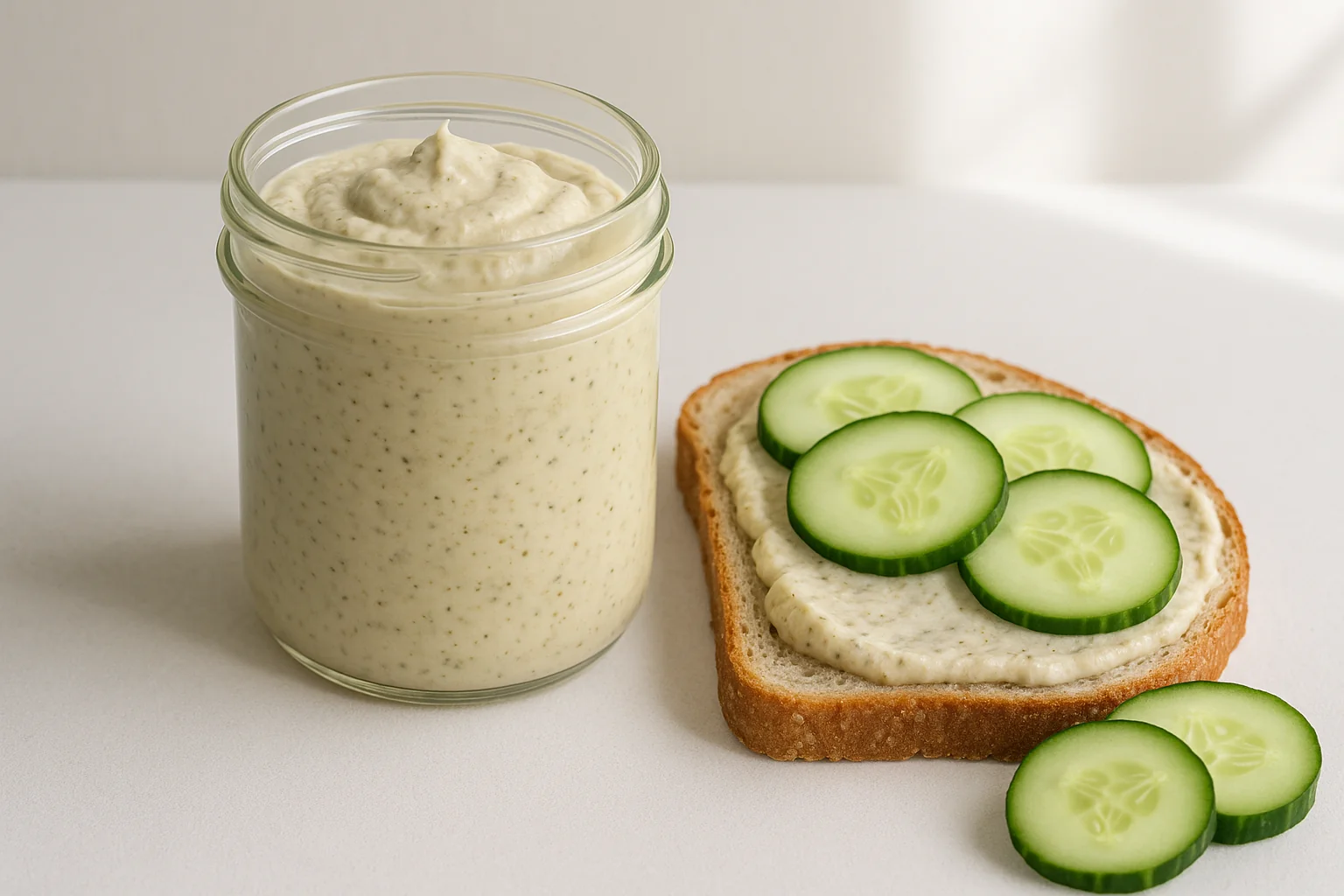

Vegan Sandwich Spread with Hemp Seeds and Onion
Vegan sandwich spread made with hulled hemp seeds, onion, and garlic. Proportions, order of steps, and calculated protein per sandwich. Dairy-free and no cooking.
A dairy-free sandwich spread, no cooking, and ready in ten minutes sounds like a compromise. It is not if the base is hulled hemp seeds. One hundred grams of seeds with a few tablespoons of cold water transforms in a blender into a thick mixture that spreads like cottage cheese and tastes like mild tahini. USDA FoodData Central record 170148 states that these seeds contain 31.6 g of protein per 100 g. Onion, garlic, and lemon juice turn the nutty base into a sandwich spread. Below you will find the proportions, the order of steps, and three flavor variations. You will also find an honest answer to the question of whether hemp protein is truly complete, as this statement appears more often in culinary recipes than measurements suggest.
KEY INFORMATION
• Hulled hemp seeds have 31.6 g of protein per 100 g (USDA FoodData Central, record 170148).
• House et al. (J Agric Food Chem, 2010) measured PDCAAS at 63-66%, with lysine being the first limiting amino acid.
• 30 g of seeds provide 210 mg of magnesium; per 100 g, the same record states 700 mg.
• The spread is vegan and gluten-free and is made without heat processing.
Why are hemp seeds suitable for sandwich spread?
Because they have a lot of fat and a soft structure, they break down in the blender faster than nuts. USDA record 170148 states that hulled seeds contain 48.8 g of fat per 100 g, of which 38.1 g is polyunsaturated fatty acids. This fat is released during grinding and binds the mixture without adding oil.
Callaway (Euphytica, 2004) describes hemp seeds as a source of over 30% oil and about 25% protein, with the oil being over 80% polyunsaturated, with an omega-6 to omega-3 ratio usually from 2:1 to 3:1. In practical cooking, this means one thing: ninety seconds in a good blender is enough for a smooth mixture. Nuts need several minutes and breaks to cool the blade.
The taste is milder than sesame. Tahini can be bitter, while the hemp seed spread remains sweet-nutty, so it withstands strong additions without fighting for dominance. Onion and garlic do not overshadow it; they simply complement it. The seeds also do not require roasting before grinding: roasting would dry them out and hinder the release of the fat that holds the entire consistency of the spread.
How much protein is in this spread and what is its quality?
In a sandwich with 40 g of spread, there is about 5.5 g of protein. One hundred grams of seeds, from which the entire portion is made, contributes 31.6 g of protein (USDA 170148), which is spread over approx. 230 g of the finished mixture. This is clearly more than the same portion of hummus provides, and roughly the same as a portion of cottage cheese.
The quality of this protein is more interesting than most recipes suggest. Callaway states that hemp seed proteins contain nutritionally significant amounts of all essential amino acids. This statement is about presence, not proportions. House et al. (J Agric Food Chem, 2010) measured the proportions directly: lysine was found to be the first limiting amino acid in all tested hemp products, and the PDCAAS was 63-66% for hulled seeds compared to 49-53% for whole seeds. The digestibility of the protein itself is high, between 83.5% and 92.1%.
The conclusion for the kitchen is simple. Hemp protein is good, but not reference-quality, so the statement about a “complete amino acid profile” requires qualification. Pair the spread throughout the day with a lysine-rich product, such as chickpeas or lentils, and this deficiency becomes insignificant.
Ingredients: what do you need?
Proportions for approx. 230 g of spread, which is five to six sandwiches. Preparation time: ten minutes, most of which is spent chopping the onion.
- 100 g hulled hemp seeds
- 3-4 tablespoons of cold water to adjust consistency
- 1/2 small white onion or 2 green onion stalks
- 1 clove of garlic
- 1 tablespoon of extra virgin olive oil or cold-pressed hemp oil
- 1 tablespoon of fresh lemon juice
- salt and freshly ground black pepper to taste
- optional: a pinch of smoked paprika, a teaspoon of Dijon mustard, 2 tablespoons of chopped chives
The seeds must be hulled. Whole seeds have a hard shell that does not break down in a home blender and leaves noticeable bits in the spread. This is also evident in the composition: House et al. measured hulled seeds at 35.9% protein compared to 24.0% for whole seeds, as the shell is mostly fiber.
Add the olive oil or hemp oil at the end and only cold. The spread does not go any further into a pot, and hemp oil consists of over 80% polyunsaturated fatty acids (Callaway, Euphytica, 2004), which is the fraction that oxidizes the fastest under heat.
How to prepare the spread step by step?
The recipe does not require cooking or an oven. Just a jug blender or food processor and ten minutes of work at the counter.
- Pour 100 g of hulled hemp seeds into a blender and add 3 tablespoons of cold water. Blend for 60-90 seconds continuously. The mixture goes through a dry and lumpy state until it becomes creamy.
- Chop the onion as finely as you can and press the garlic through a press. Add both ingredients to the ground seeds. If you prefer a milder taste, sauté the onion in a tablespoon of oil first and let it cool before adding.
- Pour in olive oil or hemp oil and lemon juice. Add salt, pepper, and chosen spices. Blend for another 20-30 seconds, just to combine the ingredients.
- Check the consistency. The spread should be spreadable but not runny like a sauce. If too thick, thin it with a spoonful of water; if too thin, thicken it with a spoonful of tahini or cashew butter.
- Transfer the spread to a glass jar and refrigerate for at least an hour. In the cold, the mixture thickens, so stir it with a spoon before serving.
Serve on dark bread or rice crackers. The same spread works well as a dip for raw vegetables and as a base for baked sweet potatoes.
What flavor variations are worth trying?
The nutty base accepts additions without resistance. Three directions that change the character of the spread the most look like this:
- Herb variant: a handful of fresh basil or cilantro added while blending. The spread becomes light green and fresh in taste, and in this version, it replaces pesto for pasta.
- Sun-dried tomato variant: 2-3 tomatoes from oil, finely chopped. The sweet-sour accent contrasts with the nuttiness of the seeds, and a pinch of oregano completes the Mediterranean profile.
- Spicy variant: half a teaspoon of chili flakes or a teaspoon of sriracha. The spiciness comes in gradually and gives an effect similar to spicy peanut butter.
We noticed during tests that the spread tastes significantly better after two hours in the refrigerator than right after grinding. Freshly made has a sharp aftertaste of raw onion, which subsides after cooling and stops overshadowing the nutty base. If you are making it for a gathering, prepare it the day before.
If you are looking for further uses for these seeds, check out chickpea and hemp seed patties or hemp ideas for a festive breakfast. The version with fish is described in the recipe for tuna spread with hemp oil.
Frequently Asked Questions
How much protein is in the hemp seed sandwich spread?
Approx. 5.5 g per sandwich with 40 g of spread. The entire portion is made from 100 g of hulled seeds, which USDA record 170148 attributes 31.6 g of protein per 100 g, spread over approx. 230 g of the finished mixture. Hummus in the same portion provides about 3 g.
Is the protein from hemp seeds complete?
It contains all essential amino acids, but not in ideal proportions. House et al. (J Agric Food Chem, 2010) measured PDCAAS at 63-66% for hulled seeds and identified lysine as the first limiting amino acid. Pairing with legumes throughout the day compensates for this deficiency.
Does the hemp seed spread taste like hemp butter?
The base is the same, creamy and nutty. Hemp butter is just ground seeds, ground longer until all the fat is released. This spread has additions already in the composition, so it goes on the sandwich without anything more.
How long can you store the hemp seed spread?
Up to five days in a sealed jar in the refrigerator. The surface may slightly darken from contact with air, so stir the spread before use. Avoid freezing, as after thawing the mixture separates and loses creaminess.
What can replace the onion in this spread?
Green onion gives a milder effect, chives are gentler, and onion powder is the most convenient. You can also skip the onion and leave just the base with garlic and herbs. The amino acid composition of the seeds does not change in any of these variants.
Do hemp seeds contain THC?
Trace amounts may be detected, which is why the law sets an upper limit for them. Commission Regulation (EU) 2023/915, applicable from May 25, 2023, allows for 3.0 mg of total delta-9-THC and THCA per kilogram in hemp seeds and products derived from them.
Hulled hemp seeds are not currently available in the store at u Bucha. Among hemp food products, you will find hemp teas.
This article is for informational and educational purposes and does not replace consultation with a doctor. If you are pregnant, breastfeeding, taking medications, or have chronic conditions, consult the use of supplements or herbs with a specialist.
Author: Michał Waluk · Published: 2026-06-22 · Updated: 2026-08-16