
TRPV1: the capsaicin receptor through which CBD modulates pain and temperature
TRPV1 transmits pain and heat. What original works on capsaicin, anandamide, and cannabidiol really showed and where the clinical evidence in pain ends.
When we bite into a hot pepper, our mouths report a burning sensation, even though the food is at room temperature. This is due to one ion channel: TRPV1, commonly known as the capsaicin receptor. This same channel opens in response to heat at tissue-damaging levels, as well as in response to anandamide, an endogenous cannabinoid. Cannabidiol also interacts with it, but it does so differently than the popular version suggests: not more gently than capsaicin, but simply on the same channel. Below, we separate what original works have shown from what secondary literature has added. We go in order: from the cloning of the receptor in 1997, through the role of anandamide and desensitization of the channel, to the distribution of the protein in human tissue and the real state of clinical evidence in chronic pain. Several popular statements about this receptor had to be retracted along the way.
KEY INFORMATION
• The capsaicin receptor is a non-selective cation channel from the TRP family, also opened by temperature increases in harmful ranges (Caterina et al., Nature 1997).
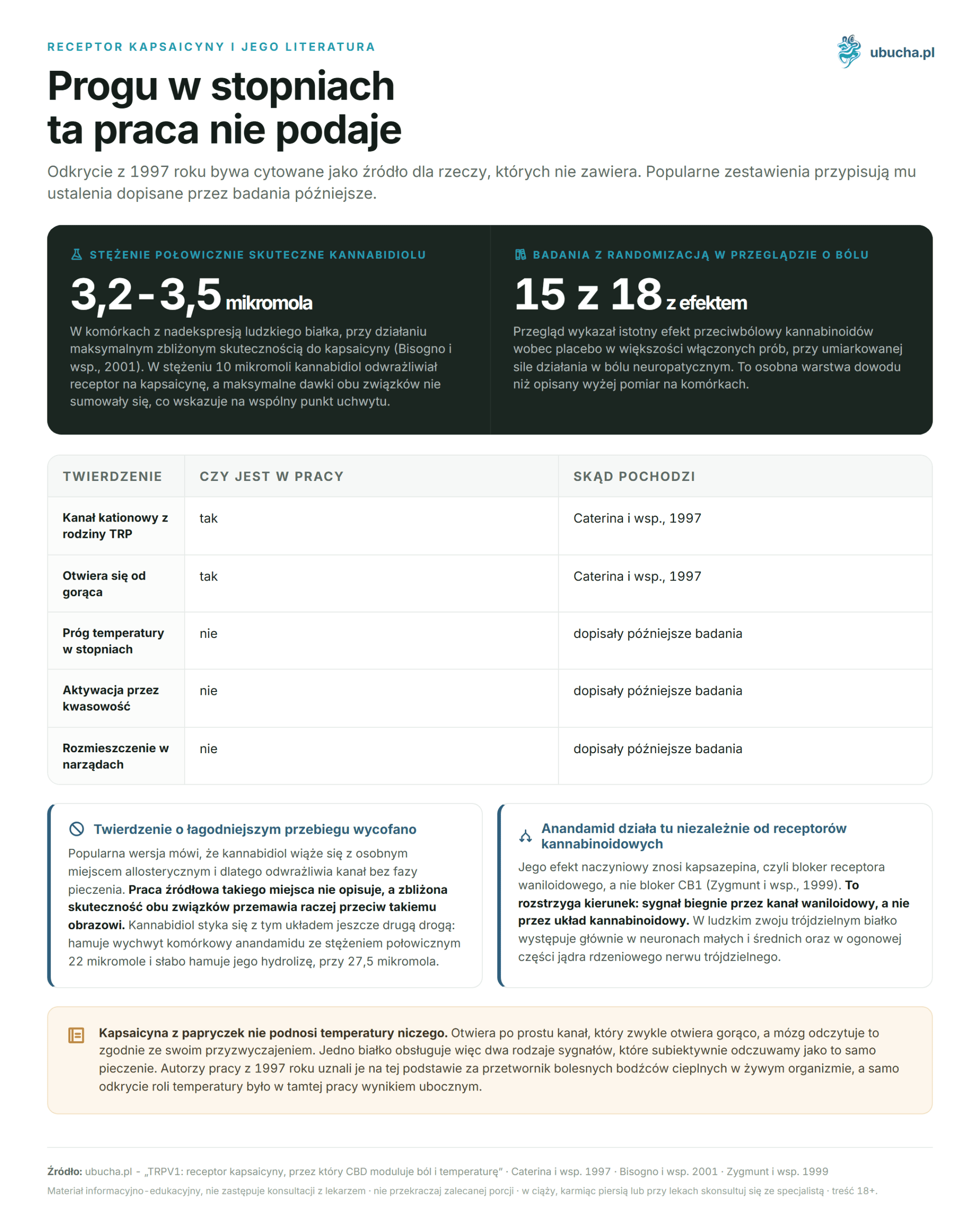
• Cannabidiol stimulates this channel with an efficacy similar to that of capsaicin, and at a concentration of 10 micromoles, it desensitizes it to capsaicin itself (Bisogno et al., British Journal of Pharmacology 2001).
• Anandamide acts on the vanilloid receptor independently of cannabinoid receptors: its vascular effect is abolished by capsazepine, not by the CB1 blocker (Zygmunt et al., Nature 1999).
• In the human trigeminal ganglion, TRPV1 is mainly found in small and medium neurons and in the caudal part of the spinal trigeminal nucleus.
• A review of 18 randomized studies showed a significant analgesic effect of cannabinoids compared to placebo in 15 of them, with moderate efficacy in neuropathic pain.
What is the TRPV1 receptor and what stimulates it?
It is an ion channel that simultaneously transmits information about heat and pain. Caterina’s team isolated the coding cDNA from sensory neurons using calcium influx-based expression cloning. It turned out that the capsaicin receptor is a non-selective cation channel, structurally related to the TRP channel family (Caterina et al., Nature 1997).
The most interesting aspect of this work was a side discovery. The cloned capsaicin receptor also opened in response to temperature increases at levels harmful to tissues, allowing the authors to consider it a transducer of painful thermal stimuli in a living organism. One protein thus handles two types of signals, which we subjectively perceive as the same burning sensation. Capsaicin from peppers does not raise the temperature of anything. It simply opens a channel that is usually opened by heat, and the brain interprets this according to its habit.
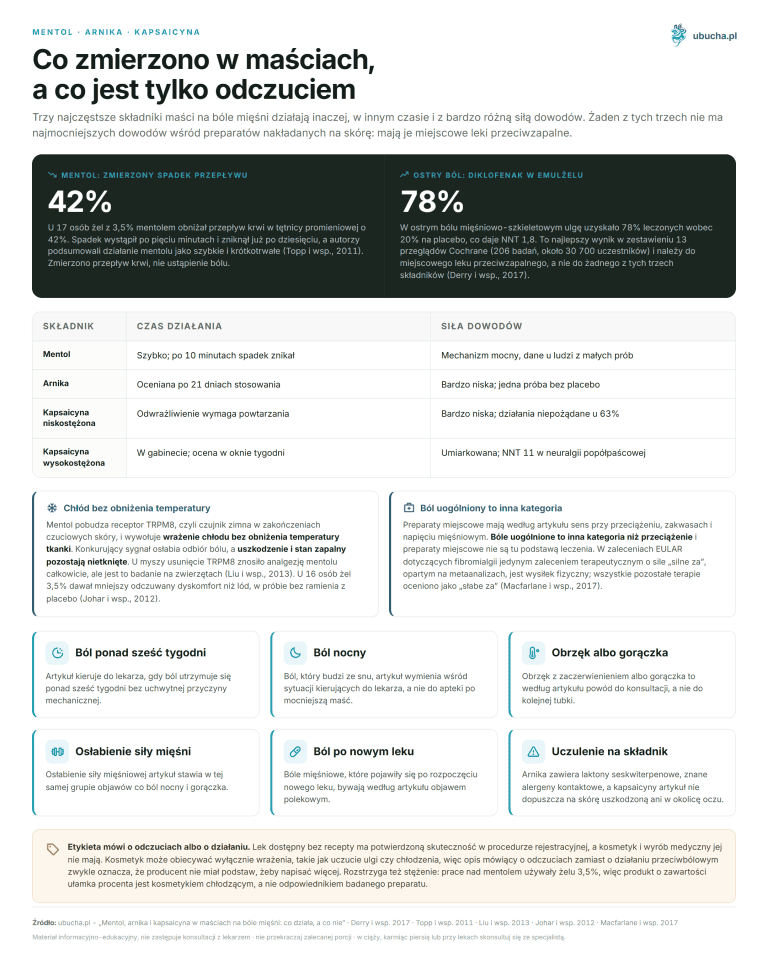
It is worth noting what this work does not say. It does not provide a temperature threshold in degrees, does not describe activation by tissue acidity, nor the distribution of the receptor in specific organs. These elements were added by later studies, and popular compilations usually attribute them to the 1997 work. The practical implications of this knowledge for topical preparations have been gathered in the text about menthol, arnica, and capsaicin in muscle pain ointments.
Does cannabidiol act on TRPV1 differently than capsaicin?
It acts similarly to what is commonly written, and this is the most frequently misrepresented part of this story. In the work of Bisogno and colleagues, cannabidiol stimulated the vanilloid receptor in cells with overexpression of human protein, with a half-maximal effective concentration of about 3.2-3.5 micromoles, and its maximum effect was similar in efficacy to that of capsaicin (Bisogno et al., British Journal of Pharmacology 2001).
The divergence begins at the second stage. Cannabidiol at a concentration of 10 micromoles desensitized the receptor to the action of capsaicin, and the maximum doses of both compounds did not sum up, indicating a common point of action. The popular version states that cannabidiol binds to a separate allosteric site and therefore desensitizes the channel without a burning phase. This work does not describe such a site, and the similar efficacy of both compounds argues against such a picture. The claim of a gentler course is retracted as unsupported by the source.
This same work describes a second pathway through which cannabidiol interacts with the vanilloid system. The compound inhibited cellular uptake of anandamide with a half-maximal concentration of 22 micromoles and weakly inhibited its hydrolysis, with a concentration of 27.5 micromoles. Since anandamide itself stimulates the vanilloid receptor, increasing its availability is a second, indirect way of influencing this channel. The authors also note that only the positive isomers of the studied compounds had high affinity for CB1 and CB2 receptors, not the natural cannabidiol present in hemp oils.
What connects anandamide to the TRPV1 channel?
Direct stimulation, independent of cannabinoid receptors. Zygmunt’s team studied the vasodilation caused by anandamide in isolated arteries. The effect was sensitive to capsaicin and was accompanied by the release of calcitonin gene-related peptide, in short CGRP (Zygmunt et al., Nature 1999).
The decisive factor was the blockade system. A selective CGRP receptor antagonist inhibited vasodilation, while the CB1 receptor blocker named SR141716A did not inhibit it. Capsazepine, a selective vanilloid receptor antagonist, abolished both vasodilation and CGRP release. Other cannabinoid receptor agonists, both endogenous and synthetic, did not reproduce the action of anandamide. In patch clamp studies on cells with the cloned vanilloid receptor, anandamide induced a current sensitive to capsazepine.
The authors’ conclusion is balanced and worth quoting in this form: the vanilloid receptor may be another molecular target of endogenous anandamide, alongside cannabinoid receptors, in the nervous and cardiovascular systems. It is worth noting that the work concerns vessels, not pain conduction, and that it does not describe desensitization of the channel by anandamide. The history of the molecule itself is described in the text about the discovery of anandamide in 1992.
Where in the human body is TRPV1 located?
Data from human tissue are narrower than popular receptor maps suggest. The work describing the distribution of this protein in humans covered the trigeminal ganglion and the spinal trigeminal nucleus, in individuals of various ages, from fetal life to old age (Quartu et al., Journal of Anatomy 2016).
The image emerged organized. The receptor was mainly found in small and medium neurons of the trigeminal ganglion and in the caudal part of the spinal trigeminal nucleus, where bands of fibers and small punctate elements were primarily marked, and stained cells were rare. The percentage of ganglion neurons showing the presence of the receptor was higher in individuals in the early perinatal period than later. The protein partially co-occurred with CGRP and substance P.
The authors also noted clear differences compared to the distribution previously described in rats, both spatially and developmentally. This is a warning against transferring rodent maps to humans. The conclusion that emerges from the work is cautious: the distribution of the receptor supports its involvement in processing thermal and painful stimuli in the human trigeminal system, that is, in the area of the face and head. We discuss how this channel relates to the actual cannabinoid receptors in the guide to CB1 and CB2 receptors.
Does blocking TRPV1 provide a good painkiller?
The idea is old, and the result is still incomplete. The entire strategy of antagonists is based on the assumption that endogenous substances stimulating this receptor play a significant role in certain pain syndromes. Based on this, several small-molecule antagonists have entered phase I and II trials for indications including chronic inflammatory pain and migraine (Szallasi et al., Nature Reviews Drug Discovery 2007).
The range of possible applications turned out to be broader than pain itself. The authors of the review list data indicating the usefulness of antagonists of this receptor also in urgent urinary incontinence, chronic cough, and irritable bowel syndrome. Animal models also suggested value in cancer pain. The lack of effective drugs in some of these indications is cited by the authors as the main argument for further research.
A newer review of the same field presents the matter more soberly. The discovery of drugs targeting TRP channels has moved beyond pain, towards respiratory diseases, neurology, psychiatry, diabetes, and cancers, but the authors directly point out the challenge these compounds face in clinical practice: the need for very precise targeting to limit adverse effects resulting from the multifunctionality of TRP channels (Koivisto et al., Nature Reviews Drug Discovery 2022). A channel that handles both heat and pain at the same time is difficult to quiet without side effects.
What do studies on cannabinoids in pain show?
Moderate efficacy in neuropathic pain and a lot of caution in drawing conclusions. A systematic review of randomized studies included 18 works meeting the inclusion criteria, and a significant analgesic effect compared to placebo was shown in 15 of them. Several studies also noted improvement in sleep, and serious adverse effects were not reported (Lynch and Campbell, British Journal of Clinical Pharmacology 2011).
The authors summarize that cannabinoids are safe and moderately effective in neuropathic pain, with preliminary evidence of efficacy in fibromyalgia and rheumatoid arthritis. However, the studied preparations included smoked cannabis, extracts administered to the oral mucosa, and synthetics, so the result does not refer to cannabidiol itself. The contribution of the vanilloid receptor to this effect was not measured in these studies.
A separate thread is inflammation. In a model of acute inflammation of the rat paw induced by carrageenan, orally administered cannabidiol reduced swelling and thermal hyperalgesia, and after three doses, it lowered the concentration of prostaglandin E2 in plasma, cyclooxygenase activity in tissue, nitric oxide production, and free radicals (Costa et al., Naunyn-Schmiedeberg’s Archives of Pharmacology 2004). However, this work does not attribute the effect to desensitization of the vanilloid receptor, although it is often cited as such. This is an animal model, and draw your own conclusions about pain with a doctor, not from an abstract.
| Substance | What it does to the vanilloid receptor | How we know this |
|---|---|---|
| Capsaicin | Selectively stimulates the channel; the same channel is opened by heat | Receptor cloning, Nature 1997 |
| Anandamide | Stimulates the channel independently of the CB1 receptor | Capsaicin blockade and patch clamp, Nature 1999 |
| Cannabidiol | Stimulates with efficacy similar to capsaicin, then desensitizes | In vitro study on cells with human protein, 2001 |
| Small-molecule antagonists | Block the channel; studied in inflammatory pain and migraine | Drug development reviews, 2007 and 2022 |
Frequently Asked Questions
Does cannabidiol stimulate or block the TRPV1 receptor?
It stimulates and then desensitizes. In a study on cells with human protein, cannabidiol opened the channel with an efficacy similar to that of capsaicin, and at a concentration of 10 micromoles, it abolished the reaction to capsaicin itself. The maximum effects of both compounds did not sum up, indicating a common point of action.
Does anandamide act on TRPV1 without the involvement of cannabinoid receptors?
Yes. The vasodilation caused by anandamide was abolished by capsazepine, a vanilloid receptor antagonist, but not by the CB1 receptor blocker. Other cannabinoid receptor agonists could not substitute for anandamide in this effect, indicating a separate point of action.
Where in humans has the presence of the TRPV1 receptor been confirmed?
In a study on human tissue, it was described in the trigeminal ganglion, mainly in small and medium neurons, and in the caudal part of the spinal trigeminal nucleus. The authors noted clear differences compared to the distribution previously described in rats.
Is there a drug that blocks TRPV1?
Small-molecule antagonists of this receptor have entered phase I and II trials for chronic inflammatory pain and migraine. However, a newer review of drug development targeting TRP channels indicates the need for very precise targeting to limit adverse effects resulting from the multifunctionality of these channels.
Do cannabinoids help with neuropathic pain?
A systematic review of 18 randomized studies showed a significant analgesic effect compared to placebo in 15 of them, with moderate efficacy. The studied preparations included smoked cannabis, mucosal extracts, and synthetics, so the result does not refer to cannabidiol itself or to a single receptor.
This article is for informational and educational purposes only and does not constitute medical advice. Before starting to use cannabis or CBD for therapeutic purposes, consult with a doctor, especially if you are taking other medications, are pregnant, or breastfeeding.
Author: Michał Waluk · Published: 2026-08-09 · Updated: 2026-08-11