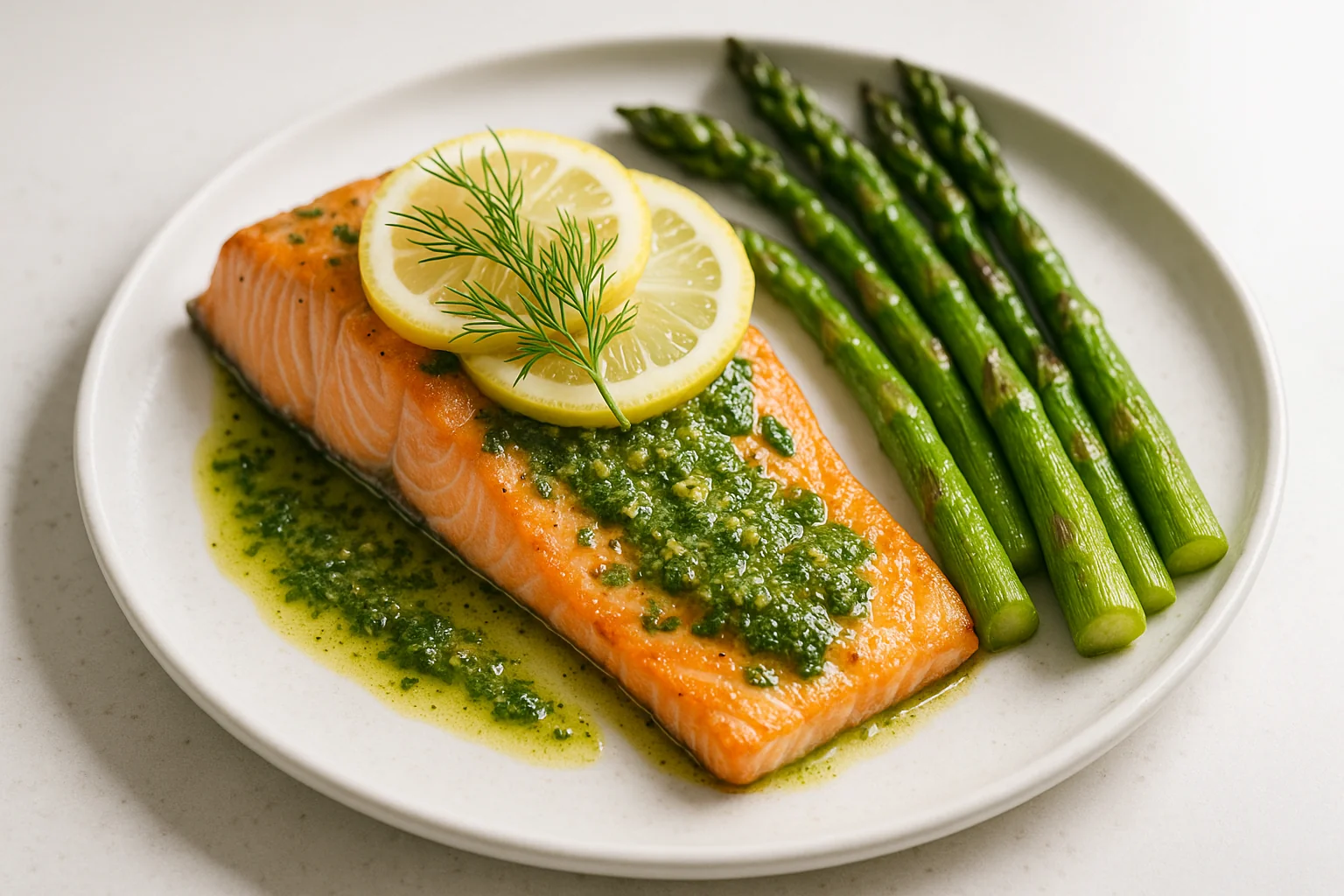

Baked Salmon with Hemp Oil Sauce
Baked salmon with a cold sauce made with hemp oil. Recipe for two servings in 25 minutes, nutritional values from the USDA database, and the reason why we do not heat the oil.
Salmon and hemp seed oil bring two different types of omega-3 fatty acids to the plate. The fish provides EPA and DHA, which are long-chain forms that the body uses directly. Hemp oil contributes ALA, a plant form. Additionally, there is a flavor layer: the cold herbal sauce poured over the hot fish creates a contrast that sounds stranger than it tastes. The combination makes culinary and nutritional sense, but under one condition: the hemp oil remains cold. It is not a fat for frying or long baking, as I will explain shortly. I will show you how to bake the fillets in 12-15 minutes, how to make the herbal sauce that is poured only on the plate, and how much omega-3 you actually get in such a serving according to the USDA food composition database.
KEY INFORMATION
• Hemp seed oil is over 80% polyunsaturated fatty acids, and the omega-6 to omega-3 ratio is usually between 2:1 and 3:1 (Callaway, Euphytica, 2004).
• One hundred grams of farmed Atlantic salmon provides 2.15 g of EPA and DHA and 22.1 g of protein (USDA, record 175168).
• Use hemp oil only cold, without contact with the frying pan.
• The entire dish takes 25 minutes and serves two.
Why does hemp oil pair well with salmon?
Because each side brings a different type of fat. Salmon provides EPA and DHA, ready-to-use long-chain acids for the body. Hemp seed oil provides alpha-linolenic acid, a plant precursor of this family. Additionally, there is flavor: the herbal sauce made with cold oil contrasts with the hot, fatty fish.
Hemp seed oil is over 80% made up of polyunsaturated fatty acids, and the omega-6 to omega-3 ratio is usually between 2:1 and 3:1. This is described by Callaway (Euphytica, 2004), who calls this ratio optimal for humans. This is the author’s own assessment, not a recommendation from WHO or FAO. None of these institutions specify a particular value for such a ratio.
Why does the ratio matter at all? Simopoulos (Nutrients, 2016) describes that in the Western diet, the omega-6 to omega-3 ratio today reaches 20:1, while in the diet of our ancestors it was about 1:1. This change is associated with an increase in obesity rates, and the author links it to systemic inflammation. A dish combining ocean fish with hemp oil shifts this ratio towards omega-3 from two independent sources at once.
Can you bake and fry with hemp oil?
No. The same composition that makes it valuable also makes it unstable: over 80% of polyunsaturated fatty acids are the fraction most susceptible to oxidation, as the more double bonds in the chain, the easier it is for oxygen to break it down. The longer the contact with heat and air, the more of these acids disappear. The alpha-linolenic acid itself disappears the fastest, as it has three double bonds.
In practice, this means a simple kitchen rule. Hemp oil is added to the dish after removing it from the heat or just before baking, in a thin layer on the surface. For a heated pan, use olive oil, ghee, or canola oil, which are fats with a predominance of monounsaturated or saturated fractions. More about what hemp oil can and cannot do in the kitchen is gathered in the post hemp oil in the kitchen.
Safety: Do not pour hemp oil onto a hot pan and do not heat the finished sauce. In this recipe, the oil appears twice: in a thin layer on the fillet before placing it in the oven and as a cold sauce poured on the plate.
How much omega-3 does one serving provide?
One hundred grams of farmed Atlantic salmon contains 0.69 g of EPA and 1.46 g of DHA, totaling 2.15 g of these two acids, along with 22.1 g of protein and 206 kcal. These values come from record 175168 in the USDA food composition database. A fillet weighing 150 g after baking thus provides about 3.2 g of EPA and DHA.
Additionally, there is fat from the sauce. A tablespoon of any vegetable oil contains about 13.6 g of fat and roughly 120 kcal, so two tablespoons per serving add about 27 g of fat and 245 kcal. The entire serving thus amounts to approximately 550 kcal, 33 g of protein, and 46 g of fat, with a trace amount of carbohydrates.
The USDA database does not have a separate record for edible hemp oil. The numbers we provide for the oil result from the fat mass in a tablespoon, not from a separate measurement for hemp.
Ingredients - what do you need?
The proportions yield two servings. Preparation takes 10 minutes, baking 12-15 minutes. The sauce is made in a bowl, without a blender and without heating.
- 2 salmon fillets, 150-180 g each, about 3 cm thick
- 4 tablespoons of cold-pressed hemp seed oil
- 1 clove of garlic
- 1 tablespoon of fresh dill or tarragon
- 1 teaspoon of lemon juice and lemon slices for serving
- sea salt and freshly ground black pepper
- optional: 1 teaspoon of Dijon mustard for the sauce
- for serving: asparagus, zucchini, or lettuce
When shopping, two things matter. The first is the thickness of the fillet: pieces thinner than 2 cm dry out before they can brown, so take the middle section instead of the tail. The second is the oil itself, which must be cold-pressed and kept in a dark bottle, preferably in the fridge. Fresh hemp oil smells nutty and grassy. If the smell resembles old linseed oil or glue, the bottle is already past its expiration date, and the sauce will turn bitter. Do not remove the skin from the fillets: it keeps the fish intact and protects the bottom from drying out.
How to bake salmon with hemp sauce step by step?
This recipe requires precision in one area: baking time. A temperature of 200 degrees and 12-15 minutes is the window beyond which the salmon becomes dry. The rest is just mixing in a bowl.
- Take the fillets out of the fridge 15 minutes before baking and dry them with a paper towel, as a dry surface browns better. Sprinkle with salt and pepper on both sides. Preheat the oven to 200 degrees.
- Make the sauce: in a small bowl, combine hemp oil, garlic pressed through a garlic press, chopped dill, lemon juice, and a pinch of salt. Dijon mustard is optional, but it binds the sauce and deepens the flavor. Mix with a fork or whisk.
- Line the baking sheet with parchment paper and place the fillets skin-side down. Spoon a tablespoon of sauce on each and spread it thinly over the surface. Set the rest aside for serving.
- Bake for 12-15 minutes, depending on the thickness of the fillet. You can check for doneness with a fork: the meat separates along the fibers and loses transparency. A slightly pink center is fine.
- Transfer the fillets to plates and drizzle with the remaining cold sauce just before serving. Add a slice of lemon. Asparagus, rice, or a colorful salad with hemp dressing that uses the same oil pairs well with this dish.
In our kitchen, the sauce poured over the hot fillet right after removing it from the oven thins out from the heat of the fish and mixes with the juices that flow out. It turns out better than the sauce served separately, and the oil does not go into the frying pan or the oven.
How to modify this recipe?
The base is simple enough to allow for substitutions of herbs, additions, and methods of preparing the fish. The sauce remains cold in every variant, so you only change what surrounds it. You can also substitute the fish: Atlantic herring provides 2.01 g of EPA and DHA per 100 g, almost as much as salmon, while cod only provides 0.16 g (USDA).
| Variant | What you change | What to watch out for |
|---|---|---|
| Asian | Instead of dill, use a teaspoon of soy sauce, a teaspoon of grated ginger, and a few drops of sesame oil | Soy sauce is salty itself, so omit the salt from the recipe |
| One tray | Arrange asparagus or zucchini slices drizzled with olive oil around the fillets | Drizzle vegetables with olive oil, not hemp oil |
| In a pan | Skin down in olive oil, 4-5 minutes, then 2-3 minutes on the other side | Drizzle the sauce after removing the pan from the heat |
| On the grill | Fillet on a tray or cedar plank, sauce as a finishing marinade | Do not grease the grill with hemp oil |
The grilled version has its own rules for choosing marinades, which we outlined in the post about grilling with seeds and hemp oil.
Frequently Asked Questions
Can hemp oil be used for baking salmon?
Only a thin layer on the surface of the fillet and for a short time. Hemp seed oil is over 80% polyunsaturated fatty acids (Callaway, Euphytica, 2004), and this fraction oxidizes the fastest. The main portion of oil is served cold, already on the plate.
How much omega-3 does a serving of baked salmon provide?
One hundred grams of farmed Atlantic salmon contains 0.69 g of EPA and 1.46 g of DHA, totaling 2.15 g (USDA, record 175168). A fillet weighing 150 g after baking thus provides about 3.2 g of these two acids. The sauce adds plant fat, but not EPA or DHA.
How to check if the salmon is already baked?
The meat separates with a fork along the natural fibers and loses transparency. A thermometer inserted into the thickest part shows 63 degrees. A 3 cm thick fillet needs 12-15 minutes at 200 degrees. It’s better to check two minutes early than too late.
What herbs go well with hemp oil sauce?
Dill and tarragon are the safest choice with fish, as they balance the earthy taste of the oil. Cilantro shifts the dish towards Asian cuisine. Parsley and chives are neutral. Basil with tomatoes gives a Mediterranean variant.
Can the hemp sauce be made a day in advance?
Yes, but keep it in a sealed jar in the fridge and use it within a day. Polyunsaturated fatty acids oxidize when exposed to air, and crushed garlic and lemon juice accelerate flavor change. Shake the jar before serving, as the sauce separates.
The hemp food products we have today in our offer are hemp teas and herbal blends: we have gathered them in the food category. You will not find oil or hemp seeds in it.
This article is for informational and educational purposes and does not replace consultation with a doctor. If you are pregnant, breastfeeding, taking medications, or have chronic conditions, consult the use of supplements or herbs with a specialist.
Author: Michał Waluk · Published: 2026-06-22 · Updated: 2026-08-16