
CBD Oils: Which Concentration to Choose? Guide 2026
CBD oils 5%, 10%, and 20% plus CBG oils: how many milligrams per drop, cost per 100 mg, and how to match concentration to your daily dose. Prices 2026.
A drop from the pipette is about 0.033 ml, so one press delivers 1.6 mg of cannabidiol in 5 percent oil and 6.6 mg in 20 percent oil. This single number determines everything else: how many drops you measure in the evening, how many days a bottle lasts, and how much you pay for a month of supplementation. The u Bucha store currently offers six sublingual oils: three with cannabidiol at 5, 10, and 20 percent concentrations, and three with cannabigerol at 5, 10, and 15 percent. There is no 30 percent version, so instead of promising four levels, we compare what is actually on the shelf. Here you will find a milligram-to-drop converter, the cost of 100 mg for each label, the monthly bill at doses of 25 and 50 mg, and a rule for matching concentration to your own dose.
KEY INFORMATION
• Shannon’s 2019 study included 72 adults usually taking 25 mg cannabidiol daily: 79.2% reported less anxiety, and 66.7% better sleep after a month (Shannon et al., PMC 2019).
• A drop is about 0.033 ml, i.e., 1.6 mg in 5 percent oil, 3.3 mg in 10 percent, and 6.6 mg in 20 percent.
• The cost of 100 mg cannabidiol in u Bucha’s offer drops from 13.00 zł at 5 percent to 9.50 zł at 20 percent, as of August 8, 2026.
• There is no 30 percent oil in the store; the strongest available is 20 percent, i.e., 2000 mg in a 10 ml bottle.
• Higher concentration does not work stronger; it only changes the load per drop and the price of a possible dosing mistake.
What is oil concentration and how to convert it to drops?
Percentage concentration is the mass of the phytocompound per unit volume of oil. A 10 percent oil in a 10 ml bottle contains 1000 mg cannabidiol, i.e., 100 mg per milliliter. A drop from the pipette is about 0.033 ml, so a milliliter divides into roughly 30 drops. These two numbers determine everything else.
5 percent oil has 50 mg per milliliter, divided by 30 drops gives about 1.6 mg per drop. 10 percent oil is 100 mg per milliliter and about 3.3 mg per drop. 20 percent oil is 200 mg per milliliter and about 6.6 mg per drop. 15 percent cannabigerol oil gives 150 mg per milliliter, exactly 5 mg per drop. Values are approximate because MCT oil viscosity and pipette design change drop size by 10-15 percent.
Why does this detail matter in practice? A 20 mg daily dose is about 12 drops in 5 percent oil, 6 drops in 10 percent, and only 3 drops in 20 percent. The first version uses a 10 ml bottle in 25 days, the last in 100 days. After two months, the difference is noticeable both in your wallet and in time spent with the pipette under your tongue.
Project CBD describes dose selection with the principle start low, go slow: you start with the smallest sensible portion and raise it gradually, observing your body’s reaction (Project CBD). The lower the concentration, the smaller the step you can take, because one drop changes the dose by less than 2 mg instead of over 6 mg.
Which sublingual oils are really available at u Bucha?
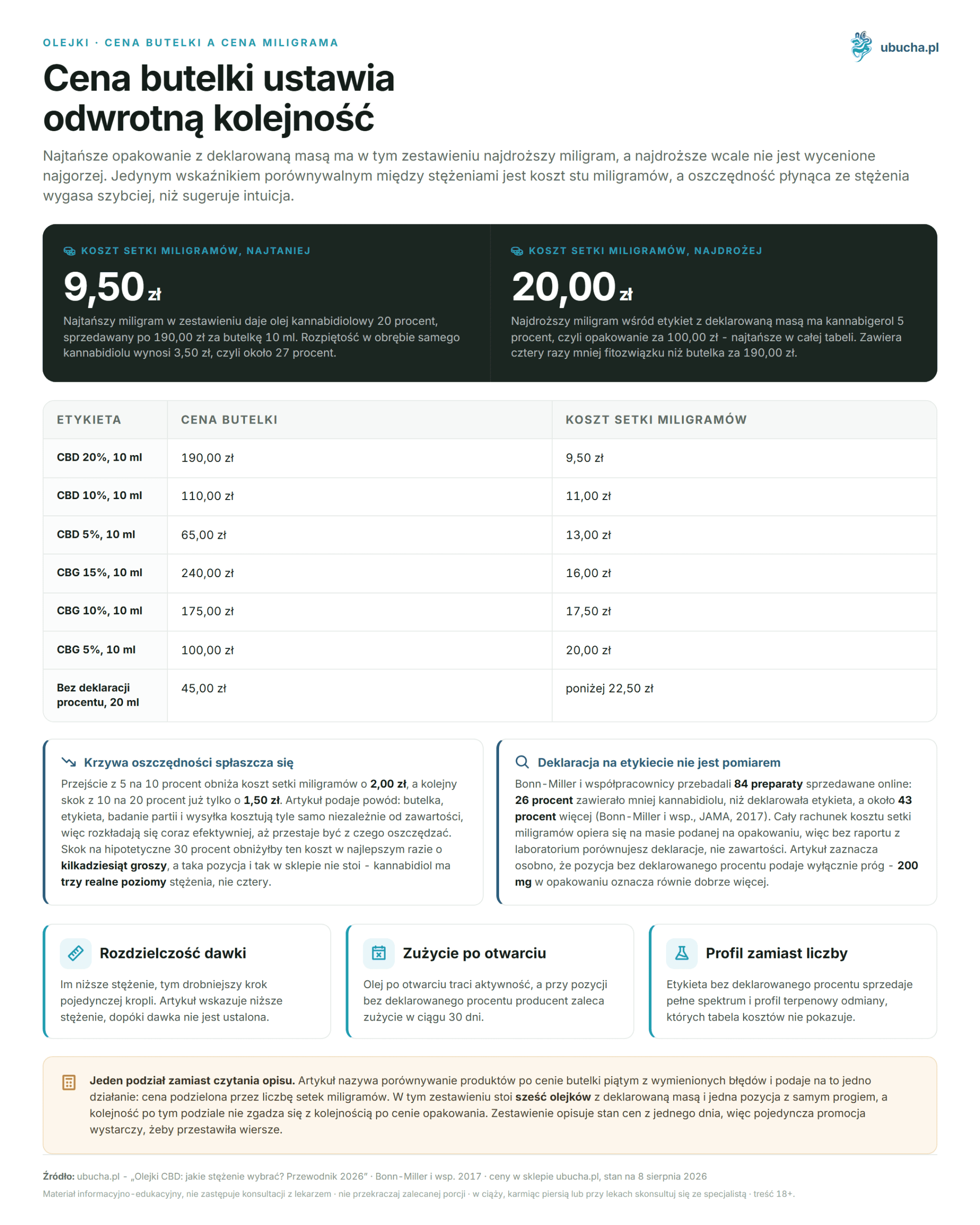
As of August 8, 2026, the oil category has six items, all from the CANNOVA brand: three with cannabidiol and three with cannabigerol. The table below orders them by cost per 100 mg, the only comparable metric across concentrations. Prices come from the store and reflect that day’s status.
| Rank | Name | Highlight | Content | Price | Cost per 100 mg |
|---|---|---|---|---|---|
| 1 | CANNOVA Natural CBD Oil 20%, 10 ml | cheapest milligram in the offer, 3 drops per 20 mg dose | 2000 mg in 10 ml | 190.00 zł | 9.50 zł |
| 2 | CANNOVA Natural CBD Oil 10%, 10 ml | balance of price and precision, bottle lasts 40 days at 25 mg | 1000 mg in 10 ml | 110.00 zł | 11.00 zł |
| 3 | CANNOVA Natural CBD Oil 5%, 10 ml | lowest entry threshold and smallest dose step | 500 mg in 10 ml | 65.00 zł | 13.00 zł |
| 4 | CANNOVA Natural CBG Oil 15%, 10 ml | strongest cannabigerol oil, 5 mg per drop | 1500 mg in 10 ml | 240.00 zł | 16.00 zł |
| 5 | CANNOVA Natural CBG Oil 10%, 10 ml | mid-range cannabigerol, 3.3 mg per drop | 1000 mg in 10 ml | 175.00 zł | 17.50 zł |
| 6 | CANNOVA Natural CBG Oil 5%, 10 ml | test version of cannabigerol, 1.6 mg per drop | 500 mg in 10 ml | 100.00 zł | 20.00 zł |
| 7 | Green Out Pure XL, 20 ml (Critical Jack, O.G. Kush) | sublingual oil outside the category, no declared percentage | over 200 mg in 20 ml | 45.00 zł | below 22.50 zł |
The seventh item requires comment. Green Out Pure XL is a sublingual oil, but the producer states content as a minimum threshold, not an exact number, so its cost per 100 mg can only be estimated from above. The other six labels declare mass precisely, and these are compared further in the text. The entire category is at olejki u Bucha.
Which oil is cheapest per 100 mg?
The cheapest milligram is from 20 percent cannabidiol oil: 9.50 zł per 100 mg. Next is 10 percent at 11.00 zł, and the entry threshold, 5 percent, costs 13.00 zł per 100 mg. The range within cannabidiol alone is 3.50 zł, about 27 percent.
Economies of scale apply but weaken faster than intuition suggests. Moving from 5 to 10 percent lowers the cost per 100 mg by 2.00 zł, and the next jump from 10 to 20 percent only by 1.50 zł. The reason is simple: bottle, label, batch testing, and shipping cost the same regardless of content, so they spread more efficiently until there is nothing left to save.
We also noticed another pattern when comparing these six labels, rarely discussed. Cannabigerol oils are more expensive at every concentration, and even the strongest, 15 percent at 240.00 zł, is worse priced per 100 mg than the weakest cannabidiol oil. Those who compare only bottle price will draw the opposite conclusion and buy 500 mg cannabigerol for 100.00 zł, thinking it is economical.
Bottle price misleads in the other direction too. The most expensive item in the table, 15 percent cannabigerol at 240.00 zł, is not the best priced product, and the cheapest, 5 percent cannabidiol at 65.00 zł, is not the worst. Only the cost per 100 mg sets them in a sensible order for repeat purchases. Therefore, repeat this calculation with each order, as a single promotion can reorder the rows.
Who is 5 percent oil for and how many drops per day?
5 percent oil is the starter version: 500 mg in a 10 ml bottle, about 1.6 mg per drop, price 65.00 zł. For a typical dose of 15-25 mg daily, you measure 9-15 drops, i.e., one-third to half a pipette. The bottle then lasts 20-33 days, so the first test month fits in one package.
The main advantage of this concentration is not price but dosing resolution. Each drop shifts the dose by less than 2 mg, so you can raise it every few days without jumps. At 20 percent, the same move means over 6 mg at once. For someone just testing their reaction, a small step is worth more than a cheaper milligram.
Shannon’s 2019 study included 72 adults with anxiety and sleep problems, usually given 25 mg cannabidiol daily. After the first month, 79.2 percent reported lower anxiety, and 66.7 percent better sleep (Shannon et al., Permanente Journal, 2019). This dose fits in about 15 drops of 5 percent oil, so for most wellness scenarios, the weakest concentration in the offer is sufficient.
The downside is volume at higher doses. Someone needing 40 mg daily drinks nearly a full pipette at this concentration, which must be held under the tongue for a minute. Above this threshold, it makes sense to switch up, if only to avoid buying two bottles monthly.
When does 10 percent concentration have an advantage over 5 percent?
10 percent oil contains 1000 mg in 10 ml, gives about 3.3 mg per drop, and costs 110.00 zł. Its advantage over 5 percent appears in two cases: when your established dose exceeds 25 mg daily and when you start buying oil regularly, not just for testing. Then 11.00 zł per 100 mg versus 13.00 zł starts to add up.
At 25 mg daily, you measure 7-8 drops, and the bottle lasts 40 days. Monthly cost drops from 97.50 zł (at 5 percent) to 82.50 zł, a 15.00 zł saving monthly and 180.00 zł yearly. Not a breakthrough, but with identical phytocompound content, it’s hard to argue for staying lower.
Dosing resolution remains decent. A 3.3 mg step allows going down and up by 5-7 mg without big jolts, enough after the first observation month. That’s why 10 percent is called a maintenance concentration: you know the dose, so precision is less important, and cost matters more.
When does 10 percent not make sense? When you take 10-15 mg daily and the bottle lasts over 60 days. Oil loses activity within months after opening, so buying a half-year supply can be worse than paying 2.00 zł more per 100 mg in a smaller package.
Who really benefits from 20 percent oil?
20 percent oil is the strongest in the category: 2000 mg in 10 ml, about 6.6 mg per drop, price 190.00 zł, and the lowest cost per 100 mg in the set, 9.50 zł. It makes sense for people with an established dose above 40 mg daily and those bothered by the volume of oil held under the tongue.
Let’s calculate specifically. At 60 mg daily in 5 percent oil, you measure 38 drops, over 1 ml at once. In 10 percent, 18 drops. In 20 percent, only 9 drops, 0.3 ml, easily held under the tongue for the required minute. For someone using oil daily for two years, this is the difference between routine and ordeal.
The cost of mistakes rises proportionally. Two extra drops at this concentration mean over 13 mg difference, so titrating with 5 mg accuracy becomes impossible. Therefore, 20 percent is a good choice after establishing an effective dose at lower concentration, and a bad one at the start. The order is opposite to price here.
Also check how fast you use the bottle. At 25 mg daily, 2000 mg lasts 80 days; at 15 mg, over four months. Store oil after opening in cool, dark conditions, as only then does milligram savings really stay in your pocket.
Why won’t you find 30 percent oil here?
There is no 30 percent oil in the u Bucha store and there wasn’t when preparing this comparison. The strongest cannabidiol is 20 percent, 2000 mg in 10 ml. The strongest cannabigerol is 15 percent. The text thus describes three real cannabidiol concentration levels, not four.
For the reader, this is less loss than it seems. Jumping from 20 to 30 percent would reduce cost per 100 mg by at best a few groszy, as the savings curve flattens near 20 percent. The real gain would be volume: 3 drops instead of 5 for a 30 mg dose. That’s convenience, not savings.
If your daily dose really exceeds 70 mg, it makes more sense to check if that dose is needed than to look for a stronger bottle. The cannabidiol dose-effect curve is not linear, as the next section explains. Sometimes returning to 40 mg gives the same result at half the cost.
There is also a practical argument against highest concentrations at low doses. A 3000 mg bottle at 25 mg daily would last four months, but after opening, oil should be used much faster to keep full value. You buy a supply that partly ages in the cabinet. A stronger bottle pays off only if you realistically use it in reasonable time.
If the offer changes, you can always check the current category status directly at the oils page. Comparisons like this age faster than the catalog, as a single price change can reorder the table.
Does higher concentration mean stronger effect?
No, pharmacologically. Cannabidiol from 20 percent oil is exactly the same compound as from 5 percent oil, acting on the same endocannabinoid system. Only the load per drop is stronger. At the same milligram dose, the effect should be comparable regardless of which bottle you measure from.
Moreover, more is not always better. Zuardi et al. in 2017 tested cannabidiol’s effect on public speaking anxiety at 100, 300, or 900 mg. Only the middle dose worked; the extremes were indistinguishable from placebo (Zuardi et al., Frontiers in Pharmacology, 2017). They described this as an inverted U-shaped curve.
The practical takeaway is inconvenient for marketing but simple for your wallet: the goal is not the highest dose but hitting your range. Someone responding well to 25 mg won’t feel more by switching to a stronger bottle if they still measure 25 mg. Only the number of drops and next order date change.
Therefore, the question “which concentration is best” is wrongly posed. Better is: what milligram dose do I want to take, and which package delivers it cheapest and most conveniently? You find the answer to the second in the table; the first you answer yourself after weeks of observation. We break down concentration math and drop size differences in the text which CBD concentration to choose.
What is the difference between CBG oil and CBD oil?
Cannabigerol is a separate hemp phytocompound, a precursor to cannabidiol and several other compounds in the plant. At u Bucha, it comes in three concentrations: 5 percent for 100.00 zł, 10 percent for 175.00 zł, and 15 percent for 240.00 zł. Administration and drop conversion are identical to cannabidiol.
The immediately visible difference is price. 100 mg cannabigerol costs from 16.00 to 20.00 zł, while the same cannabidiol mass costs from 9.50 to 13.00 zł. Cannabigerol occurs in hemp in much smaller amounts, so its extraction requires more raw material. This arithmetic directly affects the label.
The second difference concerns evidence. Cannabidiol has WHO reviews, observational studies, and randomized clinical trials behind it. Literature on cannabigerol is much poorer, based mainly on preclinical studies and user surveys. This does not mean it doesn’t work, only that choosing concentration is harder to base on hard numbers.
Drop conversion works the same here, so you can use the same formula as for cannabidiol. 15 percent cannabigerol oil gives 150 mg per milliliter, exactly 5 mg per drop, and 10 percent about 3.3 mg. If you want to test this profile without big expense, the 5 percent version for 100.00 zł suffices for a few weeks at a low daily dose.
So when to reach for cannabigerol? When you have tested cannabidiol and want to try a different profile, not when seeking savings or stronger effect. We develop the comparison in the post CBG vs CBD, what is the difference.
Does oil without declared percentage make sense?
Outside the oil category are two Green Out Pure XL variants in 20 ml bottles, taken sublingually in 0.2 ml portions, about four drops. Price is 45.00 zł instead of regular 55.00 zł. The producer does not declare a percentage but a threshold: over 200 mg hemp phytocompounds in the whole package.
This changes the purchase character. You cannot calculate exact dose per portion or reliably compare milligram price, as “over 200 mg” can mean 210 mg or 260 mg. The upper estimate of cost per 100 mg is 22.50 zł, more than the most expensive declared percentage oil in the category.
Why buy it? Because these oils sell something other than a number: full spectrum with the natural terpene profile of a specific strain, named. Those seeking a specific terpene set instead of a countable dose find value here that the table won’t show. These variants are in the Green Out category.
Note another difference, this time in storage. The producer recommends keeping the opened bottle in the fridge and using it within 30 days, while standardized 10 ml oils last noticeably longer. At 20 ml volume, this means regular use, not occasional, if you don’t want to waste the rest.
A simple rule applies here. If you buy oil to take a repeatable dose, choose only labels declaring phytocompound mass per bottle. If you buy for profile and aroma, percentage declaration is secondary, but then don’t compare price with standardized products.
How to match concentration to your daily dose?
The simplest method fits in one step. Multiply your planned daily dose in milligrams by 30 days, then divide by 100. You get the percentage concentration at which a 10 ml bottle will last roughly a month. For 20 mg daily, this is 6 percent; for 35 mg about 10 percent; for 60 mg, 18 percent.
Round the result to the nearest available option: 6 percent practically means 5 percent oil; 18 percent points to 20 percent. If exactly between, choose lower concentration if dose is not yet established, and higher if you have taken the same portion for months.
The second variable is experience. First time using oil? Start at 5 percent regardless of formula result and give yourself a month to observe. The third variable is individual sensitivity, unpredictable from a table. Some react at 10 mg, others need four times more; the only way to check is gradual dose increase.
Record results, as memory is unreliable here. Rate sleep, tension, and energy on a 1-10 scale daily for four weeks. Comparing averages before and after supplementation says much more than impressions on day three, when the body is still adapting.
The formula has one more use, easy to forget: it works backward too. If you already have a bottle and want to check if it fits your dose, divide its milligram content by your daily dose. A result below 20 days means you buy too often; above 90 days means you bought too much at once. The range between is a convenient target.
How much does a month of supplementation cost at each concentration?
Monthly cost is simple: daily dose times 30 days gives demand, which you divide by bottle content and multiply by price. The table below shows results for two typical doses and how long one package lasts at 25 mg daily.
| Concentration | Bottle Price | Month at 25 mg daily | Month at 50 mg daily | Bottle lasts (25 mg) |
|---|---|---|---|---|
| CBD 5%, 500 mg | 65.00 zł | 97.50 zł | 195.00 zł | 20 days |
| CBD 10%, 1000 mg | 110.00 zł | 82.50 zł | 165.00 zł | 40 days |
| CBD 20%, 2000 mg | 190.00 zł | 71.25 zł | 142.50 zł | 80 days |
At 25 mg daily, the difference between weakest and strongest oil is 26.25 zł monthly, 315.00 zł yearly. At 50 mg daily, it rises to 52.50 zł monthly and 630.00 zł yearly. The higher the dose, the stronger the argument for moving to higher concentration, as savings scale with it.
Note the last column, often overlooked. A 20 percent bottle at 25 mg daily lasts nearly three months, so a one-time 190.00 zł expense replaces three 65.00 zł purchases. The annual cost is lower, but the entry threshold is clearly higher and not everyone likes that.
Do this calculation before your first purchase, not after the third. Someone buying only 5 percent bottles for a year at 50 mg daily spends 2340.00 zł, while at 20 percent the same year costs 1710.00 zł. The 630.00 zł difference comes not from promotions but packaging arithmetic. The condition is one: dose must be established, or you save on something you don’t yet know.
What mistakes most often spoil concentration choice?
The first mistake is jumping to high concentration on the first purchase, usually after seeing price per milligram. The effect is predictable: a 6.6 mg dose step prevents smooth titration, and beginners easily overshoot their need. A cheaper milligram does no good if you don’t yet know how many milligrams you need.
The second mistake concerns technique, not concentration. Sublingual form requires contact with mucous membrane for 60-90 seconds before swallowing. Shortening this time shifts absorption to the digestive tract, where part of the dose is metabolized in the liver before reaching the bloodstream. You effectively pay for a dose you don’t absorb.
The third mistake is irregularity. Taking oil “when you remember” makes any efficacy assessment difficult, mixing doses, times, and body states. A fixed time for four weeks gives comparable data and lets you notice if effect depends on intake time.
The fourth mistake is ignoring the certificate of analysis. Bonn-Miller et al. tested 84 online products and found 26 percent contained less cannabidiol than label declared, and about 43 percent more (Bonn-Miller et al., JAMA, 2017). Without a lab report, concentration on the package remains a claim, not a measurement.
The fifth mistake is comparing products by bottle price. This is most visible in the table above, where a 100.00 zł package fares worse than a 190.00 zł one because it contains four times less phytocompound. One division, price by number of hundred milligrams, sets everything straight and takes less time than reading product descriptions.
Is higher concentration oil less safe?
The compound remains the same, so the answer is no due to concentration. EFSA in a 2026 opinion set a provisional safe cannabidiol dose at 0.0275 mg/kg body weight per day, about 2 mg for a 70 kg person (EFSA, 2026). Safety cannot be established for people under 25, pregnant or breastfeeding women, or those taking medications. Typical consumer doses are many times above this, so higher concentration raises the cost of dosing mistakes.
Risk shifts toward precision and interactions. At 20 percent, a two-drop mistake changes dose by over 13 mg, half a typical evening portion. Also, the chance of exceeding the threshold where cannabidiol affects metabolism of chronic medications grows with dose.
The mechanism is known: cannabidiol inhibits cytochrome P450 enzymes, including CYP3A4 and CYP2C9, responsible for metabolizing many prescription drugs. This concerns warfarin, some statins, and certain antiepileptics. The scale of this effect grows with dose, so higher concentrations require more caution.
Side effects reported in studies are mild and usually resolve spontaneously. Shannon et al. list mainly drowsiness and appetite changes, reported by a small part of participants in the first weeks (Shannon et al., Permanente Journal, 2019). If they appear at higher concentration, the first step is to reduce by one drop, not stop entirely.
The practical rule is: up to 25 mg daily in a healthy adult, risk is low; above 50 mg, discuss any chronic medication with a doctor or pharmacist. If you are on chronic treatment, consultation should precede the first drop, regardless of bottle choice.
Broad spectrum, full spectrum, or isolate: what to choose?
Extract type can change sensations more than the percentage on the label. Isolate is purified cannabidiol without other plant components. Broad spectrum retains other phytocompounds and terpenes but no tetrahydrocannabinol. Full spectrum keeps natural proportions of all components, including trace THC within legal limits.
For most people, broad spectrum is a reasonable compromise. It preserves accompanying phytocompounds and terpenes while not introducing THC, important for professional drivers and athletes under anti-doping control. Full spectrum is described as fuller in effect, though the difference is subtle and highly individual.
Isolate is usually chosen for a specific reason: hypersensitivity to other hemp components or need for total certainty about composition. It can be cheaper per milligram, but comparing it to full extract is misleading, as you buy one compound instead of a whole set.
The third element is carrier oil, usually fractionated MCT coconut oil. It determines viscosity and thus drop size and dosing accuracy. A producer who states carrier composition and portion volume makes dose calculation easier than one who only highlights percentage on the front label. We discuss extract types and carriers more in the guide to CBD oil types.
When comparing offers, check two things at once, not one. Percentage tells how much main ingredient is present; extract type tells what else is in the bottle. Only both together let you assess if a cheaper label is really cheaper.
Summary: choose concentration based on dose, not vice versa
The decision order is opposite to what store shelves suggest. First, establish your daily dose in milligrams, then choose the concentration that delivers it most conveniently and cheaply. The formula is linear: daily dose times 30, divided by 100, gives the percentage at which a 10 ml bottle lasts a month.
In practice, this means three typical paths. First purchase and dose below 25 mg lead to 5 percent oil for 65.00 zł. Established dose 25-40 mg points to 10 percent for 110.00 zł. Dose above 40 mg daily justifies 20 percent for 190.00 zł, where 100 mg costs 9.50 zł instead of 13.00 zł.
Regardless of bottle chosen, two rules apply. Raise dose slowly and give yourself four weeks before assessment, as a single day decides nothing. Check batch lab reports, since the JAMA study showed discrepancies between label and content in over two-thirds of tested products.
If you remember one number from this text, let it be cost per 100 mg. It orders the offer regardless of bottle volume, percentage, and price tag. All other differences, from extract type to terpene profile, add to this calculation only once you know what you really pay per milligram.
Prices in this comparison reflect August 8, 2026, and come directly from the store catalog. The catalog changes faster than text, so before purchase, compare with current category values, especially if your decision depends on a few złotys difference per 100 mg.
Frequently Asked Questions
How many milligrams of CBD are in one drop of 5%, 10%, and 20% oil?
A drop from the pipette is about 0.033 ml, so 1 ml is roughly 30 drops. In 5% oil, this gives about 1.6 mg cannabidiol per drop, in 10% about 3.3 mg, and in 20% about 6.6 mg. Oil viscosity and pipette design shift these values by 10-15 percent one way or the other.
Which oil concentration should I choose to start?
Starting with 5 percent is safest because one drop changes the dose by less than 2 mg and allows you to increase it in small steps. Project CBD describes this method as start low, go slow. In the u Bucha store, this corresponds to CANNOVA Natural CBD Oil 500 mg for 65.00 zł, as of August 8, 2026.
Is there a 30 percent oil in the u Bucha store?
No. As of August 8, 2026, the oil category has six items: cannabidiol in concentrations of 5, 10, and 20 percent, and cannabigerol in concentrations of 5, 10, and 15 percent. The strongest cannabidiol oil is 20 percent, i.e., 2000 mg in a 10 ml bottle for 190.00 zł.
How much does 100 mg of cannabidiol cost at each concentration?
According to prices in the store as of August 8, 2026, 20% oil costs 9.50 zł per 100 mg, 10% oil 11.00 zł, and 5% oil 13.00 zł. The difference between the cheapest and most expensive option is 3.50 zł per 100 mg, about 27 percent.
Does a higher concentration have a stronger effect?
Not pharmacologically. A higher concentration only changes the load per drop, not the compound itself. In Zuardi’s 2017 study on public speaking, a 300 mg dose worked, but 100 mg and 900 mg did not, resulting in an inverted U-shaped curve.
How to convert daily dose to oil concentration?
Multiply the planned daily dose in milligrams by 30 days and divide by 100. The result is the concentration at which a 10 ml bottle will last roughly a month. For 20 mg daily, this is 6 percent, practically 5 percent oil; for 60 mg daily, 18 percent, i.e., 20 percent oil.
What is the difference between CBG oil and CBD oil?
Cannabigerol is a different hemp phytocompound, a precursor to cannabidiol in the plant. In the u Bucha store, it is more expensive: 100 mg of cannabigerol costs from 16.00 to 20.00 zł, while 100 mg of cannabidiol costs from 9.50 to 13.00 zł. The evidence base for cannabigerol is clearly smaller.
Is higher concentration oil less safe?
The compound itself remains the same. WHO in its 2018 review recognized cannabidiol as well tolerated and without addictive potential. However, higher concentration increases the cost of mistakes: at 20 percent, two extra drops mean over 13 mg difference, and drug interactions increase with dose.
Current prices and stock of all six oils can be checked in the olejki u Bucha category, and variants without declared percentage are in the Green Out category.
This article is informational and educational. It contains internal links to product categories available at u Bucha. Prices and specifications may change: check current data on the product page before purchase. If you take medications regularly, are pregnant, or breastfeeding, consult supplementation with a doctor.
Author: Michał Waluk · Published: 2026-05-11 · Updated: 2026-08-08