
CB1 and CB2 Receptors: Where They Are Located and What They Are Responsible For (Guide)
Where in the body are CB1 and CB2 receptors, how they transmit signals, and how the action of CBD differs from THC at the receptor level. A guide based on research.
When you hear that CBD acts on the endocannabinoid system, it refers to the CB1 and CB2 receptors. These are two proteins embedded in cell membranes through which the body transmits signals regulating neurotransmitter release and immune response. Δ9-tetrahydrocannabinol was isolated in the mid-1960s, but the receptors and main endocannabinoids were only described twenty to twenty-five years later. This guide shows where both receptors are located, how they transmit signals into the cell, and why cannabidiol behaves quite differently towards them than THC. You will also find a map of the CB1 receptor distribution in the brain read by autoradiography and an explanation of why this distribution translates into the observed effects of cannabis. Each claim is supported by a review paper or original report, with links in the text, and where the result comes from cell culture, we indicate it directly.
KEY INFORMATION
• CB1 is mainly found on central and peripheral neurons, and one of its functions is to inhibit neurotransmitter release (Howlett et al., Pharmacological Reviews, 2002).
• CB2 was cloned not from neural tissue but from marginal zone macrophages of the spleen (Munro et al., Nature, 1993).
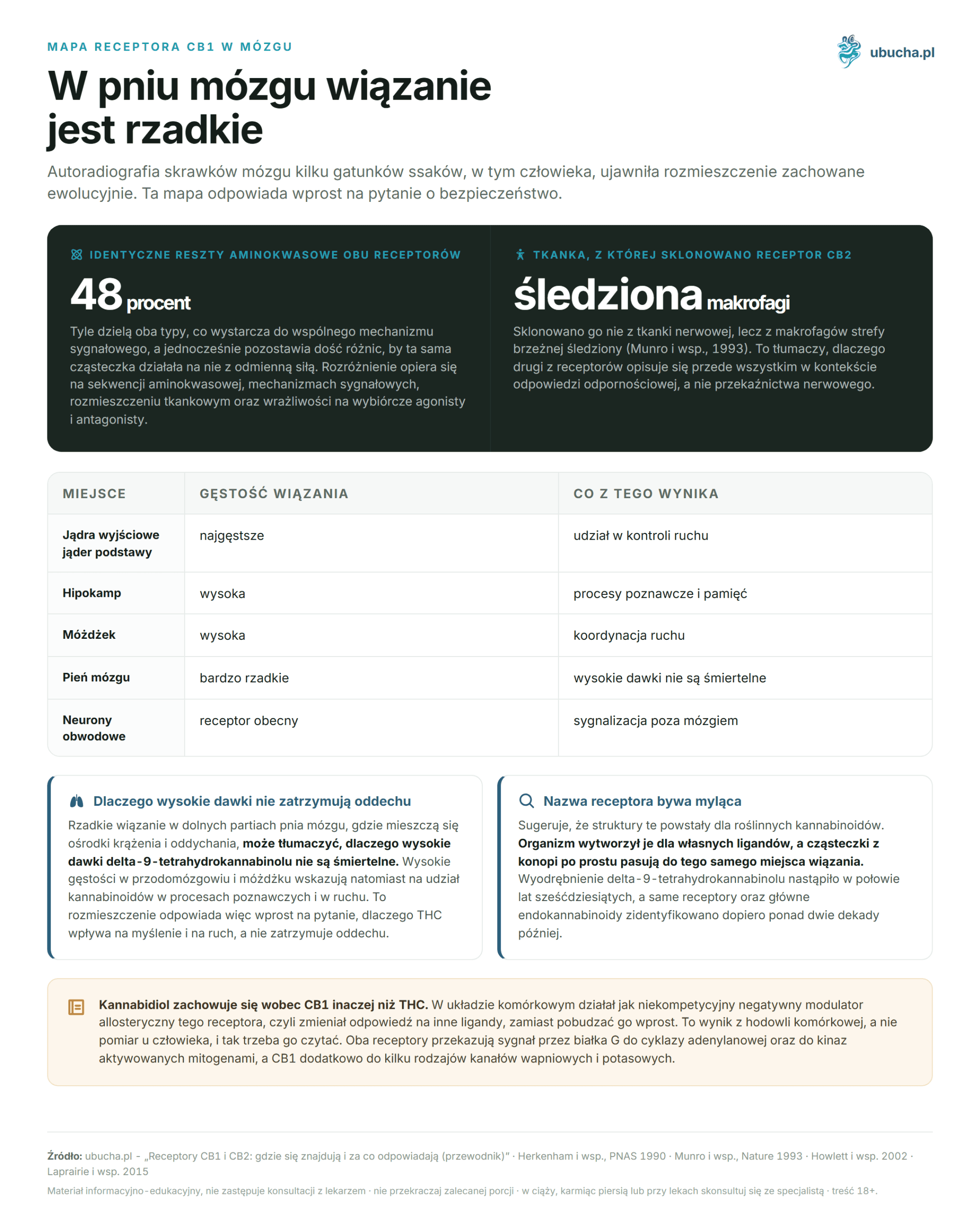
• Brain autoradiography showed the densest binding in the output nuclei of the basal ganglia, in the hippocampus and cerebellum, and very rare in the brainstem (Herkenham et al., PNAS, 1990).
• In cell systems, CBD behaved as a non-competitive negative allosteric modulator of CB1 (Laprairie et al., British Journal of Pharmacology, 2015).
What is a cannabinoid receptor and how does it transmit signals?
A cannabinoid receptor is a membrane protein coupled with a G-protein that, upon binding a ligand, initiates a cascade inside the cell. Both known types, CB1 and CB2, transmit signals through G-proteins to adenylate cyclase and to mitogen-activated kinases, with CB1 additionally to several types of calcium and potassium channels.
The name itself can be misleading, as it suggests that these structures were created for plant cannabinoids. The body produced them for its own ligands, and molecules from cannabis simply fit into the same binding site. The isolation of Δ9-tetrahydrocannabinol occurred in the mid-1960s, while the receptors and main endocannabinoids were identified only over two decades later (Mechoulam and Parker, Annual Review of Psychology, 2013).
The distinction between CB1 and CB2 is based on predicted amino acid sequence, signaling mechanisms, tissue distribution, and sensitivity to selective agonists and antagonists. Both receptors share 48 percent of identical amino acid residues, which is sufficient for a common mechanism, while still leaving enough differences for the same molecule to act on them with different strength. A broader introduction can be found in the description of the endocannabinoid system and its mechanism.
Where in the body are CB1 receptors located?
CB1 is primarily found on neurons of the central and peripheral nervous system. Autoradiography of brain slices from several mammalian species, including humans, revealed an evolutionarily conserved distribution: binding is densest in the output nuclei of the basal ganglia, specifically in the reticular part of the substantia nigra and in the globus pallidus, as well as in the hippocampus and cerebellum.
The authors of this work derived two conclusions from the map. High densities in the forebrain and cerebellum indicate the involvement of cannabinoids in cognitive processes and movement. Rare binding in the lower parts of the brainstem, where the centers for circulation and respiration are located, may explain why high doses of Δ9-tetrahydrocannabinol are not lethal.
This distribution directly answers the question of why THC affects cognitive processes and movement but does not stop breathing. Outside the brain, the receptor is also present on peripheral neurons, linking the endocannabinoid system with signaling outside the central nervous system. It is worth noting that this work describes the distribution of binding sites, not the strength of the biological response in each of these areas.
Where in the body are CB2 receptors located?
CB2 has a completely different distribution than CB1: it is mainly found on immune cells. The history of its discovery illustrates this well. Munro, Thomas, and Abu-Shaar cloned a cannabinoid receptor in 1993 that is not expressed in the brain but in marginal zone macrophages of the spleen.
The contrast with the previously known receptor was striking. The latter was described as present in the brain but not in the periphery, except for a small level in male nuclei. The team sought an explanation for the actions of cannabis that cannot be reduced to psychoactive effects: analgesic, anti-inflammatory, immunosuppressive, anticonvulsant, lowering intraocular pressure in glaucoma, and antiemetic.
Subsequent review works confirmed the immunological profile of this receptor. CB2 is primarily present on immune cells, which also express CB1 to a lesser extent, and both types exert a wide range of immunological effects, including modulation of cytokine release. This is why selective CB2 agonists remain under investigation as potential anti-inflammatory drugs devoid of psychoactive effects.
It is worth noting that the division into neural and immune receptors is a useful but not sharp simplification. Immune system cells express both types of receptors, albeit in different proportions, meaning that a substance selective for one of them still reaches tissue where the other is present. For assessing anti-inflammatory action, this has practical significance: the mere fact that a given molecule stimulates CB2 does not preclude central effects.
How does CB1 differ from CB2?
In short: they differ in where they are located and what they regulate. CB1 works on neurons and suppresses neurotransmitter release, while CB2 works on immune cells and modulates cytokine secretion. The following table organizes these features for which a source has been identified.
| Feature | CB1 | CB2 |
|---|---|---|
| Year of cloning | 1990 | 1993 |
| Main location | Central and peripheral neurons | Immune cells, including spleen macrophages |
| Amino acid sequence similarity | 48 percent common residues with CB2 | 48 percent common residues with CB1 |
| G-protein coupling | Adenylate cyclase, MAP kinases, calcium and potassium channels | Adenylate cyclase, MAP kinases |
| Described function | Inhibition of neurotransmitter release | Modulation of cytokine release |
| Endogenous agonists | Anandamide, 2-AG, 2-arachidonoylglycerol ether | The same compounds |
The table is derived from review works by Howlett and colleagues and from the original report on the cloning of CB2. The review authors note that it is unknown whether the mentioned endocannabinoids are the only or even the main endogenous agonists of these receptors. For this reason, they advised against renaming cannabinoid receptors to a name derived from any of these ligands.
The table does not include a row on the binding strength of individual cannabinoids, and this is a conscious choice. Reviews only note that some ligands stimulate or block one type of receptor more strongly than the other. None of the cited works provide a single affinity value that could be fairly inserted into such a table. A later review by Pertwee and colleagues also points out that CB1 can form heteromeric complexes with other G-protein-coupled receptors, which further alters the cell’s response to the same ligand.
How does CBD interact with CB1 and CB2 receptors?
CBD is not a typical agonist of either of these receptors. In a study on two cell systems, a human line with introduced CB1 and in a model of striatal neurons naturally expressing CB1, cannabidiol reduced both the efficacy and potency of 2-AG and THC in pathways dependent on phospholipase C and ERK kinases.
The mechanism turned out to be allosteric, meaning it is not related to the main binding site. CBD limited the recruitment of arrestin 2 to the receptor and thus prevented its internalization, and its activity depended on the presence of polar residues at positions 98 and 107 of the extracellular amino terminus of CB1. The authors summarized this unequivocally: cannabidiol behaves as a non-competitive negative allosteric modulator of CB1. It is important to emphasize that these are results from cell cultures, not measurements in humans.
The second part of the answer lies outside the cannabinoid receptors themselves, although the source speaks here of an entire class of ligands, not just cannabidiol. Pertwee and colleagues’ review gathered evidence that cannabinoid ligands interact orthosterically and allosterically with targets outside of CB1 and CB2: with orphan receptors like GPR55, with TRP channels, and with peroxisome proliferator-activated nuclear receptors (Pertwee et al., Pharmacological Reviews, 2010). One of these targets, the TRPV1 channel, we describe separately, as the authors of the review consider it a possible ionotropic cannabinoid receptor.
Does the body have its own ligands for these receptors?
Yes, and they are the primary users of both receptors. The most commonly mentioned endogenous agonists are arachidonoylethanolamide, known as anandamide, 2-arachidonoylglycerol, and 2-arachidonoylglycerol ether. Review works indicate that endogenous CB1 agonists likely function as retrograde synaptic messengers.
This direction of transmission reverses the scheme known from classical neurotransmitters. The signal runs from the receiving cell back to the sending cell and suppresses further release of the transmitter. Hence the description of the endocannabinoid system as a retrograde signaling mechanism that dampens excessive synaptic activity rather than amplifying it.
Review authors exercise caution here, which is worth adhering to in popular texts as well. It is unknown whether the mentioned molecules are the only or even the main endogenous agonists, and the action of the entire system can be biphasic: lower doses can produce the opposite effect than higher ones. This last caveat explains why simple extrapolation of results from cell cultures to predictions for humans fails, and also why increasing the dose of a preparation does not necessarily enhance the observed effect. The review by Mechoulam and Parker also reminds us that the endocannabinoid system operates not only in the central nervous system but also in peripheral processes, so its reach extends beyond what is visible on brain receptor maps. More about the plant molecules themselves can be found in the guide on what cannabinoids are and how they work.
Frequently Asked Questions
What are CB1 and CB2 receptors?
These are two types of cannabinoid receptors coupled with G-proteins. CB1 is mainly found on central and peripheral neurons, where one of its functions is to inhibit neurotransmitter release. CB2 is primarily present on immune cells and participates in the modulation of cytokine release. Both share 48 percent of identical amino acid residues.
Where exactly in the brain are CB1 receptors located?
Autoradiography of brain slices from several mammalian species, including humans, showed the densest binding in the output nuclei of the basal ganglia, specifically in the reticular part of the substantia nigra and in the globus pallidus, as well as in the hippocampus and cerebellum. Binding in the lower parts of the brainstem is rare, which may explain why high doses of THC are not lethal.
Does CBD bind directly to CB1 and CB2 receptors?
In a study on cell systems, cannabidiol behaved as a non-competitive negative allosteric modulator of CB1, rather than a typical agonist. It reduced the efficacy of 2-AG and THC and prevented receptor internalization. Cannabinoid ligands as a class also interact with targets outside of CB1 and CB2, including GPR55, TRP channels, and nuclear receptors.
What role does the CB2 receptor play in the immune system?
CB2 was cloned from marginal zone macrophages of the spleen, not from neural tissue. It is primarily found on immune cells, which also express CB1 to a lesser extent, and both types exert a wide range of immunological effects, including modulation of cytokine release. Therefore, selective CB2 agonists are being studied as anti-inflammatory drugs without psychoactive effects.
Can CB1 and CB2 receptors be stimulated without THC?
The body does this on its own. The most commonly mentioned endogenous agonists are anandamide, 2-arachidonoylglycerol, and 2-arachidonoylglycerol ether. Endogenous CB1 agonists likely function as retrograde synaptic messengers, meaning the signal runs from the receiving cell to the sending cell. Review authors caution that it is unknown whether these are the only endogenous ligands for these receptors.
Why does THC have psychoactive effects while CBD does not?
The difference lies in how they occupy the CB1 receptor and in the map of its distribution in the brain. THC stimulates CB1 in areas responsible for cognitive processes and movement. Cannabidiol in cell studies did not stimulate the receptor but reduced the response to other ligands as an allosteric modulator, and a significant part of its action is attributed to molecular targets outside the cannabinoid system.
If after reading you want to see in what form cannabinoids are available for sale, browse the oils category. The receptor mechanism described above pertains to the molecules themselves and does not determine the action of a specific preparation.
This article is for informational and educational purposes only and does not constitute medical advice. Before starting to use cannabis or CBD for therapeutic purposes, consult a doctor, especially if you are taking other medications, are pregnant, or breastfeeding.
Author: Michał Waluk · Published: 2026-08-09 · Updated: 2026-08-11