
Adaptogens for Women (ashwagandha, rhodiola, maca): Which to Choose and When
Ashwagandha, rhodiola, and maca for women: what clinical studies show, how to match the raw material to the symptom, and how much a day of use costs for each form.
The store at Bucha currently has 31 products for sale that declare ashwagandha, rhodiola, or maca in their specifications. Among them, there are six single-ingredient preparations, while the rest are mixtures where the raw material of interest is combined with four others. This ratio determines something practical: with one raw material, you know what worked; with five, you know nothing. The quality of evidence is unevenly distributed among these three plants, and the difference is greater than the sales descriptions suggest. Below you will find what clinical studies have really shown for each of them, a comparison of real products from the store, and the cost per day of use, which allows for a comparison of powder, capsules, and drops.
KEY INFORMATION
• Ashwagandha reduced cortisol levels by 27.9% after 60 days (Chandrasekhar et al., IJPM, 2012).
• Rhodiola has no clinical trials on women in the perimenopausal period.
• Maca improved symptom scoring without changing estradiol and FSH levels (Brooks et al., Menopause, 2008).
• Rhodiola cannot be purchased separately in the store.
Which adaptogen to choose for stress, and which for fatigue?
For chronic stress with sleep disturbances, the first choice is ashwagandha; for fatigue and decreased attention, it is rhodiola; and for decreased libido after menopause, it is maca. This division comes from what has been measured: cortisol and sleep parameters for ashwagandha, burnout and attention for rhodiola, and climacteric symptom scoring for maca.
The mechanisms also differ. Ashwagandha acts on the hypothalamic-pituitary-adrenal axis, which is the same system that maintains elevated cortisol levels during prolonged stress. Rhodiola is described as a monoaminergic substance, affecting the availability of serotonin and dopamine, which explains why its effects are seen in attention tests rather than in sleep scales. Maca does not belong to adaptogens in the strict sense, as it does not modify the stress response, and its action has been described at the symptom level, not hormones.
Our observations from conversations in the store: the most common mistake is reaching for a mixture of four raw materials on the first try. A woman who feels an improvement in sleep after six weeks does not know whether it is due to ashwagandha, lemon balm, or melatonin from the same bottle. The reverse order is cheaper and more informative: one raw material, eight weeks, weekly notes. Before attributing fatigue to stress, it is worth ruling out a simpler cause: in menstruating women, it can be low ferritin with normal morphology, which we discussed in the text about iron for fatigue in women without anemia.
What does ashwagandha do to cortisol and sleep?
It is the only one of the three raw materials with a repeatable effect on a hard laboratory parameter. In the study by Chandrasekhar et al. (Indian Journal of Psychological Medicine, 2012), 64 individuals with chronic stress took 300 mg of root extract twice daily for 60 days. Serum cortisol levels decreased by 27.9% compared to placebo, with p = 0.0006.
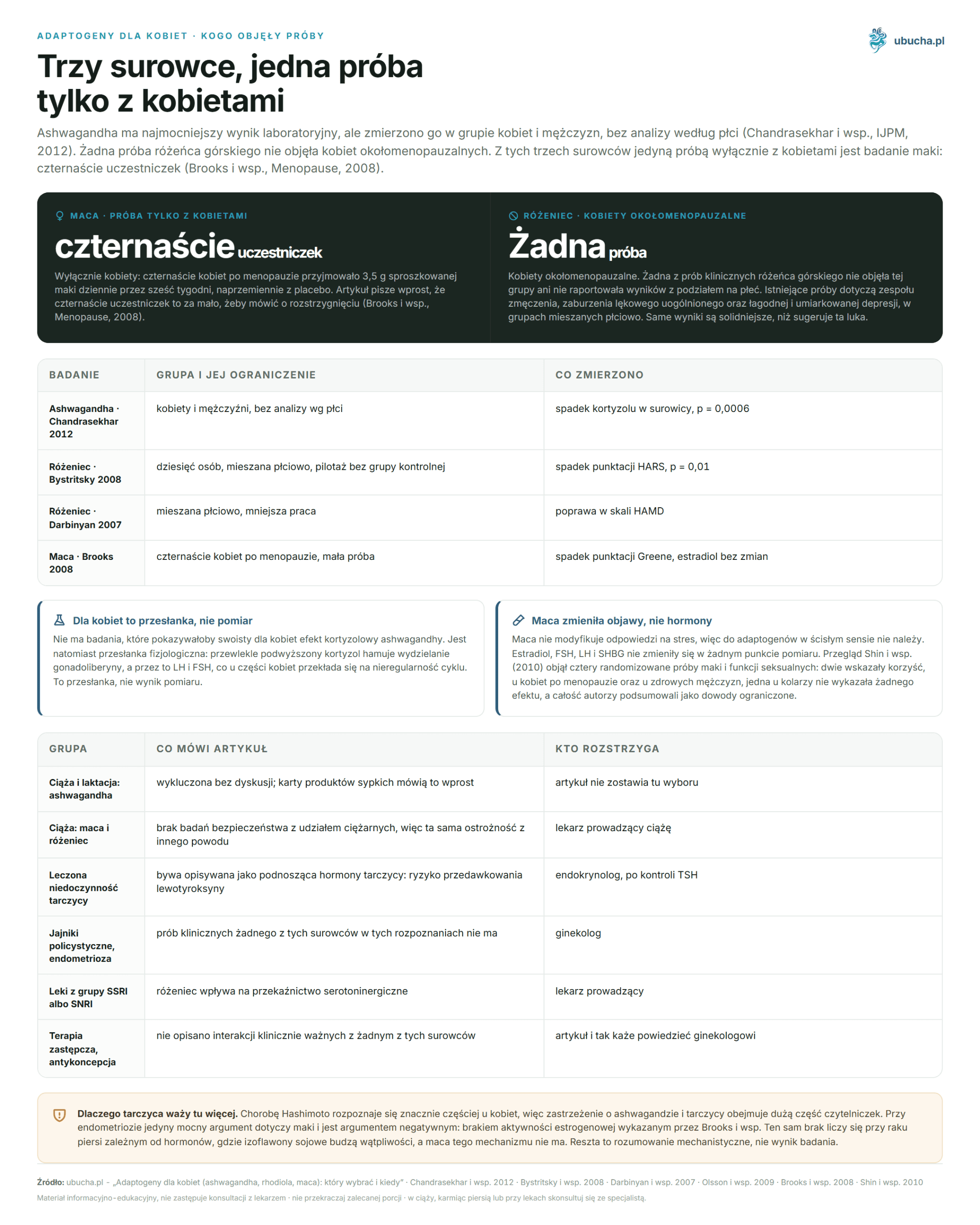
It is worth immediately noting the limitation of this result: the trial included both women and men, and the authors did not analyze the results separately by gender. Therefore, there is no study showing a specific cortisol effect of ashwagandha for women. However, there is a physiological rationale, as chronically elevated cortisol inhibits the secretion of gonadotropin-releasing hormone, and thus LH and FSH, which in some women translates to cycle irregularity.
Sleep was measured separately. In the study by Langade et al. (Cureus, 2019), 60 patients with insomnia and anxiety received 300 mg of extract twice daily for 10 weeks. Sleep efficiency increased from 75.6% to 83.5%, while in the placebo group it increased from 75.1% to 79.7%. The time to fall asleep significantly decreased compared to placebo with p = 0.019. This result comes from a group with diagnosed insomnia, not from healthy individuals who want to sleep a little better. We compared raw materials outside this trio, for which cortisol was measured directly, in the text about supplements for stress and cortisol.
What is really known about rhodiola in women?
Nothing is known specifically about women. None of the clinical trials of rhodiola rosea have been conducted on women in the perimenopausal period or reported results by gender. Everything you read about rhodiola for menopausal symptoms is a transfer of results from mixed groups.
However, the results are more solid than this gap suggests. Olsson et al. (Planta Medica, 2009) administered 576 mg of SHR-5 extract daily for 28 days to 60 individuals with diagnosed fatigue syndrome. There was a significant advantage over placebo in the Pines burnout scale and in several attention indicators in the CCPT II test, as well as in the cortisol response to awakening. Improvement in quality of life and mood occurred in both groups, including placebo, so it should not be attributed to the plant.
Two smaller studies complement the picture. Bystritsky et al. (Journal of Alternative and Complementary Medicine, 2008) is a pilot study without a control group: ten individuals with generalized anxiety disorder, 340 mg daily for 10 weeks, showing a significant decrease in the HARS scale with p = 0.01. Meanwhile, Darbinyan et al. (Nordic Journal of Psychiatry, 2007) administered 340 or 680 mg daily for six weeks to individuals with mild to moderate depression, achieving improvement in the HAMD scale at both doses. More about the raw material itself can be found in the post Rhodiola rosea: properties for stress and fatigue.
Does maca affect libido without influencing estrogen?
Yes, and this is the best-documented feature of this plant. In the study by Brooks et al. (Menopause, 2008), fourteen postmenopausal women took 3.5 g of powdered maca daily for six weeks in an alternating regimen with placebo. Estradiol, FSH, LH, and SHBG levels did not change at any measurement point.
However, the scoring in the climacteric scale changed. The decrease concerned the anxiety and depression subscales and sexual dysfunction, compared to placebo and baseline values. Additionally, the authors tested maca extracts in a yeast reporter assay and found no estrogenic or androgenic activity. This is important in hormone-dependent breast cancer, where soy isoflavones raise concerns, and maca does not have this mechanism.
However, the scale of evidence is small, and this must be stated clearly. A systematic review by Shin et al. (BMC Complementary and Alternative Medicine, 2010) included four randomized trials of maca and sexual function. Two indicated benefits, in postmenopausal women and healthy men, one in cyclists showed no effect, and the authors summarized the overall evidence as limited. Fourteen participants is too few to speak of a resolution.
Which products containing these three raw materials are available at the store at Bucha?
There are 31 items for sale that declare at least one of these raw materials in their specifications, but rhodiola cannot be purchased separately: it only appears as an ingredient in mixtures. The following table includes items where the raw material from the title is listed with the amount in the daily portion.
| No. | Product | Raw Material in Daily Portion | Price | Cost per Day |
|---|---|---|---|---|
| 1 | Ashwagandha Extract 5%, 10 g (loose) | ashwagandha, portion measured independently | 6.00 zł | 0.12 zł |
| 2 | Himalaya Ashwagandha, 60 tablets | ashwagandha 500 mg | 20.99 zł | 0.70 zł |
| 3 | Gummies NIGHT REGENERATION, 30 pcs. | ashwagandha 150 mg plus melatonin 1 mg | 55.00 zł | 3.67 zł |
| 4 | Gummies MIND IN SHAPE, 30 pcs. | rhodiola 60 mg plus cordyceps 150 mg | 55.00 zł | 3.67 zł |
| 5 | Aura Care Adaptogens Energy, 15 ml | ashwagandha 360 mg, rhodiola 187.5 mg, maca 150 mg | 99.00 zł | 3.71 zł |
| 6 | Aura Care Adaptogens Joy, 15 ml | maca 255 mg, rhodiola 150 mg | 99.00 zł | 3.71 zł |
| 7 | Aura Care Ashwagandha, 60 capsules | oil macerate 700 mg | 119.00 zł | 3.97 zł |
| 8 | Cosma Pure Herbs Maca, 30 ml | maca, the manufacturer does not provide portion size | 14.32 zł | no data |
| 9 | Cosma Pure Herbs Ashwagandha, 30 ml | ashwagandha, the manufacturer does not provide portion size | 20.98 zł | no data |
The order in the table is determined by the cost per day of use, from the lowest. Prices are from the store at Bucha, as of August 8, 2026. You can find the full offer in the supplements category.
How much does a day of use cost in each form?
The range is thirty-three times: from 0.12 zł for a portion measured from powder to 3.97 zł for two capsules of oil macerate. The price of the packaging does not show this, as a bottle for 99 zł lasts for 26 days, while tablets for 20.99 zł last for a full 30.
Three conversions require commentary. The loose powder came out the cheapest because the portion was taken at 200 mg, which corresponds to the limit of 10 mg of withanolides indicated by the Dietary Supplements Team and referenced on the product card. The Aura Care bottles were calculated from the declared approximately 400 drops and the upper limit of 15 drops per day. Two items from Cosma Pure Herbs were left without results because the manufacturer does not provide portion size for the liquid form, and guessing it would yield a number pretending to be precise.
The practical conclusion is uncomfortable for the more expensive shelves: with ashwagandha alone, the difference in daily cost between the tablet for 0.70 zł and the macerate for 3.97 zł is not supported by research, as both clinical trials described above were conducted on regular root extract, not on oil macerate.
Who should avoid these raw materials?
Pregnancy and lactation exclude ashwagandha without discussion. The product cards for loose products in the store at Bucha contain this information explicitly, and for maca and rhodiola, there are no safety studies involving pregnant women, so the same caution applies, but for a different reason: it is unknown, and it is not known that it is harmful.
The second group is thyroid diseases. Ashwagandha is sometimes described as a substance that raises levels of triiodothyronine and thyroxine, which in treated hypothyroidism poses a risk of overdosing on levothyroxine therapy. Hashimoto’s disease is diagnosed much more frequently in women, so this caution applies to a large portion of the readers. The decision to combine should be made by an endocrinologist after checking TSH.
Polycystic ovary syndrome and endometriosis require a conversation with a gynecologist, but with an honest disclaimer: there are no clinical trials of any of these three raw materials in these diagnoses. Regarding endometriosis, the only strong argument concerns maca, and it is a negative argument, namely the lack of estrogenic activity demonstrated by Brooks et al. The rest is mechanistic reasoning, not a study result.
The third area is medications. Rhodiola affects serotonergic transmission, so its combination with SSRI or SNRI drugs requires the approval of the attending physician. No clinically significant interactions with any of the three raw materials have been described with hormone replacement therapy and contraception, which does not exempt informing the gynecologist about supplementation.
How to arrange the first eight weeks?
One raw material at a time, eight weeks, weekly notes. This scheme directly results from the duration of the studies: effects were measured after 28 days for rhodiola, after six weeks for maca, and after 60 days for ashwagandha. A shorter trial will not provide answers, and a longer one without notes will not either.
The choice of starting point follows the dominant symptom. For chronic stress with poor sleep, start with ashwagandha at a dose of 300 to 600 mg of extract daily, taken in the evening. For decreased energy and attention without sleep disturbances, choose rhodiola, 200 to 400 mg in the morning, remembering that you will only find it in a mixture in the store. For decreased libido after menopause, use maca, aiming for 3.5 g daily, which is the dose from the Brooks et al. study.
The notes should include four numbers weekly: the time of falling asleep, the number of night awakenings, an energy rating on a scale from one to ten, and the length of the cycle. After eight weeks, you either see a difference in these records, or you do not, and there is no point in extending it. Only then consider adding a second raw material, and again, one at a time. The reverse order, starting with a mixture of four plants, costs 99 zł per month and does not answer any questions.
Frequently Asked Questions
Which of these three raw materials has the strongest evidence?
Ashwagandha. The study by Chandrasekhar et al. (Indian Journal of Psychological Medicine, 2012) involved 64 individuals with chronic stress and showed a decrease in serum cortisol levels by 27.9% with p = 0.0006. Rhodiola has smaller trials with mixed results, and maca is based mainly on one study involving fourteen women.
Does rhodiola help with menopausal symptoms?
It is unknown, as no one has tested this in a study involving women in the perimenopausal period. Existing trials concern fatigue syndrome (Olsson et al., 2009), generalized anxiety disorder, and mild depression, in mixed-gender groups. Transferring these results to menopause is an assumption, not a conclusion from the data.
Does maca raise estrogen levels?
No. In the study by Brooks et al. (Menopause, 2008) involving fourteen postmenopausal women taking 3.5 g of maca daily, there were no changes in estradiol, FSH, LH, or SHBG levels. Yeast tests did not show estrogenic or androgenic activity of the extracts. Improvement was related to symptom scoring, not hormones.
Are adaptogens safe to use during pregnancy?
Not for ashwagandha. The product cards for loose products in the store at Bucha explicitly exclude use by pregnant and breastfeeding women. For maca and rhodiola, there is no safety data from studies involving pregnant women, so the same caution applies, and the decision is up to the attending physician.
Can ashwagandha be combined with levothyroxine?
Not without the supervision of an endocrinologist. Ashwagandha is sometimes described as a substance that raises thyroid hormone levels, and in treated hypothyroidism, this poses a risk of overdosing on therapy. Hashimoto’s disease primarily affects women, so this caution applies to a significant portion of the readers of this text.
How long before I see an effect?
Studies measured effects after 28 days for rhodiola, after six weeks for maca, and after 60 days for ashwagandha. Consider eight weeks as the minimum assessment period for one raw material and do not add a second during this time, as you will lose the ability to attribute the change to a specific plant.
Current prices and the composition of each of the described items can be checked in the supplements category in the store at Bucha.
This article is for informational and educational purposes and does not replace consultation with a doctor. If you are pregnant, breastfeeding, taking medications, or have chronic conditions, consult the use of supplements or herbs with a specialist.
Author: Michał Waluk · Published: 2026-05-22 · Updated: 2026-08-08