
CB1 Receptor Kinetics: Why Tolerance Depends on Receptor Internalization Speed
THC tolerance involves desensitization and internalization of the CB1 receptor. What cell, animal, and PET imaging studies have shown in regular users.
Regular THC users know this from experience: the same dose that once worked strongly does little after a few weeks. This is not a psychological habit. The CB1 receptor first loses its efficiency in signal transmission, and then is physically pulled from the surface of the neuron into its interior. Both processes have different speeds and reversibility, and even some popular explanations confuse them. This distinction determines the practical answer to the question of how long a break must last to make a real difference. Below, we break them down separately and show what has been measured in cells, what in animals, and what in humans using brain imaging. Finally, we return to the question that many readers ask: can cannabidiol protect against this.
KEY INFORMATION
• The signal from the CB1 receptor comes in waves: the first, through G proteins, lasts less than 10 minutes, the second depends on beta-arrestin, the third occurs inside the cell (Nogueras-Ortiz and Yudowski, Molecular Pharmacology 2016).
• Desensitization and internalization are two different mechanisms: mutations that abolish one do not abolish the other (Jin et al., Journal of Neuroscience 1999).
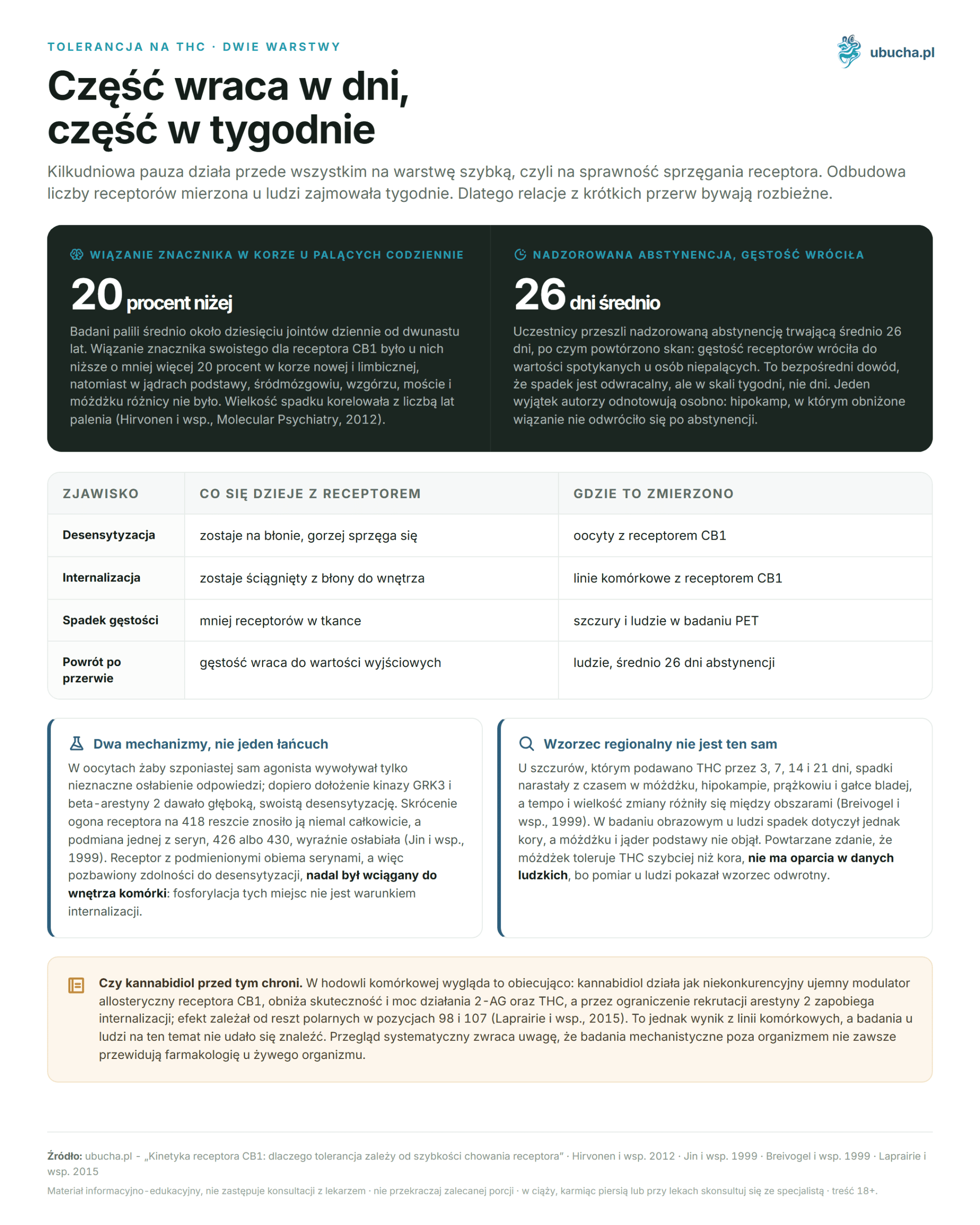
• In individuals smoking marijuana daily for several years, the binding of the CB1 receptor tracer was about 20 percent lower in the neocortex and limbic cortex, but not in the cerebellum and basal ganglia (Hirvonen et al., Molecular Psychiatry 2012).
• After a month of supervised abstinence, receptor density returned to normal, except in the hippocampus.
How does the CB1 receptor work?
The CB1 receptor is a G protein-coupled receptor, one of the most numerous in the central nervous system. Its role is to inhibit the release of neurotransmitters and participate in synaptic plasticity, which translates into the analgesic, anxiolytic, and psychoactive effects of cannabinoids (Nogueras-Ortiz and Yudowski, Molecular Pharmacology 2016).
Under physiological conditions, it is activated by endocannabinoids produced on demand, which act briefly. THC mimics them but behaves differently in two respects: it remains in the body much longer and stimulates receptors simultaneously in many places, rather than pointwise where transmission is currently occurring. This difference in time and range is the source of the entire subsequent story, as the regulatory mechanisms of the receptor are designed for short impulses.
This same review also organizes the way the receptor transmits signals. It is not a single event, but three waves spread over time. The first is fleeting, lasting less than 10 minutes and running through G proteins. The second starts after about five minutes and depends on beta-arrestin. The third occurs in intracellular compartments after the receptor is pulled from the membrane. The anatomical bases have been described in the guide to CB1 and CB2 receptors.
What is CB1 receptor desensitization?
This is the first stage of tolerance: the receptor remains on the cell membrane but stops effectively transmitting signals. It is activated by G protein-coupled receptor kinases, which attach phosphate groups to the intracellular tail of the receptor, and beta-arrestin, which uncouples it from the G protein.
The clearest evidence for this mechanism comes from the work of Jin and colleagues. In oocytes of the African clawed frog, where the CB1 receptor was coupled with potassium channels, the agonist alone caused only a slight weakening of the response. Only the addition of GRK3 kinase and beta-arrestin 2 resulted in profound, specific desensitization. Shortening the receptor tail at residue 418 almost completely abolished it, and substituting one of the two serines, 426 or 430, clearly weakened it (Jin et al., Journal of Neuroscience 1999).
This same work brings a result that undermines a popular simplification. A receptor with both serines substituted, thus lacking the ability to desensitize, was still internalized. Phosphorylation of these sites is therefore not a condition for internalization, and different parts of the receptor are responsible for both processes. Explanations that speak of a single chain of events, in which phosphorylation automatically leads to receptor internalization, are thus a simplification one step too far.
How does internalization differ from desensitization?
In scale and time. Desensitization changes the efficiency of the receptor, which remains embedded in the membrane. Internalization physically removes it from the membrane: the receptor is pulled into a vesicle and enters the cell interior, from where it can return to the surface or be degraded. Only then does the number of receptors available for THC change, not just their efficiency.
This distinction has practical implications for the break in use. A few days’ pause primarily affects the rapid layer, that is, the coupling efficiency. Rebuilding the number of receptors measured in humans took weeks, as discussed below. This is why reports from two-day breaks can be inconsistent: part of the effect returns quickly, while part requires much more time. What brain imaging shows on this topic has been outlined in the text about the two-day break.
| Phenomenon | What happens to the receptor | Where it was measured |
|---|---|---|
| Desensitization | Remains in the membrane, couples less effectively with G protein | Oocytes with CB1 receptor, GRK3 kinase and beta-arrestin 2 (Jin 1999) |
| Internalization | Is pulled from the membrane into the cell interior | Cell lines with CB1 receptor (Jin 1999, Laprairie 2015) |
| Decrease in receptor density | Fewer receptors in tissue after chronic administration | Rats after 3-21 days of THC (Breivogel 1999), humans in PET study (Hirvonen 2012) |
By how much does the density of CB1 receptors decrease in regular users?
In humans, this was measured using PET imaging with a tracer specific to the CB1 receptor. The subjects smoked an average of about ten joints daily for twelve years. The binding of the tracer was about 20 percent lower in the neocortex and limbic cortex, while there was no difference in the basal ganglia, midbrain, thalamus, pons, and cerebellum. The magnitude of the decrease correlated with the number of years of smoking (Hirvonen et al., Molecular Psychiatry 2012).
The second part of this study is more important for the reader. Participants underwent supervised abstinence lasting an average of 26 days, after which the scan was repeated. Receptor density returned to levels found in non-smokers. This is direct evidence that the decrease is reversible, but on a scale of weeks, not days.
One exception the authors note separately: the hippocampus, where the reduced binding at the start did not reverse after abstinence. It is also worth remembering what this measurement entails. The scan measures the availability of binding sites in the tissue, not subjective sensation, so it does not directly answer the question of how many days of break it takes for “effects to return.” The signals by which people themselves recognize increasing tolerance have been described in the text about signals for a tolerance break.
Does tolerance develop uniformly throughout the brain?
No, it does not develop uniformly, and this has been known for a long time from animal studies. Breivogel and colleagues administered THC to rats daily for 3, 7, 14, and 21 days, simultaneously measuring G protein activation and receptor binding. Decreases accumulated over time in the cerebellum, hippocampus, striatum, and globus pallidus, with the rate and magnitude of change differing between areas. The changes resulted from a decrease in the number of binding sites, not from a change in affinity (Breivogel et al., Journal of Neurochemistry 1999).
The Sim-Selley review summarizes this pattern more broadly: adaptations of the CB1 receptor after chronic cannabinoid administration are extensive and significant, and their characteristic feature is indeed the dependence of rate and magnitude on the brain region (Sim-Selley, Critical Reviews in Neurobiology 2003). The author links this to differences in the development of tolerance to specific behavioral effects.
It is worth comparing this with the results in humans, as the regional pattern is not the same. In the PET study, the decrease affected the cortex, while the cerebellum and basal ganglia were not included, although in rats, changes were evident there. The animal model and humans differ in administration patterns, dose sizes, and observation lengths, so the maps do not have to match. The repeated statement that the cerebellum tolerates THC faster than the cortex has no basis in human data, as the measurement cited here in humans showed the opposite pattern.
Does CBD protect CB1 receptors from tolerance?
In cell culture, it looks promising, but we could not find studies in humans on this topic. Laprairie and colleagues demonstrated that cannabidiol acts as a non-competitive negative allosteric modulator of the CB1 receptor: it reduces the efficacy and potency of 2-AG and THC, and by limiting the recruitment of arrestin 2, it prevents receptor internalization. The effect depended on polar residues at positions 98 and 107 of the extracellular end of the receptor (Laprairie et al., British Journal of Pharmacology 2015).
However, this is a result from cell lines, not from the organism. A systematic review by McPartland and colleagues points out that mechanistic studies in vitro do not always predict pharmacology in a living organism, and describes cannabidiol as a ligand with very low affinity for CB1, which affects its activity indirectly (McPartland et al., British Journal of Pharmacology 2015). The popular thesis of a full spectrum protecting against tolerance remains a hypothesis, not an established fact.
That the beta-arrestin pathway truly regulates sensitivity to THC is evident in animals. Mice lacking beta-arrestin 2 reacted to THC with a stronger analgesic effect and a greater drop in body temperature than animals with the gene, while for other tested agonists, there was no difference, and the density of CB1 receptors in the cerebellum, cortex, and hippocampus remained the same (Breivogel et al., Behavioural Pharmacology 2008). This underpins the idea of ligands tilted towards G protein, with minimal involvement of beta-arrestin. This is still a stage of preclinical research. Practical strategies for breaks have been gathered in the text about tolerance breaks.
Frequently Asked Questions
Why do the effects of THC weaken after regular use?
Because CB1 receptors first couple less effectively with G proteins, and then are pulled from the surface of the neuron into its interior. After chronic administration, the number of binding sites in the tissue decreases, which has been shown in rats after 3-21 days of THC (Breivogel et al., Journal of Neurochemistry 1999), and in humans using PET imaging.
What is the difference between desensitization and internalization?
Desensitization leaves the receptor in the membrane and weakens signal transmission. Internalization removes it from the membrane into the cell interior. These are two distinct mechanisms: a receptor with substituted serines 426 and 430 did not undergo desensitization, yet was still internalized (Jin et al., Journal of Neuroscience 1999).
By how much does the number of CB1 receptors decrease in daily smokers?
In a PET study, the binding of the CB1 receptor tracer was about 20 percent lower in the neocortex and limbic cortex in individuals smoking an average of ten joints daily for twelve years. No difference was found in the basal ganglia, thalamus, pons, and cerebellum, and the magnitude of the decrease correlated with the number of years of smoking (Hirvonen et al., Molecular Psychiatry 2012).
How long does it take for receptor density to return after cessation?
In the same study, participants underwent supervised abstinence lasting an average of 26 days, after which receptor density returned to levels found in non-smokers. The exception was the hippocampus, where no reversal was noted. The scale is therefore weekly, not daily, and pertains to measurements in tissue, not sensations.
Does CBD protect against THC tolerance?
This has not been demonstrated in humans. In cell lines, cannabidiol acted as a negative allosteric modulator of the CB1 receptor and prevented its internalization by limiting the recruitment of arrestin 2 (Laprairie et al., British Journal of Pharmacology 2015). Authors of another review remind that in vitro results do not always translate to the organism.
Hemp oils available in the store can be found in the oils category.
This article is for informational and educational purposes only and does not constitute medical advice. Before starting to use cannabis or CBD for therapeutic purposes, consult your doctor, especially if you are taking other medications, are pregnant, or breastfeeding.
Author: Michał Waluk · Published: 2026-08-09 · Updated: 2026-08-16