
5-HTP properties - serotonin precursor for sleep and mood 2026
The Cochrane review found 108 studies on 5-HTP in depression, and only two were suitable for evaluation. The mechanism, the risk of serotonin syndrome, and the history of EMS.
5-HTP, or 5-hydroxytryptophan, is sold as a natural support for mood and sleep because it is a direct precursor to serotonin. The mechanism is indeed simple and well described. The evidence base looks much worse: the Cochrane review found 108 studies on 5-HTP and tryptophan in depression, and only two met methodological quality criteria, involving a total of 64 patients. Additionally, there is a risk that cannot be overlooked in consumer text: combining 5-HTP with serotonergic drugs risks serotonin syndrome, and the history of this molecule touches on an epidemic caused by contaminated raw material, which in 1989 cost the lives of dozens of people. Below, we separate what has been measured from what is repeated, and explain why not a single milligram number appears throughout the text.
KEY INFORMATION
- The Cochrane review found 108 studies on 5-HTP and tryptophan in depression, but only two met quality criteria, involving a total of 64 patients (Shaw, Cochrane Database of Systematic Reviews, 2002).
- The authors of this review state directly that since there are drugs with proven efficacy and safety, the clinical usefulness of 5-HTP remains limited today.
- Serotonin syndrome is a potentially life-threatening condition caused by excessive stimulation of serotonergic receptors, classically through the combination of two drugs with different mechanisms (Volpi-Abadie, Ochsner Journal, 2013).
- In 1989, the eosinophilia-myalgia syndrome epidemic after contaminated tryptophan involved 1531 reported cases, including 27 deaths (Swygert, JAMA, 1990).
- This text does not provide any dose of 5-HTP in milligrams, and we explain below why we have no source for it.
What is 5-HTP and where does it come from?
5-HTP is an intermediate product of the conversion of the amino acid L-tryptophan to serotonin. It is formed from tryptophan by the addition of a hydroxyl group, and then undergoes decarboxylation to serotonin. As a supplement, it bypasses the first step of this pathway, which is the reaction catalyzed by tryptophan hydroxylase, which limits the rate of the entire pathway (Birdsall, Alternative Medicine Review, 1998).
Two features distinguish it from tryptophan itself, and these are behind the popularity of this molecule. The absorption of 5-HTP from the intestine does not require a transport molecule and does not depend on the presence of other amino acids, so the preparation can be taken with a meal without loss of effectiveness. Tryptophan, on the other hand, can be directed towards the production of niacin or incorporated into protein, and 5-HTP does not have that possibility.
The commercial raw material comes from the seeds of the African shrub Griffonia simplicifolia. Chemical analysis of the seeds using HPLC with mass detection confirms that 5-HTP is the most abundantly represented compound in them, followed by the beta-carboline alkaloid griffonine and other alkaloids (Vigliante, Molecules, 2019).
This same work describes why it was created: to provide a method for unequivocal identification of commercial seeds. The authors combined chemical analysis with DNA profiling, obtaining a restriction pattern that allows confirmation that the raw material comes from the correct plant. The existence of such a tool speaks for itself about the state of the herbal raw materials market.
How does the body convert 5-HTP into serotonin?
Through a single enzymatic reaction, but the location where it occurs determines everything. The conversion is carried out by aromatic amino acid decarboxylase, and the amount of 5-HTP reaching the central nervous system depends on how much of it has been converted to serotonin in the periphery before crossing the blood-brain barrier (Turner, Pharmacology and Therapeutics, 2006).
This distinction has a consequence that is lost in product descriptions. Serotonin produced outside the brain does not affect mood because it cannot cross the blood-brain barrier. It acts in the gastrointestinal tract and in the circulatory system, which explains why the first noticeable effect of 5-HTP may be gastrointestinal discomfort rather than a change in mood.
In studies on this phenomenon, peripheral decarboxylase inhibitors, such as carbidopa, are used, which block the conversion outside the brain and thus increase the pool reaching the central nervous system. A supplement bought off the shelf does not contain such an inhibitor, so part of the dose taken never reaches where it should act.
How much of it reaches is not exactly known. A review from 1998 states that about 70% of the oral dose reaches the bloodstream and that 5-HTP easily crosses the blood-brain barrier, increasing serotonin production in the central nervous system. Serotonin itself regulates sleep, mood, anxiety, appetite, body temperature, and pain perception, so increasing its pool is not a pinpoint action.
It is also worth knowing what happens to tryptophan before it even becomes 5-HTP. Besides tryptophan hydroxylase, two other enzymes compete for the same amino acid: indoleamine 2,3-dioxygenase and tryptophan 2,3-dioxygenase. They direct tryptophan down a completely different metabolic pathway, and their activity increases, among other things, in inflammatory states.
This is where the argument for supplementing 5-HTP instead of tryptophan comes from. Administering ready 5-HTP bypasses all this competition. However, it does not bypass the peripheral decarboxylation described above, so one bottleneck replaces another, and the review discussing the factors influencing each of these enzymes itself points this out as an area requiring attention.
What do studies on 5-HTP in depression really show?
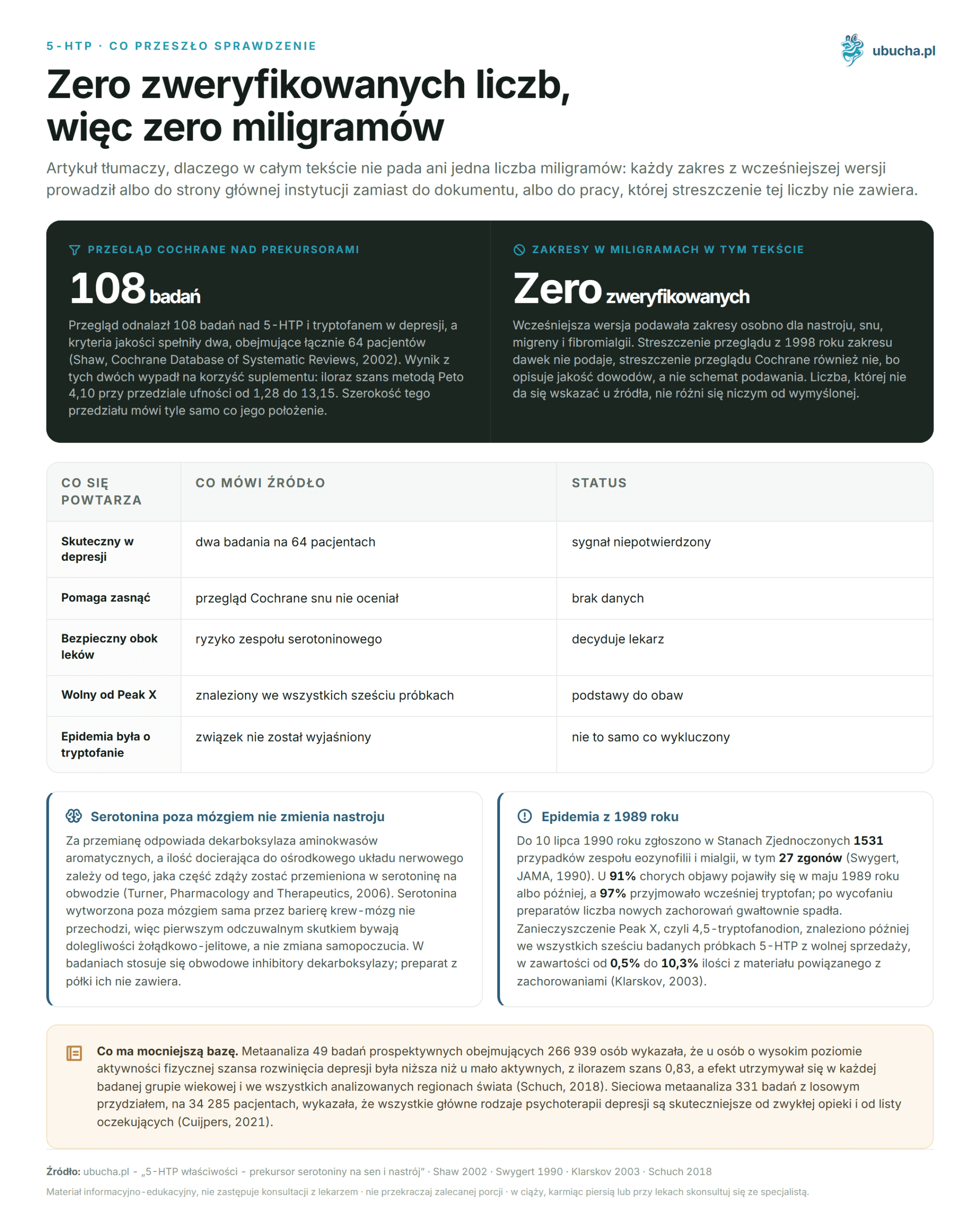
That there is a signal, but the evidence base beneath it is crumbling. The Cochrane review searched databases for randomized studies comparing 5-HTP or tryptophan with placebo in people with unipolar depression and dysthymia. It found 108 studies. Only two had sufficient quality to meet inclusion criteria, involving a total of 64 patients (Shaw, Cochrane Database of Systematic Reviews, 2002).
The result from these two studies favored the supplement: the odds ratio using the Peto method was 4.10 with a confidence interval from 1.28 to 13.15, and the number needed to treat for one additional effect was 2.78. The width of this interval says as much as its position. With 64 people, the estimate is shaky.
The authors’ conclusions are two, and both are worth knowing. The first: a large number of studies seemingly relates to the posed question, but few are reliable enough to depend on. The second, sharper: since there are antidepressants with proven efficacy and safety, the clinical usefulness of 5-HTP and tryptophan remains limited today.
So where does the optimism circulating in the market come from? From Birdsall’s review from 1998, describing 5-HTP as a clinically effective serotonin precursor and listing depression, fibromyalgia, binge eating in obesity, chronic headaches, and insomnia as conditions in which 5-HTP administration proved effective. These two sources are not contradictory. Birdsall shows a signal, Cochrane shows that the signal has not been confirmed by modern-class studies.
There is one more detail from this review that rarely makes it into market summaries, and it changes the interpretation of the result. Due to the small number of included studies, the authors had to combine the analysis for 5-HTP and tryptophan into one. Therefore, the favorable result does not pertain solely to 5-HTP, but to both precursors treated together.
The review itself was conducted rigorously, making its result harder to dismiss. Studies were searched in general and specialized databases, bibliographies of related works were reviewed, industry journals were manually searched, and authors were contacted, with publications sought in all languages. The quality of studies was assessed for the risk of systematic error. With such effort, filtering down to two works is not a result of oversight, but a state of the literature.
Does 5-HTP help with sleep?
The honest answer is: we do not have good data on this. The Cochrane review, which is the sharpest available filter here, dealt exclusively with depression, so it did not assess sleep at all. Insomnia does appear on the list of conditions mentioned by Birdsall as those in which 5-HTP administration proved effective, and that is all the material we have here (Birdsall, Alternative Medicine Review, 1998).
That is too little to make a statement about effectiveness. The 1998 review summarizes older literature, mostly from before the era of rigorous double-blind studies, and in the same field, a newer Cochrane review showed how small a portion of such output withstands stricter criteria. Assuming that it would be different for sleep has no basis.
It is also worth understanding how 5-HTP differs from melatonin, as these two substances are sometimes compared as substitutes. Melatonin is produced from serotonin in the pineal gland and is a ready signaling molecule acting on its own receptors. 5-HTP is a substrate, lying two steps earlier in the transformation, and its effect on sleep depends on what the body does with that substrate. We discuss this separately in the text about how melatonin works for sleep.
If you are looking for sleep support, this distinction is practical. A substance with a documented mechanism and studies on a specific application ranks higher than a substance whose mechanism is described, but application poorly studied. Insomnia lasting for months is, after all, a reason to visit a doctor, not to shop.
Why should 5-HTP not be combined with antidepressants?
Because it risks serotonin syndrome, a potentially life-threatening condition. It is caused by excessive stimulation of peripheral and central postsynaptic 5-HT1A receptors, and primarily 5-HT2A. A characteristic picture emerges: disturbances in mental state, excessive neuromuscular excitability, and hyperactivity of the autonomic nervous system (Volpi-Abadie, Ochsner Journal, 2013).
The authors of this review describe three pathways to serotonin syndrome. It can occur with therapeutic use of serotonergic drugs alone, from intentional overdose, but classically arises from the complex interaction of two serotonergic substances acting through different mechanisms. The last scenario precisely describes the situation where someone adds a supplement to ongoing pharmacotherapy.
This risk is explicitly mentioned in the literature on 5-HTP itself. A pharmacological review dedicated to supplementation with this molecule discusses safety issues with particular emphasis on two: eosinophilia-myalgia syndrome and serotonin syndrome (Turner, Pharmacology and Therapeutics, 2006). This is not excessive caution, but two of the most commonly discussed hazards of this substance.
The practical rule is short and does not require a list of brand names. If you are taking any medication affecting serotonergic transmission, the decision about 5-HTP is made by the attending physician or clinical pharmacist, not an internet forum. Do not stop taking your medication on your own to make room for the supplement. We discuss this group of interactions more broadly in the text about contraindications and serotonin syndrome.
The authors of the review point out something that speaks for this caution more strongly than a list of prohibitions. Many commonly used medications are responsible for serotonin syndrome, and the number of possible combinations that can trigger it is large. Therefore, it is difficult to assume in advance that our set of preparations is safe, as recognizing this threat can be difficult even for doctors.
The goal the authors set for their review is, in fact, to alert doctors to this syndrome, as it is potentially fatal yet avoidable. Proper knowledge and vigilance improve diagnostic accuracy and allow for early treatment implementation. For the reader, this means one thing: discussing the supplement with someone who knows the entire list of medications they are taking is not a formality.
What was the eosinophilia-myalgia syndrome?
An epidemic from 1989 that permanently changed the status of serotonin precursors in the supplement market. Eosinophilia-myalgia syndrome was diagnosed based on debilitating muscle pain and an absolute eosinophil count of at least one billion cells per liter of blood. By July 10, 1990, 1531 cases had been reported in the United States, including 27 deaths (Swygert, JAMA, 1990).
The disease picture was multi-organ. The most common symptoms included joint pain in 73% of patients, rash in 60%, cough or shortness of breath in 59%, and peripheral edema in 59%. Elevated aldolase levels were noted in 46%, abnormal liver function tests in 43%. Neuropathy or nerve inflammation occurred in 27% and in some patients led to paralysis and death. In 21% of individuals undergoing chest radiography, abnormalities were found.
Cases were not evenly distributed. The highest rates were recorded in western states, and 68% of patients were white women who were not of Hispanic origin, aged 35 and older. This profile, clearly deviating from the distribution in the general population, itself directed suspicion towards a specific product consumed by a defined group.
The link to the product was clear. In 91% of patients, symptoms appeared in May 1989 or later, and 97% had previously taken tryptophan. After the withdrawal of tryptophan products from the market in November 1989, the number of new cases dropped sharply, which in itself is a strong argument for causality.
This story concerns tryptophan, not 5-HTP, and this distinction is often used in marketing materials as an argument that 5-HTP is not affected by the episode. The Cochrane review from 2002 states this more cautiously: a possible link between these substances and the potentially fatal eosinophilia-myalgia syndrome has not been clarified. However, unexplained does not mean excluded.
Are today’s 5-HTP preparations free from contamination?
The study that checked this answered worryingly. Researchers determined the chemical structure of a contaminant labeled as Peak X, previously found in 5-HTP preparations associated with cases of eosinophilia-myalgia syndrome. It turned out to be 4.5-tryptophanodione, a compound considered a potential neurotoxin (Klarskov, The Journal of Rheumatology, 2003).
However, the second part of this finding is the most important. The substance was found not only in materials associated with illnesses but in all six tested samples of 5-HTP available over the counter. Its content in these samples ranged from 0.5% to 10.3% of the amount present in materials associated with disease cases.
The authors’ conclusion is stated plainly: this gives some basis for concern regarding the safety of such commercial 5-HTP preparations. We have noticed that in Polish-language descriptions of this issue, this sentence is often reversed into a reassuring statement, such as “today reputable suppliers test the raw material for the presence of Peak X.” The work they refer to does not say anything like that.
The methodology of this work deserves attention, as it explains why the result is difficult to dispute. The samples underwent high-precision mass spectrometry coupled with liquid chromatography and electrochemical detection, a reaction with reduced glutathione was performed, and the obtained spectra were compared with the spectra of the standard 4.5-tryptophanodione. Therefore, the identification is not based on retention time similarity but on comparison with a standard substance.
What this work does not resolve? It studied samples available at the time of its creation, so it does not answer the question about today’s supply chains. This is a real gap, not an evasion: we have not found a newer study that would repeat this measurement on the current market. An analysis certificate for a specific batch is, in this situation, not so much an addition as the only information a buyer can receive.
Why won’t you find doses in this text?
Because after checking the sources, it turned out that we have no basis for them. An earlier version of this article provided several ranges in milligrams, separately for mood, sleep, migraines, and fibromyalgia, along with a detailed starting protocol. Each of these ranges led either to the homepage of the institution mentioned instead of a specific document or to a work whose summary does not contain any of those numbers.
We checked this step by step. The summary of Birdsall’s 1998 review does not provide a range of doses. The summary of the Cochrane review from 2002 also does not provide them, as it describes the number of studies and the quality of evidence, not the administration scheme. So there are zero verified numbers, and a number that cannot be pointed out at the source is no different from an invented one.
The second reason is more serious than the lack of data. A dose given to a reader who is concurrently taking a serotonergic drug is an invitation to exactly the interaction this article warns against. With a substance whose main documented risk is a reaction to a combination with a drug, a number in the text works against the intention.
What to do about this in practice? If you are considering 5-HTP, determine the portion size with your doctor or pharmacist, having with you a list of everything you take regularly, including over-the-counter preparations. This is the same conversation that will also catch contraindications, so it is not an additional obstacle, but the only sensible first step.
What else affects mood and sleep?
Things with a clearly stronger evidence base than any serotonergic supplement. A meta-analysis of 49 prospective studies involving 266,939 people observed for a total of over 1.8 million person-years showed that individuals with high levels of physical activity had a lower chance of developing depression than those with low activity, with an odds ratio of 0.83 (Schuch, The American Journal of Psychiatry, 2018).
The protective effect persisted in every age group studied: among youth, adults, and older individuals, as well as in all analyzed regions of the world. The authors did not identify any factor that modified it. This is a rare situation in epidemiology and says more than a single interventional study.
The authors also checked the robustness of their result. The relationship persisted separately for a positive screening result for depressive symptoms and separately for a diagnosis of severe depression, and the quality of the included studies was assessed as moderate to high. A significant publication bias was detected, but after accounting for it, the strength of the association did not change.
On the treatment side, the picture is equally clear. A network meta-analysis of 331 studies with random assignment, involving 34,285 patients, showed that all major types of psychotherapy for depression are more effective than usual care and waiting lists, and individual methods do not differ significantly from each other, with one exception (Cuijpers, World Psychiatry, 2021). Most of them maintained a significant effect even after twelve months of follow-up.
The range of effect size compared to usual care ranged from 0.81 standard deviations for life review therapy to 0.32 for non-directive supportive counseling, and the results did not change after limiting the analysis to studies with low risk of systematic error. With one exception, methods did not differ from each other, so the choice may depend on availability and patient preference.
A supplement will not replace either of these two things, and it is worth stating this clearly before adding another jar to the shelf. If you are still looking for preparations supporting the nervous system, you can find their overview in the supplements category, but treat them as a complement to an approach that has stronger evidence.
Frequently asked questions
What is 5-HTP and why is it called a serotonin precursor?
It is an intermediate product of the conversion of L-tryptophan to serotonin. As a supplement, it bypasses the first step of this pathway, which is the reaction catalyzed by tryptophan hydroxylase, which limits the rate of the entire pathway, and provides a ready substrate for aromatic amino acid decarboxylase (Birdsall, Alternative Medicine Review, 1998).
Can 5-HTP be combined with antidepressants?
Not on your own. Serotonin syndrome classically arises from the interaction of two serotonergic substances acting through different mechanisms and is a potentially life-threatening condition (Volpi-Abadie, Ochsner Journal, 2013). The decision to combine them is made by the attending physician or clinical pharmacist.
Does 5-HTP work for depression?
The Cochrane review found 108 studies, of which only two met quality criteria, involving 64 patients. The result favored the supplement, but the authors deemed the evidence insufficient to be conclusive and pointed to the existence of drugs with proven efficacy (Shaw, Cochrane Database of Systematic Reviews, 2002).
How much 5-HTP should be taken?
This text cannot be honestly concluded with a number. The summaries of both main reviews on which knowledge about this molecule is based do not provide a range of doses, and a number not confirmed by the source is no different from an invented one. Determine the portion size with your doctor or pharmacist.
What was the eosinophilia-myalgia syndrome?
An epidemic from 1989 due to contaminated tryptophan. By July 10, 1990, 1531 cases had been reported, including 27 deaths, and after the withdrawal of tryptophan products from the market in November 1989, the number of new cases dropped sharply (Swygert, JAMA, 1990).
Are commercial 5-HTP products pure?
The study that checked this found contamination with Peak X, or 4.5-tryptophanodione, in all six tested samples available over the counter, in amounts ranging from 0.5% to 10.3% of the content in materials associated with illnesses. The authors considered this a cause for concern (Klarskov, The Journal of Rheumatology, 2003).
How does 5-HTP differ from melatonin?
Melatonin is produced from serotonin and is a ready signaling molecule acting on its own receptors. 5-HTP is a substrate lying two steps earlier in the transformation, so its effect depends on what the body does with that substrate. This is the difference between a final product and a raw material.
What does this mean?
5-HTP has a simple mechanism and a weak evidence base, and this combination fosters promises. The molecule indeed bypasses the step that limits the rate of serotonin synthesis and indeed crosses the blood-brain barrier. However, this does not imply a clinical effect, as the question of the relationship between a correct mechanism and proven action lies in studies, not in metabolic pathways.
The answer from studies is known and uncomfortable. Of the 108 works found by the Cochrane review, only two passed the quality assessment, involving 64 patients. The result was favorable, the confidence interval very wide, and the authors’ conclusion unequivocal: given the existence of drugs with proven efficacy, the clinical usefulness of this substance remains limited today.
On the risk side, we have two positions, and both are concrete. Combining with a serotonergic drug risks serotonin syndrome, which can be life-threatening. Contamination with Peak X was found in all six tested samples available over the counter, and the authors of this work called it a cause for concern, not a historical curiosity.
The practical conclusion is therefore less flashy than a dose table, but it is true. If you are struggling with low mood or insomnia lasting for weeks, the first step leads to a doctor, not a store. If you still want to try 5-HTP, do so after discussing it with your doctor or pharmacist, with a complete list of medications in hand. In case of suicidal thoughts, call 116 123, and in an emergency, call 112.
This article is for informational and educational purposes only and does not constitute medical advice. Before starting supplementation, consult your doctor, especially if you are taking medications regularly, are pregnant or breastfeeding, or have a chronic illness.
Author: Michał Waluk · Published: 2026-05-11 · Updated: 2026-08-10