
Mescaline and Peyote: Botany, Culture, and Research Status
Peyote and mescaline without legends: dating the oldest ceremonies, mechanism of action, Polish legal basis, and what clinical studies have shown.
Two dried peyote buds from the Witte Museum collection in San Antonio have lain above the Rio Grande for nearly six thousand years, yet chemical analysis detected mescaline in them (El-Seedi et al., Journal of Ethnopharmacology, 2005). This is the oldest plant psychoactive substance in which the active ingredient has been laboratory identified, rather than merely inferred from the context of the find. At the same time, mescaline is classified in Poland as a psychotropic substance of group I-P, and the cactus from which it originates is subject to international trade control as a protected species under the CITES convention. This text gathers what can be verified at the source: botany, dating of ceremonies, mechanism of action, Polish legal basis, and clinical research results. Popular texts about peyote often mix these layers together, so we support each separately. The article does not contain instructions for use or recommendations.
KEY INFORMATION
• In two archaeological peyote buds, about 2% of alkaloids were identified, with mescaline being the only identified alkaloid; radiocarbon dating indicated the years 3780-3660 B.C. (El-Seedi et al., 2005).
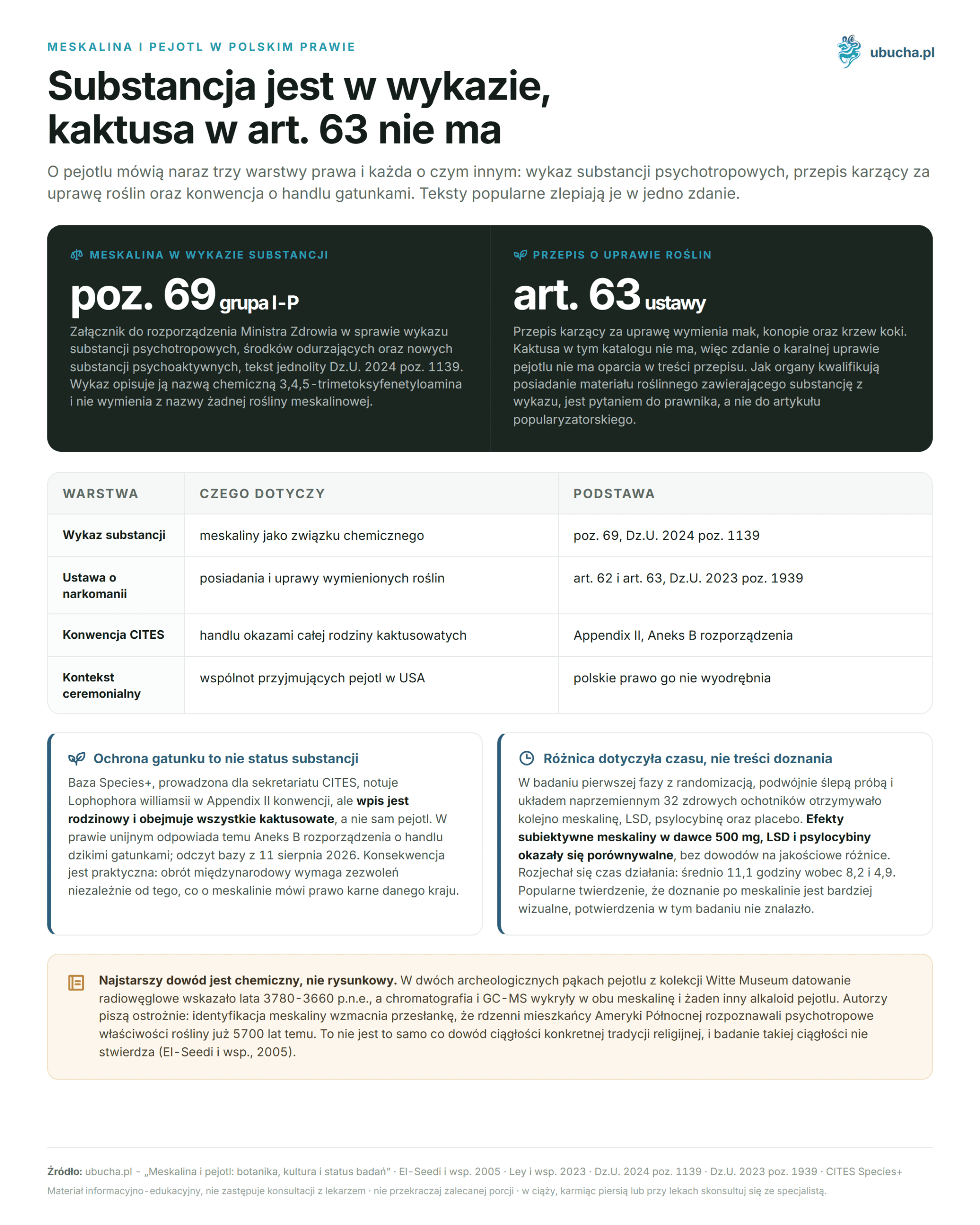
• Mescaline is listed in the Polish register as a psychotropic substance of group I-P, item 69, under the chemical name 3,4,5-trimethoxyphenethylamine.
• Art. 63 of the Act on Counteracting Drug Addiction lists poppy, hemp, and coca bush. The cactus is not included in this provision.
• Mescaline underwent a randomized double-blind study with 32 healthy volunteers. There are still no studies in patients.
What is peyote and why is it protected?
Peyote is a small, spineless cactus Lophophora williamsii from the Cactaceae family, growing in the dry areas of central Mexico and southern Texas. The Polish name comes directly from Nahuatl (peyotl). The visible above-ground part, called the crown, is a modified stem; underground lies a long, carrot-like root.
The plant contains several biologically active alkaloids: pellotine, anhalonidine, hordenine, and mescaline, which is responsible for the psychoactive effects (Doesburg-van Kleffens et al., Molecules, 2023). Mescaline is also found in the San Pedro cactus (Echinopsis pachanoi) and several related species from South America. A similar pattern, that is, a plant with a rich alkaloid profile and one leading compound, can also be found outside the Americas: we described it in relation to akuamma seeds.
The protective status is often confused with the legal status of the substance itself. The Species+ database, maintained for the CITES secretariat, lists Lophophora williamsii in Appendix II of the convention, with the entry being family-wide and covering all cacti (Cactaceae spp.), not just peyote. In EU law, this corresponds to Annex B of the regulation on the trade in wild species. The database readout from August 11, 2026. The practical consequence is that international trade in specimens requires permits regardless of what the criminal law of a given country says about mescaline.
How old are the ceremonies with peyote?
The strongest evidence is not a drawing or a note, but the results of chemical analysis. The El-Seedi team examined two archaeological peyote buds from the Witte Museum collection, attributed to Shumla Cave No. 5 above the Rio Grande. Radiocarbon dating provided a calibrated range of 3780-3660 B.C., and extraction yielded about 2% alkaloids. Thin-layer chromatography and GC-MS detected mescaline in both samples and no other peyote alkaloids (Journal of Ethnopharmacology, 2005).
The authors draw one conclusion from this, and it is worth repeating exactly in their wording: the identification of mescaline strengthens the premise that the indigenous peoples of North America recognized the psychotropic properties of peyote 5700 years ago. This is not the same as evidence of the continuity of a specific religious tradition, and such continuity has not been established by the study.
Later work in the same vein, published in the Journal of Archaeological Science in 2006 (Terry et al., vol. 33, pp. 1017-1021), dated other specimens from the Shumla caves to the years 4045-3960 B.C. and described them as compressed products made from ground peyote, rather than intact buds. The discrepancy in dates arises from the examination of different materials, not from any error in either study.
Currently, ceremonies with peyote are conducted by, among others, the Wixárika (Huichol) in Mexico and the Native American Church in the United States. Members of the latter community, who regularly consume peyote in a religious context, have been recruited for scientific studies, as mentioned below.
How does mescaline work and how does it differ from LSD?
Mescaline is a phenylethylamine. Its psychedelic action results from stimulating the serotonin receptor 5-HT2A, the same target through which psilocybin and LSD act (Doesburg-van Kleffens et al., 2023; Nichols, Pharmacological Reviews, 2016). The chemical structure is different from tryptamines, but the receptor mechanism is the same.
A direct comparison of these three substances was done once, and the result was surprising. In a phase one study with randomization, double-blind design, placebo control, and a crossover design, 32 healthy volunteers received mescaline, LSD, psilocybin, and placebo in succession. The subjective effects of mescaline at a dose of 500 mg, LSD, and psilocybin measured by psychometric scales were found to be comparable, and the authors found no evidence of qualitative differences in the induced state of consciousness (Ley et al., Neuropsychopharmacology, 2023).
A clear difference concerned duration, not the content of the experience. The average duration was 11.1 hours for mescaline, 8.2 hours for LSD, and 4.9 hours for psilocybin, with a similar half-life of mescaline and LSD in plasma (about 3.5 hours). The longer duration of mescaline was due to a slower onset to peak concentration. Mescaline also caused slightly more adverse effects in the 12-24 hour window after administration. The popular claim that the experience with mescaline is “more visual” than with psilocybin was not confirmed in this study.
Are mescaline and peyote legal in Poland?
No. Mescaline is a psychotropic substance of group I-P. It is listed as item 69 in Annex 1 to the regulation of the Minister of Health regarding the list of psychotropic substances, narcotic drugs, and new psychoactive substances, in the consolidated text Dz.U. 2024 item 1139, described by the chemical name 3,4,5-trimethoxyphenethylamine. Readout from the consolidated text, August 2026.
Sanctions arise from the Act of July 29, 2005, on Counteracting Drug Addiction, consolidated text Dz.U. 2023 item 1939. Possession of a psychotropic substance contrary to the provisions of the law is punishable by imprisonment of up to 3 years (art. 62 sec. 1). For significant amounts, the law provides for a penalty of 1 to 10 years (sec. 2), and in the case of lesser amounts, a fine, restriction of liberty, or imprisonment of up to 1 year (sec. 3).
One distinction is worth making, as it often disappears in texts about peyote. The penal provision for cultivation, that is, art. 63 sec. 1, lists three plants: poppy, hemp, and coca bush. The cactus is not included in this catalog, and the list of substances does not mention either Lophophora williamsii or any other mescaline-containing plant by name. This means that the statement “cultivation of peyote is punishable under art. 63” has no basis in the text of the provision. How authorities classify possession of plant material containing a substance from the list is a question for a lawyer, not for a popular article. In the USA, researchers have regularly recruited members of the Native American Church who consume peyote in ceremony; Polish law does not distinguish such context in any provision.
What have studies on mescaline shown?
Mescaline currently has one published randomized study with placebo control, the Ley study mentioned above involving 32 healthy volunteers. The clinical trials registry lists it under the number NCT04227756, as a phase one study sponsored by the university hospital in Basel. However, there is not a single study in patients with a clinical diagnosis, which distinguishes it from psilocybin and MDMA. The claim that mescaline “has not been studied in RCT” is now outdated; the claim that it works on depression still lacks a basis.
The largest dataset on effects comes from a survey, not a clinic. The Agin-Liebes team conducted an anonymous online survey of 452 adults using mescaline outside of a medical context. Among respondents reporting past depression, anxiety, PTSD, or problematic use of alcohol and other substances, 68-86% reported improvement after their most memorable experience with mescaline. Between 35 and 50% rated it as one of the five most significant experiences of their lives (ACS Pharmacology & Translational Science, 2021). The authors themselves note that without a control group and randomization, this is not evidence of efficacy.
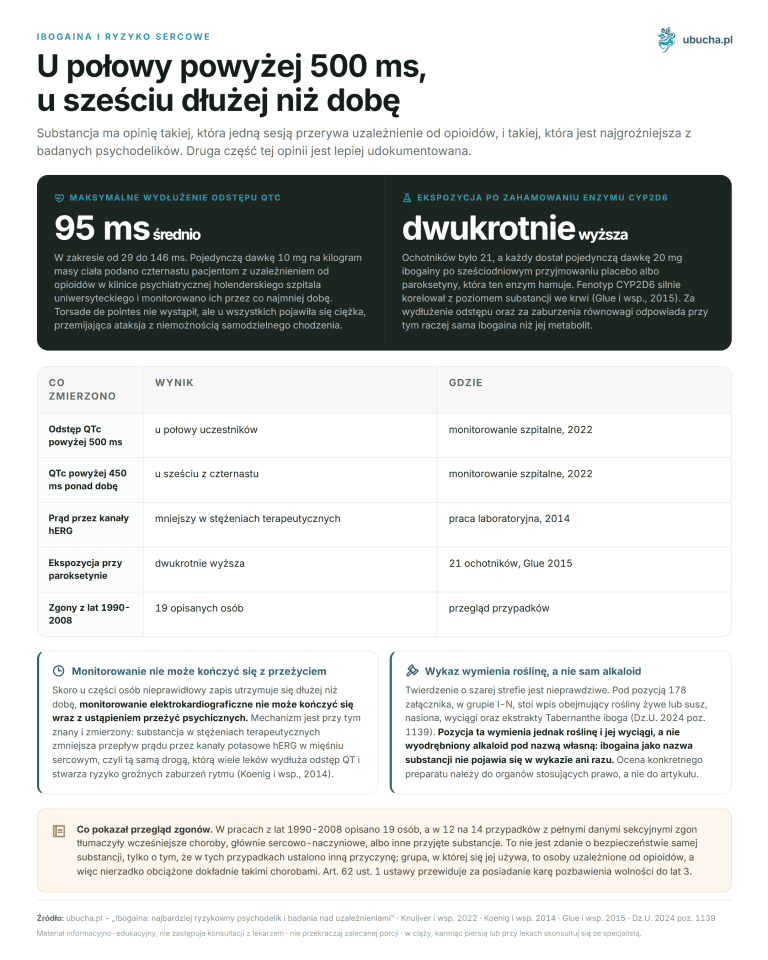
Separately, it is worth knowing about a long-term study. Halpern and colleagues compared three groups of Navajos aged 18-45: 61 members of the Native American Church regularly consuming peyote, 36 individuals with a history of alcohol dependence, and 79 individuals reporting minimal use of any substances. The peyote group showed no significant deficits in mental health scales or in any of the ten neuropsychological tests; the group with a history of dependence performed significantly worse on every mental health scale and in two neuropsychological tests (Biological Psychiatry, 2005). The authors caution that the result should not be extrapolated to non-ceremonial use. Caution is the rule here, not the exception: we have written about it more broadly in relation to ibogaine and addiction studies.
Frequently Asked Questions
What is mescaline?
Mescaline is a phenylethylamine alkaloid with the chemical name 3,4,5-trimethoxyphenethylamine, found in peyote and San Pedro cactus. It works by stimulating the serotonin receptor 5-HT2A. In the Polish list of substances, it is classified as a psychotropic substance of group I-P, item 69.
How long has peyote been used in ceremonies?
In two archaeological peyote buds from above the Rio Grande, radiocarbon dating indicated the years 3780-3660 B.C., and chemical analysis detected mescaline. The authors consider this evidence that the psychotropic properties of the plant were recognized 5700 years ago (El-Seedi et al., 2005).
How does mescaline differ from psilocybin and LSD?
In a randomized study of 32 healthy volunteers, the subjective effects of mescaline, LSD, and psilocybin were comparable, with no qualitative differences. They differed in duration: an average of 11.1 hours for mescaline, 8.2 for LSD, and 4.9 for psilocybin (Ley et al., 2023).
Is peyote a protected species?
Yes. The Species+ database lists Lophophora williamsii in Appendix II of the CITES convention, as part of an entry covering the entire cactus family, and in Annex B of the EU regulation on the trade in wild species. The database readout from August 11, 2026. International trade requires permits.
What penalty does possession of mescaline carry in Poland?
Possession of a psychotropic substance contrary to the provisions of the law is punishable by imprisonment of up to 3 years, with significant amounts carrying a penalty of 1 to 10 years, and in the case of lesser amounts, a fine, restriction of liberty, or imprisonment of up to 1 year (art. 62 of the act, Dz.U. 2023 item 1939).
Is mescaline being studied as a drug?
Not yet in patients. There is one published randomized study involving 32 healthy volunteers, and a survey of 452 individuals using mescaline outside of medicine, where 68-86% of those reporting previous mental health issues declared subjective improvement (Agin-Liebes et al., 2021). This is not evidence of efficacy.
The article is informational and educational in nature. It describes clinical studies in which the substance is administered under medical supervision after participant qualification; self-use of these conditions does not replicate. These substances are controlled in Poland under the Act on Counteracting Drug Addiction. If you have suicidal thoughts, call the free, 24-hour numbers 116 123 or 800 70 2222. In case of life-threatening situations: 112.
Author: Michał Waluk · Published: 2026-08-09 · Updated: 2026-08-11