
How to Talk to Your Doctor About CBD and Cannabis: How to Prepare for Your Visit
What the survey among doctors really showed, which interactions are worth asking about, what to bring to the visit, and when not to wait for an appointment but seek help immediately.
Talking about CBD in the office is often postponed because the patient does not know how to start, and the doctor does not always know what to answer. There is a figure circulating that 85 percent of doctors feel discomfort in this conversation. We checked the survey they refer to, and it says something different, on a smaller scale and with a more cautious conclusion. This article provides what this work actually showed, which interactions are worth asking about to make the question resolvable with pharmacological knowledge, and what to bring with you to have a basis for the conversation. It ends with something that guides usually lack: a list of symptoms for which you should not wait for an appointment.
KEY INFORMATION
• The survey from which the circulating figure comes included 62 doctors from one care system in Minnesota with a response rate of 31 percent, not all doctors in the United States.
• Half of the respondents were not ready or did not want to answer patients’ questions about medical cannabis, and most wanted to learn more about it.
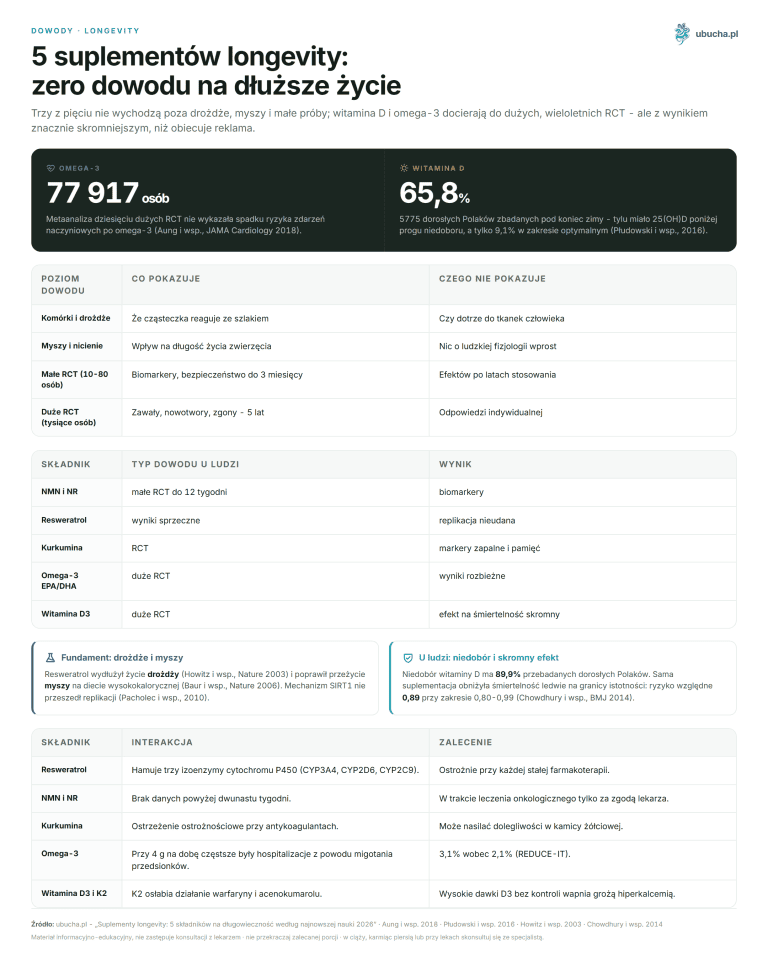
• In 18 healthy adults, 640 mg of CBD inhibited CYP2C19, CYP2C9, CYP3A, and CYP1A2, but not CYP2D6. These are the isoforms worth asking about directly.
• EFSA states that the safety of CBD cannot be established in individuals taking medications simultaneously.
• CBD is not a controlled substance in Poland, but it also does not have authorization as a novel food in the EU. Calling it a legal supplement is an oversimplification.
• Bring the packaging or certificate of analysis: without this, it is unclear what exactly to evaluate.
What Does a Primary Care Doctor Really Not Know?
They know less than the patient assumes, but also less dramatically than the circulating figure suggests. The survey was conducted electronically among primary care doctors from one large healthcare system in Minnesota between January 23 and February 5, 2018. It was completed by 62 doctors, resulting in a response rate of 31 percent, and the average age of the respondents was 46.3 years (Philpot et al., BMC Family Practice, 2019).
The results are more nuanced than a single figure suggests. The majority of respondents, 58.1 percent, considered medical cannabis a legitimate therapy. More than a third believed it interacts with treatment. Half were not ready or did not want to answer patients’ questions on the subject, while most wanted to learn more. The authors conclude with a practical takeaway: gaps in doctors’ knowledge about efficacy need to be filled, and reliable information about drug interactions needs to be disseminated.
Two things are worth taking away from this before the visit. First, it is a survey among doctors, not among patients, so the figures about how many patients talk to their doctor about CBD do not come from this work, although they are sometimes attributed to it. Second, the measured uncertainty mainly concerned efficacy, not interactions. Therefore, asking about interactions has a much greater chance of receiving a substantive answer than asking whether CBD will work.
Why Is Concealing CBD a Risk, Not Discretion?
Because the doctor interprets results and symptoms without a variable that actually affects them. Measurement in humans is clear: eighteen healthy adults received a cross-over extract containing 640 mg of CBD and 20 mg of THC, followed by a set of probe medications. Exposure to omeprazole increased by 207 percent, to losartan by 77 percent, to midazolam by 56 percent, and to caffeine by 39 percent. This corresponds to the inhibition of CYP2C19, CYP2C9, CYP3A, and CYP1A2. CYP2D6 was not inhibited, despite a clear signal for this enzyme in in vitro studies (Bansal et al., Clinical Pharmacology and Therapeutics, 2023).
Additionally, there is a regulatory stance. The EFSA panel assessed the safety of CBD in 2026 and stated that it cannot be established in individuals under 25 years of age, in pregnant and breastfeeding women, and in individuals taking medications simultaneously (EFSA, update on the safety of CBD as a novel food, 2026). If you are taking anything on prescription, you fall into this third group.
There is also a risk that is less often discussed. In a survey of 2774 cannabis users, 1248, or 46 percent, reported that they replaced a prescription medication with cannabis. The most commonly mentioned were opioids, benzodiazepine anxiolytics, and antidepressants (Corroon et al., Journal of Pain Research, 2017). This was a self-selected convenience sample, so do not generalize this percentage to all patients. However, the phenomenon is real and more significant for the doctor than the mere fact of using CBD.
What to Bring to the Visit?
Four things that take fifteen minutes to prepare and turn a general conversation into a resolvable one.
- A list of all medications and supplements, including herbal ones, with names, dosages, and frequency. Also include any as-needed medications and over-the-counter products.
- The packaging of the CBD product or its certificate of analysis. Missing or inaccurate labeling of CBD and THC content, as well as contaminants such as pesticides or heavy metals, can lead to harm or lack of expected effects (Corroon et al., Cannabis and Cannabinoid Research, 2020).
- A note on what exactly you want to improve, described in measurable terms. The number of awakenings at night or a pain rating on a scale are material for the doctor, while a general impression is not.
- The start date and form of the preparation. This is often overlooked, but it determines how long the substance may still be present.
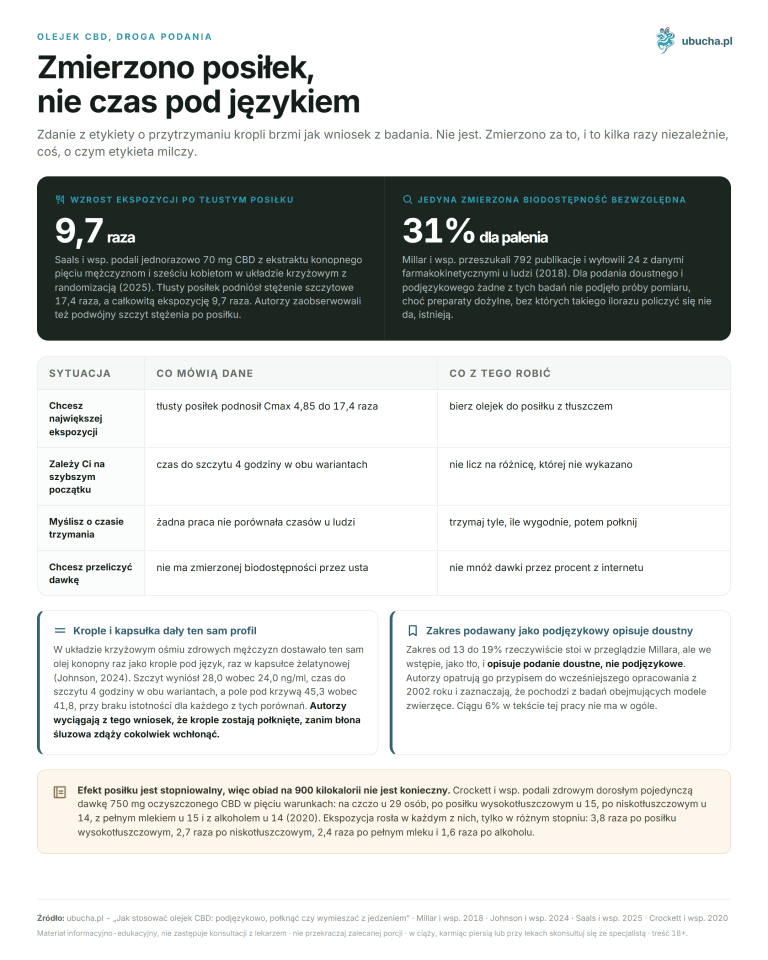
The last point is supported by measurement. A systematic review of studies in humans reports a half-life of CBD in the range of 1.4-10.9 hours after an aerosol on the oral mucosa and 2-5 days after prolonged oral administration (Millar et al., Frontiers in Pharmacology, 2018). Therefore, the form of the preparation changes the answer to the question of when the substance will cease to be significant for other medications.
How to Start the Conversation and What to Ask?
Start with facts and safety, not efficacy. The best opening sentence goes something like this: I have been using CBD oil for a few weeks, I have the packaging with me and a list of medications, and I would like to check if there are any interactions. Do not provide the dosage from memory, just show the packaging. Also, avoid suggesting that CBD should replace treatment, as this will close the conversation faster than anything else.
It is worth formulating questions in a way that allows for answers based on pharmacological knowledge, not opinion. Three such questions are: through which cytochrome isoforms do my medications pass, does any of them have a narrow therapeutic window, and what parameters should be monitored if I continue using CBD. The first can be specified immediately, as it is known which isoforms are involved: CYP2C19, CYP2C9, CYP3A, and CYP1A2.
Do not ask for a dosage and do not expect one. The indications for which a registered cannabidiol preparation has approval are narrow, and for other uses, there is simply no established dosage. If you are considering a treatment path with cannabis prescribed by a doctor, that is a separate formal route, which we describe in the text about how to become a patient of medical marijuana in Poland.
What to Do If the Doctor Does Not Want to Talk?
Look for a second interlocutor, but do not replace the consultation with a search engine. A pharmacist assesses interactions daily and is a reasonable first point of contact. In Poland, there is also a formal medication review service within pharmaceutical care, but it is worth knowing that not every pharmacy provides it and it is not a commonly reimbursed service. So ask specifically if a particular pharmacy offers it.
The second route is to find another doctor, preferably one who treats patients with cannabis prescriptions. The third is a specialist doctor managing your underlying condition, as they know the medications whose interactions are genuinely relevant. Consumer interaction search engines can be helpful as a starting point, but they have a limitation worth remembering: they do not know how many substances your preparation contains or what else is in it.
One thing is worth saying directly, as it is often left unsaid. A doctor’s rejection of the topic is not consent to discontinue treatment with established efficacy. Unsubstantiated health claims about cannabidiol products can lead to the abandonment of better-documented methods, and that is a real harm, not a hypothetical one. If you are caring for someone who uses CBD, the role of an observer is described in the text about caring for a loved one using CBD.
When Not to Wait for an Appointment?
For symptoms from the first point below, call 112, not schedule an appointment. This list exists because guides on talking to a doctor usually end with encouragement to talk and do not mention what is a warning signal.
- Difficulty breathing, loss of consciousness, seizures, increasing confusion. This is a situation for emergency number 112.
- Yellowing of the skin or whites of the eyes, dark urine, persistent vomiting, pain in the upper right quadrant of the abdomen. EFSA notes the potential hepatotoxicity in humans, especially with simultaneous use of medications, so this is a signal for urgent contact with a doctor.
- Bleeding that is difficult to stop, extensive bruising, blood in urine or stool, especially with anticoagulant medications.
- Sudden drop in blood pressure, fainting, falls.
Less severe symptoms reported in humans with CBD include diarrhea, vomiting, fatigue, and drowsiness, as well as deviations in liver tests (Huestis et al., Current Neuropharmacology, 2019). They do not require an emergency number, but they are a good reason to expedite the appointment and not wait for the next check-up.
Frequently Asked Questions
Can a doctor prohibit me from using CBD?
A doctor does not issue administrative bans, but calling CBD a legal supplement is an oversimplification. In Poland, it is not a controlled substance, while in the EU it does not have authorization as a novel food, and a sanitary notification of the product is not such authorization. Therefore, the doctor’s assessment concerns safety, not legality.
How many doctors really feel insecure in this conversation?
In a survey of 62 primary care doctors from one system in Minnesota, half were not ready or did not want to answer patients’ questions about medical cannabis. The 85 percent figure, repeated in guides, does not come from this work and is not supported by it.
Which interactions should I specifically ask about?
About drugs metabolized by CYP2C19, CYP2C9, CYP3A, and CYP1A2, as these isoforms were inhibited in humans after 640 mg of CBD. Also ask if any of your medications have a narrow therapeutic window. CYP2D6 was not inhibited in the same study, despite a list of warnings from in vitro studies.
Will a pharmacist check interactions for free?
A brief assessment at the counter usually yes, but a formal medication review is a separate service that not every pharmacy provides and is not commonly reimbursed. Ask directly if a particular pharmacy offers it, rather than assuming it is available everywhere.
How to describe the effects of CBD in a way that a doctor can evaluate?
With numbers and scales instead of impressions. Instead of saying that CBD helps, provide the number of awakenings at night before and now or a pain rating on a ten-point scale. Include the start date and the form of the preparation, as they affect the interpretation of all other data.
Should I mention CBD before a surgical procedure?
Yes, regardless of the type of anesthesia. Medications used for sedation pass through isoforms that CBD inhibits in humans, and the timing of any potential discontinuation is determined by the anesthesiologist. We have gathered details in the text about what to know before surgery and anesthesia.
This article is for informational and educational purposes and does not constitute medical advice. Before starting to use cannabis or CBD for therapeutic purposes, consult your doctor, especially if you are taking other medications, are pregnant, or breastfeeding.
Author: Michał Waluk · Published: 2026-08-09 · Updated: 2026-08-16