
THC Cookies: How Long Do They Take to Work and Are They Legal
THC cookies take effect after 30-90 minutes, peaking at 1.5-2 hours. Why homemade baked goods are a crime in Poland and how to calculate the dose in one piece.
THC cookies take effect after 30 to 90 minutes, peak after one and a half to two hours, and the total duration lasts from four to eight hours. Baking them at home from cannabis other than hemp is a crime in Poland under Article 53, regardless of the amount. Moreover, in the topic of cookies, the most confusion arises from numbers: how many cannabinoids remain after heating the raw material, how long it takes for a portion eaten instead of inhaled to take effect, and how to calculate the content in one piece. We have gathered what can be verified at the source: the results of a controlled study with brownie cookies, recommendations from the Canadian regulator, and data on child poisonings. Separate sections in the first part of the text explain how Polish law treats home processing of cannabis other than hemp and raw material issued in a pharmacy. At the end, you will find a recipe for twenty-four cookies with hemp oil along with a dosage calculation that can be reproduced from the label. Each numerical claim has a reference or scientific work, and where data simply does not exist, we state that directly instead of inserting a convenient value.
KEY INFORMATION
- Homemade baked goods from cannabis other than hemp fall under Article 62 and Article 53 of the Act on Counteracting Drug Addiction (Journal of Laws 2023, item 1939).
- Baked goods made from hemp remain legal, provided that the sum of delta-9-THC and THCA does not exceed 0.3% of dry weight.
- Health Canada recommends starting with 2.5 mg of THC or less and waiting for the full effect for up to 4 hours.
- In a controlled study with brownie cookies, THC concentrations in the blood peaked after 1.5-2 hours (Spindle et al., 2020).
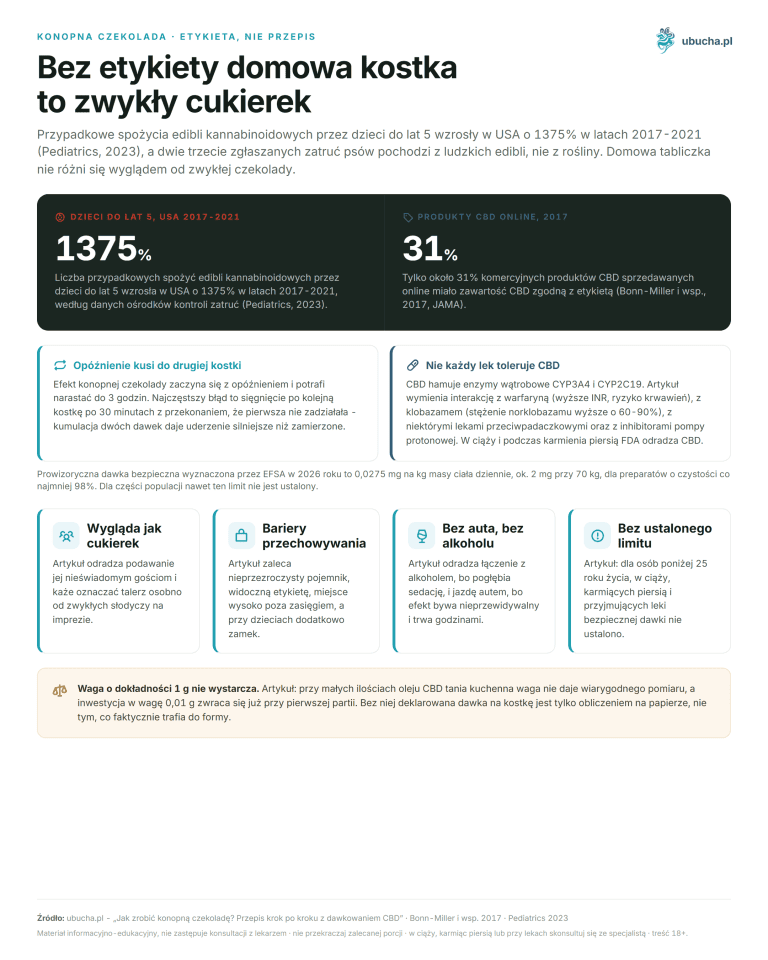
- In the USA, 7043 cases of poisoning in children under 6 years old from THC products were reported between 2017-2021 (Tweet et al., 2023).
Why do ingested cannabinoids work differently than inhaled ones?
The difference arises from the path the substance takes in the body. Inhaled THC enters the bloodstream almost immediately from the lungs. Ingested THC must pass through the digestive tract and liver, where 11-hydroxy-THC is produced. This metabolite, when administered intravenously, produces psychological and pharmacological effects that last for several hours, and the work that described this indicated it as the compound responsible for THC’s effects (Lemberger et al., Science, 1972, PMID 5041775).
How many times stronger this metabolite is than the original THC is a question that popular guides answer with a number, while the literature does not. We did not find a study that justified the circulating ratio of two or three times. Therefore, we write only as much as can be defended: through the oral route, an active metabolite is produced, which is practically absent in such quantities when inhaled, and it is this that contributes to the different nature of the effects.
The practical consequence is more important than the mechanism. The effect appears with a delay that cannot be shortened and lasts longer than someone accustomed to inhalation might expect. Hence the most common accident with edibles: taking a second portion before the first has taken effect. Both begin to work together, and the dose someone planned ceases to matter.
How quickly and how long do cookies with cannabinoids work?
The best available data comes from a study with brownie cookies. Seventeen healthy adults, including eight women, with no contact with cannabis for at least two months, consumed cookies containing 0, 10, 25, or 50 mg of THC in four sessions. THC and 11-hydroxy-THC concentrations in whole blood peaked 1.5-2 hours after consumption, then gradually decreased and usually returned to baseline values within 8 hours (Spindle et al., Journal of Analytical Toxicology, 2020, PMC7549129).
The metabolite 11-nor-9-carboxy-THC behaved differently. Its concentrations were higher than those of THC and 11-hydroxy-THC and often remained detectable for up to 8 hours after eating a cookie. Women reached higher peak concentrations of THC and all metabolites than men, which the authors partially attribute to lower body mass. Through the oral route, THC appeared in the blood much later and at much lower peak concentrations than through inhalation.
The regulator expresses the same in the language of recommendations. Health Canada states that the effects of eating cannabis may take up to 2 hours to be felt, and the full effect may take up to 4 hours, while the effects last from 4 to 12 hours, with some effects lasting up to a day (Health Canada, Cannabis: lower your risks).
Comparing these two sources gives us a rule that we adhere to in the text: the peak concentration in the blood is not the same as the peak feeling, and the feeling can outlast both. When planning an evening with a cannabis baked good, reserve the entire evening, not just two hours.
Are THC cookies legal in Poland?
No, they are not. Possession of cannabis other than hemp in violation of the law is punishable by up to 3 years in prison (Article 62, paragraph 1 of the Act of July 29, 2005, on Counteracting Drug Addiction, Journal of Laws 2023, item 1939). Simply buying the dried flower is already a punishable act, even before you turn on the oven.
Baking adds a second provision. The law defines processing as obtaining mixtures of narcotic substances and giving these substances a new form (Article 4, point 20), and processing as actions leading to their transformation into other substances (Article 4, point 19). Manufacturing, processing, or altering narcotic substances in violation of the law is punishable by up to 3 years in prison (Article 53, paragraph 1). Hemp butter and a cookie baked from it is precisely giving a narcotic substance a new form. The qualification in a specific case is, of course, determined by the court, but the mere fact that you are doing it at home and for yourself is not a consideration in these provisions.
The line is drawn at the cannabinoid content. Hemp is defined as plants in which the sum of delta-9-THC and tetrahydrocannabinolic acid in the flowering or fruiting tops, from which the resin has not been removed, does not exceed 0.3% based on dry weight, rounded to one decimal place (Article 4, point 5). Above this value, we are dealing with cannabis other than hemp (Article 4, point 37). The threshold is not calculated from delta-9-THC alone, but from the sum of both compounds, which realistically changes the laboratory test result. We have expanded on the topic of regulations in the text about whether chocolate with cannabis is legal.
What are the penalties for homemade THC baked goods?
The severity of the penalty depends on which provision applies and what quantity is involved. The table below summarizes the sanctions directly from the Act on Counteracting Drug Addiction, without rounding and without the common simplifications that circulate on forums.
| Act | Penalty | Provision |
|---|---|---|
| Possession of a narcotic substance | up to 3 years in prison | Article 62, paragraph 1 |
| Possession of a significant amount | 1 to 10 years in prison | Article 62, paragraph 2 |
| Minor offense | fine, restriction of freedom, or up to 1 year in prison | Article 62, paragraph 3 |
| Manufacturing, processing, or altering | up to 3 years in prison | Article 53, paragraph 1 |
| Processing a significant amount or for financial gain | fine and imprisonment for not less than 3 years | Article 53, paragraph 2 |
The concept of a significant amount does not have a weight threshold in the law. The Supreme Court in its judgment of May 7, 2013 (case III KK 25/13) stated that it refers to an amount sufficient to intoxicate at least several dozen dependent individuals. The numbers in grams provided by online guides do not come from the provision or that judgment.
There is also a narrow loophole. In the case of a small amount intended for personal use, the proceedings can be discontinued even before a decision to initiate an investigation or inquiry is made, if the imposition of a penalty would be pointless due to the circumstances of the act and the degree of its social harmfulness (Article 62a). Discontinuation is a possibility, not a subjective right, and it pertains to possession, not processing.
Can a patient with a prescription bake cookies from pharmacy-sourced material?
Here lies a boundary that many texts blur. Article 33a of the Act on Counteracting Drug Addiction allows cannabis other than hemp and extracts from it to be pharmaceutical raw materials intended for the preparation of prescription medications, after obtaining permission from the President of the Office for Registration of Medicinal Products. The provision refers to prescription medications, i.e., those prepared in a pharmacy, and not to the home processing of raw material by the patient.
The law does not contain a provision that exempts the patient from responsibility for independently giving the raw material a new form. There is no exception analogous to that which applies to the possession of a prescription medication. The assertion that a prescription holder can legally bake their own cookies from raw material has no basis in the text of the law and should not be treated as advice.
The practical conclusion for the patient is therefore different from what intuition suggests. The method of taking the medication is determined by the doctor, and the form of the medication is prepared by the pharmacy. If the oral form makes sense in your therapy, that is a topic for discussion with your attending physician, not a kitchen experiment. Everything you read below about chemistry and dosing is meant to help you understand why this experiment is risky medically, not just legally.
What is decarboxylation and what is really known about it?
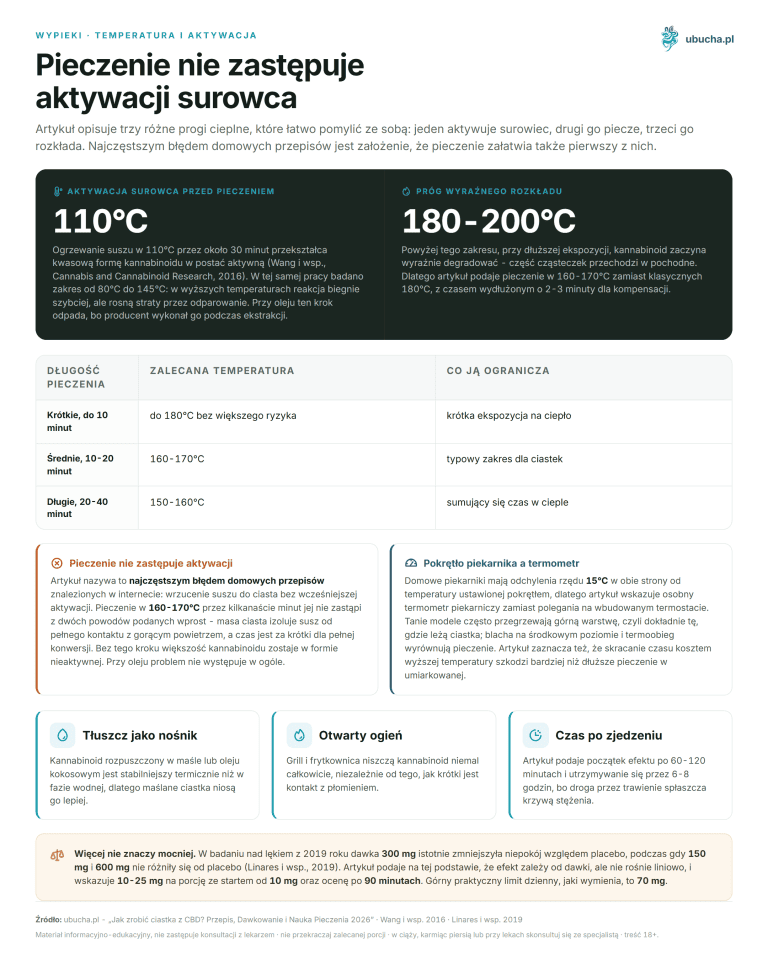
The raw plant mainly contains acidic forms of cannabinoids, namely THCA and CBDA, which do not produce psychoactive effects on their own. Heating removes a carboxyl group from them and converts them into THC and CBD. This is why a baked good made from raw material thrown directly into the dough behaves differently than one made from previously heated raw material.
The kinetics of this reaction have been studied in laboratory conditions. Cannabis sativa extracts were heated in a vacuum dryer at temperatures of 80, 95, 110, 130, and 145 degrees Celsius for various times, up to 60 minutes. The change in concentrations over time followed an exponential course, indicating a first-order reaction, and the rate constants for THCA were twice as high as for CBDA and CBGA. The decomposition of THCA proceeded cleanly, without side reactions, while for CBDA and CBGA, the authors noted unexplained losses of reagents or products (Wang et al., Cannabis and Cannabinoid Research, 2016, PMC5549281).
Note what is not in this study. There is no single “correct” pair of temperature and time for a home oven, no declared conversion percentage like 95-98%, and no data for conditions other than laboratory vacuum. Such numbers circulate in recipes, but they are not found in the cited works. A home oven adds its own error, as the dial setting and the actual temperature of the chamber can diverge.
For the version with hemp oil, this has one convenient consequence. Oil with a label declaring cannabinoid content is already a finished product and does not require any preliminary heating. This entire stage is eliminated along with its uncertainty.
Why is home dosing of THC uncertain?
Because there are at least three unknowns in the home chain. The first is the cannabinoid content in the raw material, which no one measures without laboratory testing. The second is the percentage that actually transfers to the fat during extraction. The third is the uniformity of fat distribution in the dough, which means that two cookies from the same tray can differ significantly from each other.
Popular recipes cover this gap with an extraction efficiency factor, most often 70-80%. We checked the references that are supposed to support it, and they lead to the homepage of the journal, not to a specific work. Therefore, we do not provide this number, as inserting it into the formula turns guessing into a seemingly precise result that someone then measures and eats.
There are two reference points that have coverage. Health Canada recommends starting with 2.5 mg of THC or less for edible products and waiting for the effect before taking another serving, as well as the principle of “start low and go slow.” The controlled brownie study used doses of 10, 25, and 50 mg of THC per serving in individuals with no contact with cannabis for two months, under medical supervision.
The difference between 2.5 mg and 50 mg is twentyfold. If you cannot say where your cookie lies within that range, it means you do not know the dose. In home cooking with plant material, it is usually impossible to know it, and that is an honest answer, not an excuse.
What cannabis ingredients can be added to baked goods?
Separately, the question about coconut oil instead of butter returns, and the answer is: it is suitable, and in several situations, better. Cannabinoids are fat-soluble, so any fat can be a carrier, and coconut oil has a high content of saturated fatty acids, solidifies at room temperature, and does not contain water or milk proteins, which in butter can burn during prolonged melting. The coconut version is also the only one that comes out dairy-free. The proportions are calculated one to one by weight.
Legally acceptable cannabis includes seeds, hemp flour, hemp seed oil, and dried and extracted hemp that falls within the 0.3% threshold. Seeds and flour are regular food and do not contain significant amounts of cannabinoids, as THC does not occur in the seed itself but appears on it secondarily, when in contact with resin during harvesting.
For seed products, a separate regulation applies, expressed in milligrams per kilogram, not in percentages. The highest permissible level is 3.0 mg/kg for hemp seeds and for ground seeds and other processed products, and 7.5 mg/kg for hemp seed oil. The level refers to the sum of delta-9-THC and delta-9-THCA, expressed as delta-9-THC, with a coefficient of 0.877 for the acidic form. The basis is Annex I to Commission Regulation (EU) 2023/915 of April 25, 2023, applicable from May 25, 2023.
These two values should be separated from the 0.3% threshold, as they pertain to different matters. The threshold in the Act on Counteracting Drug Addiction describes the plant and determines whether we are dealing with a narcotic substance at all. The limit from the EU regulation describes finished food and determines whether it can be marketed. Mixing them together is the most common mistake in texts about cannabis in the kitchen.
You can therefore safely add hemp flour, hulled seeds, or hemp seed oil to your baked goods. A product with a declared cannabinoid content is a separate category, and its label determines the dosage calculation that we outline in the further part of the text.
How to bake legal chocolate cookies with hemp oil?
The recipe below yields 24 moist chocolate cookies and uses only legally available ingredients. Dark chocolate and cocoa mask the herbal taste well, so the oil does not change the character of the baked good. Add the oil to the wet ingredients, never to the dry ones, as it will otherwise distribute unevenly.
- 120 g butter, softened
- 150 g brown sugar and 100 g white sugar
- 2 large eggs
- 1 teaspoon vanilla extract
- 200 g wheat flour type 480
- 50 g unsweetened cocoa powder
- 1 teaspoon baking powder
- half a teaspoon of sea salt
- 100 g chopped dark chocolate 70%
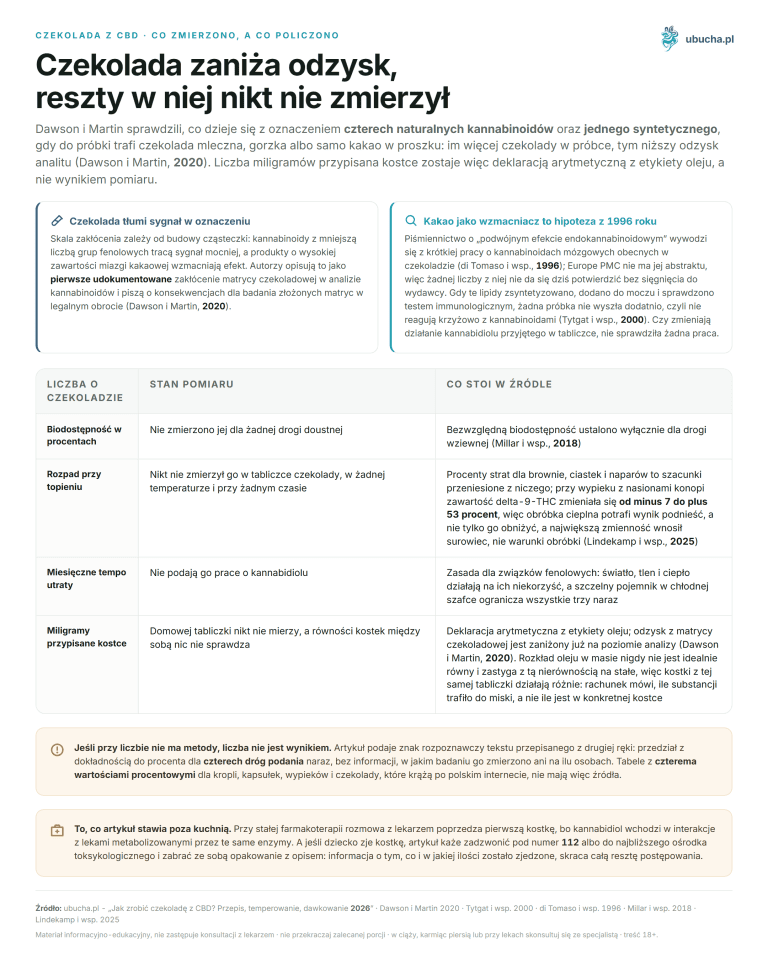
- 5 ml hemp oil with declared cannabinoid content
Preheat the oven to 175 degrees and line two trays with paper. Cream the butter with both sugars for 4-5 minutes until light and fluffy. Add the eggs one at a time, mixing after each, and finally pour in the vanilla and hemp oil. In a second bowl, sift the flour, cocoa, baking powder, and salt. Combine the dry ingredients with the butter mixture in three batches, mixing briefly to avoid developing gluten, and fold in the chopped chocolate.
Form balls of about 25-30 g, place them 5 cm apart, and slightly flatten them with the bottom of a glass. Bake for 10-12 minutes, until the edges are golden and the center remains soft. Leave the cookies on the tray for 5 minutes, then transfer them to a rack. You can choose the oil from the category of hemp oils, and a quicker version, for one serving, is described in the recipe for a single cannabis cookie.
How to calculate the cannabinoid content in one cookie?
With oil that has a label, the calculation is simple arithmetic and does not require any assumptions about extraction efficiency. Take the declared mass of cannabinoids in the package, divide by the volume, multiply by the amount used in the recipe, and divide by the number of servings. Below is the same calculation using a bottle declaring 1000 mg in 10 ml.
| Step | Value | Source |
|---|---|---|
| Label declaration | 1000 mg in 10 ml | product packaging |
| Content per milliliter | 100 mg | 1000 divided by 10 |
| Amount in the recipe | 5 ml | recipe above |
| Content in the dough | 500 mg | 100 times 5 |
| Number of cookies | 24 pieces | recipe above |
| Per cupcake (12 pieces from the same batch) | about 42 mg | 500 divided by 12 |
| Per cookie | about 21 mg | 500 divided by 24 |
This result has one assumption, and it is better to name it than to hide it. It assumes that the oil has distributed evenly in the dough, which a home mixer does not guarantee. Accurately weighing the balls reduces variability more than any mixing trick, so a kitchen scale is more useful here than in a regular bake.
The second caveat concerns the label. The number on the bottle is the manufacturer’s declaration, not the result of testing your batch. If the manufacturer provides a certificate of analysis for the batch number, it is worth checking it, as it tells you what you actually bought. More about baking with oil is described in the guide how to make cookies with CBD.
Legal versions of such baked goods, made with hemp seed oil, fall within the food category. Why an ingested portion hits harder and later than inhaled, we break down in the text about the 11-hydroxy metabolite, and the legal status of the chocolate itself with cannabis in the text about whether chocolate with cannabis is legal.
How to store and label cannabis baked goods?
A baked good with butter and eggs is primarily regular food and should be treated as such. Keep the cookies in an airtight container in the refrigerator, and for longer storage, in the freezer, in a package that does not allow air in. Glass with a seal works better than thin plastic, as odors do not pass through it.
Cannabinoids do not like light, oxygen, or heat, so a dark cabinet wins over a windowsill. We do not provide percentage losses of potency after four or eight weeks, as we have not found a study measuring them for homemade baked goods. A practical rule is sufficient: bake small batches and eat them fresh, rather than making reserves.
Labeling is more important than the container. Write on the label the date of baking, the oil used, and the calculated content per piece, and if there are children or guests at home, add a clear warning. A cannabis cookie looks exactly like a regular one, and that is the essence of the problem. Do not keep it in a container that once held regular cookies and do not leave it on the counter.
We have noticed in the comments under our culinary texts that questions about storage arise more often than questions about baking itself. We have described it more broadly in the guide on how to store cannabis and CBD flower.
Why should edibles be kept out of reach of children?
Because the scale of accidental poisonings is measured and growing. An analysis of reports to the American National Poison Data System covered 7043 cases of exposure of children under 6 years old to edible cannabis products between 2017-2021. In 2017, 207 cases were reported, while in 2021, there were already 3054, corresponding to a 1375% increase (Tweet et al., Pediatrics, 2023, PMID 36594224).
The most important numbers in this data are two others. As much as 97.7% of exposures occurred in domestic settings, meaning not at a party and not with strangers, but where someone left the baked good on the counter. Among cases with known outcomes, 70% were associated with central nervous system depression, and 22.7% of all reported patients were hospitalized.
The authors also noted that during the pandemic, there was a significant increase in the number of admissions to intensive care units and beyond, while the number of children discharged after just being treated decreased. In other words, not only did the number of incidents rise, but their severity did as well. This is the strongest argument for a locked cabinet that we know, and it applies equally to baked goods with THC and those with hemp oil.
Pets are subject to the same principle, although we do not have equally hard Polish data for them. A dog consumes a baked good faster and more eagerly than a child, and body mass works against it. Keep everything out of reach of both.
What to do after eating too much?
First, determine what actually happened, as this will affect further action. Symptoms of cannabinoid overdose appear with a delay and typically include severe anxiety, heart palpitations, nausea, and disorientation. Since the full effect can develop only after four hours, assume that the situation may worsen, and do not plan any obligations during that time.
First aid is simple and deliberately non-heroic. Lie down in a quiet, cool place, drink water, and do not stay alone. Do not drive, do not reach for alcohol, and do not try to speed up the end with another substance. Popular home remedies like black pepper or lemon have no research backing, so do not base your plan on them.
Call for medical help without hesitation if there are difficulties with breathing, loss of consciousness, seizures, or if the symptoms concern a child. The emergency number is 112. Tell the team directly what and when was eaten, including the amount, as this shortens the diagnosis by hours. Medical personnel are not law enforcement, and your health takes precedence over shame.
Separately about driving. Driving under the influence of a narcotic substance is punishable by up to 3 years in prison (Article 178a, paragraph 1 of the Penal Code, Journal of Laws 2025, item 383), and being in a state after using a substance acting similarly to alcohol is an offense punishable by detention or a fine of not less than 2500 PLN (Article 87, paragraph 1 of the Offenses Code, Journal of Laws 2025, item 734). After consuming THC baked goods, the car stays at home for the entire next day.
Frequently Asked Questions
Are THC cookies legal in Poland?
No. Possession of cannabis other than hemp is punishable by up to 3 years in prison (Article 62, paragraph 1 of the Act on Counteracting Drug Addiction, Journal of Laws 2023, item 1939), and giving a narcotic substance a new form falls under Article 53, paragraph 1 of the same Act. Baked goods made from hemp remain legal.
Where is the line between hemp and cannabis other than hemp?
The threshold is a total delta-9-THC and tetrahydrocannabinolic acid content of 0.3% based on dry weight, rounded to one decimal place (Article 4, points 5 and 37 of the Act on Counteracting Drug Addiction). The threshold is calculated from the sum of both compounds, not just delta-9-THC, which realistically changes the laboratory test result.
How long do cannabinoid baked goods take to work?
Health Canada states that the effects may take up to 2 hours to be felt, the full effect up to 4 hours, and the effects last from 4 to 12 hours. In a study with brownie cookies, THC and 11-hydroxy-THC concentrations in the blood peaked 1.5-2 hours after consumption and usually returned to baseline values within 8 hours (Spindle et al., 2020, PMC7549129).
What dose of THC should I start with if I have no tolerance?
Health Canada recommends starting with 2.5 mg of THC or less per serving and waiting for the full effect before taking another. In a controlled study, brownie doses of 10, 25, and 50 mg were used under medical supervision. In homemade baked goods from plant material, the doses are usually unknown because you do not know the content in the raw material or the efficiency of extraction.
Does decarboxylation at 110-120 degrees convert 95-98% of THCA to THC?
Such a result is not found in the work that is usually referenced. The kinetics study was conducted in a vacuum dryer at 80, 95, 110, 130, and 145 degrees for up to 60 minutes; the reaction followed first-order kinetics, and THCA decomposed twice as fast as CBDA and CBGA (Wang et al., 2016, PMC5549281).
Can a patient with a prescription bake cookies from pharmacy-sourced material?
Article 33a of the Act on Counteracting Drug Addiction allows cannabis other than hemp to be used as a pharmaceutical raw material for the preparation of prescription medications, i.e., prepared in a pharmacy. The law does not contain a provision exempting the patient from responsibility for independently giving the raw material a new form. The form of the medication is determined by the doctor with the pharmacy.
How to calculate the cannabinoid content in one cookie with oil?
Divide the declared mass of cannabinoids by the volume of the package, multiply by the amount used in the dough, and divide by the number of servings. A bottle with 1000 mg in 10 ml gives 100 mg per milliliter, so 5 ml in the dough for 24 cookies is about 21 mg each. The calculation assumes even distribution of the oil.
How to keep baked goods away from children?
Keep them in a locked cabinet, in a marked container, never in a package of regular cookies. An analysis of reports to the American Poison Control Center showed 7043 exposures of children under 6 years old in 2017-2021, of which 97.7% occurred at home, and 22.7% of patients were hospitalized (Tweet et al., 2023, PMID 36594224).
This article is for informational and educational purposes and does not replace consultation with a doctor. If you are pregnant, breastfeeding, taking medications, or have chronic conditions, consult the use of supplements or herbs with a specialist.
Author: Michał Waluk · Published: 2026-05-11 · Updated: 2026-08-24