
How to Make CBD Chocolate? Recipe, Tempering, Dosage 2026
CBD chocolate step by step: tempering, dose calculation per piece, and five mistakes that spoil the batch. What research confirms and what is marketing.
Chocolate seems like the simplest CBD carrier in a home kitchen. It melts at 40-50 degrees, contains a lot of fat, and cocoa masks the herbal taste of the oil better than yogurt or cake. The problem starts with dosage. Popular recipes specify cannabidiol content per piece down to milligrams, but the first study checking cannabinoid behavior in a chocolate matrix shows that chocolate itself lowers their recovery in lab analysis. This guide leads through raw material selection, tempering by seeding, dose calculation, five common mistakes, and storing the finished bar. It also shows where research-based knowledge ends and marketing promises begin, as this boundary is reached earlier than most guides suggest.
KEY INFORMATION
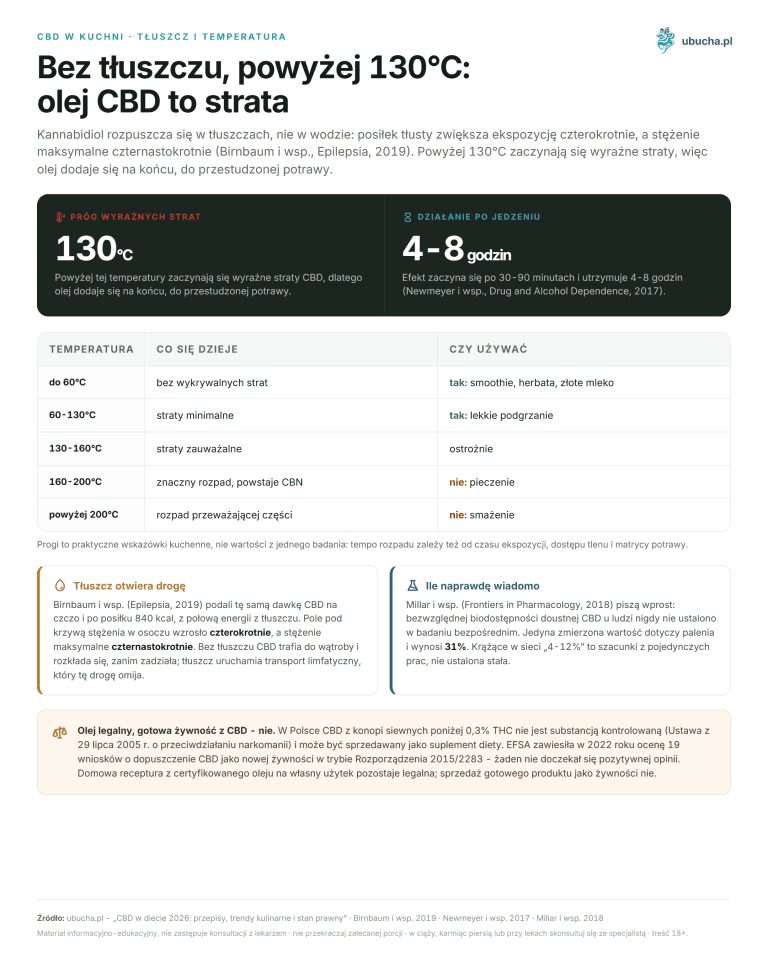
• A fatty meal increased patients’ maximum blood CBD concentration on average 14-fold and total exposure 4-fold (Birnbaum et al., 2019).
• Absolute bioavailability of CBD in humans was measured only for inhalation and is about 31 percent; no study has established it for oral administration (Millar et al., 2018).
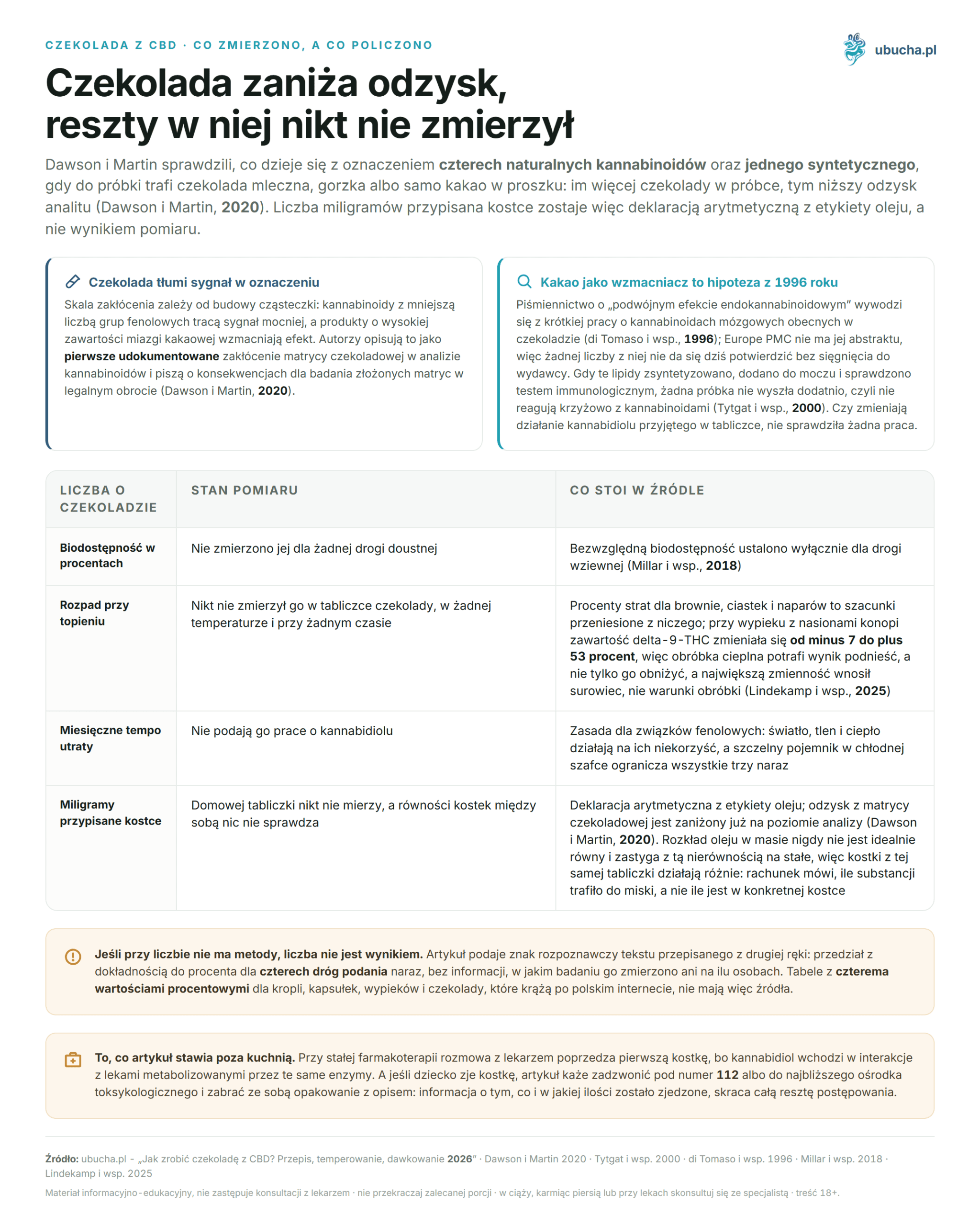
• Chocolate lowers cannabinoid recovery in analysis, so dose per piece remains an estimate from calculation, not a measurement result (Dawson and Martin, 2020).
• Tempering dark chocolate involves three thresholds: 45-48, then 27-28, then 31-32 degrees.
• EFSA sets a temporary safe dose of 0.0275 mg CBD per kilogram of body weight per day and does not establish it for persons under 25 years old (EFSA, 2026).
Is chocolate a good carrier for CBD?
Chocolate is a convenient CBD carrier for three practical reasons: it melts at a temperature that does not require an oven, contains enough fat to disperse the oil without separation, and intense cocoa masks the extract’s taste. These are kitchen advantages, not pharmacological, and it’s worth separating them at the start.
Cocoa butter forms a homogeneous suspension with the carrier oil in which cannabidiol is dissolved. In milk drinks or yogurt, such a mixture separates within hours, and the last portion from the bottle carries a different dose than the first. A solidified bar fixes the oil distribution at pouring time, so if well mixed, pieces are similar.
Similar is not the same as equal. Fixing the distribution works both ways: a roughly mixed batch solidifies with that unevenness permanently and cannot be corrected. Therefore, mixing time after adding oil is more important than any other parameter, including temperature.
We noticed while organizing this article that popular guides treat these three advantages as proof of chocolate’s higher effectiveness. This is a shortcut. Convenient administration and higher substance availability are two different things, and data for the latter are much scarcer than the tone of these texts suggests.
There is also a drawback these texts omit. A chocolate piece looks exactly like ordinary chocolate, so a household member or guest can easily mistake it, unlike a bottle with a dropper. No one accidentally takes a dose from drops because the form signals it is not a snack. Chocolate does not, so labeling and storage location are part of the procedure, not an afterthought.
Does fat really improve CBD absorption?
Yes, and this is one of the few points with strong clinical confirmation. In a study by Birnbaum et al., eight adult patients with drug-resistant epilepsy took the same 99-percent CBD capsule once fasting and once after a high-fat meal of 840-860 calories. After the meal, maximum blood concentration was on average 14 times higher, and total exposure 4 times higher (Birnbaum et al., 2019).
Confidence intervals were wide: 7.47-31.86 for maximum concentration and 3.42-7.82 for total exposure. This means the effect direction is certain, but its size for an individual is hard to predict. Eight participants is a small sample, and authors describe the work as preliminary.
Millar et al.’s pharmacokinetic review reaches the same conclusion from another angle. Maximum concentration increases in the fed state and in lipid formulations, i.e., those where CBD is in fat (Millar et al., 2018). A chocolate bar is by definition a lipid formulation and is usually eaten as part of or after a meal.
The practical conclusion is simple and needs no numbers: a piece eaten after a fatty meal works stronger than the same piece fasting. The difference can be several times, so if dosing, keep one meal pattern rather than changing daily.
Note what this mechanism does not refer to. Fat in the bar and fat in the meal are different things, and Birnbaum’s study measured the latter. A chocolate piece weighs a few grams, so it contributes a fraction of what a regular meal does. Planning eating time around meals is more sensible than relying on the carrier alone.
How much CBD from a piece actually reaches the blood?
Unknown, and that is an honest answer. A systematic review of all published human CBD pharmacokinetic data found 24 studies with measurable parameters. Absolute bioavailability, the dose fraction reaching circulation, was measured only for inhalation and was about 31 percent. No study did this for oral administration, although intravenous preparations needed for comparison exist (Millar et al., 2018).
Tables with four percentage values for drops, capsules, baked goods, and chocolate circulating online have no source. They are neither underestimated nor overestimated. They simply describe a measurement no one performed.
What does the review provide instead? Cannabidiol half-life: 1.4 to 10.9 hours after mucosal spray, 2 to 5 days with chronic oral dosing, 31 hours after smoking. Time to maximum concentration ranges from zero to four hours and is later for oral than inhaled. This suffices to plan chocolate eating time.
Authors close with a statement about data scarcity and discrepancies despite widespread use. Since 2018, this picture has not changed enough to justify giving readers a specific percentage for chocolate.
Where do these tables come from then? Usually from copying one value secondhand without opening the source paper. You recognize such text by giving a percentage range to the percent for four administration routes at once without stating the study or sample size. If no method is given, the number is not a result.
Why does dose per piece remain an estimate?
Because no one measures it in a home bar, and labs would have real problems measuring it. Dawson and Martin checked what happens to four natural cannabinoids and one synthetic when milk chocolate, dark chocolate, or cocoa powder is added to the sample. The relationship was clear: the more chocolate in the sample, the lower the analyte recovery (Dawson and Martin, 2020).
The interference scale depends on molecule structure. Cannabinoids with fewer phenol groups lose signal more, and products with high cocoa mass content amplify the effect. Authors describe this as the first documented chocolate matrix interference in cannabinoid analysis and write directly about consequences for complex matrix testing in legal trade.
For home confectioners, one practical tip follows. The milligrams you calculate from the oil label and piece count is an arithmetic declaration, not a measurement result. Treat it as orientation, not a drug dose, and leave a margin, especially for the first batch from a new bottle.
This is also why chasing accuracy to one milligram when dividing the bar is pointless. Calculation precision is lost during mixing, cooling, and uneven mold filling. Detailed calculations for baked goods and fats are in a separate text: how to calculate CBD dose in homemade baked goods and butter.
Does cocoa enhance CBD effect?
Nothing confirms this, though the thesis has circulated for years and has a real starting point. In 1996, di Tomaso, Beltramo, and Piomelli published a short paper on brain cannabinoids present in chocolate (di Tomaso et al., 1996). Europe PMC lacks its abstract, so no number from this paper can be confirmed today without the publisher. This is the source of later literature on “double endocannabinoid effect” in CBD chocolate.
What resulted in practice is shown by a court case described by Tytgat et al. The defense of a person accused of marijuana trafficking explained a positive urine test by eating a large amount of chocolate containing lipids related to anandamide, which inhibit its breakdown in the brain and act as cannabinoid mimetics. Authors synthesized these compounds, added them to urine with anandamide, and tested immunologically. No sample was positive, so the defense failed (Tytgat et al., 2000).
In other words: compounds in cocoa exist and have described mechanisms, but even a large chocolate portion is insufficient to trigger a cannabinoid test reaction. No study checked if these lipids change cannabidiol’s effect in a bar.
Until such a study exists, the statement “cocoa enhances CBD” remains a hypothesis with nice chemical justification. Choose chocolate for taste and fat, as these two definitely work.
What ingredients do you need for CBD chocolate?
The list is short: chocolate, CBD oil, a pinch of salt, and optionally cocoa butter and flavor additions. The chocolate type choice determines two things at once: fat content and how strongly cocoa masks the extract taste. The table below collects what matters for the work.
| Chocolate type | Cocoa butter | Oil taste masking | Work notes |
|---|---|---|---|
| Dark 70-85% | highest | very good | easiest to temper, least sugar |
| Premium milk | medium | moderate | lower temperature thresholds, sweetness dominates |
| White | cocoa butter only | weak | lowest thresholds, easy to overheat |
| Sugar-free, erythritol-based | depends on brand | good | cooling sweetener taste, tempers like base |
CBD oil wins over dry herb if you want repeatability. It is ready to use, measured with a syringe, and requires no decarboxylation. Dry herb gives a fuller terpene profile but must be heated first to convert acidic cannabinoids to neutral, then infused in fat. We described the first step separately: what is decarboxylation.
A pinch of sea salt per bar enhances bitterness and suppresses sweetness perception. Vanilla extract adds depth without affecting crystallization. About 10 g cocoa butter per 100 g chocolate improves gloss and gives some tempering margin.
When buying oil, check two things on the label: concentration and bottle volume. Without them, you cannot calculate anything, and producers describe the same thing in various ways, sometimes percent, sometimes milligrams per package. Convert one to the other before measuring with a syringe, as a magnitude error at this stage affects every piece and is not visible until consumption.
What equipment is really needed?
You can make CBD chocolate without a thermometer but cannot temper it. A few degrees deviation at any of the three thresholds results in a matte surface and white bloom after a few days. The rest of the equipment is ordinary kitchen gear.
- Digital thermometer with 0.5-degree accuracy. Analog probe has too large tolerance for this process.
- Two bowls, preferably glass. Larger for hot water, smaller for chocolate, sized so the smaller bowl’s bottom does not touch water.
- Silicone mold for pieces, dry and clean, wiped before use.
- 5 ml needleless syringe for measuring oil with 0.1 ml accuracy.
- Silicone spatula and small whisk. Spatula for melting, whisk for oil distribution.
Glass heats evenly and forgives brief inattention. Thin metal bowls can overheat chocolate at the bottom before the thermometer shows anything alarming inside the mass.
Kitchen scales are not on this list by accident. For a 100 g bar, a few grams difference in chocolate changes nothing, but eyeballing oil changes dose in every piece. If choosing one device, pick the syringe.
Choose the mold for the number of portions you want, not vice versa. Dividing the bar into 16 or 20 pieces determines dose per piece, so it’s easier to buy a mold for the planned portion than cut a solid slab later. Cutting finished chocolate yields pieces of varying size, and all previous arithmetic loses sense.
What is chocolate tempering?
Tempering is controlled crystallization of cocoa butter. Cocoa butter can solidify in several crystal forms, but only one, called form V, gives a hard snap with gloss and bloom resistance. The whole process forces this form by passing the mass through three temperature thresholds.
| Chocolate | Melting | Cooling | Working temperature |
|---|---|---|---|
| Dark 70-85% | 45-48°C | 27-28°C | 31-32°C |
| Milk | 43-45°C | 26-27°C | 29-30°C |
| White | 40-42°C | 25-26°C | 28-29°C |
At home, the easiest way to force form V is seeding. Melt about two-thirds of chopped chocolate, remove the bowl from the water bath, add the reserved one-third. The added chocolate pieces carry ready crystals of the correct form and impose it on the rest while stirring, lowering temperature to the second threshold.
The alternative is the table method: pouring mass on a cold slab and scraping it with a spatula. It gives very good results but requires a stone countertop and skill. For a few bars monthly, seeding is more convenient and less messy.
Is tempering mandatory? No. It affects appearance and shelf life, not cannabidiol content. If you eat the pieces within a week, you can safely skip it.
The biggest practical problem for beginners is not measurement but pace. The mass cools faster than expected, especially in a cold kitchen and thin bowl, and reheating above working temperature erases seeding effect. Therefore, set mold, syringe, and toppings within reach before placing chocolate on the bath. This is the only step where seconds really count.
Does melting chocolate destroy CBD?
Chocolate working temperatures are below the range studied for cannabinoid thermal transformations, so melting losses are small. However, it’s worth knowing what this certainty is based on, as Polish guides circulate a specific threshold number no study provides.
Kinetics of acidic cannabinoid transformations were studied from 80 to 145 degrees. Tetrahydrocannabinolic acid degraded cleanly, but cannabidiol and cannabigerolic acids showed unexplained substrate or product loss, i.e., side reactions (Wang et al., 2016). The lowest studied threshold, 80 degrees, is still more than twice the dark chocolate working temperature.
What happens during baking was recently measured in breads with hemp seeds. Baking temperature and time significantly changed cannabinoid profiles, favoring decarboxylation, and delta-9-THC content varied from minus 7 to plus 53 percent. The biggest factor was raw material variability, not processing conditions (Lindekamp et al., 2025). Heat treatment can thus increase the result, not only decrease it.
Two practical limits exist. Do not heat mass above the melting threshold in the table and do not keep it warm longer than necessary. Real risk is burning at the bottom of a pot placed directly on a burner and microwaving, where the block heats unevenly before you can measure anything.
Separately, note what literature lacks. No one measured cannabidiol degradation in a chocolate bar at any temperature or time. Percent loss figures for brownies, cookies, and infusions in guides are thus estimates transferred from nowhere. Lindekamp’s work also shows why such numbers are hard to establish: raw material variability contributed most, not the oven.
How to calculate CBD dose per piece?
The calculation is one-step: milligrams in the whole bar divided by the number of pieces. Milligrams in the bar come from the oil label. 5-percent oil carries 500 mg in a 10 ml bottle, i.e., 50 mg per milliliter; 10-percent oil twice that. The whole difficulty is consistent measuring.
| Oil | Volume per 100 g | CBD in bar | Number of pieces | Per piece |
|---|---|---|---|---|
| 5% | 3 ml | 150 mg | 16 | about 9 mg |
| 10% | 2.5 ml | 250 mg | 16 | about 16 mg |
| 10% | 4 ml | 400 mg | 20 | 20 mg |
Add the word “nominally” mentally to the last column numbers. Cannabinoid recovery from the chocolate matrix is lowered in analysis, and oil distribution in the mass is never perfectly even. The calculation shows how much substance you put in the bowl, not how much is in a specific piece.
For the first batch, choose the lowest variant from the table and assess effect after one and a half hours before taking a second piece. The effect appears with delay, so adjusting dose after twenty minutes results in both doses absorbing simultaneously.
Record eating time, portion size, and when you felt a change. After two weeks, you will have your own reaction picture worth more than any online table, including the above.
How much oil can be added to 100 g of chocolate?
The practical limit is about 5 ml of carrier oil per 100 g chocolate. Above this, liquid fat starts to dominate over crystalline cocoa butter, and the bar either does not set or softens in hand. Cannabidiol itself has nothing to do with this; the volume of oil in which it is dissolved is the issue.
If you want a stronger bar, change concentration instead of volume. The same 400 mg load is 8 ml of 5-percent oil or 4 ml of 10-percent oil, and a 4 ml difference decides if the mass sets properly. Crystalline isolate adds negligible volume but loses accompanying compound profile.
At 5 ml per 100 g, the mass becomes noticeably looser in the bowl and holds the mold worse. This is a good moment to go one step down or increase the bar to 150-200 g with the same oil amount.
Carrier oil type also matters, though less than amount. Oils with distinct flavor, e.g., cold-pressed hemp, penetrate cocoa more than neutral medium-chain oil. In dark chocolate with high cocoa content, most disappear; in milk and white, they become noticeable.
If after the first batch you find the bar too weak, do not add oil to the same mass. Recalculate the recipe and make another batch, as adding and adjusting already solidified chocolate results in uneven distribution that cannot be corrected later.
The same dose arithmetic applies to other baked goods. How to convert it to cookies and baking temperature is shown in the CBD cookie recipe.
How to make CBD chocolate step by step?
The recipe below yields a 100 g bar divided into 16 pieces with 250 mg cannabidiol load, about 16 mg nominally per piece. Work time is 25-30 minutes; cooling takes 2-3 hours. The recipe scales directly: for 200 g, double all ingredients without changing temperatures.
- Prepare the station. Wipe the mold with a dry towel, check thermometer reading in boiling water, chop 100 g chocolate into pieces about half a centimeter, and set aside 30 g.
- Melt the chocolate. Place the remaining 70 g with 10 g cocoa butter on a water bath at about 55 degrees and stir with a spatula, bringing the mass to 45-48 degrees.
- Seed the mass. Remove the bowl from the bath, add the set-aside 30 g, and stir continuously for 3-5 minutes until everything melts and the thermometer shows 27-28 degrees.
- Add the oil. Measure 2.5 ml of 10-percent oil with a syringe, pour in a thin stream while stirring constantly, add a pinch of salt, and whisk for a full 90 seconds.
- Raise to working temperature. Place the bowl on the bath for 5-10 seconds, stirring intensively, and stop at 31-32 degrees.
- Pour into the mold. Pour the mass, tap the mold on the counter several times to release bubbles, and spread toppings on top. You have about three minutes for this.
- Set aside for crystallization. Leave the mold in a dry place at 18-20 degrees for 2-3 hours, then push out the pieces and transfer to an airtight container.
Two moments decide the result. First is the full 90 seconds of mixing after adding oil, as it determines portion uniformity. Second is cooling outside the fridge, discussed more in the mistakes section.
How to make a non-tempered version?
The simplified version skips seeding and one temperature threshold. Melt all 100 g chocolate in a water bath to 45-50 degrees, remove the bowl, cool mass to 35-40 degrees, add oil, mix 60-90 seconds, and pour into the mold. The bar sets at room temperature for 3-4 hours.
The result differs in appearance and shelf life, not cannabidiol content. The surface is matte, the snap crumbles rather than breaks, and white fat bloom appears earlier than in tempered bars. Taste remains unchanged.
This is a good path for the first time and batches made on the fly. If the bar is a gift or will sit longer in a drawer, return to the three-threshold version.
One thing does not simplify and must not be shortened: mixing after adding oil. The non-tempered version is shorter by the seeding step, not the 90 seconds of whisking. The mass may be even looser here because you work at a higher temperature, so oil has more chance to gather on one bowl wall.
The simplified version is also easy to overdo from the other side. Cooling mass below 35 degrees before adding oil causes chocolate to set during mixing, and some oil stays on the spatula instead of the mold. If the thermometer shows less, put the bowl back on the bath for a few seconds before pouring.
What mistakes spoil a home batch?
Failed batches repeat several fixed patterns, all sharing a common denominator: temperature, water, or mixing haste. Below are five situations that spoil the result most often, with symptoms and how to avoid them.
| Mistake | How it looks | What to do differently |
|---|---|---|
| Overheating the mass | grainy texture, matte surface, burnt taste | stick to melting threshold from the table, measure with thermometer |
| Drop of water in chocolate | mass thickens rapidly and forms lumps | dry bowl, wiped bottom before transfer, steam away from mass |
| Too short oil mixing | pieces from the same bar act differently | full 90 seconds with whisk, never oil directly into mold |
| Cooling in the fridge | gray streaks and white bloom within a day | 18-20 degrees, dry, no drafts |
| Too much oil | bar does not set or softens in hand | max 5 ml per 100 g, increase concentration instead |
The first three are irreversible. Grainy mass from overheating and curdled mass from water can still be eaten but cannot make a proper bar. Uneven oil distribution solidifies with chocolate and cannot be fixed later.
The last two are reversible. A bar with bloom after fridge can be melted and poured again. Too loose mass can be saved by adding chocolate, diluting dose per piece, which must then be recalculated.
How to store CBD chocolate?
Storage conditions for cannabidiol chocolate do not differ from regular chocolate: 15-20 degrees, dry, dark, in an airtight container. Cocoa butter is sensitive to moisture and temperature fluctuations, and cocoa absorbs odors faster than most expect.
| Method | Conditions | Duration | Note |
|---|---|---|---|
| Kitchen cabinet | 15-20°C, dry | several weeks | away from oven and window |
| Regular fridge | 4-6°C, humid | not recommended | moisture causes gray streaks on surface |
| Humidity-controlled cabinet | 12-15°C | longest | solution for regular production |
| Freezer | -18°C, individually packed | months | thaw gradually, first in fridge |
This text does not provide specific percent activity loss month to month, nor will you find it in cannabidiol studies. The general rule for phenolic compounds is well established: light, oxygen, and heat act against them, and an airtight container in a cool cabinet limits all three simultaneously.
Separately, protect aroma. Cocoa absorbs surrounding aromas, so a bar kept near coffee, spices, or cheese will take their smell within days. An airtight container solves this along with moisture protection, so do not replace it with cling film wrapped around the bar.
If you also make other hemp products, conditions are similar and described in detail here: how to properly store dried hemp and CBD products.
What to do if white bloom appears on the bar?
White or grayish bloom on chocolate surface is not mold and does not mean spoilage. It is bloom, a component that migrated to the surface: either cocoa butter or sugar. Both look similar, form for different reasons, and require different reactions.
Fat bloom forms when cocoa butter recrystallizes in the wrong form, usually after rapid cooling or failed tempering. The surface is matte and slightly greasy to touch, and the bloom spreads under a finger. Such a bar can be melted and poured again, this time watching the three thresholds, as ingredients are intact.
Sugar bloom is different. It forms when moisture settles on the surface, dissolves sugar, and evaporates, leaving rough crystals. This usually happens after taking chocolate from a regular fridge to a warm room. The surface is rough, not greasy, and this state cannot be reversed by melting, as moisture already changed the structure.
In both cases, chocolate is edible; only appearance and mouthfeel change. Cannabidiol content remains the same, as bloom concerns fat and sugar, not the substance dissolved in oil. If you plan to remelt the bar, recalculate portions after re-dividing into pieces.
How to secure supply from children?
A homemade bar looks like ordinary chocolate, and this is the biggest risk of the whole recipe. US poison control data show the scale of the problem with edible cannabis products: from 2017-2021, 7043 cases of exposure in children under six were reported, rising from 207 in 2017 to 3054 in 2021, a 1375 percent increase (Tweet et al., 2023).
Two numbers from this work say most about prevention. 97.7 percent of incidents occurred at home, and 22.7 percent of children were hospitalized. These are not street poisonings or accidental finds but reaching for packaging within reach. Seven out of ten children with known course showed central nervous system depression.
The work concerns cannabis products as a whole category, not cannabidiol alone, so do not directly transfer it to THC-free bars. The organizational conclusion is the same: label with content and date, separate container, and high shelf or locked cabinet.
If a child eats a piece, call 112 or the nearest poison control center and bring packaging with description. Information on what and how much was eaten shortens the rest of the procedure.
How to make a vegan or sugar-free version?
Both adaptations change only the chocolate base. Dose, temperatures, and mixing time remain unchanged, as they depend on cocoa butter, not sweetener or milk origin in the composition.
For vegan, choose dark chocolate and read the ingredients fully. Some high-cocoa chocolates contain trace milk powder or are made on lines processing dairy. Cocoa butter is by definition plant-based, unlike milk butter, and CBD oil contains no animal ingredients.
For sugar-free, buy a ready bar sweetened with erythritol or stevia and treat it like dark chocolate. You can also make a base from cocoa butter, cocoa powder, and powdered sweetener, adding a bit of lecithin for smoothness. Erythritol leaves a slightly cooling taste that pairs well with mint and chili.
Safe toppings are dry: roasted nuts, freeze-dried fruits, candied peel, spices. Fresh fruits add water, and water in chocolate ends in lumps, as the mistakes table shows.
Roast and cool nuts in advance. Warm nuts added to working temperature mass locally raise it and spoil crystallization there, and moisture evaporating from them goes straight into chocolate. The same problem applies to candied peel straight from a jar if sticky with syrup.
Spread toppings on top after pouring mass, do not mix them in. Mixed-in toppings sink to the mold bottom, i.e., future piece top, and push mass so portions are not volume-comparable. For a bar where you count dose per piece, this is not just an aesthetic issue.
When is the best time to eat CBD chocolate?
The best moment is after or with a fatty meal, as the Birnbaum study effect applies then. Time of day is secondary and depends on how you react to cannabidiol’s sedative effect, which can be noticeable at higher doses.
Time to maximum concentration ranges from zero to four hours and is later for oral than inhaled administration (Millar et al., 2018). Practically, a piece eaten just before sleep may work strongest in the middle of the night, not at falling asleep.
Evening works well with a portion two hours before bedtime. During the day, keep smaller portions and check your reaction before driving. Sleepiness is among the most reported cannabidiol side effects, so this is not theoretical caution.
Better not combine alcohol with CBD chocolate the same evening. Both burden the liver, both act sedatively, and the hepatotoxic signal described by EFSA concerns situations where cannabidiol meets other substances metabolized in the same place.
When choosing time, remember caffeine in chocolate itself. A dark high-cocoa bar contains caffeine and theobromine, both stimulating and lasting hours. Sensitive people eating a piece late evening may have trouble falling asleep regardless of cannabidiol. If you notice this, move the piece earlier or switch to milk chocolate, which has less of these compounds.
Is CBD chocolate safe?
For a healthy adult, a dose of several dozen milligrams of cannabidiol is usually well tolerated, but safety is not a closed topic. Brown and Winterstein’s review reports nearly half of CBD users experienced side effects, dose-dependent. Most common were elevated aminotransferase activity, drowsiness, sleep disturbances, infections, and anemia (Brown and Winterstein, 2019).
The same work describes drug interaction mechanisms. Cannabidiol affects enzymes involved in drug metabolism, including CYP3A4 and CYP2C19, and P-glycoprotein responsible for excretion. Authors recommend considering lower primary drug doses, monitoring side effects, or changing therapy, especially in patients with complex treatment.
The latest assessment was issued by EFSA panel in 2026. The temporary safe dose is 0.0275 mg per kilogram body weight per day, about 2 mg for a 70 kg person, and applies only to supplements with at least 98 percent cannabidiol purity. Safety cannot be established for persons under 25, pregnant or breastfeeding women, and those taking medications (EFSA, 2026).
Compare this number with the dosing table in this article, as they differ by an order of magnitude. EFSA’s assessment concerns daily long-term supplement use, not a single portion, but this is no reason to ignore it. Cannabidiol is not on controlled substance lists, but sanitary notification of supplement introduction is not authorization of novel food or ingredient status.
Will CBD chocolate cause a positive drug test?
The test result depends on the oil, not chocolate. Screening tests detect THC metabolites, so the question is how much tetrahydrocannabinol the product you used contains, not what you ate it with. Cocoa itself contributes nothing and was checked in court conditions.
Tytgat et al. described the case. The defense claimed a positive screening test came from eating a large amount of chocolate containing lipids related to anandamide. Authors synthesized these compounds, added them to urine samples with anandamide, and tested immunologically. No sample was positive, indicating no cross-reaction with cannabinoids (Tytgat et al., 2000).
The practical conclusion: if subject to drug testing, assess risk by declared THC content in oil and product documentation, not administration form. Full-spectrum products contain trace THC, isolate contains none, and broad-spectrum lie between and differ by producer.
This article does not resolve how much is enough to exceed detection threshold in a specific test, as it depends on method, cutoff, and usage frequency. If this has professional or legal consequences, ask the testing lab, not a culinary recipe.
How does chocolate differ from other CBD forms?
Administration forms differ mainly in speed: how fast you feel effects and how long they last. Hard data on how much substance reaches blood exist only for inhalation, so the table below compares what can be honestly described.
| Form | Onset speed | Availability knowledge | Suitable for |
|---|---|---|---|
| Chocolate and other edibles | slowest, meal-dependent | no absolute measurement | evening, long horizon |
| Under-tongue drops | faster than edibles | no absolute measurement | flexible dosing |
| Capsules | similar to edibles | no absolute measurement | repeatable dose without measuring |
| Vaporization | fastest | about 31 percent, only measured | short and quick effect |
Chocolate’s advantages lie outside pharmacokinetics: easy to divide, good taste, no measuring each use. Drawbacks are delay, making early dose adjustment easy, and no control over piece uniformity.
Combining forms makes sense only if you understand why. Two different forms taken the same day sum in the body, and since only inhalation has known dose fraction reaching blood, summation is guesswork. It’s simpler to stick to one form for two weeks before changing.
Legal status of homemade product is a separate issue depending on raw material. We described it here: are marijuana and CBD chocolates legal.
Is it worth adding CBG to chocolate?
CBG is sometimes added to bars as a cannabidiol complement, but evidence for its effect is limited and comes from surveys, not controlled studies. The largest published survey included 127 people using products with predominant cannabigerol and describes reasons for use (Russo et al., 2022).
Most cited reasons were anxiety in 51.2 percent, chronic pain in 40.9 percent, depression in 33.1 percent, and insomnia and sleep disorders in 30.7 percent. Forty-four percent reported no side effects; among reported, most common were dry mouth (16.5 percent), drowsiness (15 percent), increased appetite (11.8 percent), and dry eyes (8.7 percent).
Authors state this is the first such survey and results justify randomized studies, not replace them. Effectiveness declaration comes from users without control group or blinding, so no conclusion on the compound’s effect can be drawn.
One more number from the survey concerns safety. Eighty-four percent reported no symptoms after stopping, and the only more frequent problem was sleep difficulties in two people. This is reassuring but not proof in a 127-person sample without control.
If you want to try, add cannabigerol oil together with CBD oil at the same stage and watch total liquid volume, as the 5 ml per 100 g limit applies to the sum, not each oil separately.
How much does a homemade CBD chocolate bar cost?
The bar cost is mostly oil, not chocolate. The simplest calculation is in bottle parts: 2.5 ml of 10-percent oil uses a quarter of a 10 ml bottle; 3 ml of 5-percent oil uses less than a third. The rest is store-bought chocolate bar, a pinch of salt, and optionally 10 g cocoa butter.
This yields a practical buying tip. Higher concentration oil gives more milligrams per bottle and less volume in the mass, so regular bar making favors it in both respects. For one batch per quarter, lower concentration suffices and avoids storing an opened bottle for months.
The second cost item is chocolate itself, and here the calculation works inversely. A better quality bar raises batch cost by a small fraction of oil cost but improves taste and eases tempering, as it has more cocoa butter and fewer substitute fats. Saving on this ingredient is least advisable.
Add also the first batch that fails. Learning tempering is normal, and better plan this cost upfront by making a first trial with chocolate only, no oil. You will learn to guide mass through three thresholds without risking the most expensive ingredient.
This text does not give prices in zlotys, as assortment and rates change faster than the article. Current concentrations and volumes are in the hemp oils category in the u Bucha store.
Summary: what to remember about CBD chocolate
Chocolate is a convenient and tasty cannabidiol carrier, and its biggest advantage is fat. A high-fat meal increased patients’ maximum blood CBD concentration on average 14-fold, and a bar by definition delivers cannabidiol in fat. This is the best-documented argument for this form and suffices alone.
Three things decide a successful batch. Watch temperature thresholds from the table, mix oil for a full 90 seconds, and cool the bar at room temperature, not in the fridge. Calculate dose from oil label but treat the result as nominal, as cannabinoid recovery from chocolate matrix is lowered already at analysis.
This article consciously does not provide: percentage bioavailability for chocolate, cannabidiol degradation percentage when melting, or monthly activity loss rate in storage. Such measurements simply do not exist, and circulating numbers have no source. Record your observations for two weeks and start with the lowest portion from the table.
Finally, two non-kitchen matters. Cannabidiol interacts with drugs metabolized by the same enzymes, so with ongoing pharmacotherapy, talk to your doctor before the first piece, not after. Label the finished bar and keep it out of children’s reach, as it differs from ordinary chocolate only by the label you write yourself.
Frequently Asked Questions
Does CBD degrade when melting chocolate?
In practice, no. The working temperature of dark chocolate is 31-32 degrees, and melting ends at 48 degrees. Thermal transformations of acidic cannabinoid forms were studied only from 80 degrees upwards (Wang et al., 2016), so melting is clearly below this range.
How much CBD oil to add to 100 g of chocolate?
Typically from 2.5 to 3 ml, depending on concentration. 2.5 ml of 10-percent oil gives 250 mg in the bar, about 16 mg nominally per piece when divided into 16 parts. The practical limit is about 5 ml per 100 g; above that, the mass stops setting properly.
Is it necessary to temper CBD chocolate?
No. Tempering changes the appearance, snap, and shelf life of the bar, not the cannabidiol content. The untempered version is matte and crumbles unevenly but tastes the same. If the pieces disappear within a week, you can safely skip this step.
Which chocolate is best suited?
Dark with high cocoa content. It has the most cocoa butter, the least sugar, and best masks the extract’s taste. Milk chocolate requires lower temperature thresholds and masks the oil’s taste less, while white is the most sensitive to overheating among the three.
Does chocolate increase CBD absorption?
Fat increases it, not cocoa itself. In patients taking a capsule after a meal of 840-860 calories, the maximum concentration was on average 14 times higher than fasting (Birnbaum et al., 2019). No study has measured absolute bioavailability for oral administration.
How to store homemade CBD chocolate?
In an airtight container, at 15-20 degrees, dry and away from light. A regular fridge is a bad idea because moisture settles on the surface and causes gray streaks. For longer storage, a freezer is suitable, with each piece packed separately.
Can CBD chocolate be made in a microwave?
It can, but it is the worst method. The block heats unevenly, and the thermometer shows an average, not the hottest spot. If you have no other choice, set low power and heat in 20-30 second cycles, stirring each time.
This article is informational and educational and does not constitute medical advice. Before starting cannabis or CBD for therapeutic purposes, consult a doctor, especially if taking other medications, pregnant, or breastfeeding.
Author: Michał Waluk · Published: 2026-05-04 · Updated: 2026-08-24