
Is Marijuana Chocolate Legal? Law 2026
THC chocolate is illegal in Poland, while CBD chocolate has novel food status. Thresholds, mg/kg limits, and EFSA's February 2026 position all in one place.
Marijuana chocolate and CBD chocolate look almost identical on the website but legally stand on opposite sides of the line. The former contains psychoactive tetrahydrocannabinol and remains outside the market in Poland regardless of the country of purchase. The latter is subject to novel food regulations and, from February 2026, has for the first time a numerical reference point as EFSA established a provisional safe intake level for cannabidiol. Descriptions of such products often mix two completely different measures: the percentage threshold for the plant and limits in milligrams per kilogram for food made from seeds. Below, we separate one from the other, show the legal basis for both values, and explain what you can realistically buy in a Polish hemp store. You will also find what to look for in an analysis certificate before accepting the producer’s declaration as verified.
KEY INFORMATION
- The 0.3% threshold applies to the plant and is counted as the sum of delta-9-THC and tetrahydrocannabinolic acid, rounded to one decimal place (Art. 4 point 5 of the anti-narcotics law).
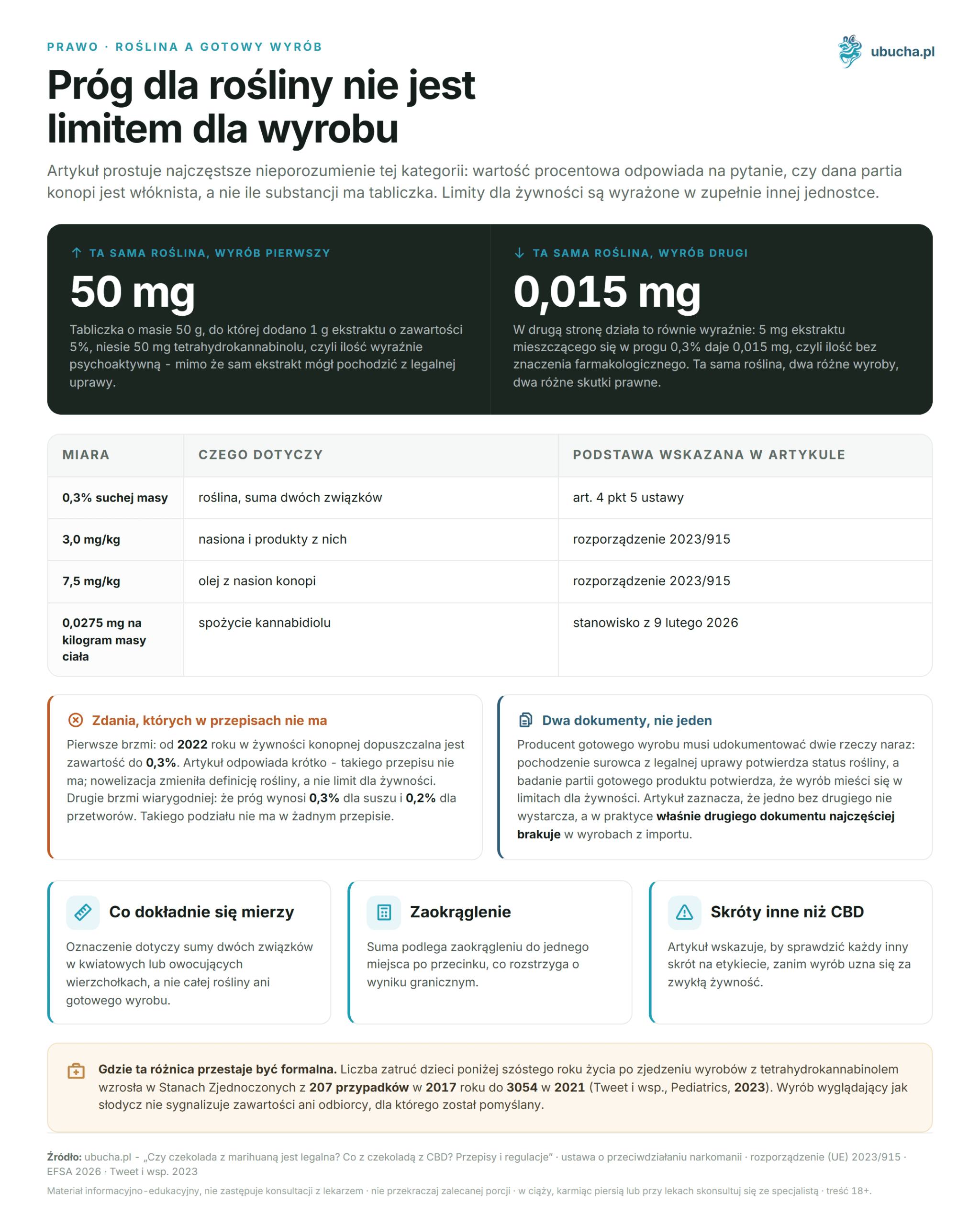
- Food from hemp seeds has separate limits expressed in mg/kg: 3.0 mg/kg for seeds and processed products and 7.5 mg/kg for oil (Regulation 2023/915).
- EFSA established on February 9, 2026, a provisional safe intake level for CBD at 0.0275 mg per kilogram of body weight per day (EFSA, 2026).
- The number of poisonings in children under 6 years old after consuming THC products increased in the United States from 207 cases in 2017 to 3054 in 2021 (Tweet et al., Pediatrics, 2023).
Is THC chocolate legal in Poland?
No. A food product containing cannabis other than fiber hemp or its extract is subject to the anti-narcotics law, and tetrahydrocannabinols remain psychotropic substances of group I-P. It does not matter whether the bar was legally purchased in the Netherlands, Germany, or the United States. What matters is what you have with you in Poland.
The basis is the law of July 29, 2005, currently consolidated and published by the Marshal of the Sejm on August 17, 2023 (Journal of Laws 2023 item 1939). Possession of narcotics under Article 62 paragraph 1 carries a penalty of up to three years imprisonment, and for a significant amount, Article 62 paragraph 2 raises the upper limit to ten years. Article 62a allows discontinuation of proceedings if the amount is insignificant and intended for personal use, but this is a prosecutor’s or court’s decision, not a subjective right.
Cannabidiol stands on the other side of this line. The word “cannabidiol” does not appear in the list of psychotropic substances, narcotics, or new psychoactive substances, so the compound itself is not controlled in Poland. However, this does not determine the legality of chocolate with its addition, as food trade is regulated by a separate branch of law, described later in the text.
It is also worth closing the amendment topic. The law of July 3, 2026, which comes into force on August 27, 2026, concerns substitution treatment, laboratories, and reporting. It does not affect the THC threshold, substance classification, or retail sales rules. A broader picture of the legal status is collected in the post about the legality of hemp and CBD in Poland and the EU.
Products with semi-synthetic cannabinoids require separate attention, as they are sometimes described as hemp and sold alongside chocolates in online trade. Hexahydrocannabinol, abbreviated as HHC, is a controlled substance in Poland; its position in the list changed by the Minister of Health’s regulation of July 7, 2026 (Journal of Laws 2026 item 934), effective from July 28, 2026. Moving between list groups is not legalization and does not open retail trade. If you see an abbreviation other than CBD on the label, check it before considering the product ordinary food.
Is marijuana chocolate legal in Poland?
No. Marijuana chocolate contains cannabis other than fiber hemp, i.e., a narcotic under the law, and remains outside the market regardless of where it was purchased. Bringing it from a country where it was legal changes nothing on the Polish side of the border.
We separate four products most often confused in queries in the table below. They differ not in taste but in legal basis, which decides everything.
| Product | Legal basis | Status in Poland | What is actually on the shelf |
|---|---|---|---|
| Marijuana chocolate | Anti-narcotics law, Art. 62 and Art. 53 | off the market | not available in legal sales |
| THC chocolate | same law, 0.3% threshold of sum delta-9-THC and THCA | off the market | not available in legal sales |
| CBD chocolate | novel food regulations, from February 2026 with EFSA provisional level | status unresolved | sometimes sold, certificate of analysis recommended |
| Chocolate with hemp seeds | Regulation (EU) 2023/915, 3.0 mg/kg delta-9-THC equivalent limit | legal | this is most often on the shelf |
How does Polish law divide hemp into fiber and other?
The criterion is one and numerical. Fiber hemp are Cannabis sativa L. plants in which the sum of delta-9-THC and tetrahydrocannabinolic acid in flowering or fruiting tops with unremoved resin does not exceed 0.3% on a dry weight basis. The sum is rounded to one decimal place.
This wording of Art. 4 point 5 has been in force since May 7, 2022, introduced by the law of March 24, 2022 (Journal of Laws 2022 item 763). Previously, the threshold was 0.20%. On the same day, another law dated the same day, marked as Journal of Laws 2022 item 764, came into force, which is often mistakenly cited as the basis for the threshold. Item 764 changes registers and cultivation purposes, while Art. 4 point 5 remains unchanged.
Three details from this definition affect laboratory test results and must be given together with the number. First, the sum of two compounds is measured, not just delta-9-THC; a sample with low neutral form and high acidic form may exceed the threshold. Second, the measurement concerns flowering or fruiting tops, not the whole plant or finished product. Third, rounding to one decimal place decides borderline results.
Symmetrically constructed is Art. 4 point 37: cannabis other than fiber hemp is any aerial part of the plant excluding seeds, in which the same sum exceeds 0.3%. Above this value, the raw material falls under controlled substances regime, along with everything made from it, including extract added to chocolate mass.
Fiber hemp cultivation itself is not free in Poland. It requires registration with the producers’ register maintained by the director of the local branch of the National Agricultural Support Center, and the law lists permissible cultivation purposes. Food purposes are on this list alongside textile, cosmetic, pharmaceutical, and feed purposes, so raw material for hemp food may come from legal Polish cultivation. Cultivation for own needs has a separate area limit of one hectare per year and does not grant the right to resale.
What does the 0.3% THC threshold mean for finished chocolate?
Much less than product descriptions suggest. The 0.3% threshold describes plant raw material and answers whether a batch of hemp is fiber hemp. It is not a limit for THC content in a chocolate bar and cannot be directly converted to the finished product because extraction changes proportions.
The calculation is visible in a simple example. A 50 g bar with 1 g of extract containing 5% THC carries 50 mg tetrahydrocannabinol, a clearly psychoactive dose, even though the extract itself could come from legal cultivation. Conversely, 5 mg of extract within the 0.3% threshold gives 0.015 mg THC, a pharmacologically insignificant amount. The same plant, two different products, two different legal effects.
This is the most common misunderstanding in this category, also repeated by sellers: the statement that since 2022, food hemp products may contain up to 0.3% THC. No such regulation exists. The 2022 amendment changed the plant definition, not the food limit, and food limits are expressed in a completely different unit, described in the next section.
The finished product manufacturer must therefore document two things simultaneously. The origin of raw material from legal cultivation confirms the plant status. Testing the finished product batch confirms the product fits within food limits. One without the other is insufficient, and in practice, the latter document is most often missing in imported products.
The second version of the same misunderstanding sounds even more credible: that the threshold is 0.3% for dry herb and 0.2% for processed products. No such division exists in any regulation. The law uses one value 0.3% in Art. 4 point 5 and the same value in Art. 4 point 37. The 0.20% number is true only historically, valid until May 6, 2022. Presented as current is simply outdated and used to describe processed products mixes two different regulations.
What THC limits apply in food from hemp seeds?
Separate limits expressed in milligrams per kilogram, not percentages. Commission Regulation (EU) 2023/915 of April 25, 2023, on maximum levels of certain contaminants in food sets in Annex I, in the section on delta-9-THC equivalents, three values for products from hemp seeds.
| Measure | Applies to | Value | Basis |
|---|---|---|---|
| 0.3% threshold | Plant, i.e., flowering or fruiting tops dry weight | 0.3% sum of delta-9-THC and THCA | Art. 4 point 5 of the anti-narcotics law |
| Food limit | Hemp seeds | 3.0 mg/kg | Annex I to Regulation (EU) 2023/915 |
| Food limit | Ground seeds and other processed products | 3.0 mg/kg | Annex I to Regulation (EU) 2023/915 |
| Food limit | Hemp seed oil | 7.5 mg/kg | Annex I to Regulation (EU) 2023/915 |
These levels refer to the sum of delta-9-THC and delta-9-THCA expressed as delta-9-THC, with a conversion factor of 0.877 for the acidic form. The regulation applies since May 2023 and repealed the earlier Regulation 1881/2006, which introduced the same limits a year earlier.
The practical conclusion for buyers is simple. If a bar contains only hemp seeds or flour ground from them, the 3.0 mg/kg limit applies, and it is ordinary food. If the producer added flower extract, we leave the seed area and enter novel food regulations. The distinction is usually visible in the ingredients: “hemp seeds” is one thing, “hemp extract” is quite another.
It is also worth knowing how to read test results, as units can be confusing. The 3.0 mg/kg limit means three milligrams per kilogram of product, so for a 50 g bar, this is 0.15 mg in the whole bar. This value excludes psychoactive effects and is intended to control raw material contamination, not the user dose. If the laboratory report gives results in percentages instead of mg/kg, ask for conversion, as the units then describe different things.
Is CBD chocolate legal under novel food regulations?
Formally, it requires authorization, which has not yet been issued. Novel food is food not significantly consumed in the EU before May 15, 1997, and its market introduction requires authorization under Regulation (EU) 2015/2283. No evidence of consumption before this date has been shown for cannabidiol or other cannabinoids derived from Cannabis sativa L.
The cutoff date and mechanism are described by the European Commission’s novel food status catalogue. This non-binding tool clarifies the situation: the burden of proof for consumption before May 15, 1997, lies with the entrepreneur placing the product on the market, not the supervisory authority. In practice, no one has provided such evidence for cannabinoid extracts.
This creates a situation that looks contradictory but is not. CBD oil sold as a cosmetic or non-food product moves under a different legal regime. The same oil added to chocolate mass becomes a food ingredient and enters the authorization procedure. Therefore, some producers label products as collectible or for research, which is a labeling workaround, not a legal solution.
The consequence for consumers is a lack of uniform standards. National supervisory authorities in member states interpret the status of extracts differently and enforce regulations variably, from withdrawing batches from the market to silent tolerance. So before taking a bar abroad, check the destination country’s regulations, as a product legally purchased in one EU country may not be authorized there.
The procedure has three stages worth knowing to assess the current status. The entrepreneur submits an application to the European Commission, the European Food Safety Authority assesses the ingredient’s safety, and only after a positive assessment does the Commission add it to the EU novel food list by implementing regulation. Cannabidiol stalled at the second stage and, as the next section shows, only in 2026 received the first number that decides anything.
What did EFSA establish regarding CBD safety?
First, it suspended the assessment, and after nearly four years, provided a number. In a June 7, 2022, statement, EFSA announced it could not establish cannabidiol’s safety as novel food due to data gaps and suspended evaluation of nineteen applications (EFSA, 2022).
The gaps concerned CBD’s effects on the liver, gastrointestinal tract, endocrine and nervous systems, mental performance, and reproduction, where animal studies showed significant adverse effects. The authority clearly stated it did not find cannabidiol dangerous but lacked data to consider it safe. This distinction is lost in most market descriptions. The full justification was published as an EFSA Journal opinion, adopted April 26, 2022.
The breakthrough came on February 9, 2026. EFSA’s panel established a provisional safe intake level of 0.0275 mg per kilogram of body weight per day, about 2 mg daily for a 70 kg person (EFSA, 2026). The level applies only to supplement preparations with at least 98% purity and no nanoparticles, and EFSA still cannot establish safety for persons under 25, pregnant or breastfeeding women, and those taking medications.
This number has a market consequence for chocolates that is hard to miss. Typical products declare from several to several dozen milligrams of CBD per serving, a multiple of the level EFSA considers provisionally safe. The term “provisional” is not decorative: the panel applied a 400-fold uncertainty factor because some data gaps remain open.
The updated opinion also describes what literature search until June 2024 did not close. Animal studies showed repeatable liver toxicity, with liver mass and histopathological changes as the most sensitive endpoints. Human studies indicated possible liver damage, especially with concurrent medication use. Hormonal disorders and neurodevelopmental consequences after prenatal exposure were also noted, and immunotoxicity has not yet been studied (NDA panel, EFSA Journal, 2026).
How to recognize reliable hemp chocolate in a store?
By ingredients, batch number, and certificate of analysis, not by packaging graphics. Start by distinguishing two product categories, as they stand side by side in stores, look similar, but are subject to different regulations.
The first category is chocolates with hemp seeds. Seeds contain no significant cannabinoids, are ordinary food, and subject to a 3.0 mg/kg limit. Their nutritional value is real: seeds contain over 30% oil and about 25% protein, with an omega-6 to omega-3 ratio usually from 2:1 to 3:1, and main proteins are edestin and albumin (Callaway, Euphytica, 2004). We described such products in detail in the post about hot chocolate with hemp seeds, and you can find ready products of this type in the hemp food category.
The second category is chocolates with isolate or broad-spectrum extract. The label declaration here requires verification, as the cannabinoid product market has documented problems. In an analysis of fourteen CBD oils available in Europe, nine samples had concentrations significantly different from declared, and only five were within reasonable limits (Pavlovic et al., Molecules, 2018).
What to look for in the certificate of analysis before accepting the declaration as credible:
- Batch number matching the packaging, as a general certificate says nothing about a specific bar.
- Cannabinoid content in mg per piece and per 100 g, with separate THC result.
- Contaminants, i.e., pesticides, heavy metals, and solvent residues from extraction.
- Laboratory, its accreditation, and test date.
Lack of any of these elements does not mean a bad product but means unverifiable. For imports from outside the EU, a second risk arises, described later, i.e., THC content higher than declared.
Two warning signs are worth knowing upfront. The first is a content description without numbers, like “with hemp extract added,” without mg per piece or per 100 g. Without this, products cannot be compared or portion related to EFSA’s level. The second is markings suggesting psychoactive effects, e.g., information about high THC content. Such a declaration cannot appear on a product legally available in Poland, so either the description lies or the product should not be there.
How does CBD chocolate’s effect differ from vaporization?
Sometimes in effect and dose predictability, not strength. After ingestion, cannabinoids pass through the digestive tract and liver, where part of the substance is metabolized before entering circulation. After inhalation, it reaches the blood from the lungs, so the effect appears faster and fades faster.
Market descriptions often invent numbers here, so it is worth citing what was actually measured. A systematic review of cannabidiol pharmacokinetics in humans covered 792 articles, 24 of which contained pharmacokinetic data. Absolute bioavailability was determined only after smoking and was 31%. For oral and sublingual routes, no study determined it despite availability of intravenous forms (Millar et al., Frontiers in Pharmacology, 2018).
| Route of administration | What was measured in humans |
|---|---|
| Inhalation | Absolute bioavailability 31%; half-life 31 hours |
| Oral, i.e., chocolate and other edibles | Absolute bioavailability not determined; half-life 2-5 days with chronic administration |
| Sublingual and mucosal | Absolute bioavailability not determined; half-life 1.4-10.9 hours |
| All oral | Maximum concentration reached between zero and four hours after administration |
One phenomenon is well measured and relevant for chocolate. Eight patients took a pure CBD capsule once fasting and once after a high-fat meal of 840-860 kcal. The maximum concentration in the fed state was on average fourteen times higher, and the area under the curve four times higher (Birnbaum et al., Epilepsia, 2019). Cocoa butter is fat, so chocolate indeed acts as a carrier. The delayed and prolonged effect mechanism of edibles is described separately in the post about why edible CBD hits stronger and later than dry herb.
This delay causes the most common error with edibles, regardless of cannabinoid. Maximum concentration after oral administration occurs between zero and four hours after ingestion, so a person who feels nothing after half an hour takes a second dose before the first started working. EFSA’s 2026 opinion also notes that CBD bioavailability is variable and depends on the carrier and meal consumed. Both factors act simultaneously in chocolate.
What risks does cannabinoid chocolate carry?
Three deserve attention: criminal liability for THC products, child poisonings, and drug interactions. The first results directly from the regulations described at the beginning; the other two have solid data and are often omitted in product descriptions.
Child poisonings are the best documented risk in this category. An analysis of reports to the US poison control system covered 7043 cases of edible cannabis ingestion by children under 6 years old from 2017-2021. Reports rose from 207 in 2017 to 3054 in 2021, a 1375% increase. Almost all incidents (97.7%) occurred at home, 70% of cases involved central nervous system depression, and 22.7% were hospitalized (Tweet et al., Pediatrics, 2023).
Drug interactions concern the liver. Cannabidiol is metabolized hepatically, so there is a real possibility of pharmacokinetic interactions via enzyme and transporter inhibition or induction; a documented example is CBD’s effect on clobazam metabolism (Lucas et al., British Journal of Clinical Pharmacology, 2018). If you take medications chronically, inform your doctor before using cannabinoid products.
Pregnancy and breastfeeding stand separately. The problem is lack of human data, not proven harm: a review of CBD adverse effects lists developmental toxicity and embryofetal mortality at doses higher than used in humans in animal studies (Huestis et al., Current Neuropharmacology, 2019). EFSA’s 2026 opinion also excludes this group from the provisional safe level, noting additionally that cannabidiol crosses the placenta and accumulates in the body.
There is a rarely mentioned risk resulting directly from the product form. A chocolate bar does not look like medicine and goes to the food cabinet, not the first aid kit. Poison control data show 97.7% of reported ingestions by small children occurred at home, not elsewhere. If you keep cannabinoid products in the kitchen, treat them as preparations, not sweets: in original packaging, out of children’s reach, and with clear content labeling on the outside.
What are legal alternatives to CBD chocolate?
Two have clearer status and better dose control: oil administered sublingually and hemp dry herb for vaporization. Both avoid the problem affecting edibles, i.e., dose enclosed in a food product with unknown repeatability.
Oil provides a predictable portion, as you measure the dose in drops according to the label’s conversion, not chocolate squares. The same caveat applies as with chocolate: it is worth comparing the declaration with the batch certificate, as nine of fourteen tested preparations deviated from the declaration (Pavlovic et al., 2018). Sublingual oil also shares the oral route problem in literature, as no human study determined absolute bioavailability for this route.
Hemp dry herb is legal as long as it comes from fiber hemp meeting the threshold in Art. 4 point 5. Vaporization is the only route for which bioavailability was actually measured, and the effect appears within minutes instead of an hour. The price also looks different, as a dry herb portion usually suffices for one session and does not require buying a carrier in the form of confectionery.
If you still want to stick with chocolate, make it yourself and control the dose. Acidic cannabinoid forms convert to neutral only at temperatures studied between 80 and 145 degrees Celsius over several tens of minutes (Wang et al., Cannabis and Cannabinoid Research, 2016), so melting the mass in a water bath does not convert anything. A practical recipe is described in the post about how to make CBD chocolate.
The homemade version also solves the portion division problem that a purchased bar does not solve at all. Measuring oil drops on a known chocolate mass lets you know how much cannabinoid per piece and relate it to EFSA’s provisional level. With ready products, you only have the producer’s declaration, which as shown in the fourteen-preparation study, often diverges from measurement. Just remember to store the finished mass in a cool, dark place, as cannabinoid preparation stability during storage is a documented weak point (Golombek et al., Toxics, 2020).
Frequently Asked Questions
Can I legally buy THC chocolate in Poland?
No. A product containing cannabis other than fiber hemp or its extract is subject to the anti-narcotics law, and possession of narcotics under Article 62 paragraph 1 carries a penalty of up to three years imprisonment. It does not matter that the bar was legally purchased abroad, as the place of possession counts.
Does CBD chocolate require a prescription?
No, because cannabidiol is not listed in the Polish controlled substances register. However, this does not determine the product’s market authorization: cannabinoid extracts are subject to novel food regulations and require authorization under Regulation (EU) 2015/2283, which no preparation has yet obtained.
How much THC is allowed in food made from hemp seeds?
Regulation (EU) 2023/915 sets 3.0 mg/kg for hemp seeds and products processed from them, and 7.5 mg/kg for hemp seed oil. These levels refer to the sum of delta-9-THC and delta-9-THCA expressed as delta-9-THC. This is a different measure than the 0.3% threshold that applies to the plant.
What is the currently recognized safe daily intake of CBD?
On February 9, 2026, EFSA established a provisional safe intake level of 0.0275 mg per kilogram of body weight per day, approximately 2 mg for a 70 kg person. This level applies only to preparations with at least 98% purity and does not apply to persons under 25 years old, pregnant women, or those taking medications.
Can I make CBD chocolate at home?
For personal use, yes, using legally purchased oil. Melting the mass in a water bath does not convert cannabinoids, as acidic forms convert to neutral only between 80 and 145 degrees Celsius over several tens of minutes (Wang et al., Cannabis and Cannabinoid Research, 2016).
Will a drug test be positive after eating CBD chocolate?
Standard tests detect THC, not cannabidiol. Full-spectrum products contain trace amounts of tetrahydrocannabinol, so regular consumption carries a risk of a positive result. Isolates and broad-spectrum preparations are safer in this regard, provided the batch certificate confirms the absence of THC.
Does CBD chocolate help with insomnia?
The data are weaker than product descriptions suggest. In a retrospective case series of 72 adults, anxiety scores improved in the first month in 79.2% of patients, and sleep scores in 66.7%, though the latter fluctuated over time (Shannon et al., Permanente Journal, 2019). The authors call for controlled studies.
Can CBD chocolate be transported to another EU country?
Do not assume so. The status of cannabinoid extracts in food is not harmonized in the EU, and national supervisory authorities interpret and enforce regulations differently. A product legally purchased in one member state may not be authorized in another, so check the destination country’s regulations before traveling.
A better regulated alternative to edibles is collected in the hemp oils category.
This article is for informational and educational purposes and does not constitute legal advice. The legal status described applies as of the publication date: hemp regulations may change. Consult a lawyer or current legal acts before making decisions.
Author: Michał Waluk · Published: 2026-05-06 · Updated: 2026-08-24