
How to Choose a CBD Oil? Buying Guide 2026
Concentration, spectrum, and COA certificate: how to recognize good CBD oil in 2026 and avoid mislabeled products. Proven selection criteria.
For your first purchase, take a 5 or 10 percent oil in a 10 ml bottle, and before paying, open the Certificate of Analysis and check two things: the declared cannabidiol content and the pesticide and heavy metals test results. Higher concentrations and larger volumes make sense only when you know the product suits you. Meanwhile, the global CBD product market will reach a value of 47.2 billion USD by 2028, growing at 21.3% annually from 4.9 billion USD in 2021 (Vantage Market Research, 2022), but choosing the right product is not simple. Polish store shelves are overloaded with oils, capsules, cosmetics, and flower, and quality differences can be dramatic, even among products with the same declared price and concentration. A 2017 Penn State College of Medicine study found that 69% of tested online CBD oils did not match label claims (Bonn-Miller et al., JAMA, 2017): nearly 7 out of 10 products contained too little or too much CBD, and 18 of 84 samples had detectable THC despite a “0% THC” label. This guide shows which criteria to watch to avoid such products: concentration, spectrum, extraction method, storage, and COA certificate. There is no dosage table here.
KEY INFORMATION
• The global CBD market will grow to 47.2 billion USD by 2028, at 21.3% annually (Vantage Market Research, 2022).
• 69% of CBD oils sold online have concentrations inconsistent with the label (Bonn-Miller et al., JAMA 2017), so a COA certificate is essential.
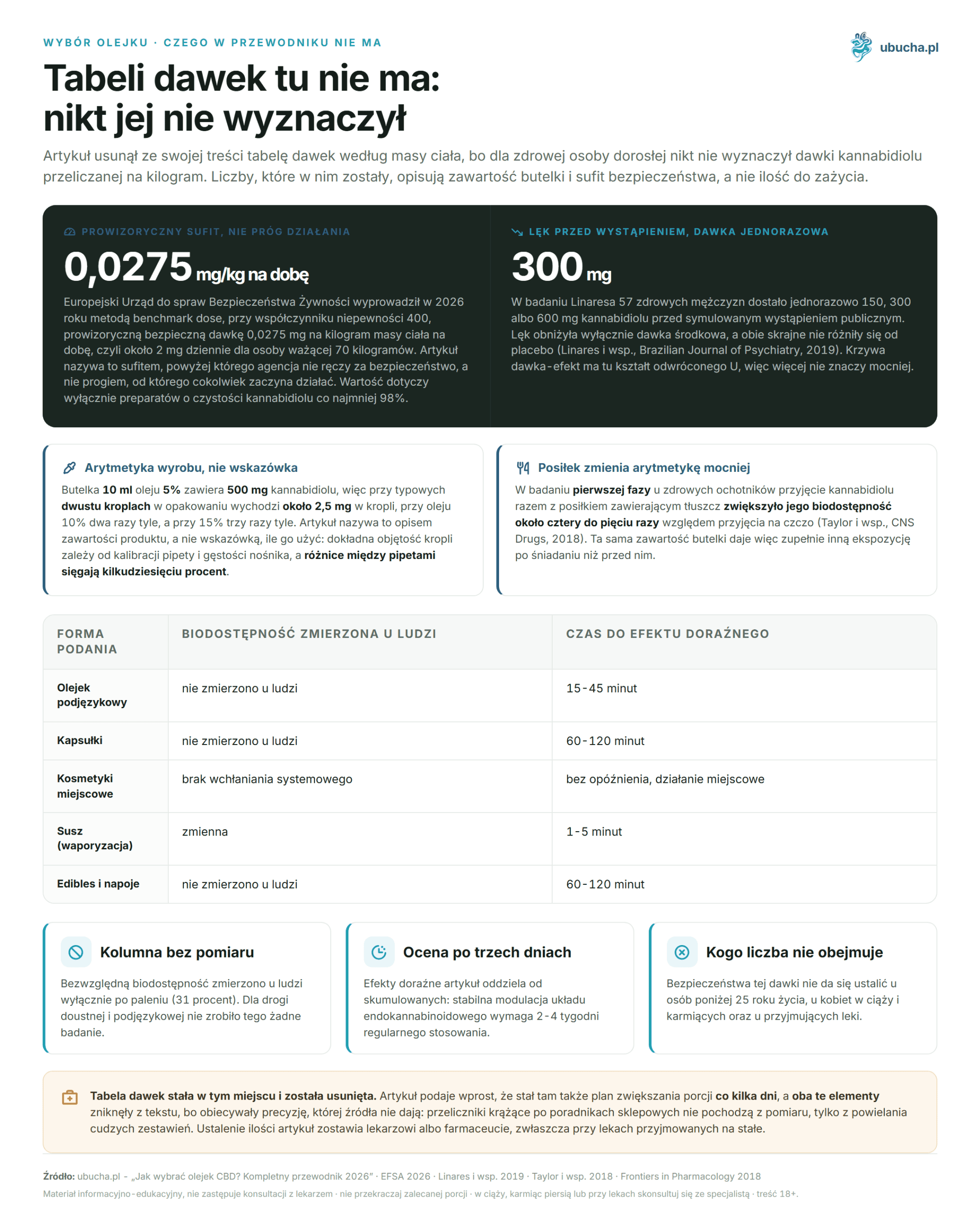
• The only body weight-related number with basis is EFSA’s provisional safe dose (2026): 0.0275 mg/kg body weight per day, about 2 mg at 70 kg.
• CO2 extraction yields the purest extract without solvent residues.
• Broad spectrum preserves the entourage effect without risk of THC detection in drug tests.
What is CBD and why does product quality matter?
Cannabidiol (CBD) is a non-psychoactive compound from industrial hemp Cannabis sativa L., which unlike THC does not cause intoxication. It acts by modulating the endocannabinoid system (ECS), regulating sleep, mood, pain, and immunity. WHO in a 2018 report classified CBD as safe and well tolerated, without addictive potential (WHO, 2018).
However, not every CBD product meets these conditions. Penn State College of Medicine tested 84 internet CBD products in 2017: 26% had more CBD than declared, 43% less, and only 31% were within a 10% tolerance range (Bonn-Miller et al., JAMA, 2017). 18 of 84 samples contained detectable THC despite a “0% THC” label.
Why do such discrepancies occur? Cannabidiol is sensitive: improper extraction, wrong temperature during production, light exposure, and too long raw material storage degrade the molecule before bottling. Some producers deliberately understate CBD content to save on more expensive raw material. CBD product quality is thus a technological and ethical issue, not marketing.
Three factors determine finished product quality:
- Raw material origin. Hemp is a phytoremediator and absorbs soil contaminants, so cultivation on polluted land yields oil with heavy metals.
- Extraction method. Supercritical CO2 extraction yields the purest cannabinoid profile without solvent traces. Ethanol extraction is cheaper, while hexane or butane extraction may leave toxic residues.
- Certificate of Analysis (COA). A solid COA from an independent lab includes HPLC profile, pesticide, heavy metals, and microbiology tests, separately for each batch.
A premium producer publishes all this openly: hemp origin, extraction method, terpene profile, and full COA. A cheap producer stops at phrases like “natural hemp extract” without specifying milligram concentration. Price also speaks: producing quality extract and lab tests cost more than a few dozen PLN, so suspiciously cheap oil is usually diluted or mislabeled.
What types of CBD products are there and which to choose?
The CBD market offers several basic forms: oils, capsules, cosmetics, flower, and edibles. Oils dominate because they provide quick effect and precise drop dosing. The bioavailability column says the same in every row, as absolute bioavailability was measured in humans only after smoking (31 percent), and no study measured it for oral or sublingual routes (Frontiers in Pharmacology, 2018). Form choice depends on purpose and lifestyle: an athlete after training will choose differently than a person with a tight meeting schedule, and the problem type influences choice as much as taste preferences.
| Form | Bioavailability | Time to effect | Best use | For first purchase |
|---|---|---|---|---|
| Sublingual oil | not measured in humans | 15-45 minutes | Precise dosing, universal form | yes, 5-10% in 10 ml |
| Capsules | not measured in humans | 60-120 minutes | Travel, discretion, fixed dose | no, no drop dosing |
| Topical cosmetics | no systemic absorption | local effect, no delay | Acne, muscle pain, microinjuries | no, different use |
| Flower (vaporization) | variable | 1-5 minutes | Fastest effect, requires vaporizer | no, requires vaporizer |
| Edibles and drinks | not measured in humans | 60-120 minutes | Daily routine, low dose precision | no, low dose precision |
Hemp flower is the least processed form, with a full profile of cannabinoids and terpenes in natural plant proportions. Vaporization gives the fastest effect but requires investment in quality equipment, and flower infusion has low bioavailability because CBD poorly dissolves in water. We write more about this form in a separate guide on CBD flower.
CBD cosmetics act locally: CB2 receptors in skin and sebocytes allow modulation of sebum and inflammation. A 2014 study showed CBD inhibits sebum production and proinflammatory cytokine secretion in sebocytes (Oláh et al., Journal of Clinical Investigation, 2014), making this form interesting for acne and atopic dermatitis.
Capsules solve taste and discretion issues: you swallow one with a fixed dose, usually 10, 25, or 50 mg, without measuring drops. Their drawback is lower bioavailability and slower onset, as cannabinoids must pass through the digestive system and liver, where cytochrome P450 enzymes metabolize part of the dose. They suit business travelers, people eating lunch at work, or those needing repeatable, fixed dosing without measuring.
Why won’t you find a dosage table by body weight here?
Because there is no basis to build one. No dose per kilogram of cannabidiol has been established for healthy adults, and dosage charts circulating in store guides come from copying others’ data, not measurement. Such a table with a plan to increase doses every few days was removed because it promised precision that does not exist.
The only body weight-related number with basis goes against the usual recommendation. The European Food Safety Authority in 2026 derived by benchmark dose method, with an uncertainty factor of 400, a provisional safe dose of 0.0275 mg per kilogram body weight per day, about 2 mg daily for a 70 kg person. This is a ceiling above which safety is not guaranteed, not a threshold where effects begin. The value applies only to preparations with at least 98% cannabidiol purity, and safety cannot be established for people under 25, pregnant or breastfeeding women, or those taking medications.
Numbers reported in studies look very different and do not translate to store shelves. In Linares’ study, 57 healthy men received a single 150, 300, or 600 mg cannabidiol dose before simulated public speaking: only the middle dose reduced anxiety, and both extremes did not differ from placebo (Linares et al., Brazilian Journal of Psychiatry, 2019). The dose-effect curve is an inverted U shape, so more does not mean stronger. This is exactly why a table with increasing numbers would mislead rather than help.
If you still want to try cannabidiol, determine the amount with a doctor or pharmacist, especially if you take medications regularly. This is the only way that considers your situation, not an averaged number from someone else’s chart.
How much cannabidiol is in a drop and how long until it starts working?
These are two things that can be given without guessing: the first comes from product arithmetic, the second from pharmacokinetic measurements. A 10 ml bottle of 5% oil contains 500 mg cannabidiol, so with typically two hundred drops per package, there is about 2.5 mg per drop; 10% oil has twice that, and 15% three times that. This describes product content, not how much to use. Exact drop volume depends on pipette calibration and carrier density, so quality oil producers state milligrams directly on the label or COA, and pipette differences can reach several tens of percent.
Meal composition changes this arithmetic more than concentration differences. In a phase 1 study with healthy volunteers, taking cannabidiol with a fat-containing meal increased bioavailability about four to five times compared to fasting (Taylor et al., CNS Drugs, 2018). The same bottle content thus gives a very different exposure after breakfast than before.
Effect time depends on administration route. Oil held under the tongue starts working in 15-45 minutes, with effects lasting several hours. Capsules and edibles start after 60-120 minutes, as they must pass through the digestive system and liver, where cytochrome P450 enzymes metabolize part of the substance. These are acute effects: stable ECS modulation requires 2-4 weeks of regular use, so an assessment after three days usually says more about the user’s patience than the product.
Full spectrum, broad spectrum, or isolate - what to choose?
Spectrum choice is one of the most important decisions when buying CBD. Full and broad spectrum benefit from the entourage effect, synergy of cannabinoids and terpenes, described by Ethan Russo in the British Journal of Pharmacology in 2011 (Russo, British Journal of Pharmacology, 2011). Isolate, pure CBD without other components, is chosen less often: mainly for precise dosing in research or terpene allergy.
Terpenes share a biochemical precursor with cannabinoids and influence both scent and oil effect, which we discuss in detail in the text about terpenes in CBD. The choice between full and broad spectrum is mainly practical, related to drug tests: broad spectrum eliminates THC detection risk while preserving entourage effect, so it is chosen by people regularly tested at work.
Full spectrum contains the full hemp profile: CBD, CBG, CBN, CBC, CBDV, terpenes, and flavonoids, with trace THC up to 0.3%. It gives the strongest entourage effect but with intensive, long-term use may be detected in drug tests.
Broad spectrum is the same profile with THC removed, usually by chromatography, with content below detection limit 0.01%. It is a compromise chosen by most users: entourage effect without detection risk.
CBD isolate is pure 99% CBD without terpenes or other cannabinoids, tasteless and odorless. It provides full dose certainty but without entourage effect acts weaker per milligram than full spectrum extracts.
| Spectrum | THC Content | Entourage Effect | Best Use |
|---|---|---|---|
| Full spectrum | Up to 0.3% (legal in PL) | Maximum | Experienced users without professional restrictions |
| Broad spectrum | None (below 0.01%) | High | Most users, drivers, athletes |
| CBD isolate | None | None | Allergics, research, precise dosing |
If you need a deeper comparison of technical parameters, check our complete guide to CBD types, where we compare these three variants regarding drug interactions and storage.
Which CBD to choose at the start?
Sublingual oil 5 to 10 percent in a 10 ml bottle. This form allows drop dosing, so you can start low and increase slowly, and the small volume limits loss if the product does not suit you. Broad spectrum is more reasonable at start than full, as it contains no residual THC.
What not to buy at the start: concentrations above 20 percent, large promotional volumes, products without a batch-specific COA, and combined sets with other raw materials, as it is impossible to tell what worked or caused allergy. Cosmetics and gummies save for later, when you already know how you react to cannabidiol alone.
You won’t find a ranking of best oils in this guide, and that is a decision. Without head-to-head comparative studies, such a list would be an opinion disguised as measurement, and the criteria in this text allow you to assess any product independently.
How to recognize a good CBD product when buying?
The Certificate of Analysis (COA) is the first and most important test: without it, the product is unreliable. A solid COA comes from an independent, accredited laboratory (e.g., ISO 17025), covers a specific batch (batch number), and includes an HPLC cannabinoid profile, pesticide, heavy metals, and microbiology tests.
How to verify COA yourself:
- Locate the batch number on the COA and compare it with the number on the bottle.
- Check the test date: it should be within the last 12 months.
- Compare declared CBD concentration with the label: the difference should be within a 10% tolerance.
- Check THC: below 0.3% for full spectrum, below detection limit for broad spectrum and isolate.
- Review pesticide and heavy metals sections: each item should be marked “ND” (not detected) or below the norm.
Before buying, ask the seller directly:
- Where does the hemp come from? (preferably Poland, Czech Republic, Slovenia, Italy, or Switzerland)
- What extraction method is used? (CO2 preferred)
- What spectrum is it and why this one?
- Is there a current COA for this specific batch?
A bad answer is vague, like “all our products are high quality.” A good answer includes the farm or country name, extraction method description, and a COA link, and the seller can explain the spectrum difference without looking at a cheat sheet.
Five warning signs when buying: price grossly inadequate to production costs, no COA or COA from a non-accredited lab, producer absent from search engines or registered only recently, medical claims like “cures cancer” (illegal in the EU), and lack of dosing and contraindication information. We discuss recognizing such products in more detail in the guide on cheap CBD vs good CBD.
From our experience, the simplest test of store credibility is whether the COA can be found without asking, directly at the product. Stores that hide the certificate or provide it only on request usually have something to hide.
Is CBD legal in Poland in 2026?
Yes. CBD from industrial hemp Cannabis sativa L. is legal if the sum of delta-9-THC and tetrahydrocannabinolic acid (THCA) in flowering or fruiting tops does not exceed 0.3% dry weight, rounded to one decimal place. The basis is Article 4 point 5 of the Act of July 29, 2005 on counteracting drug addiction (consolidated text Dz.U. 2023 item 1939), as amended by the Act of March 24, 2022 (Dz.U. 2022 item 763). Cannabidiol is not listed on any controlled substances list.
The Polish CBD market reached about 130 million euros in 2024, with a forecast growth to 200 million euros in 2028 (Fakty Konopne, 2024). CBD products are sold in Poland as cosmetics or for collection purposes: they are not registered as dietary supplements or medicines. Since 2019, oral CBD products are subject to the EFSA “Novel Food” procedure, which has not yet completed full authorization, though this does not affect sales legality if THC limits are respected. Until 2017, the industry operated in a legal gray zone: only clarifying the THC limit for industrial hemp gave stores and producers a clear basis to operate without criminal liability risk.
In practice, this means:
- You may buy, possess, and use CBD products with THC below 0.3%, sell them online and offline, and transport them in luggage domestically and in the EU, subject to local regulations.
- You may not present CBD as a medicine (“cures depression,” “stops cancer”) or sell products exceeding THC limits.
Drug tests detect THC and its metabolites, not cannabidiol, so pure broad spectrum or isolate usually do not yield positive results. Full spectrum contains up to 0.3% THC, which with intensive and long-term use may be detected in urine tests. For people regularly tested at work, broad spectrum or isolate with current COA is recommended.
What mistakes do we most often make when choosing and using CBD?
The most common mistakes concern too high or too low doses, wrong form, unrealistic expectations about effect speed, and incorrect storage. Each reduces supplementation effectiveness or increases side effect risk, and most can be easily avoided by understanding CBD’s mechanism. The following five are the most frequent mistakes regardless of form and concentration.
- Starting with a large dose at once. The belief that more means better is common among new users, but the result can be drowsiness, dry mouth, sometimes dizziness, and weaker long-term effect due to the inverted U curve. Discuss dose with a doctor or pharmacist instead of reading it from online tables.
- Expecting immediate effects. Acute effects appear after 15-45 minutes, but full ECS modulation requires 2-4 weeks of regular use. Quitting after 3-5 days means losing the cumulative effect that is just arriving.
- Improper storage. CBD is sensitive to light, heat, and oxygen: oil kept in a bathroom or on a windowsill loses potency within weeks. Optimal conditions are dark glass, 15-20°C temperature, and no direct light.
- Ignoring drug interactions. CBD inhibits cytochrome P450 enzymes, including CYP3A4 and CYP2C9, which metabolize a significant portion of drugs, including warfarin, statins, and some antiepileptics (Brown and Winterstein, Journal of Clinical Medicine, 2019). Combining without medical consultation may increase side effects.
- Buying the cheapest product. A 5% CBD oil in 10 ml for 25-30 PLN is usually diluted or mislabeled, as producing quality extract and lab tests cost more. Real market prices for certified CBD oils start around 70-80 PLN for 10 ml at 5% concentration.
We noticed in customer conversations that the most common disappointment reason is not a faulty product but expecting effects on the first day. Clear information “cumulative effect after 2-4 weeks” on the label and product description realistically limits such disappointment.
How to store and transport CBD?
Cannabidiol degrades under oxygen, UV radiation, and temperatures above 25°C. Stability studies show that CBD dissolved in oil is significantly less stable than pure CBD powder, and storage conditions realistically determine product shelf life (Kosović et al., 2021). Improper storage accelerates potency loss noticeably faster than the declared expiration date.
Optimal conditions are a tightly closed dark glass bottle, 15-20°C temperature, no direct light, and low humidity: a kitchen cabinet or drawer works better than a bathroom, windowsill, or car in summer. Standard CBD oil shelf life is 18-24 months from production, and after opening, it is best used within 6-12 months. Some users keep oil in the fridge, which is safe, though it must be warmed to room temperature before use, as cold oil thickens and is harder to dose precisely with a dropper.
| Country or region | THC limit in CBD products |
|---|---|
| Poland and most of the EU | 0.3%, according to national law |
| Slovakia, Lithuania | 0% |
| United Kingdom | 0.2% |
| USA (federal level) | 0.3%, states have additional regulations |
Before international flights, check local regulations of destination and transit countries, and keep oil in original packaging with a clear label, preferably with a COA printout. This is rarely needed but provides real peace of mind during customs control.
Signs of degradation are color change from light golden to dark red or brown, thickening, and bitter taste. Degraded oil is not dangerous but loses some potency: if the product is just past expiration but looks and tastes normal, it probably retained most potency, though effect will be weaker than fresh oil. With clear color, smell, or consistency changes, better buy a new bottle than rely on uncertain effects of expired product.
Summary - how to consciously choose CBD oil in 2026?
Conscious CBD choice is a process, not a single decision. First, define the goal: sleep, stress, recovery, skin. Then the form: oil as a universal option, capsules for convenience, cosmetics for topical use. Next, spectrum: broad for most users, full for experienced without professional restrictions, isolate for allergics.
Next step is concentration and brand. Concentration describes cannabidiol density in the carrier, not effect strength: lower allows finer dosing steps, higher less liquid for the same bottle content. A brand with transparent hemp origin, CO2 extraction, and full COA from an accredited lab. Price adequate to quality, neither cheapest nor most expensive.
Determine amount with a doctor or pharmacist, especially if taking drugs metabolized by CYP3A4, and keep EFSA’s provisional ceiling in mind. Give yourself 2-4 weeks before judging effect. Store oil in a dark, cool place away from sunlight.
CBD is not a miracle cure but a proven tool to support the endocannabinoid system. The market grows fast, so more people test cannabidiol as part of daily routine. Success depends on understanding your needs, choosing a quality product with a COA certificate, and patiently testing effects. Whether you ultimately choose oil, capsule, flower, or cosmetic, producer transparency and a current Certificate of Analysis remain the only reliable reference points in a market changing faster than shelf labels.
Frequently Asked Questions
What does the concentration of CBD oil actually indicate?
It describes the density of cannabidiol in the carrier, not the strength of the effect. A 5% oil contains 500 mg in 10 ml, which is about 2.5 mg per drop with two hundred drops in the bottle, allowing for finer dosing steps than 10% or 15% oils. This is product arithmetic, not a dosage guideline: determine that with a doctor or pharmacist, as no dose has been established for a healthy adult.
Are CBD oils legal in Poland in 2026?
Yes, products from industrial hemp Cannabis sativa L., where the sum of delta-9-THC and THCA does not exceed 0.3% dry weight, are legal in Poland. The basis is Article 4 point 5 of the Act of July 29, 2005 on counteracting drug addiction (consolidated text Dz.U. 2023 item 1939), as amended by the Act of March 24, 2022 (Dz.U. 2022 item 763). CBD is not listed on any controlled substances list.
What is a COA certificate and why is it important?
A Certificate of Analysis (COA) is a report from an independent laboratory confirming cannabinoid content and absence of contaminants. It should include an HPLC profile, pesticide, heavy metals, and microbiology tests. A 2017 Penn State study found that 69% of tested CBD oils did not match label claims, making the COA certificate crucial (Bonn-Miller et al., JAMA, 2017).
What is the difference between broad spectrum and full spectrum?
Full spectrum contains all cannabinoids and terpenes, including trace THC up to 0.3%. Broad spectrum has the same profile but without THC. Both benefit from the entourage effect described by Ethan Russo in the British Journal of Pharmacology in 2011 (Russo, 2011). Isolate is pure CBD without other cannabinoids and without synergy effect.
Is there an established dosage for CBD oil?
For a healthy adult, no. No study has established a cannabidiol dose per kilogram of body weight, and dosage charts circulating in stores replicate others’ numbers. However, there is a limit: EFSA set a provisional safe dose in 2026 at 0.0275 mg per kilogram of body weight per day, about 2 mg for 70 kg, noting that safety cannot be established for people under 25, pregnant or breastfeeding women, or those taking medications.
How long does it take for CBD oil to start working?
Sublingual CBD oil acts within 15-45 minutes, with effects lasting 4-6 hours. Capsules and gummies start working after 60-120 minutes due to first-pass liver metabolism. Topicals act in tissues under the skin but do not exclude absorption into the blood: in the most cited transdermal study, plasma cannabidiol concentration increased linearly with dose, though measured in rats. Full ECS modulation effect appears only after 2-4 weeks of regular use.
Does CBD interact with medications?
Yes. CBD inhibits cytochrome P450 enzymes, mainly CYP3A4 and CYP2C9, which together metabolize a significant portion of drugs on the market (Brown and Winterstein, Journal of Clinical Medicine, 2019). This includes warfarin, statins, and some antiepileptic drugs. Consult a doctor or pharmacist before starting supplementation, especially if you take medications regularly.
How to recognize a cheap, low-quality CBD oil?
Low-quality oils usually do not provide a COA, have imprecise concentration descriptions without milligrams, come from solvent extraction such as hexane, and the producer does not disclose raw material origin. A price significantly below 50 PLN for 10 ml of 5% oil is usually a warning sign. The 2017 Penn State study found that 69% of such oils had incorrect CBD concentration (Bonn-Miller et al., JAMA, 2017).
If you are looking for oil, start browsing the CBD oils category in the u Bucha store and check the COA for the specific batch before purchase.
This article is informational and educational and does not constitute medical advice. Before starting cannabis or CBD for therapeutic purposes, consult a doctor, especially if you take other medications, are pregnant, or breastfeeding. CBD is not registered as a medicine or dietary supplement in Poland; it is sold as a cosmetic or for collection purposes.
Author: Michał Waluk · Published: 2026-05-11 · Updated: 2026-08-24