Adaptogens and Their Impact on the Central Nervous System - Molecular Mechanisms of Stress Protection
Adaptogens and the central nervous system: cortisol, NGF, GABA, and neuroinflammation. We separate human trials from animal studies, provide doses and contraindications.
The brain pays a measurable price for chronic stress, although it is smaller than popular texts suggest. In the largest imaging meta-analysis to date, the hippocampus of people with depression was 1.24% smaller than that of healthy individuals, and in recurrent depression 1.44% smaller (Schmaal et al., Molecular Psychiatry 2016). Adaptogens enter this picture as substances that shift the stress response rather than block a single receptor. The problem is that some mechanisms described online come from cell cultures or mice and have never been verified in humans. Below we separate one from the other, provide doses from specific trials, and show where evidence simply does not exist.
KEY INFORMATION
• The hippocampus in depression is smaller by 1.24%, not by several percent (Schmaal et al., 2016).
• Ashwagandha 240-600 mg daily lowered morning cortisol by 23-27.9% in two randomized trials.
• Hericenones from Hericium erinaceus do not stimulate NGF production, contrary to widespread claims (Mori et al., 2008).
• Eight cases of liver injury after ashwagandha, including 3 deaths, have been reported (Philips et al., 2023).
What does chronic stress do to brain structure?
Chronic stress damages the central nervous system via three described pathways: excess glucocorticoids, disruption of glutamatergic transmission, and low-grade inflammation. Volume differences visible on MRI are real but small. The ENIGMA meta-analysis on 1728 patients and 7199 controls showed a hippocampal difference of about 1.2% (Schmaal et al., 2016). The effect was driven by patients with recurrent episodes; it was absent in first episodes.
| Damage Pathway | What Happens | Source |
|---|---|---|
| Glucocorticoids | Repeated episodes of elevated cortisol exhaust regulatory systems, termed allostatic load by McEwen and Stellar | McEwen and Stellar, 1993 |
| Glutamate | Stress alters glutamate release, receptor density, and uptake in prefrontal cortex and hippocampus | Popoli et al., 2011 |
| Inflammation | Dysregulation of innate and adaptive immunity worsens prognosis and antidepressant response | Beurel et al., 2020 |
Popoli and colleagues gathered evidence that glucocorticoids released during stress alter glutamatergic transmission in the prefrontal cortex and hippocampus (Nature Reviews Neuroscience, 2011). Beurel, Toups, and Nemeroff showed that the relationship between inflammation and depression is bidirectional (Neuron, 2020). Not all depressed patients have elevated inflammatory markers, so anti-inflammatory treatment is not universally effective.
Allostatic load, described by McEwen and Stellar in Archives of Internal Medicine, is not a single measurement but the cumulative wear on regulatory systems after multiple mobilization episodes (1993). The organism pays not for stress itself but for a response that does not shut off in time. Therefore, it is measured by a set of cardiovascular and metabolic parameters, not by a single cortisol measurement.
It is also important to remember what these MRI numbers represent: average differences between large groups, not results interpretable for an individual. In the ENIGMA meta-analysis, symptom severity at study entry was not associated with volume of any structure. Age of onset below 21 years was linked to a 1.85% smaller hippocampus. The phrase “stress eats your hippocampus,” common in popular texts, describes a real phenomenon but on an incorrect scale.
Which adaptogen mechanisms are confirmed in humans, and which only in animals?
Only two mechanisms have strong confirmation in human studies: lowering morning cortisol and improving sleep and anxiety parameters measured by scales. The rest - such as increased neurotrophic factors, microglia inhibition, or action on the GABA-A receptor - come from cell cultures and rodents. Panossian and colleagues described adaptogens as substances with biphasic action, behaving as mild stressors at low doses (Medicinal Research Reviews, 2021).
| Mechanism | Strongest Evidence | Tested On |
|---|---|---|
| Lowering morning cortisol | Lopresti 2019, Chandrasekhar 2012 | Humans, randomized trials |
| Shortening sleep latency | Langade 2019, actigraphy | Humans, 60 patients |
| Memory improvement in mild cognitive impairment | Mori 2009, HDS-R scale | Humans, 30 people |
| NGF production stimulation | Mori 2008, JNK pathway | Astrocytoma cell line and mice |
| Enhancement of GABA-A signaling | Mehta 1991, flunitrazepam binding | Cell culture and rat spinal neurons |
| NLRP3 inflammasome inhibition | McColgan 2026, systematic review | Animal models only |
This table looks more modest than typical marketing descriptions, and that is intentional. The leap from astrocytoma cells to the human hippocampus is often omitted in advertising texts, yet it determines whether a substance truly changes anything in your brain.
Panossian also highlights another feature of this group: biphasic response. At low doses, an adaptogen acts as a mild stressor, activating the same adaptive pathways that protect cells from strong stress. At high doses, the same extract may act oppositely. The practical conclusion is: more is not better, and exceeding doses from studies lacks pharmacological justification.
The second reason why in vitro results do not translate to humans is concentration. Receptor binding studies are conducted at concentrations of tens of micrograms per milliliter in direct contact with tissue. After oral ingestion, the substance must pass through the gut, liver, and blood-brain barrier, and how much reaches the neuron is unknown for most adaptogen extracts. The European Medicines Agency dedicated a separate reflection paper on the adaptogen concept, describing how to evaluate such products. It is not an approved therapeutic indication.
Do adaptogens lower cortisol in humans?
Yes, ashwagandha lowers morning cortisol and this is the best-documented effect of the group. In Lopresti et al.’s study, 60 people with elevated stress took 240 mg of Shoden extract or placebo for 60 days. Cortisol dropped by 23% in the active group and rose by 0.5% in placebo (Medicine, 2019). Anxiety scale HAM-A improved significantly versus placebo; DASS-21 scale improvement was borderline significant.
The second study by Chandrasekhar et al. used a higher dose of 600 mg daily in 64 people for the same period. Perceived stress scale dropped by 44% versus 5.5% in placebo; serum cortisol dropped by 27.9% versus 7.9% (Indian Journal of Psychological Medicine, 2012). A meta-analysis of nine trials on 558 patients confirmed the direction: mean cortisol difference was 2.58 units favoring ashwagandha (Arumugam et al., Explore 2024).
One caveat: a systematic review of 52 trials on hypothalamic-pituitary-adrenal axis plants showed such heterogeneity that authors did not calculate a pooled effect (Lopresti et al., Nutritional Neuroscience 2022). The cortisol change direction is reproducible, but magnitude depends on preparation, dose, and baseline stress level.
DHEA-S, an adrenal hormone often presented as cortisol’s counterbalance, showed inconsistent results in two studies by the same team. In a stress study, DHEA-S dropped along with cortisol, interpreted as general adrenal downregulation. In a study on overweight men over 40, the same extract raised DHEA-S by 18% and testosterone by 14.7%, with no cortisol change (Lopresti et al., American Journal of Men’s Health 2019).
Thus, the studied population changes hormonal outcomes. The popular phrase about “improving the cortisol to DHEA ratio” is unsupported by these studies, as in one both hormones dropped, and in the other cortisol was unchanged. If planning lab tests, it is more sensible to focus on morning cortisol alone than on a composite ratio.
What do studies say about BDNF, nerve growth factor, and neurogenesis?
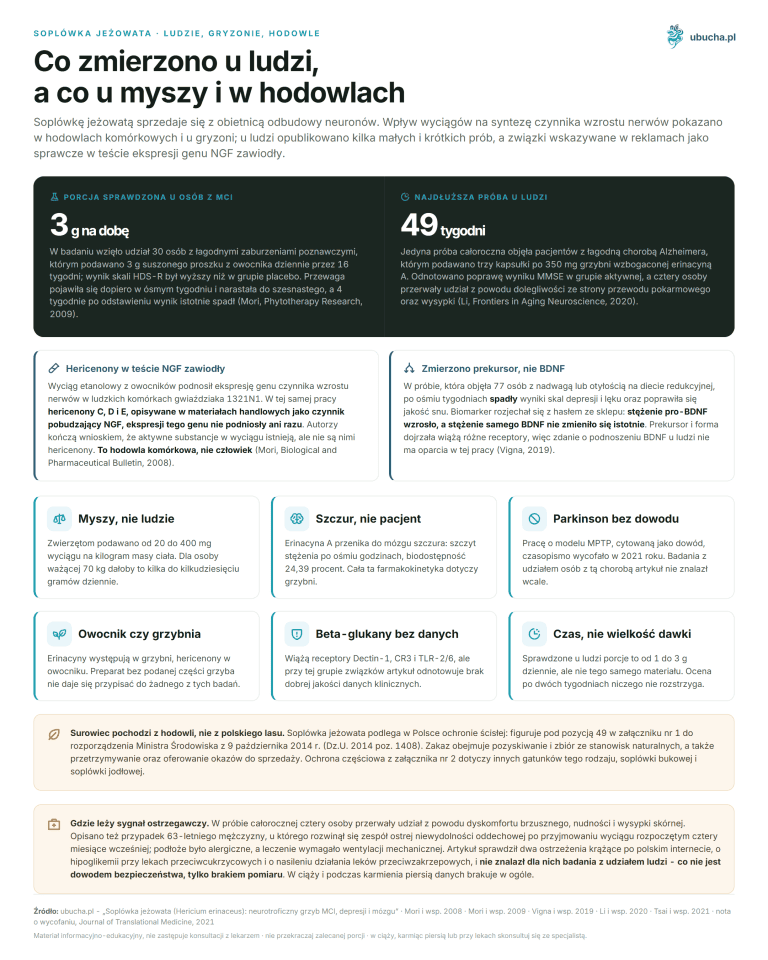
Popular descriptions often contradict source papers. During literature verification, we noticed the common claim about Hericium erinaceus contradicts the cited study. Mori et al. tested extracts from four edible mushrooms on human astrocytoma 1321N1 cells. The Hericium extract did increase NGF production via the JNK pathway, but hericenones C, D, and E did not (Biological and Pharmaceutical Bulletin, 2008).
The authors concluded that compounds responsible for NGF synthesis stimulation are not hericenones. The phrase “hericenones stimulate NGF” has circulated in Polish internet for years without basis in this work. In mice fed Hericium powder for 7 days, hippocampal NGF mRNA increased, but this is an animal result, not human.
Similarly, Brandalise et al.’s study, often described as hippocampal regeneration in Alzheimer’s model, involved wild-type (healthy) mice and showed enhanced excitatory transmission in CA3 synapses and improved recognition memory (Evidence-Based Complementary and Alternative Medicine, 2017). This is interesting but not evidence of reversing neurodegeneration. None of the cited human trials measured serum BDNF or NGF, so claims of increased proteins in humans remain hypotheses.
Even if measured, interpretation would be difficult. Peripheral BDNF mainly comes from platelets, and its correlation with brain levels is disputed. Therefore, human Hericium studies measured reliably measurable outcomes: cognitive test results, not signaling proteins. Mori et al. used the HDS-R scale; Pingali et al. measured reaction times in psychomotor tasks.
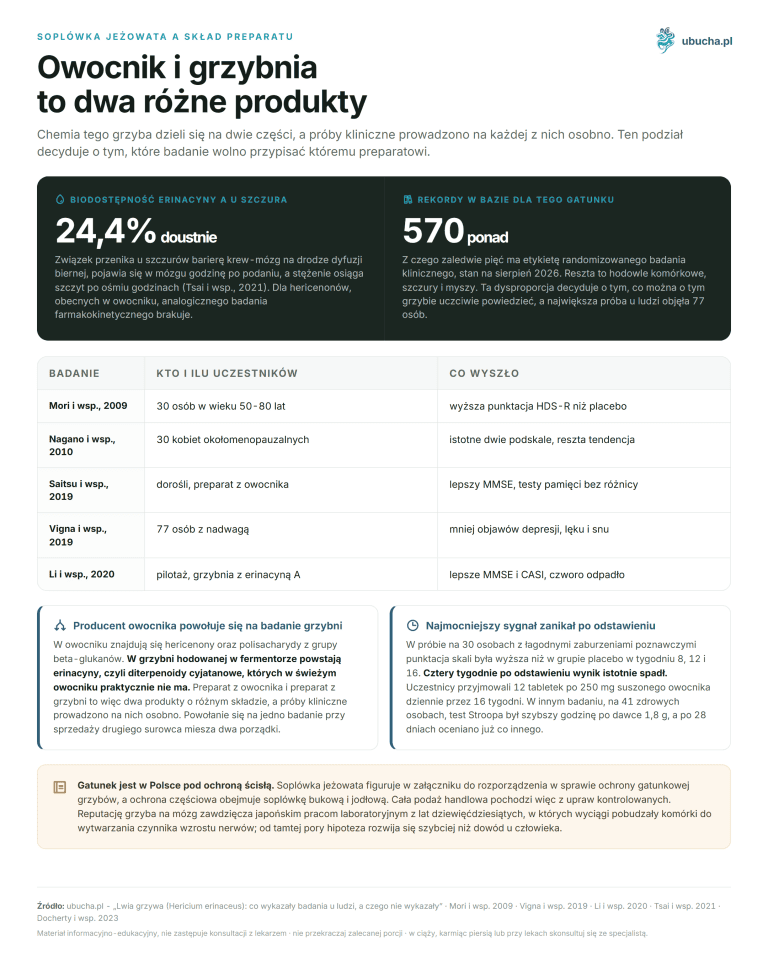
It is worth distinguishing two Hericium compound groups. Hericenones come from fruiting bodies, erinacines from mycelium. Most market supplements are made from fruiting bodies or grain substrate with mycelium. Since hericenones did not stimulate NGF synthesis in the 2008 study, declaring their content on labels does not guarantee effect. Producers citing hericenone content as a selling point rely on a feature not proven to affect neurons.
How do adaptogens affect the GABA and glutamate systems?
Data come from electrophysiology and receptor binding studies, not humans. Methanolic extract of ashwagandha root inhibited GABA and TBPS binding while enhancing flunitrazepam binding at the benzodiazepine site by 20-91% depending on concentration (Mehta et al., Indian Journal of Medical Research 1991). In mammalian spinal neurons, the extract increased chloride influx even without GABA; bicuculline and picrotoxin abolished this effect.
Authors summarized this as GABA-mimicking activity. This is an important distinction from the popular “partial agonist” description: the study shows interaction with the GABA-A receptor complex including the benzodiazepine site, tested in tissue preparations. No human replication exists.
Cannabidiol acts on the same receptor differently. In frog oocytes expressing human GABA-A receptors, it was a positive allosteric modulator of alpha1-6 beta gamma2 subtypes, without involving the classical benzodiazepine site (Bakas et al., Pharmacological Research 2017). The strongest enhancement was on receptors containing the alpha2 subunit. Reishi prolonged sleep in rats after three days of oral administration, measured by EEG and EMG (Cui et al., 2012). Again: rodents, not humans.
Practically, if you take ashwagandha in the evening and simultaneously a sedative acting on the same receptor, the risk of additive effects is real despite lack of human studies. Both substances act in the same direction, enough to inform your doctor.
It is important to distinguish this from claims about glutamate. The statement that adaptogens “restore glutamate to GABA balance” in the human brain lacks any measurement support. Concentrations of both neurotransmitters can be assessed by magnetic resonance spectroscopy, but no such study with adaptogens has been published. All knowledge about stress effects on glutamatergic transmission comes from animal models and glucocorticoid studies, not plant extract trials.
Do adaptogens inhibit brain inflammation?
We do not know this in humans. The hypothesis is plausible because the link between inflammation and depression is well described, but no clinical trial on adaptogens measured microglial activation or inflammatory markers in the central nervous system. A systematic review with meta-analysis on the NLRP3 inflammasome included only animal depression models and confirmed its role in depressive behaviors (McColgan et al., Psychiatry Research 2026).
That a pathway exists in mice does not mean a mushroom extract will inhibit it in you. Beurel et al. highlight another problem: it is unknown what proportion of untreated depressed patients have elevated inflammatory markers (Neuron, 2020). Anti-inflammatory intervention would make sense only in some patients, not all.
The practical conclusion is simple. If a seller describes reishi or cordyceps as “inhibiting neuroinflammation,” they refer to cell culture and rodent results, even if not stated. Beta-glucans and triterpenes have documented immunomodulatory effects in such systems, but translation to the human brain is unmeasured. More on the adaptogen concept and its limitations is in our text adaptogens and the nervous system.
Animal study quality is also a concern. The mentioned review assessed risk of bias with SYRCLE tool; 16 of 23 qualified studies with 170 animals total entered the meta-analysis. Groups are small, and rodent depression models reproduce single behaviors, not the disease.
This does not mean the hypothesis should be rejected. It means it stands at a different evidence level than cortisol reduction measured in two independent placebo-controlled human trials. Distinguishing these levels is the most practical skill when reading supplement descriptions. If a molecular pathway name appears without a clinical scale or number of subjects, it almost always refers to preclinical results.
In which CNS disorders do adaptogens have human data?
The list is shorter than usually claimed and includes five areas. Beyond these, there are no clinical trials; authors often fill gaps with molecular mechanisms. The table below shows how many people were actually studied per indication.
| Indication | Human Evidence | Caveat |
|---|---|---|
| Anxiety and chronic stress | 12 randomized trials, 1002 people (Akhgarjand 2022) | Authors rated evidence certainty as low |
| Mild to moderate depression | 1 trial, 57 people (Mao 2015) | Rhodiola weaker than sertraline |
| Insomnia | 1 trial, 60 patients (Langade 2019) | Single center, short observation |
| Mild cognitive impairment | 1 trial, 30 people (Mori 2009) | Effect faded 4 weeks after stopping |
| Life stress and burnout symptoms | Open study, 101 people (Edwards 2012) | No control group or randomization |
| PTSD, fibromyalgia, migraine, ADHD | No randomized trials | No basis for recommendation |
The last row deserves comment. A previous version of this article listed PTSD in veterans as a documented indication. We found no supporting study; the linked identifier led to an article on periodontal cells in Marfan syndrome. The claim was removed.
Note the numbers in the middle column. Except for anxiety and stress, with a thousand participants, each indication relies on a single study with 30 to 60 people. In pharmacology, this is pilot level, after which confirmatory studies are planned, not recommendations. None of these trials were replicated by independent teams in other countries.
Lack of trials does not mean the substance does not work. It means no one has checked, which is very different from a negative result. For migraine, fibromyalgia, or PTSD, online descriptions build an impression of evidence by combining molecular mechanisms with user reports. Such a setup can look convincing but means nothing. A practical test is simple: ask for the scale name, number of subjects, and comparison group. If any of these is missing, it is a hypothesis.
What exactly did trials show for depression, anxiety, and insomnia?
The strongest signal concerns anxiety and stress, weakest depression. A meta-analysis of 12 randomized trials on 1002 participants showed anxiety reduction by 1.55 standardized mean difference and stress by 1.75, at doses of 300-600 mg daily. Authors immediately noted 94% heterogeneity and low evidence certainty (Akhgarjand et al., Phytotherapy Research 2022).
For depression, there is one direct drug comparison. Mao et al. gave 57 patients Rhodiola rosea starting at 340 mg daily, sertraline 50 mg daily, or placebo for 12 weeks, with dose adjustments allowed. Symptom reduction was greater with sertraline, but difference versus placebo was not statistically significant in this trial; Rhodiola caused clearly fewer side effects (Phytomedicine, 2015). This is a pilot, not a basis for stopping medication.
Insomnia was studied by actigraphy. Langade et al. gave 60 patients 300 mg root extract twice daily for 10 weeks. Sleep efficiency increased from 75.6% to 83.5%, versus 75.1% to 79.7% in placebo; sleep latency shortened significantly (Cureus, 2019). PSQI sleep quality also improved more than placebo. Practical tips on timing and form are in our text on ashwagandha for sleep and stress.
Heterogeneity mentioned by authors is not a technical detail. A 94% value means differences between study results mostly arise from studying different things: different preparations, doses, populations, and scales. The pooled average describes a trend, not an effect you can expect personally.
Dose-dependence analysis showed benefit in the 300-600 mg daily range, exactly where doses from individual trials lie. Above this range, the curve did not rise. This argues against the popular practice of increasing dose if no effect occurs after two weeks.
Do adaptogens help with burnout and cognitive disorders?
Data on burnout are weak; on mild cognitive impairment, moderate. Edwards et al.’s study, often cited as evidence for Rhodiola and ashwagandha synergy, actually did not include ashwagandha. It was an open, non-randomized, uncontrolled study where 101 people with life stress symptoms took WS 1375 Rhodiola extract 200 mg twice daily for 4 weeks (Phytotherapy Research, 2012). Improvement occurred on all seven questionnaires, but without a control group, drug effect cannot be distinguished from expectation.
For mild cognitive impairment, Hericium erinaceus is best documented. A Japanese double-blind trial included 30 people aged 50-80 who took 3 g dried powder daily in three doses or placebo for 16 weeks. HDS-R scores improved at weeks 8, 12, and 16, then dropped significantly 4 weeks after stopping (Mori et al., Phytotherapy Research 2009). Lab tests showed no adverse effects.
Ashwagandha has one study on cognitive functions in healthy volunteers: aqueous extract improved reaction times in psychomotor tests (Pingali et al., 2014). Thirty people in one trial and twenty in another is too few to claim proven pro-cognitive action. More on the mushroom is in our text what is Hericium erinaceus.
Edwards’ study detail illustrates why lack of control group matters. Improvement appeared after just three days. It is hard to identify a biological mechanism that would reset the stress axis in 72 hours, but easy to identify participant expectation. Without placebo, these explanations cannot be separated.
The drop in scores four weeks after stopping Hericium, described by Mori, suggests something other than permanent neuron regeneration. If the extract rebuilt connections, effect would persist after stopping. The observed course fits a sustaining effect that disappears with the substance. For someone considering supplementation, this means continuous intake, not a course with lasting results.
How do adaptogens interact with psychiatric drugs?
Most described interactions are theoretical, derived from in vitro studies, not measured in patients. This is not a reason to ignore them, but also not to provide uncalculated percentages. A previous version claimed ashwagandha enhances benzodiazepine sedation in 30-50% of cases. No such study exists.
| Drug | Adaptogen | Basis for Caution |
|---|---|---|
| SSRIs and SNRIs | Rhodiola rosea | Extracts inhibited monoamine oxidase A and B in platelet assay (van Diermen 2009) |
| Benzodiazepines and Z-drugs | Ashwagandha | Enhanced flunitrazepam binding at benzodiazepine site in vitro (Mehta 1991) |
| Levothyroxine | Ashwagandha | Increased T3 and T4, decreased TSH in randomized trial (Sharma 2018) |
| Hepatotoxic drugs | Ashwagandha | Reported cases of drug-induced liver injury (Philips 2023) |
| Immunosuppressants | Reishi, cordyceps | Immunomodulatory effects described in preclinical models |
Monoamine oxidase inhibition by Rhodiola was measured in methanolic and aqueous extracts at 100 micrograms per milliliter, reaching 82-93% (van Diermen et al., Journal of Ethnopharmacology 2009). Such brain concentrations after oral capsule are unlikely, but with concurrent antidepressant treatment, the decision is for the attending physician, not the supplement seller.
Separately, mood stabilizers deserve mention. Lithium, valproate, and lamotrigine have narrow therapeutic windows; adaptogen interactions with them have not been studied. Thus, neither direction nor magnitude of possible effects can be given. In bipolar disorder, another risk exists: stimulating substances may destabilize mood, and Rhodiola is assumed to increase drive.
The practical rule is: list supplements alongside medications and show this list at every visit. Doctors often do not ask about herbs because patients do not report them, and when adverse effects occur, the simplest explanation is missing. Record product name, daily dose, and start date; without these, causality assessment is impossible.
When should adaptogens not be used?
Four situations exclude adaptogen supplementation, the most serious concerning the liver. A team from several Indian centers reported 23 cases of liver injury after ashwagandha, including 8 after single-ingredient products. Cholestatic hepatitis predominated. Five patients had pre-existing chronic liver disease; three developed acute liver failure and all three died (Philips et al., Hepatology Communications 2023).
Chemical analysis of recovered products showed only natural phytochemicals, no adulteration or contamination. This is important because popular explanations blame counterfeit products. That was not the case here.
Other contraindications are: pregnancy and breastfeeding - women in these states were excluded from all cited trials, so safety data are lacking; hyperthyroidism - in an eight-week trial on 50 people with subclinical hypothyroidism, 600 mg daily raised T3 and T4 and lowered TSH, which is undesirable in hyperthyroidism (Sharma et al., 2018); acute psychosis and mania - require psychiatric treatment, and supplements may delay proper therapy.
Also, common sense applies in autoimmune diseases. Medicinal mushrooms modulate immunity bidirectionally, and no measurements exist in patients on immunosuppressants.
Signs of liver injury usually appear after several weeks, not immediately. Yellowing of eye whites or skin, dark urine, pale stools, itching without rash, persistent fatigue, and pain under the right rib cage are signals to stop the product immediately and consult a doctor. In the reported series, median time to symptom onset was 41 days, ranging from 14 to 540 days. Jaundice occurred in seven of eight patients, itching in five.
If you have diagnosed liver disease, cirrhosis, or steatosis with elevated transaminases, do not use ashwagandha at all. This subgroup had the most severe course. In healthy people, a reasonable minimum is ALT and AST testing before starting and after two months, especially if taking paracetamol, statins, or antiepileptics concurrently.
What doses and durations were used in studies?
Doses from clinical trials are specific and fall within narrow ranges. The table below collects only those actually given to humans in cited studies, with study duration. Commercial products may be weaker due to different standardization.
| Raw Material | Dose in Study | Participants | Duration | Measured Endpoint |
|---|---|---|---|---|
| Ashwagandha, Shoden extract | 240 mg daily | 60 (Lopresti 2019) | 60 days | Morning cortisol, HAM-A scale |
| Ashwagandha, full-spectrum extract | 600 mg daily | 64 (Chandrasekhar 2012) | 60 days | Perceived stress scale, cortisol |
| Ashwagandha, root | 600 mg daily in two doses | 60 (Langade 2019) | 10 weeks | Sleep actigraphy, PSQI scale |
| Rhodiola rosea | 340 mg daily at start | 57 (Mao 2015) | 12 weeks | Depression scales, tolerability |
| Hericium erinaceus, powder | 3 g daily in three doses | 30 (Mori 2009) | 16 weeks | HDS-R scale |
None of these trials lasted longer than 16 weeks, so nothing is known about safety and efficacy after one year. Cycles with breaks are a phytotherapy practice, not a research conclusion. To check if supplementation works for you, use the same tools as in trials: the PSS-10 perceived stress scale and the GAD-7 anxiety questionnaire. Both are free, have Polish versions, and take a few minutes. Fill them before starting and after 8 weeks, as changes were shown in this time window. Comparison of compositions and standardizations of individual products is in the supplements category.
When choosing a product, pay attention to three label details. First, raw material form: extract or ground root. Cortisol studies used standardized extracts, not powder, so 600 mg powder and 600 mg extract are different active doses. Second, declared content of marker compounds, e.g., withanolides, given in percentages, not just verbal description. Third, a certificate of analysis from an independent lab covering heavy metals and microbiological purity.
The most common label problem is not false declaration but lack thereof. Producers state capsule weight and concentration ratio but omit marker compound percentage, making comparison impossible. Without this number, you cannot tell if you replicate study doses or take a fraction.
Frequently Asked Questions
Can adaptogens replace antidepressant drugs?
No. In the only direct comparison, Rhodiola rosea at 340 mg daily was less effective than sertraline in reducing depression symptoms, though it caused fewer side effects (Mao et al., 2015). The study included 57 people with mild to moderate depression. This is too few to consider it a drug substitute.
How soon can effects on sleep and anxiety be seen?
In ashwagandha trials, measurement points were at 60 days for cortisol and anxiety scales, and at 10 weeks for sleep parameters by actigraphy. None measured effects after a few days, so no rapid action has been demonstrated. Claims of improvement within a week are unsupported.
Does ashwagandha damage the liver?
In some people, yes. A team from India reported 8 cases of drug-induced liver injury after single-ingredient preparations, mainly cholestatic, and three patients with prior liver disease died (Philips et al., 2023). Chemical analysis showed no adulteration.
Does Hericium erinaceus regenerate neurons in humans?
There is no evidence in humans. A Japanese randomized study included 30 people with mild cognitive impairment and showed improvement on the HDS-R scale after 16 weeks, but did not measure brain structure (Mori et al., 2009). Results declined 4 weeks after stopping.
Can ashwagandha be combined with sleeping pills?
Only after consulting the attending physician. No pharmacokinetic study in humans has evaluated this combination. Caution arises from an in vitro study where root extract enhanced flunitrazepam binding at the benzodiazepine site of the GABA-A receptor (Mehta et al., 1991).
Are adaptogens safe during pregnancy?
There is no data to confirm this, so the answer is no. Pregnant and breastfeeding women were excluded from all cited trials. Additionally, cases of liver injury after ashwagandha in the general population were reported in 2023.
How do adaptogens affect the thyroid?
Ashwagandha raises T3 and T4 and lowers TSH. In an eight-week randomized trial in people with subclinical hypothyroidism, the effect was beneficial (Sharma et al., 2018). In hyperthyroidism, this effect is undesirable, so it is advisable to check TSH before starting and after 8 weeks.
If you seek products with declared standardization and certificates of analysis, visit the supplements and adaptogens category and the herbs section in the u Bucha store.
This article is for informational and educational purposes and does not replace consultation with a physician. If you are pregnant, breastfeeding, taking medications, or have chronic conditions, consult a specialist before using supplements or herbs.
Author: Michał Waluk · Published: 2026-05-11 · Updated: 2026-08-11