
Supplements for Women Over 40: What to Take for Hormones, Sleep, and Bones During Perimenopause
Isoflavones, calcium, vitamin D, magnesium, collagen, and black cohosh in perimenopause: what randomized studies have shown and where hormone therapy fits in.
Irregular cycles, night awakenings, mood swings, and the first hot flashes. Perimenopause usually begins between the ages of 40 and 45 and lasts from several to several years. During this time, the internet offers dozens of “hormone” preparations, most of which have weaker evidence than the label suggests. This text examines what has emerged from randomized studies: where the effect is real, where it falls within the placebo range, and where risks arise. We start with something that such articles often omit, namely the place of menopausal hormone therapy. Next in order: hot flashes, bones, sleep, skin, and tests that are good to have before reaching for anything.
KEY INFORMATION
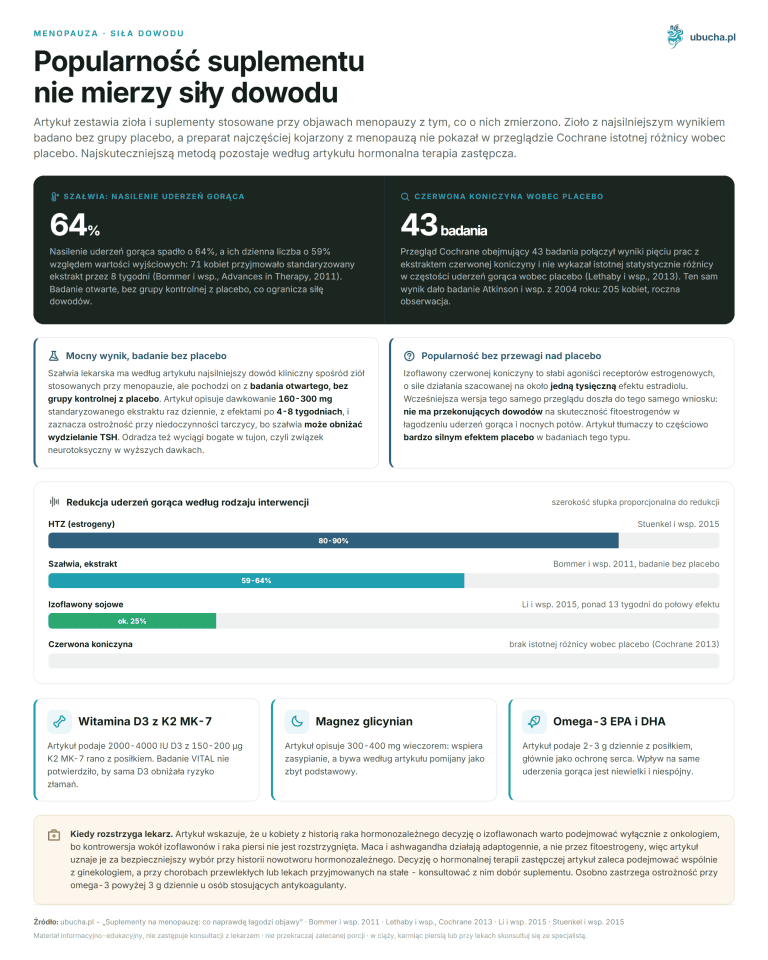
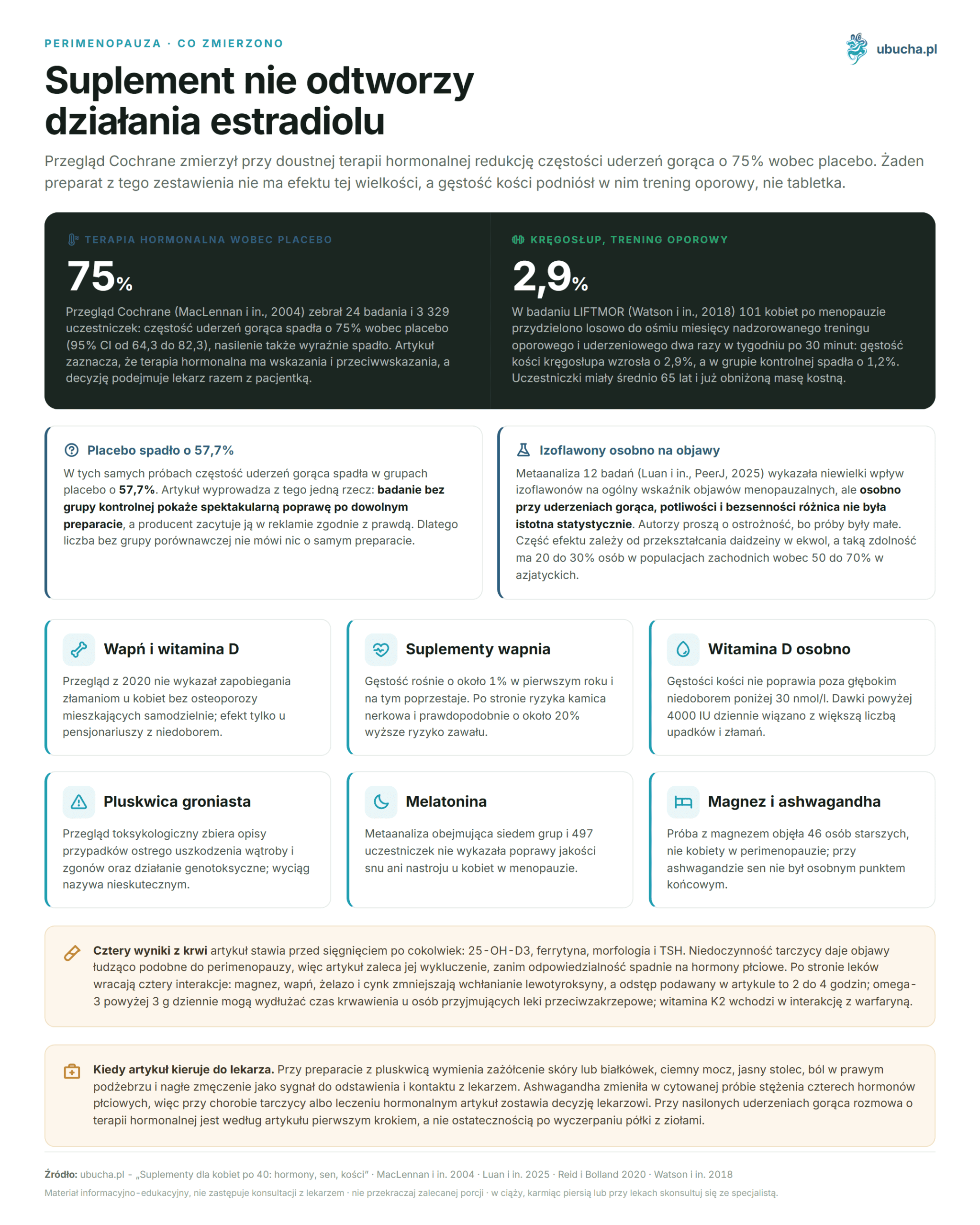
• Oral hormone therapy reduces the frequency of hot flashes by 75% compared to placebo (MacLennan et al., Cochrane, 2004). No supplement has an effect of this magnitude.
• Soy isoflavones did not improve hot flashes or insomnia separately in a meta-analysis of 12 studies (Luan et al., PeerJ, 2025).
• Calcium and vitamin D do not prevent fractures in individuals living independently (Reid and Bolland, Nutrients, 2020).
• High-intensity resistance training increased spinal bone density by 2.9% in 8 months (Watson et al., LIFTMOR, 2018).
What happens to hormones after age 40?
Perimenopause is not a single moment but a multi-year process of ovarian function decline. Estradiol begins to fluctuate instead of steadily decreasing, progesterone decreases earlier and faster, and cycles shorten and lengthen alternately. Symptoms largely arise from these fluctuations, not from the deficiency itself.
The effects are multi-organ, as estrogen receptors are in bones, vascular endothelium, skin, and the brain. Hence the simultaneous appearance of symptoms that at first glance have nothing to do with each other: poorer sleep quality, dry skin, reduced exercise tolerance, and changes in the lipid profile.
This leads to the most important limitation of supplementation. No over-the-counter preparation replicates the action of estradiol, so you cannot “balance hormones” with it. A supplement can, however, supplement a documented deficiency of a nutrient or act on one specific symptom. These are two different things, and labels often blur them.
We have noticed that most disappointments stem from this very mistake. A woman buys a product described as support for hormonal balance, expects relief from hot flashes, and receives a vitamin mix that does not work on the vasomotor symptom.
Can a supplement replace menopausal hormone therapy?
No. For troublesome hot flashes and night sweats, the best-documented treatment remains menopausal hormone therapy. The Cochrane review by MacLennan et al. (2004) gathered 24 studies and 3,329 participants, lasting from three months to three years. The reduction in the frequency of hot flashes was 75% compared to placebo (95% CI from 64.3 to 82.3), and the severity also clearly decreased.
This same review contains a number that explains half of the menopausal supplement market. In placebo groups, the frequency of hot flashes decreased by 57.7%. A study without a control group will therefore show a spectacular improvement after any preparation, and the manufacturer will quote it in advertising completely truthfully.
Hormone therapy is not a decision made at the drugstore shelf. It has indications, contraindications, and a different risk profile depending on age, time since the last menstrual period, history of thrombosis, and hormone-dependent cancers. If symptoms significantly hinder your work and sleep, ask your gynecologist about it before building a protocol with six preparations.
Do soy isoflavones alleviate hot flashes?
Weaker than the packages promise. The meta-analysis by Luan et al. (PeerJ, 2025) included 12 studies in perimenopausal women and showed a small, though statistically significant effect of isoflavones on the overall menopausal symptom score: seven studies, 533 participants, Hedges’ g equal to minus 0.25.
Breaking it down by individual symptoms is more interesting than the aggregate result. Significant improvement was noted for headaches, palpitations, psychosocial symptoms, and depression. No improvement was noted for hot flashes, sweating, or insomnia, which are exactly the symptoms for which isoflavones are most often sought. There was also no difference for paresthesia, fatigue, physical symptoms, and the entire group of vasomotor symptoms.
The authors themselves urge caution, citing the small sample sizes as a reason. There is also biology to consider. Part of the effect of isoflavones depends on the gut microbiota’s ability to convert daidzein to equol, and only 20 to 30% of individuals in Western populations have this ability compared to 50 to 70% in Asian populations (Sekikawa et al., Current Cardiology Reviews, 2019). The authors explain that this difference accounts for the discrepancy in results between Asian and Western studies.
Practically, this means: soy in the diet is a reasonable element of the menu after 40, while an isolated isoflavone preparation is not the answer to severe hot flashes. The store at Bucha does not carry isoflavone preparations, so there is nothing to promise here.
Is black cohosh safe for the liver?
Not without reservations, and this is the reason why black cohosh (Actaea racemosa) appears in this article with a warning rather than a recommendation. The toxicological review by Le et al. (2025) collects case reports in humans including mild reactions, acute liver damage, and deaths.
This same review points out two other things. Black cohosh extract exhibits genotoxic effects through an aneugenic mechanism, which disrupts chromosome separation. They write more strongly about its effectiveness than is usually summarized in self-help press: they call the extract outright ineffective in menopausal therapy. With such a statement, the balance of benefits and risks cannot be based on anything. We separately dissect this plant in the entry about black cohosh for hot flashes.
There is also the problem of reproducibility. Over a hundred compounds have been described in black cohosh root, and commercial preparations differ in composition enough that the results of one study do not transfer to another product with the same name on the label.
If you still take a preparation with black cohosh, watch for yellowing of the skin or sclera, dark urine, pale stools, pain in the right upper quadrant, and sudden fatigue. With any of these symptoms, discontinue the preparation and contact a doctor. The store at Bucha does not carry black cohosh.
Do calcium and vitamin D protect against fractures?
In women without osteoporosis living independently, the data is much weaker than advertisements suggest. The review by Reid and Bolland (Nutrients, 2020) summarizes that supplementation with calcium, vitamin D, or their combination does not prevent fractures in this group. The effect was only demonstrated in nursing home residents with vitamin D deficiency.
The details are equally sobering. Calcium supplements increase bone density by about 1% in the first year and then plateau. Vitamin D does not improve bone density in clinical trials outside of subgroups with baseline levels below 30 nmol/l, i.e., with real, deep deficiency.
On the risk side, the authors list constipation, increased incidence of kidney stones, and probably about a 20% higher risk of heart attack with calcium supplements. This is the cardiovascular signal that guides are silent about. Doses of vitamin D above 4000 IU daily have also been associated with a higher number of falls and fractures.
The practical conclusion is not “do not test and do not supplement,” but “first diet, then test results.” Dietary calcium does not carry a cardiovascular signal, and vitamin D is adjusted to the measured level of 25-OH-D3, not to age and season. You can find more about combining D3 with K2 in the entry about vitamin D3 and K2.
When to test bone density, and when to focus on exercise?
The risk of fracture is measured, not guessed from symptoms. This is done with densitometry (DXA) and the FRAX calculator, which combines the result with age, body weight, history of fractures, and risk factors. It is worth starting the conversation about testing earlier if any of the following situations apply to you.
| Situation | Why this is a signal to talk to a doctor |
|---|---|
| Fracture after age 40 with minor trauma | A low-energy fracture can be the first sign of osteoporosis |
| Menopause before age 45 | Longer time without the protective effect of estrogen on bone |
| Long-term treatment with glucocorticoids | One of the best-documented causes of secondary osteoporosis |
| Osteoporosis or hip fracture in a parent | A factor directly included in the FRAX calculator |
| Low body weight, smoking, celiac disease, or hyperthyroidism | Classic risk factors for bone mass loss |
On the side of what you can do yourself, the strongest data supports resistance training. In the study LIFTMOR (Watson et al., JBMR, 2018), 101 postmenopausal women with low bone mass were randomly assigned to eight months of supervised resistance and impact training twice a week for 30 minutes or to light home exercises. Spinal bone density increased by 2.9% in the training group and decreased by 1.2% in the control group, in the femoral neck by 0.3% and minus 1.9%, with one adverse event in the entire study. A caveat is warranted here as well: participants had an average age of 65 and already reduced bone mass, so this is not a study on forty-year-olds. However, the direction is worth noting, as no preparation from this bone density set increased it.
What really helps with sleep during perimenopause?
Start by determining what wakes you up. Night hot flashes are a different problem than difficulty falling asleep and require different approaches. The meta-analysis by Du and Tan (Frontiers in Nutrition, 2026) included seven groups and 497 participants and found no improvement in sleep quality, mood, sexual function, or menopausal symptoms after melatonin.
The only signal that this work considered promising relates to something else: bone density, especially in the femoral neck, based on two studies. The large variability in results did not even allow them to be summed, and most preparations contained melatonin along with other ingredients, so its independent contribution cannot be read from this.
With magnesium, there is a different problem: there is a study, but not on this group. The most frequently cited trial, Abbasi et al. (Journal of Research in Medical Sciences, 2012), involved 46 older individuals with primary insomnia who took 500 mg of magnesium daily for eight weeks. Insomnia severity, sleep efficiency, and time to fall asleep improved, but total sleep time did not differ between groups. These are not women in perimenopause, so directly transferring this result is an overinterpretation.
Ashwagandha has one small trial in the appropriate age group. In the study Vani et al. (Frontiers in Reproductive Health, 2025), 60 women aged 45 to 55 received either root extract or placebo for 56 days. The result was clear: a decrease in menopausal symptom scores across all three domains, fewer hot flashes, and changes in estradiol, progesterone, FSH, and LH levels.
However, two things prevent this from being applied to sleep. Sixty participants and one trial are too few to consider the matter resolved, and sleep quality was not a separate endpoint in this study. The work answers the question about menopausal symptoms, not insomnia.
The best return on effort comes from things without labels: a consistent wake-up time, a cool bedroom, less alcohol in the evening, and cognitive-behavioral therapy for insomnia. We compared forms of magnesium separately in the entry about magnesium for stress and sleep.
Do collagen, evening primrose oil, maca, and DHEA have studies in women over 40?
Studies exist, but they vary in quality and sample size. Collagen performs best, as it has been studied in the appropriate age group. In the study by Paula-Vieira et al. (Dermatology and Therapy, 2026), 119 women aged 35 to 55 took 2.5 g or 10 g of collagen peptides daily for 12 weeks. One caveat is significant and rarely cited: the control group did not receive a placebo, only received nothing, which weakens the result when assessing skin.
| Ingredient | What was studied and on how many people | Result |
|---|---|---|
| Collagen peptides | 119 women aged 35 to 55, 12 weeks, control group without placebo | Fewer wrinkles at 10 g, better elasticity and hydration |
| Evening primrose oil | Review of randomized studies, hot flashes | Less severity below 6 months, no difference in frequency |
| Maca | Four randomized studies, peri- and postmenopause | Evidence limited by small number and quality of trials, safety not demonstrated |
| DHEA | Vaginal form for vulvar and vaginal atrophy | Prescription medication, not a supplement; oral form is not routinely recommended |
The review by Thevi et al. (Journal of Menopausal Medicine, 2024) considers the evidence for evening primrose oil insufficient to draw conclusions. And the review by Lee et al. (Maturitas, 2011) shows a pattern with maca that we encountered most often in this topic: four trials, all with favorable results, all too small to carry that result. The authors add that the safety of maca has also not been demonstrated.
It is worth clarifying the popular statement that maca does not affect hormones. Studies in humans that measured hormone levels exist and report changes. In early postmenopausal women, FSH decreased after maca, while estradiol and progesterone increased; in the older of these trials, LH also increased (Meissner et al., 2005, 2006). The thing is, we are talking about groups ranging from eight to twenty participants, one preparation, and one research team. This is too thin a basis to promise “restoring hormonal balance,” but also too little to claim that no such effect has been measured.
What tests and interactions should be checked before supplementation?
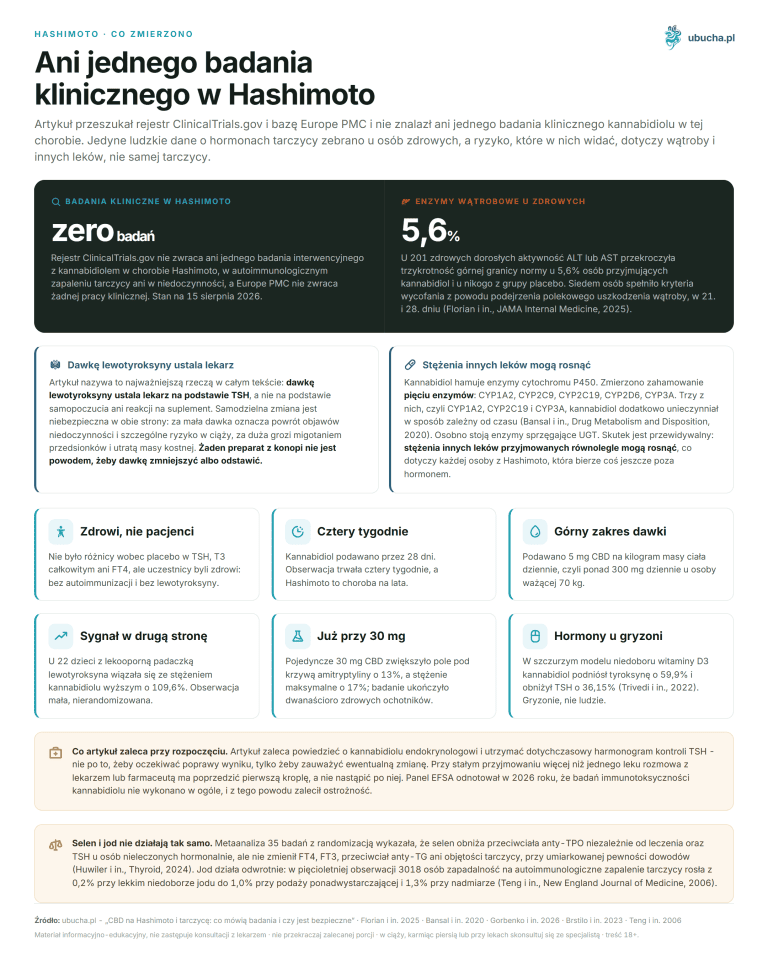
Four blood results are enough to start: 25-OH-D3, ferritin, morphology, and TSH. Hypothyroidism gives symptoms strikingly similar to perimenopause, such as fatigue, weight gain, and poor concentration, so it must be ruled out before you conclude that sex hormones are responsible for everything.
Ferritin has a separate justification in perimenopause. Bleeding can be heavier and irregular, and iron deficiency causes fatigue and hair loss with still normal morphology. However, iron should not be supplemented blindly, as excess is pro-oxidative and burdens the liver. The starting point is the test result, not the symptom.
On the medication side, four interactions come up most often. Magnesium, calcium, iron, and zinc reduce the absorption of levothyroxine, so a gap of 2 to 4 hours should be maintained between the medication and mineral supplementation. Ashwagandha is not hormonally neutral: in the cited trial above, it changed the levels of four sex hormones, so if you have thyroid disease or are on hormonal treatment, make the decision about it with your doctor. Omega-3 at doses above 3 g daily may prolong bleeding time in individuals on anticoagulant medications. Vitamin K2 interacts with warfarin and should not be used with this medication without supervision.
What to start with if you are 40 and have the first symptoms?
Start with a conversation with your gynecologist and four blood tests, not with a basket of preparations. This order determines whether supplementation will be targeted or will be guessing. Only from the result can you see whether the problem is a deficiency, thyroid, or perimenopause itself.
Then three things with the best effect-to-effort ratio. Resistance training twice a week, as this is the only intervention from this set that has actually increased bone density. Calcium from food instead of a tablet, meaning dairy, tofu, almonds, sardines, and green vegetables. Vitamin D adjusted to the measured level, not to the calendar.
Supplements come last and under specific indications. Collagen for skin, magnesium for sleep issues, iron for documented deficiency, omega-3 for low fish intake in the diet. Record the start date and one measurable symptom you want to change. If after three months you see no difference, discontinue the preparation instead of adding another.
One thing supplements will not do: they will not replicate the action of estradiol and will not eliminate severe hot flashes. For such symptoms, discussing hormone therapy is the first step, not a last resort after exhausting the herbal shelf.
Frequently Asked Questions
Can supplements replace menopausal hormone therapy?
No. The Cochrane review by MacLennan et al. (2004) showed that oral hormone therapy reduces the frequency of hot flashes by 75% compared to placebo. No supplement has an effect of this magnitude. Hormone therapy has indications and contraindications, so the decision is made by the doctor together with the patient.
Do soy isoflavones help with hot flashes?
A meta-analysis by Luan et al. (PeerJ, 2025) of 12 studies showed a small effect of isoflavones on the overall menopausal symptom score, but separately for hot flashes, sweating, insomnia, and the entire group of vasomotor symptoms, the difference was not statistically significant. The authors themselves recommend caution, as the trials were small.
Is black cohosh safe?
Not without reservations. The toxicological review by Le et al. (2025) summarizes case reports of acute liver damage from black cohosh extract, including deaths, and its genotoxic effects. The authors also call it ineffective in menopausal therapy. Jaundice, dark urine, and sudden fatigue are signals to discontinue and contact a doctor.
Do calcium and vitamin D protect against fractures?
In women without osteoporosis living independently, the review by Reid and Bolland (Nutrients, 2020) found no prevention of fractures by calcium, vitamin D, or their combination. Calcium supplements increase the risk of kidney stones and probably heart attack by about 20%. Dietary calcium is a safer starting point.
What helps with sleep during perimenopause?
First, you need to determine what is waking you up. The meta-analysis by Du and Tan (Frontiers in Nutrition, 2026) involving 497 participants found no improvement in sleep quality after melatonin in menopausal women. The magnesium study was conducted on older individuals, and the ashwagandha trial did not measure sleep separately. If hot flashes are waking you up, discuss symptom treatment with your gynecologist.
Is collagen studied in women over 40?
Yes, in the appropriate age group. In the study by Paula-Vieira et al. (Dermatology and Therapy, 2026), 119 women aged 35 to 55 took 2.5 g or 10 g of collagen peptides daily for 12 weeks. The 10 g group had fewer wrinkles, both groups improved elasticity and hydration. The control group did not receive a placebo, which weakens the result.
Does maca change hormone levels?
Not as the labels promise. Two small trials by Meissner in early postmenopausal women measured a decrease in FSH and an increase in LH, and after longer use, also estradiol and progesterone. The review by Lee et al. (Maturitas, 2011) included four randomized studies and concluded that there are too few and they are too weak to draw any conclusions; safety was also not demonstrated.
When should I have a bone density test?
It is worth starting the conversation about a DXA test if you have had a low-energy fracture after age 40, menopause before 45, have been taking glucocorticoids for a long time, or have osteoporosis in your family. The doctor usually combines the result with the FRAX calculator. The risk of fracture is calculated, not guessed based on symptoms.
Magnesium, vitamin D3 with K2, omega-3, and collagen can be found in the supplements section. We have separately described supplements for menopause.
This article is for informational and educational purposes and does not constitute medical advice. Before starting supplementation, consult your doctor, especially if you are taking medications regularly, are pregnant or breastfeeding, or have a chronic illness.
Author: Michał Waluk · Published: 2026-06-22 · Updated: 2026-08-15