
Spring Equinox: How to Overcome Fatigue with Natural Supplements
The spring equinox is not a disease and has no confirmation in studies. Check what really lies behind spring fatigue and what has evidence.
April, the sun is higher, the days are longer, and you still wake up without energy. We call this the spring equinox and treat it as something obvious. However, when researchers asked the same individuals about fatigue nine times throughout the year, they found no seasonal pattern. This does not mean that your fatigue is imagined. It means that the causes are worth looking for outside the calendar: in vitamin D levels after winter, in sleep quality, sometimes in an illness you are not yet aware of. Below, we separate what can be supported by research from what is merely a promise on a supplement label. We start with the question of whether the equinox even exists, then move on to the tests worth doing before you buy anything at the pharmacy.
KEY INFORMATION
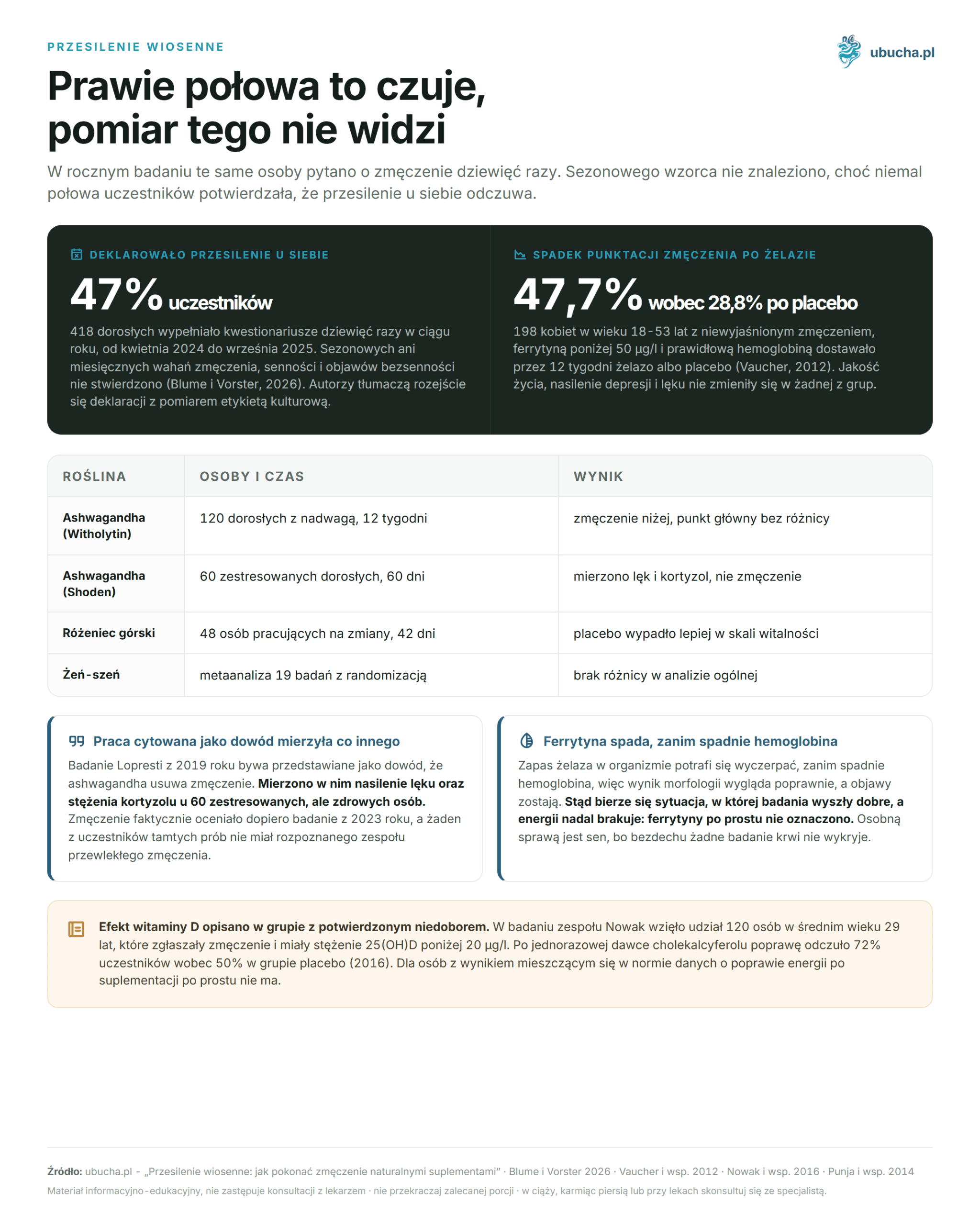
• An annual study of 418 adults found no seasonal fluctuations in fatigue, although 47% of participants reported experiencing spring equinox (Blume and Vorster, Journal of Sleep Research, 2026).
• Chronic fatigue can be the first symptom of depression, thyroid disorders, anemia, diabetes, or sleep apnea.
• Vitamin D and iron have evidence in individuals with confirmed deficiencies. For those with normal results, such data does not exist.
• Regular exercise has stronger support in studies on fatigue than adaptogens, and regarding light, we currently have observation, not randomized trials.
Is the spring equinox a documented phenomenon?
No. It is a colloquial term with no equivalent in medical classifications. In a study published in the Journal of Sleep Research, 418 adults filled out questionnaires nine times throughout the year, from April 2024 to September 2025. No seasonal or monthly fluctuations in fatigue, drowsiness, or insomnia symptoms were found.
The most interesting aspect is the discrepancy between declarations and measurements. Almost half of the participants, exactly 47%, confirmed that they experience the spring equinox. Repeated surveys did not show this. The authors explain this as a cultural label: a bad week in April gets a ready name, while an identical week in October passes without comment (Blume and Vorster, Journal of Sleep Research, 2026).
One observation from this study concerns light, not the season. Fatigue in daily activities was lower on longer days, but it did not depend on whether the day was lengthening or shortening.
What remains of the colloquial term? A few things that accumulate at the end of winter and can be measured: the lowest vitamin D level of the year, less movement, poorer sleep nights. These are the points of reference, not spring itself.
When does chronic fatigue require a doctor, not a supplement?
When it lasts longer than a few weeks, does not improve after rest, and has no obvious cause. Fatigue is among the ten most common reasons for visits to primary healthcare and can be the first symptom of a disease that does not yet show other signals.
The scale is larger than it seems. A British team compared 304,914 individuals who reported new-onset fatigue to 423,671 individuals without such complaints. Among 237 analyzed diseases, 127 occurred more frequently in men reporting fatigue and 151 in women. The strongest associations were with depression, respiratory infections, and sleep disorders, and in women, additionally thyroid diseases (White et al., British Journal of General Practice, 2024).
Before considering fatigue as seasonal, it is worth ruling out conditions that give exactly this symptom (Latimer et al., American Family Physician, 2023):
- anemia
- hypothyroidism
- diabetes
- obstructive sleep apnea
- depression
- celiac disease
- adverse effects of medications taken regularly
No supplement will fix fatigue caused by untreated hypothyroidism or sleep apnea. It can, however, delay diagnosis by months, as short-term improvement effectively discourages a visit.
What tests are worth doing before reaching for a supplement?
The starting point is usually a complete blood count, ferritin, TSH, fasting glucose or HbA1c, CRP, and 25(OH)D. The final range is determined by the doctor based on the interview, as it depends on whether to add diagnostics for celiac disease, kidney diseases, or sleep apnea.
| Test | What it checks |
|---|---|
| Complete blood count | anemia, inflammation, blood diseases |
| Ferritin | iron deficiency with still normal hemoglobin |
| TSH | hypothyroidism and hyperthyroidism |
| Fasting glucose or HbA1c | diabetes and prediabetes |
| 25(OH)D | vitamin D deficiency |
| CRP | ongoing inflammatory process |
Ferritin shows well why a complete blood count is not enough. The body’s iron stores can be depleted before hemoglobin drops, so the complete blood count result looks normal, while symptoms remain. This is where the situation arises where “tests came back good,” but energy is still lacking: ferritin simply was not measured.
A separate issue is sleep. If you snore, wake up with a headache, and fall asleep during the day despite eight hours in bed, no blood test will detect this. Here, diagnostics for sleep apnea are needed.
Does vitamin D improve energy after winter?
In individuals with deficiencies, studies show improvement. Polish guidelines from 2023 consider a 25(OH)D level below 20 ng/ml as a deficiency, 20-30 ng/ml as suboptimal, and 30-50 ng/ml as optimal. For individuals within the norm, there is simply no data on energy improvement after supplementation.
The closest answer to this question comes from a study by Nowak. It involved 120 individuals with an average age of 29 who reported fatigue and had a 25(OH)D level below 20 µg/l. After a single dose of cholecalciferol, 72% of participants felt improvement compared to 50% in the placebo group, and the drop in fatigue scores was greater than after placebo (Nowak et al., Medicine, 2016). However, this entire effect pertains to the group with confirmed deficiency and does not transfer to a person with a result of 35 ng/ml.
Polish recommendations also describe who and how often to test 25(OH)D and how to proceed in at-risk groups (Płudowski et al., Nutrients, 2023). We do not provide specific doses here. Recommendations vary according to body weight, age, and accompanying diseases, so a sensible decision is made after seeing the result, not after reading an article.
Who does iron supplementation actually help?
Menstruating women with low ferritin levels, in whom other causes of fatigue have been ruled out. Outside this group, there is no convincing data, and excess iron is harmful. Without a ferritin result, supplementation is shooting in the dark.
A reference point is a study from CMAJ. It involved 198 women aged 18-53, all with unexplained fatigue, ferritin below 50 µg/l, and normal hemoglobin. For 12 weeks, they received iron or placebo. Fatigue scores dropped by 47.7% in the iron group and by 28.8% in the placebo group (Vaucher et al., CMAJ, 2012). Quality of life, severity of depression, and anxiety did not change in either group, which is worth remembering, as it shows the limits of this effect.
A newer study from 2026 included 164 women of childbearing age, also non-anemic and with low ferritin levels. After two months, fatigue scores dropped, and ferritin increased (Sultana et al., JPMA, 2026). Both studies share one thing: participants were selected precisely because they had a deficiency. This is not evidence of iron’s effectiveness in anyone else.
What is known about magnesium and B vitamins?
Less than the packaging suggests. Studies on magnesium and B vitamins most often involve individuals with deficiencies or specific problems, such as poor sleep quality. Where participants were healthy and well-nourished, the effects are small or measured by something other than daily fatigue.
The closest topic is a study from 2025 on 155 adults who self-reported poor sleep quality. Magnesium biglycinate reduced insomnia scores more than placebo, but the effect size was 0.2 (Schuster et al., Nature and Science of Sleep, 2025). An additional analysis suggests greater improvement in individuals with lower magnesium intake in their diet, again in a group with probable deficiency. We discuss the differences between forms of magnesium in our post on choosing magnesium forms.
With B vitamins, it is similar. A four-week supplementation of a B complex in 32 healthy individuals extended the time to exhaustion (Lee et al., International Journal of Medical Sciences, 2023). This is a result from a small group fitness test, not an answer to the question of morning drowsiness. Deficiencies of B12 and folates can be a real problem for vegans and older individuals, but then we are talking about treating a deficiency, which we describe in our post on vitamin B12 and fatigue.
Do adaptogens reduce fatigue?
The evidence is weaker than the advertisements suggest. They come from small groups with very different profiles, and the subjects almost never had a diagnosis of chronic fatigue syndrome. Below is a summary of what has actually been tested.
| Plant | People and time | Result |
|---|---|---|
| Ashwagandha (Witholytin) | 120 adults aged 40-75 with overweight, 12 weeks | fatigue score lower than after placebo, main endpoint no difference |
| Ashwagandha (Shoden) | 60 healthy stressed adults, 60 days | anxiety and cortisol measured, fatigue not assessed |
| Rhodiola rosea | 48 nursing students working shifts, 42 days | placebo performed better on vitality scale |
| Ginseng | meta-analysis of 19 randomized studies | no difference in overall analysis, small effect in subgroups |
The 2019 study by Lopresti is often presented as evidence that ashwagandha eliminates fatigue. This was not the case: it measured anxiety severity and cortisol levels in 60 stressed but healthy individuals (Lopresti et al., Medicine, 2019). Fatigue was only assessed in the 2023 study (Smith et al., Journal of Psychopharmacology, 2023).
Rhodiola rosea performed worse than placebo in a reliable trial (Punja et al., PLOS ONE, 2014), and a meta-analysis of 19 studies on ginseng showed no difference compared to control groups (Li et al., Journal of Integrative and Complementary Medicine, 2023).
What works beyond supplements: exercise, light, or coffee?
Exercise and light have better support in studies on fatigue than most supplements. Caffeine works acutely, but you pay for it with a rebound after withdrawal. This is the cheapest part of the plan and usually the most overlooked.
A six-week aerobic program involved 36 sedentary, healthy young adults who reported persistent fatigue. They exercised three times a week, and the sense of energy improved similarly with low and moderate intensity effort (Puetz et al., Psychotherapy and Psychosomatics, 2008). Light exercise worked better on fatigue itself, and the changes were not associated with improvements in aerobic capacity. The group was small, so treat this as a suggestion, not a certainty.
With light, the situation is more interesting. In the aforementioned annual study, fatigue in daily activities decreased with longer days. A morning walk is therefore a reasonable idea, although it has not been tested in a randomized trial on healthy individuals.
Caffeine works, but only briefly. A review of 57 experimental studies confirmed that withdrawal symptoms include fatigue, decreased energy, and drowsiness, and headache occurred in half of the subjects. Symptoms begin 12-24 hours after the last dose and last from 2 to 9 days (Juliano and Griffiths, Psychopharmacology, 2004). Increasing the number of coffees does not cure fatigue; it only maintains the cycle.
Frequently Asked Questions
Is the spring equinox a disease?
No. It is a colloquial term with no equivalent in medical classifications. An annual study of 418 adults published in the Journal of Sleep Research in 2026 found no seasonal fluctuations in fatigue, drowsiness, or insomnia symptoms. The authors describe the equinox as a cultural label rather than a seasonal syndrome.
What tests should I do if fatigue persists?
The starting point is usually a complete blood count, ferritin, TSH, fasting glucose or HbA1c, CRP, and 25(OH)D. The range is determined by the doctor based on the interview. If you snore and fall asleep during the day, additional diagnostics for sleep apnea may be needed.
Is it worth taking vitamin D without testing its level?
Studies on fatigue included individuals with confirmed deficiencies, not those with normal results. Polish guidelines from 2023 consider a 25(OH)D level below 20 ng/ml as a deficiency, and 30-50 ng/ml as optimal. Testing 25(OH)D answers this question cheaper than guessing.
Does magnesium help with fatigue?
The data is limited. In a 2025 study of 155 adults with poor sleep, magnesium biglycinate reduced insomnia scores more than placebo, but the effect size was 0.2, which is small. Greater improvement was noted in individuals with low magnesium intake in their diet.
Does ashwagandha boost energy?
In a twelve-week study of 120 overweight adults reporting stress and fatigue, fatigue scores dropped more than after placebo. The primary endpoint, perceived stress, did not differ from placebo. None of these individuals had a diagnosis of chronic fatigue syndrome.
How long does fatigue last after quitting coffee?
A review of 57 experimental studies found that withdrawal symptoms begin 12-24 hours after the last dose, peak between 20 and 51 hours, and last from 2 to 9 days. These include fatigue, decreased energy, drowsiness, and headache.
We wrote about building reserves before the infection season in our post supplements for autumn and immunity. If tests show a specific deficiency to be supplemented, you can find products in the supplements category.
This article is for informational and educational purposes and does not replace consultation with a doctor. If you are pregnant, breastfeeding, taking medications, or have chronic conditions, consult the use of supplements or herbs with a specialist.
Author: Michał Waluk · Published: 2026-06-22 · Updated: 2026-08-11