
Vitamin B12 and energy: why deficiency does not show obvious symptoms and how to check it
Vitamin B12 deficiency can go for years without symptoms, and a basic test can be normal. What studies by Lindenbaum, Reinstatler, and Smith have shown.
Vitamin B12 is involved in the production of red blood cells, DNA synthesis, and the construction of myelin sheaths. However, its deficiency has an atypical course: it can last for years without obvious symptoms, and a basic blood test can come back normal despite a real deficiency. It even happens that nerve damage precedes any changes in morphology, as described in medicine as early as the late 1980s. Below you will find what exactly individual studies have shown on this topic: who they included, how many people they counted, and what the results were. You will also see which of the popular numbers circulating in Polish descriptions of vitamin B12 do not come from the works they are often attributed to, and where the mistake originated.
KEY INFORMATION
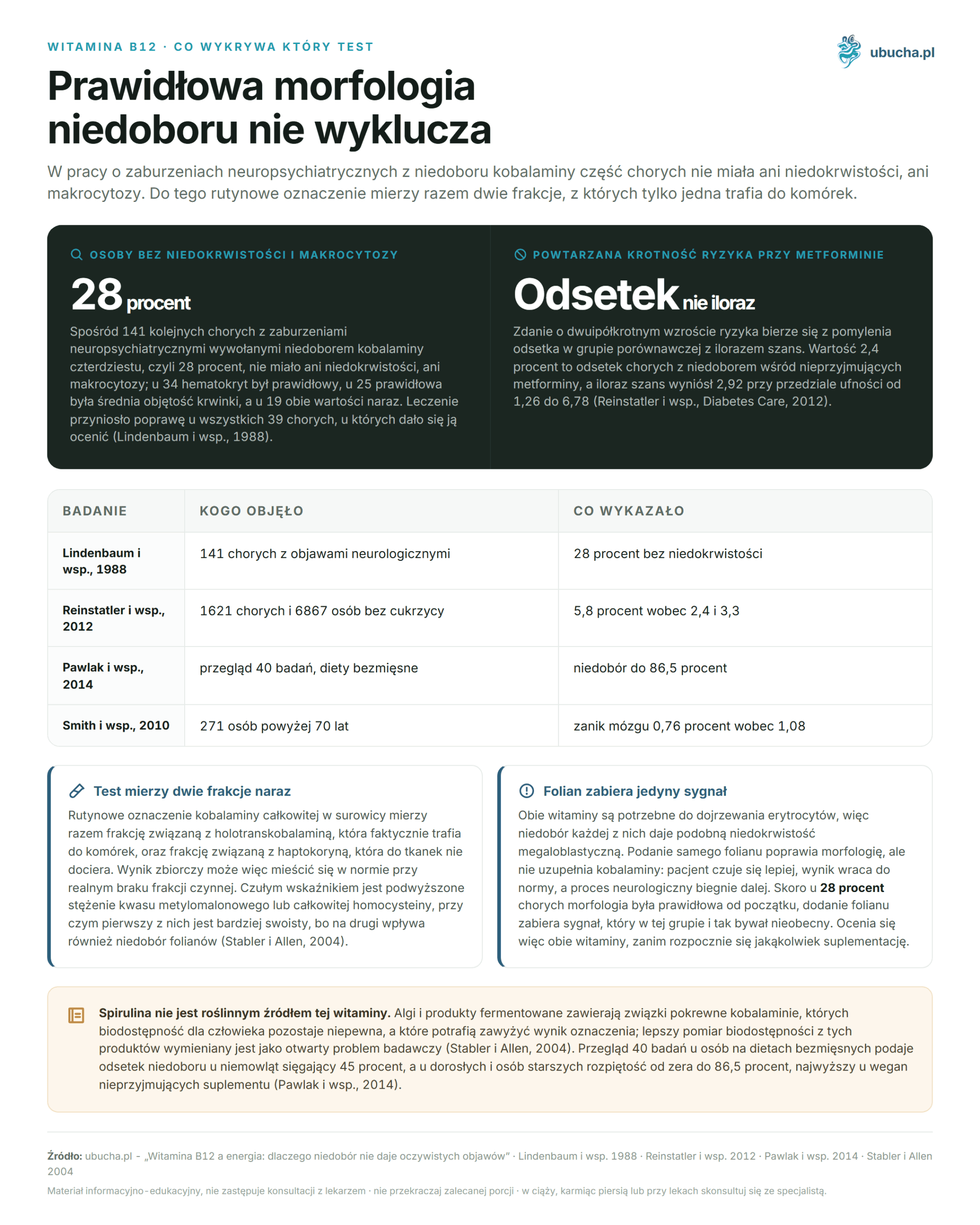
• Lindenbaum et al. (New England Journal of Medicine, 1988) described 141 patients with neuropsychiatric disorders due to cobalamin deficiency; 40 of them, or 28 percent, had neither anemia nor macrocytosis.
• In the NHANES analysis, biochemical deficiency was found in 5.8 percent of diabetic patients taking metformin compared to 2.4 percent not taking it (Reinstatler et al., Diabetes Care, 2012).
• The review by Pawlak et al. (2014) included 40 studies; the percentage of deficiency among adults and older individuals on plant-based diets reached 86.5 percent in these studies.
• Elevated levels of methylmalonic acid or homocysteine are sensitive indicators of B12 deficiency.
Why does vitamin B12 deficiency take so long to show symptoms?
This is due to two independent factors: a large reserve in the liver and insensitivity of the basic test. The liver stores cobalamin in amounts sufficient for years, so a person who has eliminated animal products will not feel anything for a long time. Symptoms only appear when the reserve is depleted, and by then some changes are already advanced.
The second reason lies in the test itself. Routine measurement of total cobalamin in serum measures both fractions: the one bound to holotranscobalamin, which actually reaches the cells, and the one bound to haptocorrin, which does not reach the tissues. Therefore, the combined result may fall within the normal range despite a real lack of the active fraction.
Our observations from reading supplement descriptions are as follows: the most commonly repeated mistake is presenting spirulina as a plant source of vitamin B12. The problem is that algae and fermented products contain compounds related to cobalamin, whose bioavailability for humans remains uncertain, and which can inflate the measurement result. Stabler and Allen (Annual Review of Nutrition, 2004) list better measurement of vitamin B12 bioavailability from these products as an open research problem.
Which test really detects B12 deficiency?
Not total cobalamin, but functional markers. Stabler and Allen (Annual Review of Nutrition, 2004) state that elevated levels of methylmalonic acid or total homocysteine are sensitive indicators of insufficient vitamin B12 supply and that these values correlate with clinical abnormalities.
The mechanism is simple. Cobalamin is involved in two reactions: in the conversion of methylmalonyl-CoA to succinyl-CoA and in the remethylation of homocysteine to methionine. When it is lacking, the substrates of both reactions accumulate, leading to increased levels of methylmalonic acid and homocysteine. The first of these markers is more specific, as the second is also influenced by folate deficiency.
The third test is holotranscobalamin, also described as active vitamin B12, which measures only the fraction transported to cells. The cutoff values for all three measurements are provided by the laboratory performing the test, and it is their reference ranges that determine the results, not numbers copied from articles. The result is always interpreted together with the clinical picture, as a single value at the borderline of normal does not determine anything by itself. After starting treatment, repeating the same measurements after a few months shows whether the chosen form of the preparation worked in that case.
Who is at risk of B12 deficiency?
The risk is distributed according to two mechanisms: insufficient supply or impaired absorption. The first concerns diets without animal products, the second concerns stomach diseases, age, and certain medications.
The scale of the problem with plant-based diets was measured by the review by Pawlak et al. (European Journal of Clinical Nutrition, 2014), which included 40 studies measuring vitamin B12 in serum. The percentage of deficiency in infants reached 45 percent, in children and adolescents ranged from zero to 33.3 percent, in pregnant women it was from 17 to 39 percent depending on the trimester, and in adults and older individuals, the range between studies reached from zero to 86.5 percent. The authors noted a higher percentage in vegans than in other vegetarians, and consider vegans not taking supplements as the most at-risk group.
On the absorption side, there are three situations. Pernicious anemia is an autoimmune disease in which the body destroys the parietal cells of the stomach or intrinsic factor, without which cobalamin cannot be absorbed in the ileum; Stabler and Allen list it as a common cause of megaloblastic anemia worldwide, especially in individuals of European and African descent. The second situation is atrophic gastritis in older individuals, where vitamin B12 does not release from food protein bonds. The third is metformin, described in the next section.
| Study | Who it included | What it showed |
|---|---|---|
| Lindenbaum et al., 1988 | 141 consecutive patients with neuropsychiatric disorders due to cobalamin deficiency | 40 individuals, or 28 percent, without anemia and without macrocytosis; neuropsychiatric improvement after treatment in 39 out of 39 evaluated |
| Reinstatler et al., 2012 | 1621 patients with type 2 diabetes and 6867 individuals without diabetes, aged 50 and older, NHANES data 1999-2006 | biochemical deficiency in 5.8 percent of those taking metformin, 2.4 percent not taking it, and 3.3 percent without diabetes; odds ratio 2.92 |
| Pawlak et al., 2014 | review of 40 studies in individuals on meatless diets | percentage of deficiency in adults and older individuals from zero to 86.5 percent; highest in vegans without supplementation |
| Smith et al., 2010 (VITACOG) | 271 individuals over 70 years old with mild cognitive impairment | rate of brain atrophy 0.76 percent per year compared to 1.08 percent with placebo; with homocysteine above 13 µmol/l, atrophy was lower by 53 percent |
Why does metformin lower vitamin B12 levels?
Metformin disrupts the absorption of the cobalamin-intrinsic factor complex in the final section of the small intestine. The scale of the phenomenon in the population was measured by Reinstatler et al. (Diabetes Care, 2012) using data from the American NHANES study from 1999-2006.
The analysis included 1621 individuals aged 50 and older with type 2 diabetes and 6867 individuals of the same age without diabetes. Biochemical deficiency, defined as serum cobalamin concentration not higher than 148 pmol/l, was found in 5.8 percent of patients taking metformin, 2.4 percent of patients not taking it, and 3.3 percent of individuals without diabetes. After adjusting for confounding factors, the odds ratio for metformin use was 2.92 with a confidence interval from 1.26 to 6.78.
Here, it is necessary to correct the number that circulates in Polish descriptions. The repeated statement about a “2.4-fold increase in risk” comes from confusing the percentage in the comparison group with the odds ratio. The value of 2.4 is the percentage of patients with deficiency among those not taking metformin, not a multiplicative risk. The paper does not separately analyze individuals treated for more than three years. However, the authors conclude with a practical significance: the amount of vitamin B12 recommended by the Institute of Medicine and the amount present in typical multivitamin preparations may not be sufficient to correct deficiency in diabetic patients.
Can B12 deficiency damage nerves without anemia?
Yes, and this was shown in one of the more frequently cited works on this topic. Lindenbaum et al. (New England Journal of Medicine, 1988) analyzed 141 consecutive patients with neuropsychiatric disorders caused by cobalamin deficiency. Forty of them, or 28 percent, had neither anemia nor macrocytosis.
In 34 patients from this subgroup, hematocrit was normal, in 25 the mean corpuscular volume was normal, and in 19 both values were normal at the same time. Symptoms included paresthesias, sensory disturbances, ataxia, dementia, and psychiatric disorders, often with long-lasting neurological complaints without anemia. Levels of methylmalonic acid and homocysteine were clearly elevated in this group, making them a diagnostic tool where morphology was silent.
Treatment with cobalamin brought improvement in neuropsychiatric disorders in all 39 patients who could be evaluated, and in 31 out of 31 studied, levels of methylmalonic acid or homocysteine dropped by more than half. The authors conclude that neuropsychiatric disorders due to cobalamin deficiency often occur without anemia and without elevated mean corpuscular volume. Therefore, normal morphology does not exclude deficiency by itself.
Why should folic acid not be supplemented blindly?
Because folate can mask the hematological symptom of vitamin B12 deficiency without stopping nerve damage. Both vitamins are needed for the maturation of erythrocytes, so a deficiency of either gives similar megaloblastic anemia. Administering folate alone improves morphology but does not replenish cobalamin.
The result is a situation described in the literature as a diagnostic trap: the patient feels better, the morphology result returns to normal, and the neurological process continues. The work of Lindenbaum et al. shows how easy it is to overlook even without supplementation, as in that study, 28 percent of patients had normal morphology from the beginning. Adding folate thus removes the only signal that in this group was already often absent.
It is worth remembering where the similarity between both deficiencies comes from. Both vitamins meet in the same reaction: 5-methyltetrahydrofolate donates a methyl group to cobalamin, which then transfers it to homocysteine. When cobalamin is lacking, folate becomes trapped in the methyl form and does not return to circulation, so the marrow behaves as if folate were lacking.
The practical conclusion concerns the order, not the doses. When suspecting a deficiency of either of these vitamins, both are assessed before starting any supplementation, and the decision about the form and dose is made by a doctor. Differences between forms of folate in preparations are described in a separate entry: folic acid or methylfolate.
Do B vitamins protect the brain from atrophy?
One trial convincingly showed this, but only in a selected subgroup. The VITACOG study, published by Smith et al. (PLoS ONE, 2010), included 271 individuals over 70 years old with mild cognitive impairment, selected from 646 examined.
Participants were randomly assigned to two equal groups for 24 months. The active group received folic acid at a dose of 0.8 mg daily, vitamin B12 at a dose of 0.5 mg daily, and vitamin B6 at a dose of 20 mg daily; the other group received placebo. Change was measured by serial volumetric MRI studies, completed by 168 individuals. The average rate of total brain atrophy was 0.76 percent per year in the active group and 1.08 percent per year in the placebo group.
However, the decisive division is according to baseline homocysteine. In participants whose homocysteine exceeded 13 µmol/l, the rate of atrophy was lower by 53 percent in the active group. Faster atrophy was associated with worse final cognitive test results. The authors themselves state that further trials are needed to determine whether such treatment delays the development of Alzheimer’s disease; this does not follow from this study. Nothing is concluded about individuals with normal homocysteine either.
Does vitamin B12 provide energy?
Only when it was lacking. Cobalamin is essential for the maturation of erythrocytes and for energy transformations in mitochondria, so its deficiency causes fatigue due to megaloblastic anemia and neurological changes. Correcting the deficiency reverses these symptoms, as seen in Lindenbaum’s study, where improvement was noted in all evaluated patients.
In a person with adequate supply, however, there is nothing to correct. The excess of water-soluble vitamin is excreted in urine, and subjective feelings of energy do not change as a result. Persistent fatigue with normal vitamin B12 markers is a signal to look for the cause elsewhere, not to increase the supplement dose.
If you belong to one of the risk groups, the sensible order is always the same: first testing, then a conversation with a doctor about the form and dose, then monitoring after a few months. What else requires attention in a diet without animal products is described in the entry supplements for vegetarians and vegans, and the symptoms of the deficiency itself are dedicated to a separate text on vitamin B12 and fatigue. You can find products from this group in the supplements category.
Frequently Asked Questions
What are the first symptoms of vitamin B12 deficiency?
In a series of 141 patients described by Lindenbaum et al. (1988), there were paresthesias, sensory disturbances, ataxia, dementia, and psychiatric disorders. In 28 percent of them, there was neither anemia nor macrocytosis, so neurological symptoms may appear with normal morphology.
Which test for vitamin B12 is the best?
Total cobalamin measures both active and inactive fractions, so it can be normal despite deficiency. Stabler and Allen (2004) indicate methylmalonic acid and total homocysteine as sensitive indicators correlating with symptoms. Reference ranges are provided by the laboratory performing the measurement.
Does normal morphology exclude B12 deficiency?
No. Among 141 patients with neuropsychiatric disorders due to cobalamin deficiency, 40 individuals had neither anemia nor macrocytosis, and in 19, both hematocrit and mean corpuscular volume were normal (Lindenbaum et al., New England Journal of Medicine, 1988).
Does metformin cause vitamin B12 deficiency?
It is significantly associated with it. In the NHANES analysis, biochemical deficiency was found in 5.8 percent of diabetic patients taking metformin compared to 2.4 percent not taking it, and the adjusted odds ratio was 2.92 (Reinstatler et al., Diabetes Care, 2012). A multivitamin supplement did not reduce this percentage in patients.
Do vegans need to supplement vitamin B12?
A review of 40 studies indicates vegans not taking supplements as the most at-risk group, with the percentage of deficiency among adults reaching 86.5 percent in these studies (Pawlak et al., 2014). The authors recommend testing for deficiency in all individuals on meatless diets.
Do B vitamins slow brain atrophy?
In the VITACOG study of 271 individuals over 70 years old with mild cognitive impairment, the annual rate of atrophy was 0.76 percent compared to 1.08 percent with placebo. In individuals with homocysteine above 13 µmol/l, atrophy was reduced by 53 percent (Smith et al., PLoS ONE, 2010).
Does vitamin B12 improve energy in a healthy person?
There is no data for this. Supplementation only alleviates symptoms when a deficiency actually existed; excess water-soluble vitamin is excreted in urine. Persistent fatigue with normal markers requires searching for another cause with a doctor.
This article is for informational and educational purposes and does not constitute medical advice. Before starting supplementation, consult a doctor, especially if you are taking medications regularly, are pregnant or breastfeeding, or have a chronic illness.
Author: Michał Waluk · Published: 2026-06-22 · Updated: 2026-08-11