
Alzheimer and Microglia: What Has Really Been Measured About CBD and the TRPV2 Receptor
We check what has really been measured regarding cannabidiol, the TRPV2 receptor, and the cleaning of amyloid by microglia. Three works, three different research objects.
The hypothesis sounds elegant: cannabidiol opens the TRPV2 receptor on microglia, the cell more efficiently engulfs amyloid plaques, and the brain gets cleaned up. We checked where this was measured, and the answer is sharper than it is usually presented. Individual links in this chain have indeed been described, but each on a different object: on rat spinal ganglion neurons, on mouse macrophages, and on the protein structure read by cryo-electron microscopy. There is no work that has measured the entire chain at once, and there is none that has measured it in humans. The distinction between the described mechanism and the demonstrated clinical effect is particularly important in this disease, as it concerns families looking for anything that works. Below, we break down the chain into parts, providing the species and measurement method for each link, and show what remains.
KEY INFORMATION
• According to the World Health Organization, in 2021, 57 million people lived with dementia, with nearly 10 million new cases each year, and Alzheimer’s disease may account for 60-70 percent of them (reading on August 16, 2026).
• Cannabidiol activates the TRPV2 receptor, as shown on rat spinal ganglion neurons (Qin et al., The Journal of Neuroscience, 2008).
• The role of TRPV2 in phagocytosis has been described on mouse macrophages, without the involvement of cannabidiol and without amyloid (Link et al., Nature Immunology, 2010).
• We did not find any work linking these two findings, and the review on the action of cannabidiol in Alzheimer’s disease does not mention TRPV2 even once in the full text (Watt and Karl, Frontiers in Pharmacology, 2017).
• The ClinicalTrials.gov registry returns seven studies of cannabidiol in Alzheimer’s disease, and none is a phase three study (as of August 16, 2026).
What are amyloid plaques and why do they destroy neurons?
Beta-amyloid is formed from the precursor protein APP with the involvement of beta- and gamma-secretase. The resulting peptides of forty-two amino acid residues particularly easily aggregate: monomers form oligomers, these arrange into fibrils, and fibrils into plaques that deposit between neurons. Plaques disrupt synaptic transmission and trigger a local inflammatory response, in which microglia release interleukin 1 beta and TNF-alpha. This creates a loop: the cell tasked with removing deposits itself damages surrounding neurons, and the damage sustains its state of activation.
For two decades, inflammation was treated as a side effect of amyloid deposition. A review in Nature Reviews Neuroscience summarizes the change in this view: new preclinical and clinical data indicate that immune system actions not only accompany the disease but drive it, and since they mainly concern innate immunity, the very concept of neuroinflammation in this disease requires clarification (Heppner et al., Nature Reviews Neuroscience, 2015). Concurrently, another pathology runs parallel, namely the hyperphosphorylation of tau protein and the formation of tangles within neurons. This distinction will return with animal models, as not every model reproduces both.
Why does microglia fail in Alzheimer’s disease?
Microglia is the only population of resident immune cells in the brain, equivalent to macrophages in nervous tissue. At rest, it constantly probes the intercellular space with its processes and engulfs debris and protein aggregates. In Alzheimer’s disease, it shifts to an inflammatory phenotype, in which cytokine secretion predominates, and the ability to phagocytose weakens.
The strongest argument that this is not solely a consequence of the disease came from genetics. A study published in the New England Journal of Medicine analyzed the variability of the TREM2 gene, a signaling receptor present on myeloid lineage cells, in 1092 patients and 1107 controls. In exon two, 22 variant alleles were found in patients compared to five in controls. The most common one, leading to the substitution R47H, showed a strong association with the disease, subsequently confirmed in a meta-analysis of data from association studies and in a separate group of 1887 patients and 4061 controls (Guerreiro et al., NEJM, 2013). The authors cautiously formulate the conclusion: rare heterozygous variants are associated with a significant increase in risk. This indicates the efficiency of cleaning as an element of the disease mechanism, but does not itself resolve the causal direction. The work was funded, among others, by the organization Alzheimer’s Research UK.
What has really been measured regarding TRPV2 and cannabidiol?
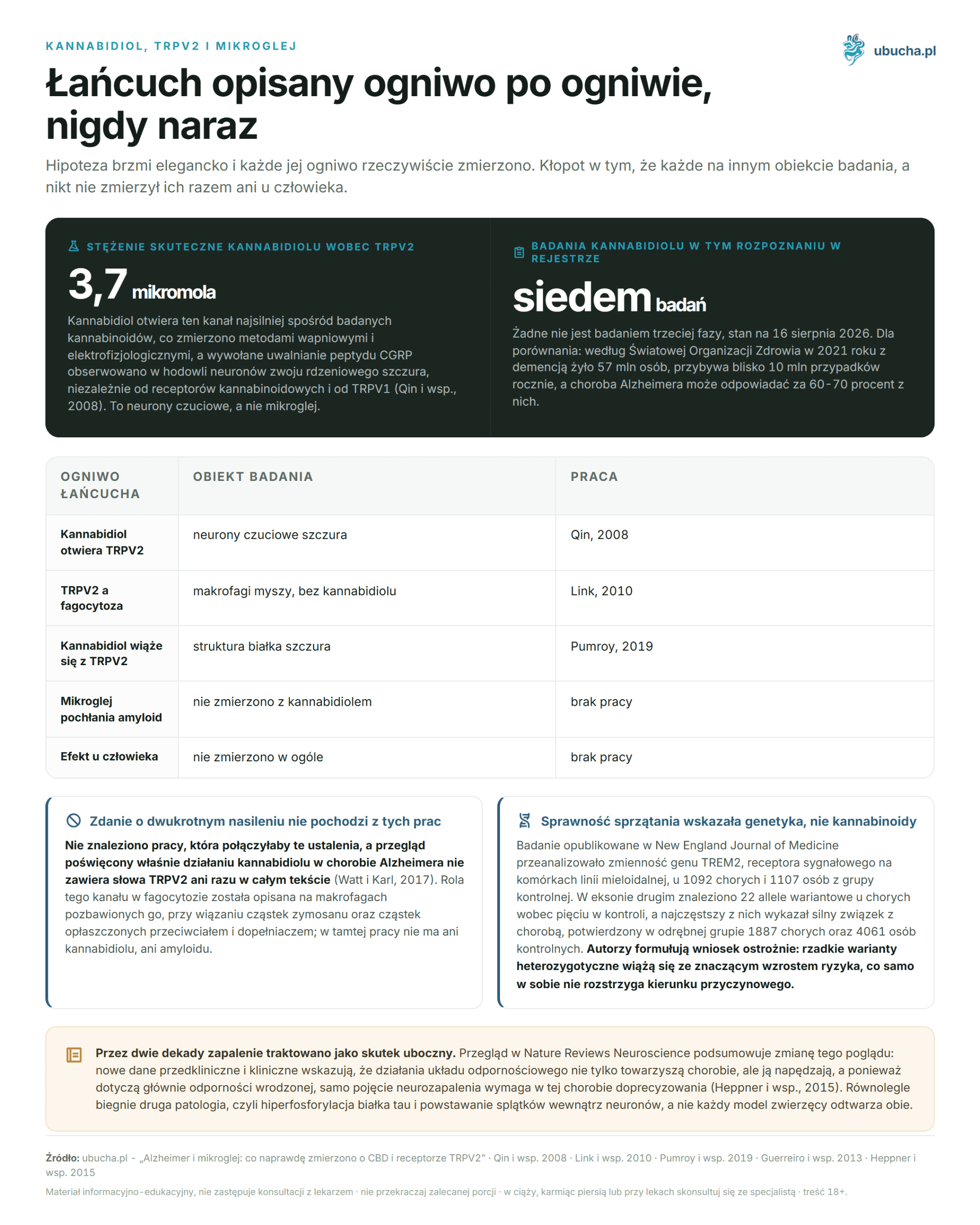
Three things, each on a different research object and none together. First, cannabidiol does indeed open the TRPV2 channel and does so most strongly among the studied cannabinoids, with an effective concentration of half equal to 3.7 micromoles. This was measured using calcium and electrophysiological methods, and the resulting release of the peptide CGRP was observed in cultures of rat spinal ganglion neurons, independently of cannabinoid receptors and TRPV1 (Qin et al., The Journal of Neuroscience, 2008). These are sensory neurons, not microglia.
Second, TRPV2 is indeed involved in phagocytosis, but this was described on macrophages lacking this channel, when binding zymosan particles and antibody- and complement-coated particles. Mice without TRPV2 fared worse in bacterial infection. This work does not involve either cannabidiol or amyloid (Link et al., Nature Immunology, 2010). Third, the binding structure was identified: cryo-electron microscopy showed that cannabidiol binds to rat TRPV2 in a pocket between the S5 and S6 helices of adjacent subunits (Pumroy et al., eLife, 2019). The statement about the double increase in amyloid uptake by microglia under the influence of cannabidiol does not come from any of these works. We did not find any work that would connect them, and the review dedicated precisely to the action of cannabidiol in Alzheimer’s disease does not contain the word TRPV2 even once in the entire text.
| Link in the chain | Research object | Work |
|---|---|---|
| Cannabidiol opens TRPV2 | Culture of rat sensory neurons | Qin 2008 |
| TRPV2 is needed for phagocytosis | Macrophages and mice without TRPV2, without cannabidiol | Link 2010 |
| Cannabidiol binds to TRPV2 | Rat protein structure, cryo-electron microscopy | Pumroy 2019 |
| Cannabidiol through TRPV2 increases amyloid cleaning | We did not find any work that measured this | None |
What has been measured about cannabidiol and microglia in models of this disease?
Significantly less impressive things, but really. In a study from Molecular Pharmacology, cannabidiol and two other cannabinoids reduced the ATP-induced increase in intracellular calcium in the N13 microglia cell line and in primary rat microglia in a concentration-dependent manner. The effect of cannabidiol on cell migration was abolished by cannabinoid receptor antagonists, and the inhibition of nitrite production after bacterial stimulation was insensitive to these antagonists. In the animal experimental part, three weeks of cannabidiol administration to mice after intracerebroventricular injection of beta-amyloid affected the performance on a spatial navigation task and the expression of cytokine genes (Martín-Moreno et al., Molecular Pharmacology, 2011).
A review collecting data from living organisms formulates a conclusion on the same scale. The authors summarize that in pharmacological and transgenic models, cannabidiol reduces reactive gliosis and neuroinflammatory response, promotes neurogenesis, and reverses and prevents cognitive deficits in rodents, and they call this evidence of principle, not evidence of efficacy (Watt and Karl, Frontiers in Pharmacology, 2017). The thread about the PPAR-gamma receptor described there comes from an experiment in which human beta-amyloid was injected into the hippocampus of adult rats. The authors of the review declare no commercial ties, and one of them received funding from the Australian health and medical research council. We discuss the receptor itself separately in the entry about PPAR-gamma and the action of cannabidiol on the nuclear receptor.
How does the mouse model differ from Alzheimer’s disease in humans?
To the extent that the results cannot be directly transferred, and this is a substantive reservation, not a courteous one. Transgenic mice carry human genes introduced to overproduce amyloid, so they reproduce one selected fragment of pathology, not the disease. In rodents, neurofibrillary tangles from tau protein do not spontaneously form, which is the second axis of damage in humans. The model thus reproduces the amyloid cascade, not the full clinical picture with cortical atrophy and progressive dementia.
Even further from the disease is the model in which beta-amyloid is injected into the brain ventricle or into the hippocampus of a healthy animal. This is an acute chemical exposure lasting weeks, not a process of deposit accumulation over decades. The animal also does not have the risk genotype, age, or comorbidities that co-determine the course in humans. Therefore, the statement about the effect on the navigation test result in mice after amyloid injection is a statement about mice after amyloid injection. We describe the history of attempts to translate these results to the clinic more broadly in the entry about cannabidiol in the therapy of Alzheimer’s disease.
What is the status of clinical trials in this disease?
In the early and few. The ClinicalTrials.gov registry returns seven entries for cannabidiol and Alzheimer’s disease, checked on August 16, 2026. None is a phase three study. Among them are, among others, a trial in individuals at increased risk of the disease and a study of THC-free oil in agitation in diagnosed patients, both ongoing recruitment.
We also checked the name CannCog, attributed to an Australian randomized study on the combination of cannabidiol with THC in early dementia. A query for this name returns zero entries in the clinical trial registry and zero hits in the Europe PMC database (as of August 16, 2026), so there is nothing to refer to. The practical conclusion for the reader is simple: the mechanisms described above are real biological findings, but none of them is a result in humans, and the supplement does not cure Alzheimer’s disease. The EFSA panel derived a provisional safe dose of 0.0275 mg per kilogram of body weight per day, about 2 mg for a person weighing 70 kg, and stated that the safety of cannabidiol cannot be established in individuals taking medications (EFSA, EFSA Journal, 2026). People treated for dementia usually take medications, so the decision lies with the attending neurologist. The basics of the action of cannabinoids themselves are collected in the entry about what cannabinoids are and how they work.
Frequently Asked Questions
Does cannabidiol increase the cleaning of amyloid by microglia?
We did not find any work that measured this. The activation of TRPV2 by cannabidiol on rat sensory neurons and the role of TRPV2 in macrophage phagocytosis without cannabidiol have been described separately. There is no source that combines these two findings into one sentence about microglia and amyloid.
Does the review on cannabidiol in Alzheimer’s disease mention TRPV2?
No. In the full text of the review by Watt and Karl from 2017, the word TRPV2 does not appear even once, which we verified in the text downloaded from Europe PMC on August 16, 2026. The review describes a reduction in gliosis and inflammatory response and an improvement in cognitive outcomes in rodents.
Is the amyloid mouse model Alzheimer’s disease?
No. Transgenic mice overproduce amyloid from introduced human genes and do not spontaneously develop tau protein tangles, which is the second axis of pathology in humans. The model with beta-amyloid injection into the brain is an acute chemical exposure, not a process lasting decades.
How many clinical trials of cannabidiol in Alzheimer’s disease are registered?
Seven, checked in the ClinicalTrials.gov registry on August 16, 2026, and none of them is a phase three study. They concern, among others, individuals at increased risk of the disease and agitation in patients already diagnosed.
Is there a study called CannCog?
We could not confirm it. A query for this name returned zero entries in the ClinicalTrials.gov clinical trial registry and zero hits in the Europe PMC database when checked on August 16, 2026. The name circulates in texts about cannabis and dementia, but there is no study corresponding to it in these two sources.
What does genetics say about the role of microglia in this disease?
Rare variants of the TREM2 gene, a receptor present on myeloid lineage cells, are associated with a significant increase in the risk of Alzheimer’s disease. This was demonstrated in 1092 patients and 1107 controls, and the result was confirmed in a separate group of 1887 patients and 4061 controls (Guerreiro et al., NEJM, 2013).
The article is for informational and educational purposes and does not constitute medical advice. Before starting to use cannabis or CBD for therapeutic purposes, consult your doctor, especially if you are taking other medications, are pregnant, or breastfeeding.
Author: Michał Waluk · Published: 2026-08-09 · Updated: 2026-08-16